• About Us
    • What Is Street Harassment?
    • Why Stopping Street Harassment Matters
    • Meet the Team
      • Board of Directors
      • Past Board Members
    • In The Media
  • Our Work
    • National Street Harassment Hotline
    • International Anti-Street Harassment Week
    • Blog Correspondents
      • Past SSH Correspondents
    • Safe Public Spaces Mentoring Program
    • Publications
    • National Studies
    • Campaigns against Companies
    • Washington, D.C. Activism
  • Our Books
  • Donate
  • Store

Stop Street Harassment

Making Public Spaces Safe and Welcoming

  • Facebook
  • Instagram
  • Pinterest
  • Tumblr
  • Twitter
  • YouTube
  • Home
  • Blog
    • Harassment Stories
    • Blog Correspondents
    • Street Respect Stories
  • Help & Advice
    • National Street Harassment Hotline
    • Dealing With Harassers
      • Assertive Responses
      • Reporting Harassers
      • Bystander Responses
      • Creative Responses
    • What to Do Before or After Harassment
    • Street Harassment and the Law
  • Resources
    • Definitions
    • Statistics
    • Articles & Books
    • Anti-Harassment Groups & Campaigns
    • Male Allies
      • Educating Boys & Men
      • How to Talk to Women
      • Bystander Tips
    • Video Clips
    • Images & Flyers
  • Take Community Action
  • Contact

“This is not being talked about”

May 19, 2017 By Contributor

There’s no single day when i don’t get catcalled.

At first, i thought that maybe it’s my fault, i wear provocative clothes, i wear too short of shorts, i wear dresses, fitted shirts, etc, or maybe because i wear too much make up to the point where i attract too much attention.i tried to change myself, i tried wearing pants even though it’s scorching hot on where i live (Philippines), i wore sleeved tops, i stopped wearing shorts and dresses.

but it made no difference, i still got catcalled on our street, at my university.

it made me realize how i am not the one at fault here. i started researching about street harassment and catcalling, i made it my mini-thesis for two of my subjects, i made it my topic on almost all of my concept papers and position papers.

it was hard, why? because not much is written about sexual harassment on streets, catcalling, wolf-whistling, and other forms of it. i was devastated when i think about how i wouldn’t be able to pass my papers with very few bibliography materials. but i was more frustrated, thinking that not much people would be able to write about this. not much books to educate people about the issue. there are only few blogs here and there but we all know that it is not much academically accepted as research materials.

i may focus on how i was getting catcalled every single time i step out of our home, but i’d rather stress on the issue on how this is not being talked about. it’s not just a simple ‘offending or inappropriate comment’. street harassment is the result of normalizing rape culture, it is about the entitlement of those who think they have the right to catcall somebody. street harassment is all about instilling subconscious fear to women and men, LGBTQ people who experience it everyday or at least once in their life.

Optional: What’s one way you think we can make public places safer for everyone?

Put up more information about it, educate people. educate victims, specially girls, on how to protect their selves, let them know their rights, what to do when they experience these. but most of all, address the root of the problem. educate perpetrators, specially men, not only the ‘do not do this, do not do that,’ but let them know the effects of their actions. what does these kind of comments do to a victim’s brain? it instills fear, it makes them conscious of how they look, it is not seen as a compliment, it’s seen as harassment.

– D. Saunders

Location: Manila, Philippines

Need support? Call the toll-free National Street Harassment hotline: 855-897-5910

Share your street harassment story for the blog.
See the book 50 Stories about Stopping Street Harassers for idea
s.

Share

Filed Under: Stories, street harassment

“Did you just f**king kicked my dog???”

May 18, 2017 By Contributor

I was walking my dog today along the same route I do every night because I find it “safer” than going around the block. About 5 or 6 guys were hanging out in front of the Dali, by the corner of Flatbush and Woodruf (Brooklyn). I was on the phone and one of the guys kept on saying “Good evening” and raising his voice because I wouldn’t respond. So I finally put the phone down and said “I am on the phone and I don’t have to respond to you talking to me on the street just because you want me to.”

He came to me as if he was going to punch me. His friend held him and my blood boiled so, I said, “What the f**k did you just do? Are you going to hit me?”

His friends kept on telling him to calm down and for me to walk. I kept on walking and he came from the side and kicked my dog. I screamed, “Did you just f**king kicked my dog???”

He pretended he was going to punch me again. His friends kept on pushing him. Then he threw some paper at me and walked. I called the police and had to wait 30 minutes. Which is absurd. His friends came back and kept on on trying to intimidate me saying I was lying, over and over. I am not sure what the police would do about it. I pointed out that the Deli had a camera but I don’t know if they bothered to look or not.

Optional: What’s one way you think we can make public places safer for everyone?

More police available. I have been thinking to put posters around with examples of Street Harassment. Educate men better and provide free self defense classes to women .

– Joana F

Location: Prospect Lefferts Garden, Brooklyn, NY

Need support? Call the toll-free National Street Harassment hotline: 855-897-5910

Share your street harassment story for the blog.
See the book 50 Stories about Stopping Street Harassers for idea
s.

Share

Filed Under: Stories, street harassment

“What gives them the right to do that to random women on the street?”

May 17, 2017 By Contributor

I was walking back from the shop with my milk this afternoon, in shorts (not that that’s entirely relevant), and these two guys drive up next to me being like ‘alright, love?’ When I told them to f**k off they got all offended. I was fuming – what gives them the right to do that to random women on the street?

Optional: What’s one way you think we can make public places safer for everyone?

By stopping with the victim blaming and have more of a focus on blaming the perpetrator, who is actually the one at fault.

– Sara

Location: Exeter, England

Need support? Call the toll-free National Street Harassment hotline: 855-897-5910

Share your street harassment story for the blog.
See the book 50 Stories about Stopping Street Harassers for idea
s.

Share

Filed Under: Stories, street harassment

USA: Street Harassment is Not a Joke

May 16, 2017 By Correspondent

Dee Rodriguez, Reading, PA, USA, SSH Blog Correspondent

It seems like memes have really taken off in the past few years. Whether it’s making fun of celebrities and pop culture or addressing social justice issues, memes have become a way to communicate with friends and social media followers. What’s the first thing we do when we come across a funny or relate-able meme? The instinct is to share it or tag a friend.

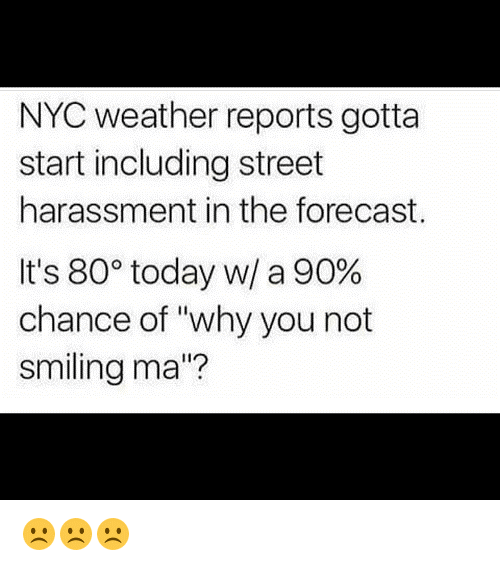
Whenever warmer weather starts to approach, one particular meme seems to pop up:

I would always chuckle when I came across this because not only was the “why you not smiling ma” scenario my experience growing up in New York City, but a street harassment report would be super helpful! I wanted to share this picture with friends but I hesitated. The meme is funny, but it’s funny in the way we joke about tragedy.

Street harassment is part of the sexual violence continuum. The continuum includes everything from rape jokes to sexual assault and anything in between. Making jokes about rape or street harassment may not seem like a big deal, but it is part of rape culture which normalizes rape and the different types of sexual violence. Joking about these issues contributes to rape culture as well. Some folks defend these jokes as being a way to deal with how normalized sexual violence has become or that it’s just humor and it doesn’t mean anything, but it’s not funny to those that may have experienced sexual assault.

It’s certainly not funny to those of us who are advocates. When you’ve had to sit through a rape kit, rape is not funny. As a sexual assault advocate, I’ve sat with victims during their examinations. I’ve talked to parents whose children have been sexually abused. When you fear walking down the street alone because you may be harassed and killed, street harassment isn’t funny. Sexual violence is not a joke.

The meme may have been created as a way to make fun of the street harassment that many folks face each day and as a way to cope but we shouldn’t have to cope. The fact that street harassment has become so pervasive that people can now joke about it is a tragedy. While a street harassment report would be helpful, you know what would be more helpful? If we didn’t get harassed in the first place.

Dee is a volunteer coordinator and domestic violence/sexual assault advocate for a non-profit social services agency and works on a project to better serve Latinx women survivors. She has a bachelor’s degree in Global Studies with a focus on Latin American Culture from Penn State University. She originally hails from New York City and is a proud daughter of immigrant parents from the Dominican Republic. You can follow Dee on Instagram at @missdeerodriguez.

Share

Filed Under: correspondents, street harassment

Brazil: Women’s Issues are Absent from Public Policy in Rio de Janeiro

May 15, 2017 By Correspondent

Yasmin Curzi, Rio de Janeiro, Brazil, SSH Blog Correspondent

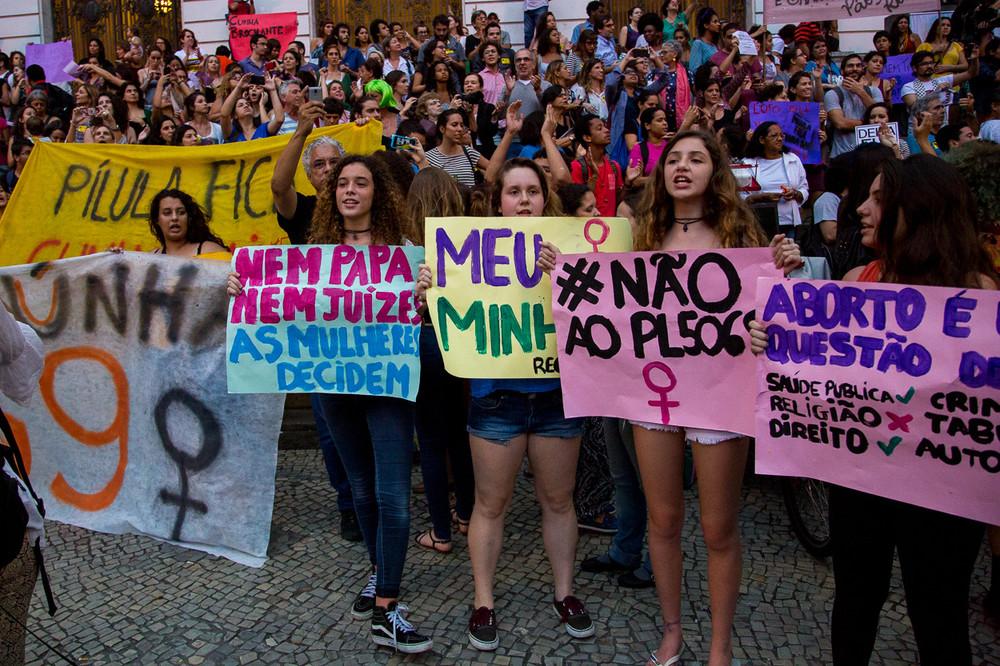
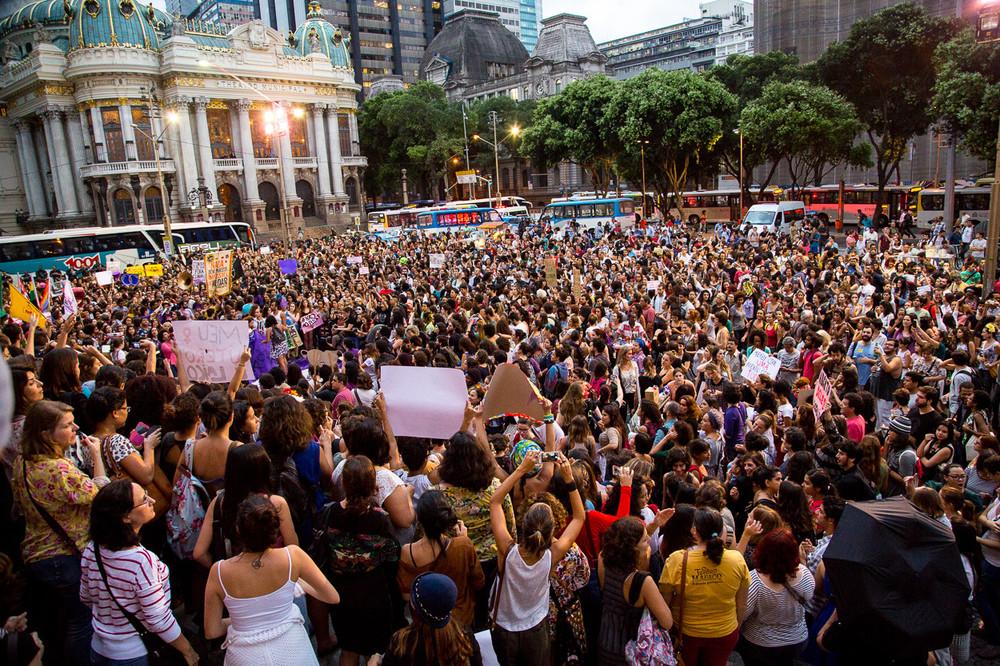
An Oct. 2016 protest against a series of legislative initiatives passed by male deputies that reduced women’s rights. Credit:  Matias Maxx.

Rio de Janeiro is the second largest city in Brazil with over 6 million inhabitants and while more than half are women, there is not much incorporation of gender in the public policy.

Democracy in Brazil is a delicate theme. In short, we have been under several dictatorships in our recent history and the political system is mostly formed by oligarchies. After the struggles of democratic transition in the late 1980’s, our modern Federal Constitution – also known as “Civic Constitution” – reflected a lot of social movement’s concerns and intended to amplify decision-making procedures to the civil society. Still, the Civic Constitution is not effective enough to change the concentration of political and economical power held in the hands of a few rich white men, men who still predominantly run the public institutions.

Photo Credit: Matias Maxx.

As a result of Brazil’s historical exclusion of women (they are misrepresented in the legislature and the decision making processes are failing to consider popular agendas), the main public institutions neglect women’s issues. This challenging scenario of gender inequality in politics inherently affects the public policy choices of the country.

In the past two decades, the Federal Government took important measures observing the platform that was defined at the World Conference on Women held in Beijing in 1995. Significantly, Beijing’s agenda observes the necessity of women’s empowerment by the opening of decision-making processes to their participation and the incorporation of gender’s perspective in all public policies. In order to attend these directions, the Brazilian Federal Secretariat for Women’s Policies was created in 2013. It plays a key role encouraging states and municipal administrations to create and implement public policies that reduce inequalities between women and men. The “National Plan of Women’s Policies” formulated by this Federal Secretariat serves as an orientation guide to others federal entities that should, in turn, create more specific measures aiming to attend women’s particular needs in their locations. However, until today, Rio de Janeiro doesn’t have a Municipal Plan.

In Rio, gender inequality is mostly perceived by cases of material violence. According to the “Women Dossier”[1], women registered 56.031 occurrences of physical injuries in the year of 2014, and the estimate of domestic abuse is almost 80 daily cases. In cases of attempted murder, 33,8% of the defendants are the victim’s partners or ex-partners and 3,8% are the victim’s fathers or stepfathers. Even with these significant numbers, in the whole city there are only five attention houses for victims of domestic abuse. In this same year, 4.725 women registered occurrence for rape. And we can say that these data are under-representative, as there are a lot of constraints that inhibit women from seeking institutional help. In cases of sexual harassment, rape or abuse, the institutions are often unwelcoming to the victims: police officers commonly question the victim’s behavior and even the creation of Rio de Janeiro’s Women Protection Police Precinct[2] isn’t effective to mitigate this scenario.

When it comes to street harassment, an online survey[3] of nearly 8,000 people conducted by the journalist Karin Hueck, a member of the NGO “Fiu Fiu Enough”, discovered that 99,6% of theses women had suffered some kind of harassment in public spaces at some point of their lives. They said it limits their freedoms, like clothing and mobility choices. 90% had said they changed their way of dressing because they feared suffering with harassment and 81% gave up the idea of going somewhere alone. Just 17% had said they liked the catcalls. Other research[4], conducted by the NGO ActionAid, interviewed 503 women[5] and 86% said they had experienced street harassment. Even with this clear evidence of a problem, there’s no public policy against street harassment.

In conclusion, the invisibility of women’s issues and the lack of appropriate treatment of their concerns stems from women’s under-representation in political institutions. Women need to be heard in the formulation and implementation of policies and programs that concern them. The fact that the city of Rio de Janeiro doesn’t have any public policy plan directed at women’s issues is a dramatic sign of the persistent situation of our exclusion from the public sphere. The oligarchies that constitute political power in Rio de Janeiro nowadays treat female matters as irrelevant and, apparently, don’t intend to expand the civil society channels. To overcome this scenario, women need to fight for their fair distribution of political power and occupy institutions of public life.

[1] A public research that reunites data about violence against women, published in 2015.

[2] This type of Precinct was created to give specialized attention to women. Although, there’re only 300 unities in a country that has 5.561 cities. The infrastructure of these precincts is also a questionable theme: mostly doesn’t have social assistants, neither psychologies, or orientation of women toward their rights.

[3] You can access the partial results from this survey in this link: http://thinkolga.com/2013/09/09/chega-de-fiu-fiu-resultado-da-pesquisa/

[4] You can access an article about this research in this link: http://agenciabrasil.ebc.com.br/en/direitos-humanos/noticia/2016-05/survey-shows-86-brazilian-women-have-experienced-street-harassment

[5] The sample was constructed trying to reflect the Brazilian demographics, as exposed in the last census from Brazilian Institute of Geography and Statistics (IBGE).

References:

CURZI, Yasmin and RADD, Carolina. “Política para Mulheres” in: “O Rio que Queremos: propostas para uma cidade inclusiva”. Disponible at: <http://www.grabois.org.br/uploads/arquivos/1484084673.pdf>

PINTO, Andréia Soares, MONTEIRO, Joana e MORAES, Orlinda Claudia R. “Dossiê Mulher”. Instituto de Segurança Pública – Rio de Janeiro, 2015. Available at: <http://arquivos.proderj.rj.gov.br/isp_imagens/uploads/DossieMulher2015.pdf>

Yasmin is a Research Assistant at the Center for Research on Law and Economics at FGV-Rio. She has a BA in Social Sciences from FGV-Rio and a Master Degree in Social Sciences from PUC-Rio, where she wrote her thesis on street harassment and feminists’ struggles for recognition.

Share

Filed Under: correspondents, street harassment

« Previous Page
Next Page »

Share Your Story

Share your street harassment story for the blog. Donate Now

From the Blog

  • #MeToo 2024 Study Released Today
  • Join International Anti-Street Harassment Week 2022
  • Giving Tuesday – Fund the Hotline
  • Thank You – International Anti-Street Harassment Week 2021
  • Share Your Story – Safecity and Catcalls Collaboration

Buy the Book

  • Contact
  • Events
  • Join Us
  • Donate
  • Facebook
  • Instagram
  • Pinterest
  • Tumblr
  • Twitter
  • YouTube

Copyright © 2026 Stop Street Harassment · Website Design by Sarah Marie Lacy