• About Us
    • What Is Street Harassment?
    • Why Stopping Street Harassment Matters
    • Meet the Team
      • Board of Directors
      • Past Board Members
    • In The Media
  • Our Work
    • National Street Harassment Hotline
    • International Anti-Street Harassment Week
    • Blog Correspondents
      • Past SSH Correspondents
    • Safe Public Spaces Mentoring Program
    • Publications
    • National Studies
    • Campaigns against Companies
    • Washington, D.C. Activism
  • Our Books
  • Donate
  • Store

Stop Street Harassment

Making Public Spaces Safe and Welcoming

  • Facebook
  • Instagram
  • Pinterest
  • Tumblr
  • Twitter
  • YouTube
  • Home
  • Blog
    • Harassment Stories
    • Blog Correspondents
    • Street Respect Stories
  • Help & Advice
    • National Street Harassment Hotline
    • Dealing With Harassers
      • Assertive Responses
      • Reporting Harassers
      • Bystander Responses
      • Creative Responses
    • What to Do Before or After Harassment
    • Street Harassment and the Law
  • Resources
    • Definitions
    • Statistics
    • Articles & Books
    • Anti-Harassment Groups & Campaigns
    • Male Allies
      • Educating Boys & Men
      • How to Talk to Women
      • Bystander Tips
    • Video Clips
    • Images & Flyers
  • Take Community Action
  • Contact

“It didn’t stop until I left the country”

February 28, 2017 By Contributor

The street harassment went on practically everyday when I was 12-14. Every time I walked to and from school I was leered at, and often men three times my age winked or remarked at me. I was never touched, thank god (though I have been before, just not on the street). I remember walking by a man and I had an over-sized jacket on, looking like a mess, yet he still felt the need to go, “Oh my god…”. I never replied. I was taught not to, though I often scratched my face with my rude finger. It didn’t stop until I left the country.

Optional: What’s one way you think we can make public places safer for everyone?

TEACH PEOPLE THAT IT IS NOT ACCEPTABLE TO STREET HARASS. If you’re a victim, there is nothing you can do. It’s too threatening. The only people who can make things somewhere safer are the ones doing the endangering in the first place.

– Anonymous

Location: Lebanon

Need support? Call the toll-free National Street Harassment hotline: 855-897-5910

Share your street harassment story for the blog.
See the book 50 Stories about Stopping Street Harassers for idea
s.

Share

Filed Under: Stories, street harassment Tagged With: lebanon, young age

Philippines: It’s Not Fun to Get Catcalled in the Philippines

February 27, 2017 By Correspondent

Ken Rodrigo, Makati City, Philippines, SSH Blog Correspondent

Women, girls and members of the LGBT+ in the Philippines continue to face the terrifying experience of being catcalled on the streets and other public spaces. This can make the experience, for both the locals and tourists, not fun! Fortunately, in the recent years, there is a growing recognition of the issue of gender-based harassment most apparent in catcalling. This can be attributed to a number of factors such as the rise of the LGBT+ movement and the availability of awareness promotion instruments such as the social media.

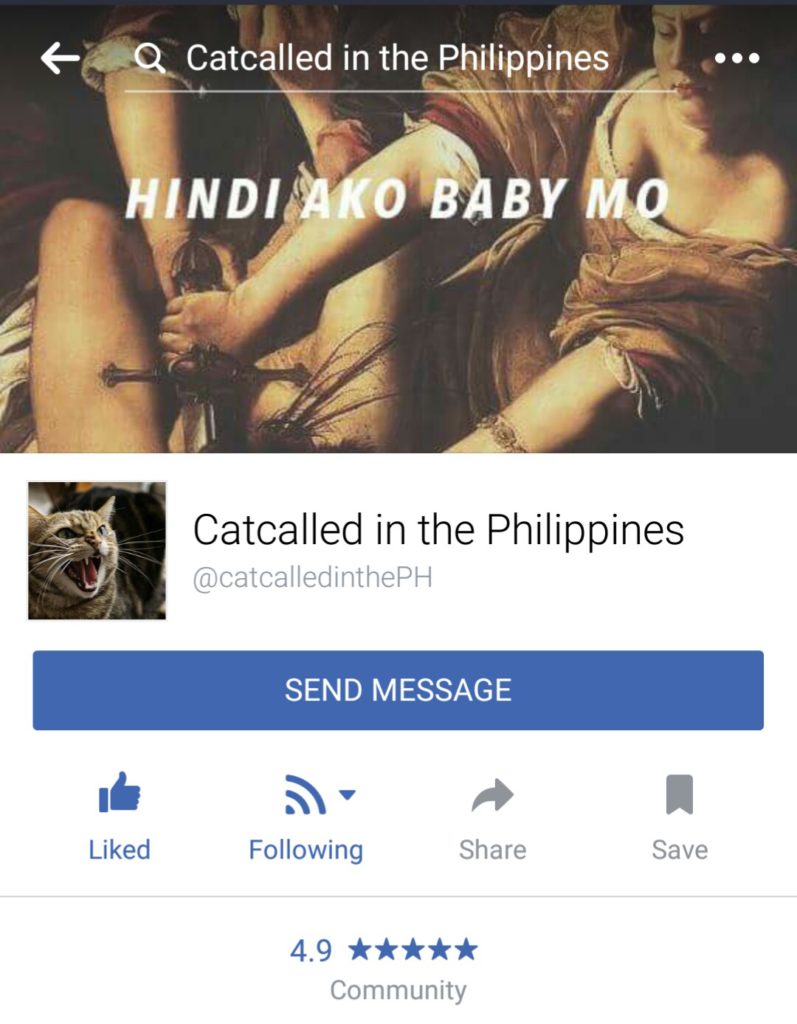
Platforms such as Facebook, blogs and interactive online news provide venue for discussion and exchange. In the Philippines, an ally of the Stop Street Harassment movement is a public Facebook page called ‘Catcalled in the Philippines’ founded in June 2016. In an interview I conducted with creator Raymond Peter Campiglio, he said he felt the need to provide a platform for people who suffer catcalling and other forms of abuse in public spaces. For him, there is a “lack of empathy and understanding regarding acts of personal violation.” It is also his intention to show that catcalling is not an isolated incident or happens because of the victim’s fault, but a social issue that is prevalent and must therefore be addressed.

Catcalled in the Philippines currently has nearly 16,000 likes and counting. It is a community where members are free to share their stories and learn from each other’s experiences. Apart from catcalling, issues such as sexual violence, the rape culture, and the various manifestations of misogyny in Philippine media and politics are also discussed.

Facebook: a double-edged sword

According to Raymond, the overall response to Catcalled in the Philippines is supportive, but he also stressed the challenges to his cause. He said: “I was surprised with the divided stance of a lot of people. Most of the supporters are female yet there are some female detractors as well. It showed me that internalized misogyny is more prevalent than I imagined. The overall response is support but a lot of the pushback are from people who feel that mobilization against it is a form of cultural disobedience.”

He also labelled Facebook as a double-edged sword, that while it is one of the widest and quickest ways to spread positive ideas, it does the same for negative ideas. For someone who simply wants to help address catcalling, he was shocked with his experience of being reported, causing the page to be paralyzed. He claims “the reporting system can be weaponized as a form of censorship and silencing.”

A message of hope

Asked to give a message to the public, Raymond said: “I want them to know that there will always be someone who is willing to help. Cliché as it sounds, they should never give up hope that the streets will be safer but patience will be needed. Apart from that, courage. Courage to stand up against it, even the courage to ask for help.”

Raymond explains that what he does is dedicated to his mother who as a single-parent raised him with values such as respect, passion and conviction to defend what he believes in, no matter the outcome.

Something bigger

Earlier this month, Raymond was invited by the Office of Senator Risa Hontiveros to participate in the press conference of the senator’s Safe Spaces Bill. The bill which aims to eliminate catcalling on a national scale is currently deliberated in the Senate. Additionally, a Catcalled in the Philippines website is a work in progress according to Raymond.

Ken is a teacher of international studies at a university in Manila. After law school, she traveled to Denmark and eventually studied in Malmö University in Sweden where she earned her master’s in Human Rights. You can contact her at krnrdrg@gmail.com or on Facebook.

Share

Filed Under: Activist Interviews, correspondents, street harassment

“I hurried into a shop to feel safe”

February 17, 2017 By Contributor

Three men in a car just beeped aggressively as I was walking down the street. As I looked up to ask why they were beeping, they started swearing. I went up to the car (the car window being open) and just said, “What”?

The car was stationary. They said nothing, so I walked away. Then I heard comments such as, “You f*cking bitch” etc. I hurried into a shop to feel safe.

Optional: What’s one way you think we can make public places safer for everyone?

Make verbal harassment a crime.

– lisa palmer

Location: Walkley, Sheffield, UK

Need support? Call the toll-free National Street Harassment hotline: 855-897-5910

Share your street harassment story for the blog.
See the book 50 Stories about Stopping Street Harassers for idea
s.

Share

Filed Under: Stories, street harassment

UK: “We Need to Change the Whole Picture”

February 16, 2017 By Correspondent

Annabel Laughton, Gloucestershire, UK, SSH Blog Correspondent

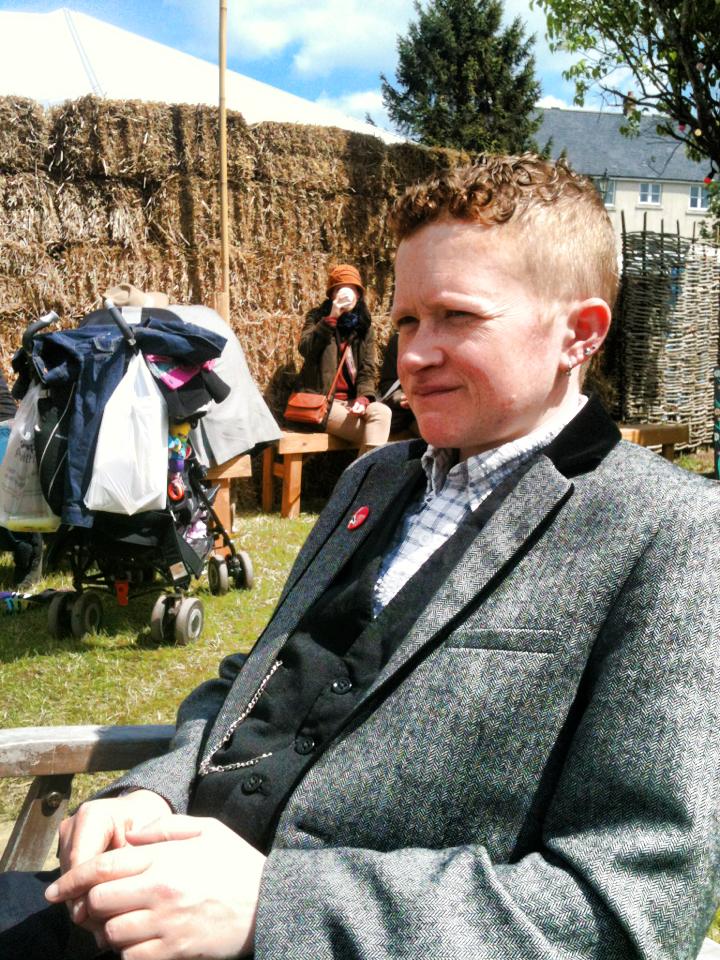
Finn Mackay. Credit: Rosie Charlotte Mackay

This week I was delighted to meet Dr. Finn Mackay, a teacher and feminist activist. She’s a sociology lecturer and former youth worker, and has a special interest in working with boys and men, as a researcher and campaigner. She’s involved with the White Ribbon Campaign, and domestic violence prevention work, and speaks and writes about feminism and male violence against women.

First we talk about Reclaim the Night. Mackay set up the London Feminist Network in 2004 and revived a national women-only Reclaim the Night march held in London every November. Mackay explains how Reclaim the Night marches directly tackle intimidation of women in public space. “Public space is gendered, though it shouldn’t be,” she says.

As the name suggests, Reclaim the Night is women’s takeover of public space from men. I ask her about the street harassment I experienced on my local Reclaim the Night march in November, and she laughs wryly. “That happens on all the marches. Groping, asking the way to brothels…  it’s an explicit reaction to women taking back the space. Men feel we are trespassing. It’s their way of saying, ‘these are our streets; go back home.'”

Reclaim the Night marches are a powerful statement. For her book, Radical Feminism: Feminist Activism in Movement, Mackay interviewed women about Reclaim the Night, and many women said the march was the only time they could feel safe and powerful.

Is street harassment getting better or worse, I asked?

Her answer is grimly definite: worse. Mackay explains that in her experience, young women say street harassment is an inevitable part of a night out, and how if they reported every instance, they’d never be off the phone. Working in secondary schools in London on anti-bullying campaigns, it was common for girls to report that they would go out wearing two pairs of pants, or would wear tights in summer, because it was so normal for boys to try to grope them inside their underwear. She believes women feel they have to appear unaffected by incidents, not wanting to appear delicate, prudish, or like a victim, and talks about women priding themselves on thinking of witty ripostes to sexual comments. She also explains that most people don’t know the definition of sexual assault (in the UK this is any unwanted intentional sexual touching), and are unsure at what point harassment becomes a criminal offence.

Next I want to find out what Mackay thinks about other areas that interlock with street harassment, like porn. Her view is that it’s an enabler. “Porn is part of a culture where men have to do things to women, and women have to put up with them; a predator/prey dynamic.”

Even more directly, a man can see violent images online and think, “I’ll go and do that to a woman”. Likewise, online harassment is part of that culture of women putting up with everything. The vicious, vitriolic online misogyny experienced by women has contributed to the development of a dialogue where the victim is expected to “toughen up” – because it “happens to everyone”.

Finally, we talk about causes and prevention. Good sex and relationships education (SRE) in schools, including education around consent, would go a long way. At present, there is no duty on schools to teach more than the biology of reproduction, despite many attempts by campaign groups, so provision varies. While there is some progressive, radical work in schools, others offer no SRE, and even in schools that do, it’s often taught by an over-worked gym teacher or someone else without adequate training.  Mackay is sceptical about statutory consent campaigns.

“One recent one was, ‘Give it: Get it’. This doesn’t take apart the predator/ prey dynamic. In fact, it sets it up. It’s obvious who’s doing the giving and who’s doing the getting. This is still about controlling women’s sexuality; it removes their sexual agency, as well as assuming men are desperate for sex and women have to be persuaded. And what can be given, can also be taken.”

This points to an urgent need for educating men and boys, and for tackling the expectations of how men behave. In Mackay’s experience, men are usually shocked and defensive about how they come across, even perpetrators of domestic violence. “They split the power thrill [of the act of violence] from the reaction. This is a status defence; they know they have higher status. Men need help. We need to think about how we’re constructing masculinity.”

In the end, though, Mackay sees street harassment in the broadest possible context: the whole of society. “We live in a male supremacy; there’s no getting away from that. All our major institutions are run by men. Ultimately, we need to change the whole picture.”

Annabel is involved in campaigns for human rights, mental health, environmental issues and social justice. She has an honours degree in Classical Studies, a diploma in counselling, and works in Higher Education.

Share

Filed Under: Activist Interviews, correspondents, street harassment Tagged With: Reclaim the night, street harassment

UK Campaign, Philippines Law

February 15, 2017 By HKearl

Two big stories this week –> a new anti-harassment campaign in the UK and a new law introduced in the Philippines

Via The Gazette

“A poll by England Athletics revealed that a large proportion of women feel anxious when running alone, with nearly half of those surveyed stating that this is due to personal safety concerns…

Of those who had experienced harassment, shouting and car horns beeped by passing motorists were the most common.

But RunTogether, a national programme from England Athletics to get more people jogging regularly, aims to erase this via its This Girl Can Run campaign…

The RunTogether website provides instant access to a rapidly growing network of multiple local running groups in Lancashire.”

Via the Manila Bulletin:

“Sen. Risa Hontiveros [in the Philippines] filed on Tuesday a bill that seeks to protect women and members of the lesbian, gay, bisexual and transgender (LGBT) community from harassment, especially on the streets and other public spaces.

Hontiveros said she filed the measure, Senate Bill 1326, in response to the growing number of gender-based harassment in public spaces such as the case of a female student from the University of Santo Tomas (UST) who was allegedly groped in a public utility vehicle by a fellow student.

The bill, also known as the “Safe Streets and Public Spaces Act of 2017,” seeks to penalize gender-based street and public spaces harassment such as catcalling, wolf-whistling, cursing, leering, groping, persistent request for name and contact details and the use of words tending to ridicule on the basis of actual or perceived sex, gender expression, or sexual orientation and identity including sexist, homophobic and transphobic slurs.”

Quezon City already has a similar bill at the city-level, passed last year.

Share

Filed Under: News stories, Resources, street harassment Tagged With: england, legislation, philippines, running, UK

« Previous Page
Next Page »

Share Your Story

Share your street harassment story for the blog. Donate Now

From the Blog

  • #MeToo 2024 Study Released Today
  • Join International Anti-Street Harassment Week 2022
  • Giving Tuesday – Fund the Hotline
  • Thank You – International Anti-Street Harassment Week 2021
  • Share Your Story – Safecity and Catcalls Collaboration

Buy the Book

  • Contact
  • Events
  • Join Us
  • Donate
  • Facebook
  • Instagram
  • Pinterest
  • Tumblr
  • Twitter
  • YouTube

Copyright © 2026 Stop Street Harassment · Website Design by Sarah Marie Lacy