• About Us
    • What Is Street Harassment?
    • Why Stopping Street Harassment Matters
    • Meet the Team
      • Board of Directors
      • Past Board Members
    • In The Media
  • Our Work
    • National Street Harassment Hotline
    • International Anti-Street Harassment Week
    • Blog Correspondents
      • Past SSH Correspondents
    • Safe Public Spaces Mentoring Program
    • Publications
    • National Studies
    • Campaigns against Companies
    • Washington, D.C. Activism
  • Our Books
  • Donate
  • Store

Stop Street Harassment

Making Public Spaces Safe and Welcoming

  • Facebook
  • Instagram
  • Pinterest
  • Tumblr
  • Twitter
  • YouTube
  • Home
  • Blog
    • Harassment Stories
    • Blog Correspondents
    • Street Respect Stories
  • Help & Advice
    • National Street Harassment Hotline
    • Dealing With Harassers
      • Assertive Responses
      • Reporting Harassers
      • Bystander Responses
      • Creative Responses
    • What to Do Before or After Harassment
    • Street Harassment and the Law
  • Resources
    • Definitions
    • Statistics
    • Articles & Books
    • Anti-Harassment Groups & Campaigns
    • Male Allies
      • Educating Boys & Men
      • How to Talk to Women
      • Bystander Tips
    • Video Clips
    • Images & Flyers
  • Take Community Action
  • Contact

New U.S. Transgender Survey

December 8, 2016 By HKearl

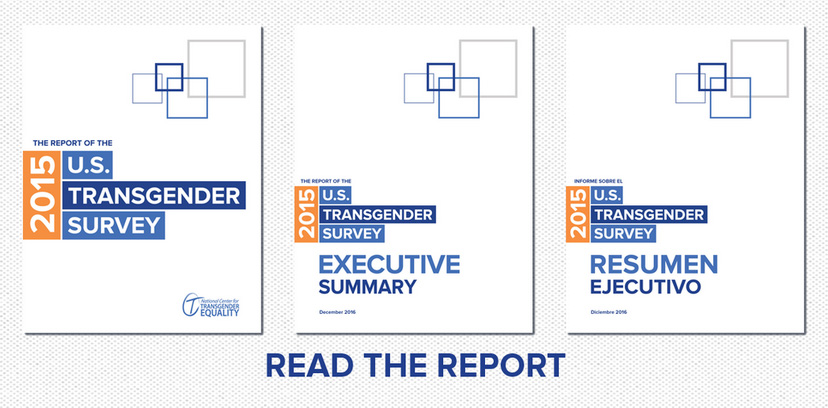
transgenderreportThe U.S. Transgender Survey was released today by the National Center for Transgender Equality. Among the findings are alarming ones relating to discrimination and harassment in public spaces:

Public accommodations and bathrooms

“Accessing basic goods and services is also a major hurdle for transgender people:

  • 31 percent of trans people experienced mistreatment in the past year at a place of public accommodation (stores, hotels, etc.), including being denied equal service (14 percent), verbal harassment (24 percent), or physical attack (2 percent).
  • 20 percent avoided at least one type of public accommodation because they feared mistreatment.
  • 9 percent of respondents were denied access to a restroom in the past year.
  • Restrooms were often unsafe, with 12 percent experiencing verbal harassment, 1 percent experience physical attacks, and 1 percent experience sexual assault when accessing a restroom.
  • 59 percent avoiding a public restroom in the last year out of fear of confrontations, with 32 percent actually limiting what they ate or drank to avoid the restroom.
  • 8 percent reported a urinary tract infection, kidney infection, or other kidney-related problem in the past year as a result of avoiding the restrooms.”

And…

  • “46 percent of trans people experienced verbal harassment in the past year.
  • 9 percent of trans people experienced a physical attack in the past year.”

H/T our board member Patrick

Share

Filed Under: LGBTQ, Resources, street harassment Tagged With: research, transgender

The Bahamas: Interview with Founder of #LifeInLeggings

December 7, 2016 By Correspondent

Guest post by former Blog Correspondent Alicia Wallace

Image via: https://redforgender.files.wordpress.com

From #BlackLivesMatter in the U.S. to #SupportThePuff in The Bahamas, we’ve seen the power of social media, the rise of hashtag movements, and the propensity of new media to create change. Recently, #LifeInLeggings has gained the attention of the Caribbean region, giving women the space to share their stories of sexual violence ranging from harassment to rape. Started in Barbados by Ronelle King, the hashtag made its way to Guyana, Jamaica, Trinidad and Tobago, and The Bahamas among among other countries.

King, founder of #LifeinLeggings, told me she was frustrated by her own experiences of sexual violence. “I had an idea to create a hashtag that would create a forum for Caribbean women to share their daily experiences of sexual harassment and abuse.” She recently worked with B-GLAD (Barbados Gays, Lesbians and All-Sexuals Against Discrimination), but has found social media and blogging to better suited forms of activism for her personality and schedule.

The launch of #LifeInLeggings on the first day of 16 Days of Activism against Gender-Based Violence was coincidental. “I wasn’t aware of the 16 days of activism until the hashtag took off and people starting mentioning it in correlation with the hashtag.” King noted the importance of the annual campaign, and said she is happy to have #LifeInLeggings play a role in bringing awareness to the issue of gender-based violence.

It is difficult to predict the success of a hashtag movement, whether by geographical reach or number of participants, but King was certain she would receive support from her friends and women in Barbados, knowing it’s an everyday reality for them.

“I did intend for it to spread through the Caribbean. Rape culture isn’t just a Barbadian issue; it’s a Caribbean issue as well as a global one, so I know that support would pour in from the other countries.”

Sexual violence is a pervasive issue in the Caribbean, as evidenced by statistics. In a survey conducted in nine Caribbean countries 48% of adolescent girls reported that their sexual initiation was “forced” or “somewhat forced.” The United Nations Office on Drugs and Crime and the Latin America and the Caribbean Region of the World Bank report noted, “While the worldwide average for rape was 15 per 100,000, The Bahamas had an average of 133, St. Vincent and the Grenadines 112, Jamaica 51, Dominica 34, Barbados 25 and Trinidad and Tobago 18.”

#LifeInLeggings has given Caribbean women space to put their names, faces, and stories next to those statistics, making them a visible reality for the people around them.

In Dominica, Delroy Nesta Williams and Khadijah Moore saw the effects of #LifeInLeggings and the potential to have a national conversation. The pair started #LévéDomnik to engage the country of less than 73,000, primarily on Facebook, in the discussion. Within days, they had collected over 400 stories, some of which were shared anonymously — sent to someone’s inbox and then posted on their behalf.

Williams said this is only the beginning of the conversation in Dominica. The #LévéDomnik has met with the country’s Bureau of Women’s Affairs and several NGOs, and is planning activities for 2017 that include advocacy training, yoga sessions, focus group meetings, and educational talks. “We want people to be more empathetic towards survivors, and we want to address institutional issues that act as emotional and psychological barriers to reporting sexual offenses and seeking redress through the judicial system.”

For King, #LévéDomnik is proof that #LifeInLeggings is serving its purpose. “The hashtag was created to not only show the realities of rape culture in Barbados, but in the Caribbean. It is a defiant cry for justice and a blatant refusal to be silent.”

Sexual violence is still a taboo subject, and survivors often find it difficult to talk about their experiences. In sharing our stories, we have the opportunity to sensitize people and bring attention to an issue that is often avoided in both private conversations and public discussion. Unfortunately, large numbers of people are unmoved by issues that do not directly affect them or people close to them. People participating in the #LifeInLeggings movement have commented on changes in attitudes of men around them who have been privy to the conversation. King shared that she personally received numerous messages from men who admitted they were a part of the problem, and intend to do better.

The Barbados team encourages those following #LifeInLeggings to reflect on their own experiences with sexual violence, and think of ways to keep the discussion going in family, peer, and community groups. It is also imperative that we consider the ways our words and actions contribute to women’s everyday experiences.

#LifeInLeggings started as a simple idea, and a group of dedicated women worked together to make it region-wide conversation. It caught the attention of two women in politics and Tanya Stephens among others, and is evidence of the power we all have to make a difference. In sharing our stories, women call upon men in The Bahamas and throughout the Caribbean to respect women as human beings, and take on the responsibility in engaging other men in these important conversations and holding them accountable for their actions.

We are not only responsible for what we do, but for what we allow to happen. Bystander intervention is critical to the creation of a new culture where sexual violence has not place. Bahamian women are invited to share their stories on Facebook and/or Twitter using #LifeInLeggings. Hollaback! Bahamas is accepting stories via an online form and will post on Facebook and/or Twitter for those who would like to remain anonymous.

Alicia Wallace is a women’s rights activist, public educator, and movement builder. She is the Director of Hollaback! Bahamas, produces The Culture Rush monthly newsletter, and tweets as @_AliciaAudrey. 

Share

Filed Under: Activist Interviews, correspondents, News stories, street harassment Tagged With: Bahamas, hashtag, interview, sexual violence

“Call them out on it. LOUDLY”

December 5, 2016 By Contributor

I was walking my dog and a man in a work uniform knelt down to pet her. When he got up to walk away, he slapped my ass. At first I was stunned, but then I started following him yelling (crowded street in the Streeterville part of downtown Chicago). I followed him for 10 minutes, yelling that “THIS GUY JUST ASSAULTED ME WITHOUT MY CONSENT” and “THIS GUY’S A PERVERT”. When he turned around and yelled that I was “crazy” and “should go home and act like a lady,” I really let him have it. I was really disappointed that everyone on the street just looked at me like I was insane, but I’ll bet he thinks twice before he assaults someone again.

Optional: Do you have any suggestions for dealing with harassers and/or ending street harassment in general?

Call them out on it. LOUDLY. And if you’re on the street and someone is calling a harasser out, go to her and ask if she needs help. Just be there in case the asshole tries to retaliate.

– CG

Location: Chicago, IL

Need support? Call the toll-free National Street Harassment hotline: 855-897-5910

Share your street harassment story for the blog.
See the book 50 Stories about Stopping Street Harassers for idea
s.

Share

Filed Under: Stories, street harassment

“A kind man came to my rescue and put himself between me and him”

December 4, 2016 By Contributor

I’ll start with the first one I remember.

As I was walking to turn in a job application, a man on a motorcycle passed by me. He turned around and followed me, telling me how pretty and cute I am. I thanked him for his “compliments” thinking that would get him to leave me alone. I was very busy and didn’t have the time to deal with him. I told him I was busy and wished him a wonderful day.

That did nothing but made things worse. He started to circle me as I was walking and called me kitten and told me to hop on, that he’d take me somewhere fun. I told him no, that I was busy and had lots to do (which I did), but he was persistent, getting more visibly aggressive every time I said no. He hit the seat behind him hard enough that I could hear it. He kept calling me kitten and saying to get on and that I would like it.

At this point, he scared me because he got mad and demanded I get on. I was about to cry and I felt so alone and scared. The way he was looking at me, the way he was calling me kitten made me feel vulnerable and naked. The way he was looking at my body and not me made me feel less then who I am – that I was nothing else but something for his pleasure. I felt dirty.

A kind man came to my rescue and put himself between me and him. He told the biker to leave me alone that “you can clearly see that she is not interested. You’re scaring this poor girl.”

The biker tried to tell me a couple more times to get on, but he stopped and left when the kind man kept him away from me and kept telling him, “She’s not interested.”

I thanked him soo much. He said that he would love to see me get to where I was going safely but he had errands to take care of and wished me luck.

Optional: What’s one way you think we can make public places safer for everyone?

To become more open-minded. We desperately need programs for people of all ages to attend for the development of critical thinking. Possibly a manners class too.

– Kensa

Location: Greenville, Texas

Need support? Call the toll-free National Street Harassment hotline: 855-897-5910

Share your street harassment story for the blog.
See the book 50 Stories about Stopping Street Harassers for idea
s.

Share

Filed Under: Stories, street harassment

Female Bicycle Messengers Talk about Street Harassment

December 3, 2016 By HKearl

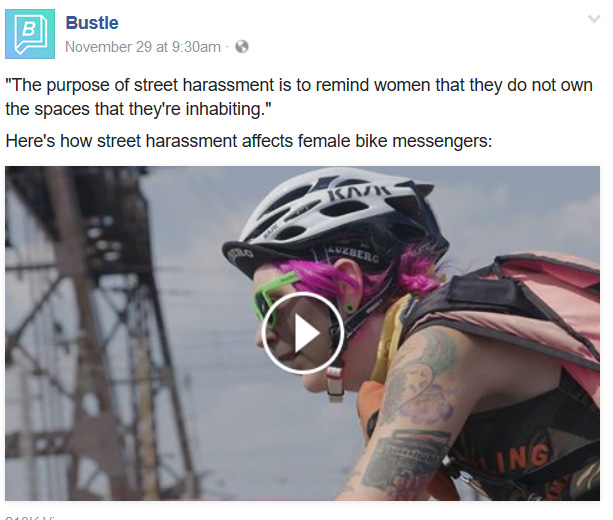
bustlebikemessengerThe new episode of Bustle’s documentary series NSFWomen (Not Safe For Women) focuses on how street harassment affects female bike messengers. Bustle’s Senior Publicist, Corporate Communications, Caitlin Eadie, shared this:

“Only 24% of all bicycle trips in the U.S. are made by women. 65% of women have reported being targeted by street harassment and 23% of women have experienced ‘sexual touching’ as a form of street harassment. To explore this issue, Bustle met with several female cyclists in Philadelphia who struggle with the fears and risks that go along with doing the job they love. One woman details a cycling incident when a male car passenger leaned out the window and grabbed her. Another discusses losing out on money because she fears for her safety when taking trips further away or past dark.

As the video’s intro states, ‘The purpose of street harassment is to remind women that they do not own the spaces that they’re inhabiting.’ A horrifying reality made even worse when Bustle reached out to 12 major U.S. city police departments and seven confirmed that they do not keep specific records of violence against female cyclists. The other five did not respond for comment.

NSFWomen tackles critical issues surrounding gender inequality, addressing the more nuanced, and sometimes undiscussed, struggles that women face on a daily basis.”

Check out the third episode of NSFWomen (Not Safe for Women).


Share

Filed Under: News stories, Stories, street harassment Tagged With: bicycles, bike messengers

« Previous Page
Next Page »

Share Your Story

Share your street harassment story for the blog. Donate Now

From the Blog

  • #MeToo 2024 Study Released Today
  • Join International Anti-Street Harassment Week 2022
  • Giving Tuesday – Fund the Hotline
  • Thank You – International Anti-Street Harassment Week 2021
  • Share Your Story – Safecity and Catcalls Collaboration

Buy the Book

  • Contact
  • Events
  • Join Us
  • Donate
  • Facebook
  • Instagram
  • Pinterest
  • Tumblr
  • Twitter
  • YouTube

Copyright © 2026 Stop Street Harassment · Website Design by Sarah Marie Lacy