Trump’s Locker Room Banter is Our Life
A recently released 2005 recording of American presidential nominee Donald J. Trump engaging in what he calls “locker room banter” about forcing himself on women has prompted many people to speak out against his behavior and his excuse of his behavior.
For instance, famed Anita Hill wrote an op-ed in the Boston Globe today saying,
“Trump’s language, which he and others have tried to minimize as “locker room banter,” is predatory and hostile. To excuse it as that or as youthful indiscretion or overzealous romantic interest normalizes male sexual violence….Today’s conversation that must extend far beyond the presidential election. We have made strides in how we think about sexual violence but we’re nowhere close to done.”
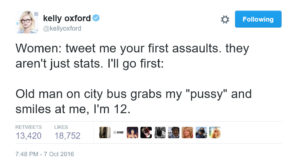
The most visible response is happening over Twitter. On Friday night, author Kelly Oxford tweeted, “Women: tweet me your first assaults. They aren’t just stats. I’ll go first: Old man on city bus grabs my ‘pussy’ and smiles at me, I’m 12.”
By Saturday morning, as many as 50 women tweeted their stories per minute of first-person accounts of sexual violence with the hashtag #notokay. By Monday afternoon, nearly 27 million people had responded or visited Oxford’s Twitter page.
Incredible, but not surprising. A 2014 study we commissioned GfK to conduct nationally in the USA showed that nearly 1 in 4 women had experienced unwanted sexual touching by a stranger while in a public space.
I can add to that number. When I was 18 years old and standing on the sidewalk in front of a cross country teammate’s friend’s house a few blocks from my college campus, a group of men walked past me. A man at least twice my size reached out and grabbed my crotch, then laughed and walked on. You don’t ever forget the humiliation and fear and disgust of something like that happening. And at the same time, I always feel “lucky” that I have never had to live through a more severe violation.
These are the kinds of stories women everywhere have lived through. To us, it is not locker room banter. It is traumatic, upsetting and memorable. We remember. Our bodies remember.
Anyway, I am really glad to see this huge response to the really alarming evidence of what we many of us suspected: Trump is a dangerous, entitled misogynist who does not respect women (nor persons of color, immigrants, etc). Surely now he will never be president. Surely now the American people will put women’s rights and respectability above any other characteristic they deem presidential about him. Surely.
“I didn’t know if they had plans of attacking me”
We were looking for a place and I had to use my phone and was scrambling to get directions on phone. A guy said, “Her pussy wet very wet and so on” and he didn’t stop until I lost him and his friend when I crossed the street. I got scared. I didn’t know if they had plans of attacking me if I confronted them. I didn’t want to look back all I know was whatever I would do if ever they would retaliate I wouldn’t win the fight and get into more trouble.
– Anonymous
Location: Hollywood, CA
Need support? Call the toll-free National Street Harassment hotline: 855-897-5910
Share your street harassment story for the blog.
See the book 50 Stories about Stopping Street Harassers for ideas.
“I am so much more than a person to be honked and hissed at by a stranger”
A man has been driving by for the past few weeks and hissing or honking at me. I am adult, it is 7 in the morning as I’m walking to the train in a quiet suburban town. I feel like he thinks it’s OK to engage in this way because women or no more than sexual objects that exist for his pleasure. I am a daughter, a wife, an aunt, a human being. I am so much more than a person to be honked and hissed at by a stranger.
Optional: What’s one way you think we can make public places safer for everyone?
Why do people do this? Do they think it makes someone feel good? No, it makes us feel threatened. Is it something taught by their parents/peers? Then raise more awareness and really drive the message home in schools.
– EG
Location: Westchester, NY
Need support? Call the toll-free National Street Harassment hotline: 855-897-5910
Share your street harassment story for the blog.
See the book 50 Stories about Stopping Street Harassers for ideas.
“This feeling of violation and insignificance is commonplace and psychologically damaging”
As I left my workplace for lunch today, two men commented on my looks as I walked by. Unfortunately, this is commonplace in the area, so I ignored it as usual. Then, a man I walked past turned to walk with me for a whole block. He said, “You’re cute. You’re not Kim Kardashian or anything, but you have a cute mole,” referring to the birthmark on my face. I asked him to please stop following me, but he kept pace with me and kept making comments, so I turned around to walk the other way and went behind a building and cried. His backhanded compliments were unusual, but that wasn’t what made me cry. The feeling of helplessness as he followed me down the street and the unsolicited comments he made about my body made me feel violated. As if my body is not my own space. I haven’t had an experience yet that would make me exceptionally fearful for my physical safety on the street, but this feeling of violation and insignificance is commonplace and psychologically damaging.
– ALK
Location: Oakland, CA
Need support? Call the toll-free National Street Harassment hotline: 855-897-5910
Share your street harassment story for the blog.
See the book 50 Stories about Stopping Street Harassers for ideas.