• About Us
    • What Is Street Harassment?
    • Why Stopping Street Harassment Matters
    • Meet the Team
      • Board of Directors
      • Past Board Members
    • In The Media
  • Our Work
    • National Street Harassment Hotline
    • International Anti-Street Harassment Week
    • Blog Correspondents
      • Past SSH Correspondents
    • Safe Public Spaces Mentoring Program
    • Publications
    • National Studies
    • Campaigns against Companies
    • Washington, D.C. Activism
  • Our Books
  • Donate
  • Store

Stop Street Harassment

Making Public Spaces Safe and Welcoming

  • Facebook
  • Instagram
  • Pinterest
  • Tumblr
  • Twitter
  • YouTube
  • Home
  • Blog
    • Harassment Stories
    • Blog Correspondents
    • Street Respect Stories
  • Help & Advice
    • National Street Harassment Hotline
    • Dealing With Harassers
      • Assertive Responses
      • Reporting Harassers
      • Bystander Responses
      • Creative Responses
    • What to Do Before or After Harassment
    • Street Harassment and the Law
  • Resources
    • Definitions
    • Statistics
    • Articles & Books
    • Anti-Harassment Groups & Campaigns
    • Male Allies
      • Educating Boys & Men
      • How to Talk to Women
      • Bystander Tips
    • Video Clips
    • Images & Flyers
  • Take Community Action
  • Contact

Egypt: Protests against Harassment This Week

July 6, 2012 By HKearl

"I Hope..." campaign against sexual harassment - Egypt
"I Wish..." Anti-Sexual Harassment Movement Event

Because sexual assault and street harassment continue unabated in Cairo, Egypt, protests against it are regularly occurring.

On Wednesday, the “I Hope…” (Nefsi) anti-sexual harassment campaign organized a human chain along a road and participants held up signs with anti-harassment messaging. In the photo on the right, the posters read from left to right: “Harassment degrades the male (harasser) before it degrades the female;” “I wish I could ride a bike without anyone bothering me;” and, “I wish you would respect me as I respect you.”

Right now, about 30 activists are wrapping up another protest on Tahrir Square.

The Safe Tahrir For Women Facebook Event page reads:
“On Friday 6th July, we’re asking everyone, men and women, to meet at Midan Talaat Harb at 1.30pm, ready to go to Tahrir to set up a safe place where women can join the protests in safety, and independent journalists can document our revolution.

We want strong people to act as guards to protect women from thugs who have been abusing them in the square. We want to catch these criminals who are destroying the reputation of the revolution, expose and shame them, and bring them to justice.
We want to say, “Enough, No!” to the terrible assaults against women which have been happening in Tahrir. We believe them to have been carried out by state-sponsored paid thugs: let’s catch them, and prove that the people of Tahrir are amongst the noblest in the world…

We want to set up a Safe Point in the square where women can join the revolutionary protest, and set up escorts to take women safely in and out of the square to the Safe Point. We want to spray paint and handcuff any thug who touches a woman, so he can be exposed and shamed for behaving like a dog. We’re asking every political group and each individual, as a human being: please help.”

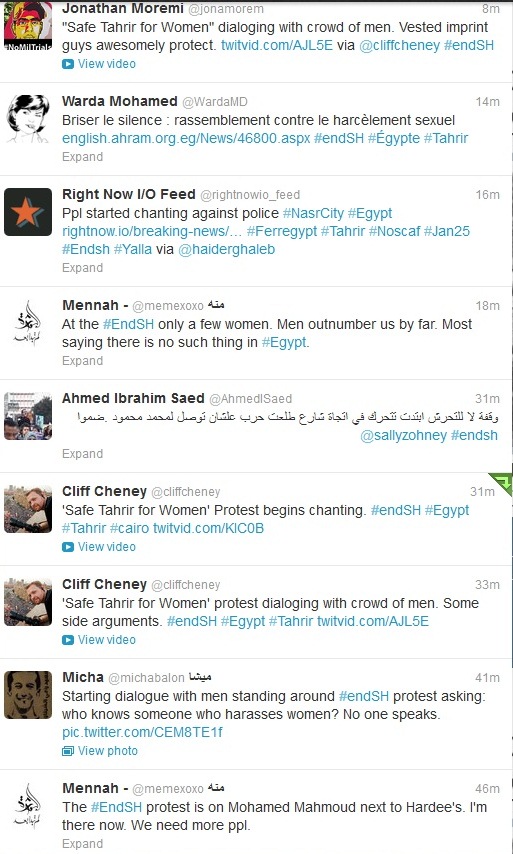
On Twitter, people are posting photos and videos about the action and right now, it sounds like the male protectors out number the female protesters….but is it any wonder when the last protest against sexual harassment on Tahrir Square ended with the women being groped and chased away?!

I am traveling to Egypt for the first time next week. Many concerned family members and friends have been emailing me articles about the assaults and harassment against women, urging me to “be careful.”

It makes me angry that just because I’m female, just because every other woman in Egypt is female, we have to be careful. And it makes me angry that even if we are “careful,” that won’t ensure complete protection from groping, harassment and even assault. We must continue to live our lives; we shouldn’t be cloistered away.

I’m glad that activists are persistent with their outcry and action and I look forward to joining their actions next week.

Share

Filed Under: News stories, street harassment Tagged With: activism, Cairo, Egypt, protests, sexual harassment

“I have so much to say, and I will say it, in time.”

June 26, 2012 By HKearl

TRIGGER WARNING – Description of sexual assault.

British journalist Natasha Smith was in Egypt this month to “independently film a 20-minute documentary on women’s rights and abuses against women in Egypt since the revolution.”

Her project was cut short this week when a huge group of men not only took away her video equipment but sexually assaulted her Sunday evening (less than 48 hours ago).

She shares her ordeal in great detail on her blog, from the hundreds of men who ripped off her clothes to the difficulty she had finding help.

She is leaving the country now, though she vows to return to finish her project. She writes:

“I am determined to continue with my documentary at some point. I have no equipment, (not even any of my photos) am nervous about the possibility of not getting my insurance to cover all the equipment and everything taken from me, and no money to resume the process. But I’ll get there.

I have to find a silver lining to this experience. I have to spread awareness; it is my duty to do so. I have to do this; I will not be driven into submission. I will overcome this and come back stronger and wiser. My documentary will be fueled by my passion to help make people aware of just how serious this issue is, and that it’s not just a passing news story that briefly gets people’s attention then is forgotten. This is a consistent trend and it has to stop. Arab women, western women – there are so many sufferers.

I am determined to return to this wonderful country and city that I love, and meet its people once again. I am determined to challenge the stereotypes and preconceptions that people have of Arab women back in the UK and the US. I have so much to say, and I will say it, in time.”

As hard as it must have been for her to relive her experiences by writing about them, I’m glad she did. The world must know. And I hope she can return to make her documentary. Sadly, her lived experiences now support the topic she was covering.

Bikya Masr reports that there may be another anti-sexual violence rally this Friday…online organizing is happening now on Facebook. So stay tuned.

Share

Filed Under: News stories Tagged With: British journalist Natasha Smith, Egypt, sexual assault, sexual violence

“We won’t be broken”

June 15, 2012 By HKearl

“Sexual harassment is a tool to keep women out of the public spaces (streets) and forcing them into the private spaces (homes),” wrote @jazkhalifa during the Egyptian-led #EndSH day of online activism this week. – via ABC News

That is why we must speak out against street harassment. It keeps women out of public spaces, and out of public life. There can never be gender equality as long as we’re relegated to the home.

It’s been one week since the attack on activists protesting against street harassment in Tahrir Square, Egypt. They’re still re-grouping, deciding on next steps and responses. In the meantime, where is a powerful video from the protest (before the attacks) you can watch and testimonies of people who were there that you can read.

“Women are at the heart of the revolution. We march, we lead chants, we sleep in sit-ins…We won’t be broken,” says one woman in the video.

Exactly. And so we’ve got to keep talking about this issue. We can’t let it fade away. Street harassment is real, it’s a problem, and it’s got to end.

Share

Filed Under: Stories, street harassment Tagged With: Egypt, protests, street harassment, Tahrir Square

June 13 #EndSH Day

June 13, 2012 By HKearl

Join the day of online action against street harassment and sexual harassment, organized by activists in Egypt. If you’re on twitter, follow and/or use the hashtag #EndSH to see the conversation and help bring attention to this issue. Blog, write Facebook updates.

Egypt Independent is tracking the online conversation live on their blog.

USA Today published a great article today about anti-street harassment activism in Egypt, Lebanon, Yemen, and Saudi Arabia. I even get a quote in there.

“In Yemen, where most women are fully covered from head to toe, harassment can be just as likely as in Lebanon, where it is not unusual to see women wearing skin-revealing clothing. This has prompted initiatives in both countries, such as the Safe Streets Campaign in Yemen, which maps reports of harassment.

“As a woman in Yemen, harassment is almost a given on the streets and on public transportation. It doesn’t matter how you dress or behave — simply being a woman is reason enough to be targeted,” said Sara Ishaq, a Yemeni filmmaker.

Nawal Saadawi, an Egyptian feminist author once jailed for writings that include criticisms of Islamic customs regarding women, said the Arab Spring has handed women an opportunity.

“Women are taking part in all the revolutions because they want to change patriarchy, to change history and to change the whole system,” she said.

In May, a woman in Saudi Arabia challenged police who tried to throw her out of a shopping mall for wearing nail polish. “It’s none of your business,” she yelled in a confrontation filmed by camera phone and posted on YouTube. The video was viewed 1 million times in a few days.

By fighting back, women in the region hope that they not only can walk free from harassment but that such a change will usher in more rights and opportunities.

“I get sexually harassed because it’s an issue of power,” said Hobeissi of Nasawiya in Lebanon, “but women in leadership positions will transform how society perceives women in general.”

And there’s a new bystander video about what men can say to men who harass women on the streets, via HarassMap in Egypt:

Share

Filed Under: street harassment Tagged With: activism, Egypt, EndSH, sexual harassment, street harassment

Egyptian Women Refuse to be Silent

June 11, 2012 By HKearl

I’m cross-posting an article I wrote for Ms. Magazine’s Blog.

Violence against women demonstrators in Egypt erupted again on Tuesday when a frenzied mob of 200 men sexually assaulted a female protester in Tahrir Square. Then, during a rally on Friday to protest the incident, about 50 women and their male allies were themselves brutalized and chased away by another mob.

Journalist Ghazala Irshad, who was on the scene Friday, says that just as the small anti-harassment protest was gathering steam, the atmosphere shifted. “A few guys were like, ‘Why are you talking about this, there are more important issues to talk about?’ [Then] some guys started saying the women protesting were whores.”

Next, a phalanx of outside men overwhelmed the protective circle of male allies and cornered and groped the women. Rally organizer Sally Zohney says, “[The violence] started with individual cases of assaults against women in the march [and] then turned into beating and chasing everyone involved. Even men were badly beaten and attacked. It was very brutal.”

Participants were forced to flee for their safety.

Sadly, the violent scene is just the latest of many. Since the military took power last February, countless women–including journalists Lara Logan, Mona Eltahawy and Caroline Sinz, Egyptian actor Sherihan and the “woman in the blue bra“–have been groped and sexually assaulted by men in Tahrir Square. Hundreds, perhaps thousands, of other women have experienced verbal sexual harassment in a place that is supposed to symbolize freedom.

The lack of safety for women in the square symbolizes, instead, just how little women have benefited from the revolution they helped create. While pre-revolutionary Egypt was notorious for street harassment–a 2008 study by the Egyptian Centre for Women’s Rights (ECWR) found that over 80 percent of Egyptian women had experienced it–the 18-day uprising in January and February 2011 was an unprecedented moment in which women could move freely in public space. Women seized the chance to become key players in the protests. “In 3 weeks of revolution we experienced no sexual harassment by men,” one woman told the Israeli paper Haaretz. “What civilization emerged! What culture!”

But that swiftly changed. Marchers in an International International Women’s Day 2011 demonstration in Tahrir Square were violently attacked. Months of assaults on women protesters followed. Some of the perpetrators have worn civilian clothes; others have been uniformed military police. During the violent government crackdown on pro-democracy protests this fall, which claimed more than 80 lives, over 100 women report being subjected to invasive “virginity tests” by the military.

Zohney believes that the attacks are systematic and fueled by unknown organized groups–whether by the military regime or others, she isn’t certain. She sees them as an attempt to discourage protests by intimidating revolutionaries and painting them in a bad light. Many of her friends have been attacked. Yet, she says, no serious security measures have been taken to stop the assaults. As a result, many women have avoided Tahrir Square, losing the opportunity to be full participants in the political process.

On the other hand, some women have spoken out against the violence. Logan, Eltahawy and others told their stories to the media. Women regularly share their harassment stories online. But, unfortunately, as on Friday, they, too, experience backlash and harassment.

If broad attempts to curb harassment in Egypt succeed, Tahrir Square may become safer for women protesters. Rebecca Ciao, a co-founder of Egyptian safe-streets organization HarassMap, says her group plans to continue conducting community outreach, spotlighting stories of harassment and allowing people to easily report incidents on an online map. Groups such as HarassMap, ECWR and the United Nations’ Safe Cities Programme have long spearheaded anti-harassment actions such as online story sharing, community safety audits, meetings, rallies, radio ads and, last month, a human chain against street harassment.

The attacks on women are also sparking anger among regular citizens. The “woman in the blue bra” became a national martyr, drawing thousands to march in solidarity in December.

No matter how many attacks they face, these brave women and men plan to speak out. Zohney and others are planning a multipronged response to Friday’s attacks that will include a larger, more organized march, as well as online testimonials by Friday’s victims and calls for more security in Tahrir Square. Activist Leil Zahra Mortada wrote in a Facebook post accompanying a photo album from the Friday march:

No matter how deep the wounds are, no matter how many times we get attacked or will be attacked, this will not stop nor silence us. More actions are planned, more noise will be made, and more proactive steps will be taken. We will see the end of sexual harassment and assault, both state-organized and individual! We will take down patriarchy, sexism and every form of violence based on gender or sexuality!

Brava. It is clear Egypt’s revolution will be incomplete until women win the streets.

Share

Filed Under: News stories, street harassment Tagged With: Egypt, EndSH, sexual assault, sexual violence, street harassment, Tahrir Square

« Previous Page
Next Page »

Share Your Story

Share your street harassment story for the blog. Donate Now

From the Blog

  • #MeToo 2024 Study Released Today
  • Join International Anti-Street Harassment Week 2022
  • Giving Tuesday – Fund the Hotline
  • Thank You – International Anti-Street Harassment Week 2021
  • Share Your Story – Safecity and Catcalls Collaboration

Buy the Book

  • Contact
  • Events
  • Join Us
  • Donate
  • Facebook
  • Instagram
  • Pinterest
  • Tumblr
  • Twitter
  • YouTube

Copyright © 2026 Stop Street Harassment · Website Design by Sarah Marie Lacy