• About Us
    • What Is Street Harassment?
    • Why Stopping Street Harassment Matters
    • Meet the Team
      • Board of Directors
      • Past Board Members
    • In The Media
  • Our Work
    • National Street Harassment Hotline
    • International Anti-Street Harassment Week
    • Blog Correspondents
      • Past SSH Correspondents
    • Safe Public Spaces Mentoring Program
    • Publications
    • National Studies
    • Campaigns against Companies
    • Washington, D.C. Activism
  • Our Books
  • Donate
  • Store

Stop Street Harassment

Making Public Spaces Safe and Welcoming

  • Facebook
  • Instagram
  • Pinterest
  • Tumblr
  • Twitter
  • YouTube
  • Home
  • Blog
    • Harassment Stories
    • Blog Correspondents
    • Street Respect Stories
  • Help & Advice
    • National Street Harassment Hotline
    • Dealing With Harassers
      • Assertive Responses
      • Reporting Harassers
      • Bystander Responses
      • Creative Responses
    • What to Do Before or After Harassment
    • Street Harassment and the Law
  • Resources
    • Definitions
    • Statistics
    • Articles & Books
    • Anti-Harassment Groups & Campaigns
    • Male Allies
      • Educating Boys & Men
      • How to Talk to Women
      • Bystander Tips
    • Video Clips
    • Images & Flyers
  • Take Community Action
  • Contact

New Play: Might Never Happen

April 4, 2016 By HKearl

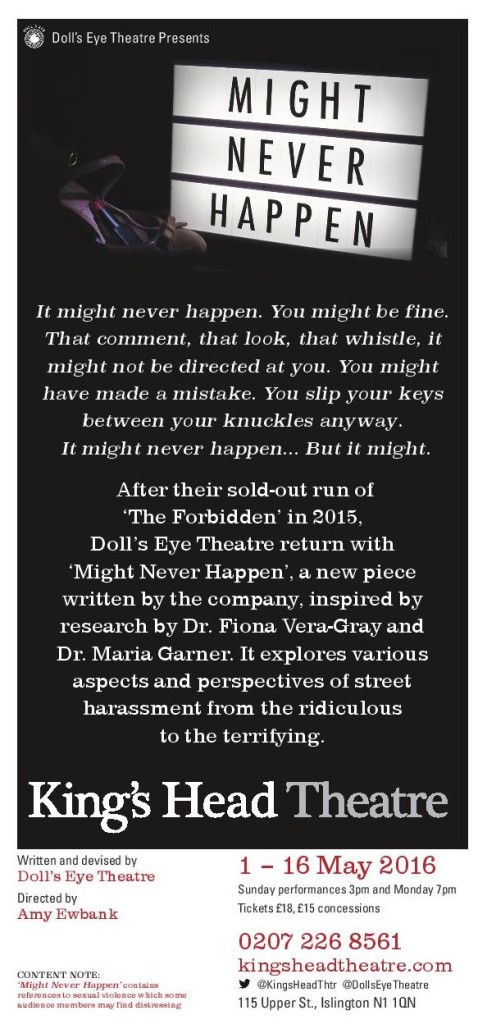
Might Never Happen DL Flyer (2) (1)-page-002 copyFrom the streets to the theatre

The London-based, all woman theatre company Dollseye Theatre have been working with street harassment researcher Dr. Fiona Vera-Gray and masculinities researcher Dr. Maria Garner to translate key themes from their work for the stage. Might Never Happen, directed by Amy Ewbank, is a piece written by the company, to explore various aspects and perspectives of street harassment from the ridiculous to the terrifying.

The first performances will be in London, at the Kings Head Theatre in Angel in May 2016 as an extension of International Anti-Street Harassment Week. A post-performance Q&A will be held on the 2nd of May and the 9th of May, featuring speakers from the Women’s Equality Party, Hollaback London, Purple Drum, Rape Crisis and more.

For Dates and to book tickets please see The King’s Head Website here.

Share

Filed Under: anti-street harassment week, Events, street harassment Tagged With: London, play, research, theatre

New Street Harassment Report in Kosovo

February 24, 2016 By HKearl

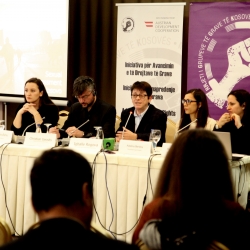
The report release event, photo via the Kosovo Women's Network site
The report release event, photo via the Kosovo Women’s Network site

The body of research about the prevalence of street harassment is growing! This week a new report was released in Kosovo.

Via NWPTV:

“The Kosovo Women’s Network recently published the country’s first national report on sexual harassment, and the research shows what Kosovar women have always known: street harassment affects women across Kosovo, regardless of geographical location, ethnicity, sexual orientation, and able-bodiedness.

Although most Kosovars know that sexual harassment is harmful, a disturbing 40 percent of both men and women think that young women actually enjoy being harassed. The majority of Kosovars still think that women’s dress and behavior causes sexual harassment, and not our country’s culture of male entitlement.

Kosovo’s feminists have tools that we didn’t have before, the first being this research, which quantifiably demonstrates that sexual harassment is real, widespread, and threatens the safety of women and girls. The second tool is an upcoming app which will allow users to report sexual harassment in real time and directly contact the police through an emergency button.”

The victim-blaming attitudes are indeed disturbing.

I went on to read the report summary, and here is information about how it was conducted and a few more statistics:

“The research involved a review of the legal framework, a survey of 1,315 Kosovo citizens in 2015 and more than 200 interviews with representatives of public institutions, civil society, and other key actors. The report concludes with recommendations for amending the legal framework and improving institutional response to sexual harassment.

  • 48.5% of Kosovars have experienced some form of sexual harassment in their lifetimes.
  • 64.1% of women report having experienced sexual harassment, 32.5% of men state that they have.
  • The most common form of sexual harassment reported by respondents is having someone make unwelcome sexual comments, jokes, or gestures to or about them, including while walking down the street.
    • One in three women (34.2%) compared to only 1.6% of men had someone honk a vehicle horn at them while walking down the street.
    • 46.4% of women and only 3.9% of men had someone whistle at them
    • 26.4% of women and 3.3% of men had someone follow them
  • Women tend to be harassed more by unknown people in the street and friends than do men. Men are more likely to be harassed by friends than women.”

Good for the Kosovo Women’s Network for thoroughly researching this topic and bringing national and global attention to the issue. It’s harder to tackle a problem without data, so this is an important step.

Raporti: Ngacmimi seksual në Kosovë
http://www.womensnetwork.org/documents/20160224112147815.pdf

Research Report: Sexual Harassment in Kosovo
http://www.womensnetwork.org/documents/20160223185243349.pdf

Izveštaj Istraživanja: Seksualno uznemiravanje na Kosovu
http://www.womensnetwork.org/documents/20160224134742609.pdf

Share

Filed Under: News stories, Resources, street harassment Tagged With: kosovo, national study, research

NYC Male Focus Group Opportunity

February 19, 2016 By HKearl

4inRinOc_400x400SAFER: NYC is a social enterprise founded by Columbia University School of International and Public Affairs graduate students, dedicated to engaging men in ending street harassment in New York City.

SAFER: NYC is currently working on a large-scale research project within the issue of street harassment in order to deepen our understanding of what solutions will have the most impact in making our streets safer for everyone.

As part of this research, they are conducting focus group conversations with small groups of adult men across NYC’s boroughs. These are 30-minute conversation with you and 5-8 of your male peers. They can provide some compensation to all participants as well as refreshments during the session. Furthermore, all participants will remain completely anonymous.

If you are interested or want more information, contact them at safernewyorkcity@gmail.com.

Share

Filed Under: male perspective, Resources, street harassment Tagged With: focus group, men, NYC, research

Italy: Street Harassment in the Eternal City

January 3, 2016 By Correspondent

Sara Rigon, Italy, SSH Blog Correspondent

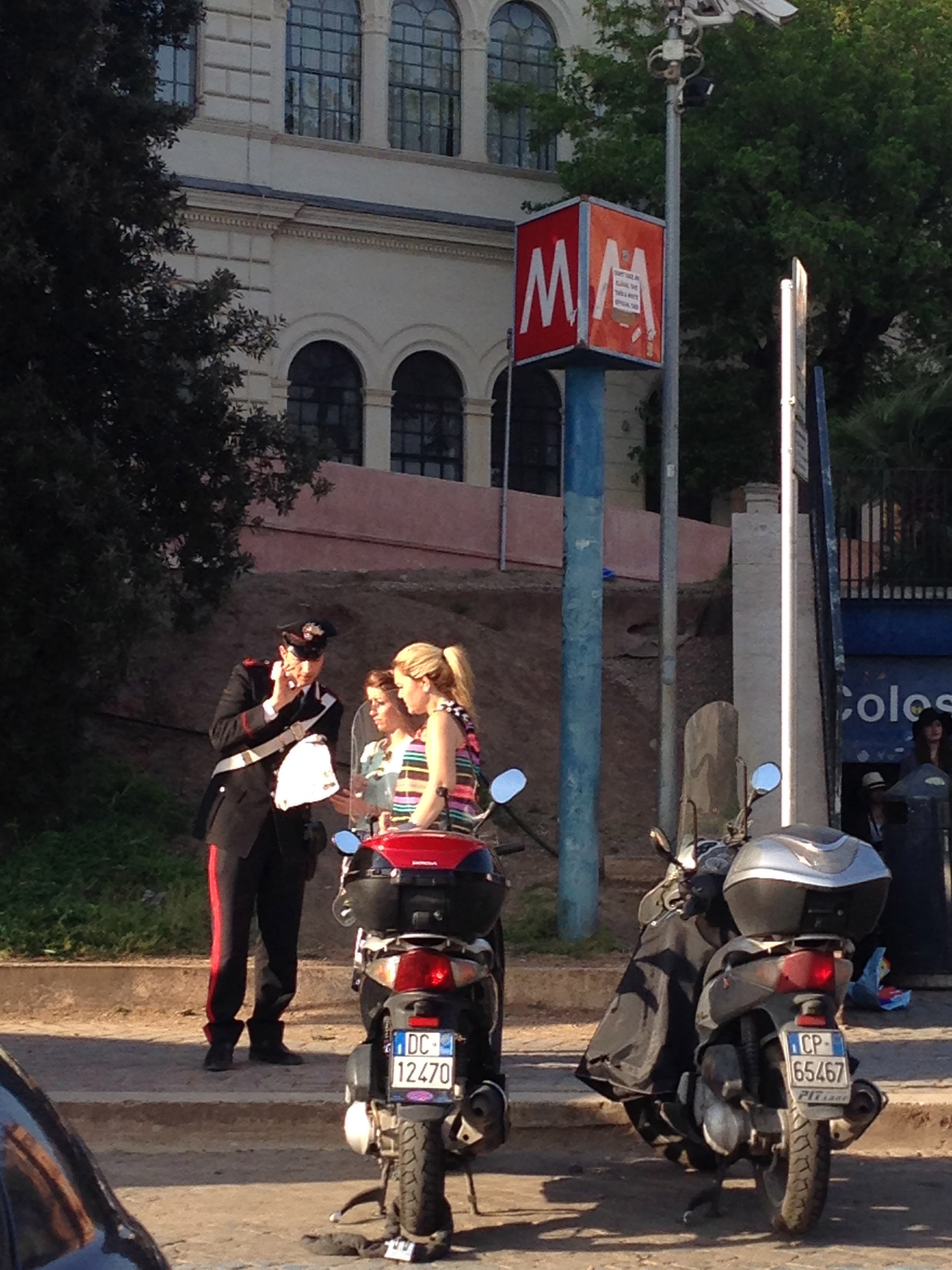
SSH_Rigon_DecPic2Recently a friend of mine tagged me on a very thought-provoking #genderviolence tweet about street harassment in Rome. She thought I might be interested in a startling video posted by La Repubblica online, an Italian newspaper that is second in national digital circulation, and she was right.

In the video, a woman walks down the central and beautiful streets of the eternal city, facing a wide range of unsolicited comments, catcalls and whistles.

Wait, this is not news and not even the “no news good news” kind of news. Street harassment is unacceptable and offensive, but sadly it is not surprising. Similar experiments have been done before in different cities around the world, producing more or less the same disturbing and upsetting outcomes.

Among the first videos about street harassment to go viral was the documentary “Femme de la rue” by Sophie Peeters. She taped her everyday walk to her university and other areas in Brussels, Belgium. It was a very disturbing glance into a woman’s life and an introduction to street harassment.

There was was the American-born filmmaker Colette Ghunim’s footage showing “what is like to walk the busiest bridge in Cairo as a girl,” showing it was not quite an enjoyable promenade. The film “10 hours of Walking in New York City as a Woman,” a walk made by Shoshanna Roberts in New York City, was unbelievably stressful. Roberts described how she felt to the Washington Post: “I wanted to break down in tears.”

After the NY City video went viral, the New Zealand Herald decided to try the experiment in kiwi land. Having lived in New Zealand, I was very pleased to discover that only two people spoke to beautiful model Nicola Simpson during her 10 hours of walking through the sunny streets of Auckland and one guy was asking for directions.

I personally do not recall any whistle or catcalling during South Pacific time, a very relaxing and fresh experience for me. However someone did throw a plastic bottle at me from a car while I was walking home on the beautiful Marine Parade in Napier. Yes, I admit it, I was reading a book and I am aware that walking and reading is not advisable or safe, but I still do not think that being hit by a (thankfully empty) plastic bottle on the head was the best way to remind me of that. But I doubt that was the message.

So back to the Italian video… what is startling about it?

This is: The Italian newspaper experiment shows a particular population of offenders, policemen and law enforcement agents, in one of the 25 most visited cities in the world. The video is quite distressing to watch, at least for me it was. Seeing men in uniform catcalling a young lady passing by gives you a sense of disbelief and alarm. While out on the streets, law enforcement agents are expected to be constantly alert, patrolling neighborhoods, and serving as a public liaison. Police officers are given more privileges than the average citizen and usually with great power comes great responsibility.

It must be said that there are many upstanding and qualified law enforcement agents in Italy and around the world, several of whom are also specifically trained to deal with gender-based violence victims and crimes. Nevertheless, this Italian video is not the only account on police officers misbehaving while on duty, taking advantage of their power and authority. Ultimately, police officers are men and street harassment is a gender-based issue.

I do not want to discuss how policemen should behave better than ordinary men, nor do I want to explore the cultural differences between northern and southern Italy, I don’t have the proper and specific knowledge or expertise. I would rather mention the aim and methodology of such videos.

The creators of the videos call them experiments, however these videos have scarce scientific foundation, not that they claim to have it. They definitely do not intend to scientifically prove the existence of sexism or gender inequality. Instead, they are meant to raise awareness on a quite mortifying and disregarded form of men’s conduct. If they do suggest something, it is that misogyny might be a global principle that unifies mankind across borders, oceans and cultures.

Even as a woman of science, I consider such “experiments” very powerful and I wish some researcher would be inspired enough by these brave women to design a valid and solid research project on street harassment since it is a heinous mistreatment women endure every day. We need valuable evidence, verifiable data to study the phenomenon and hopefully find, if not a solid solution, small steps toward achieving a truly egalitarian society and street harassment-free world.

Sara is a registered General Practitioner in Italy and New Zealand. She is the founder and current lead of the newly established Equally Different group within the European Junior General Practitioners Organization, the Vasco da Gama Movement, branch of the World Organization of Family Doctors. Follow her on Twitter @rgn_sr.

Share

Filed Under: correspondents Tagged With: Egypt, italy, New Zealand, NYC, research, rome, videos

Cameroon: Understanding the different forms of street harassment

August 9, 2013 By Contributor

By Zoneziwoh Mbondgulo, Buea, Cameroon, SSH Safe Public Spaces Mentee

“In many cities women and girls face violence not only in their homes and in relationships, but also in public spaces,” said Anna Tibaijuka, Under-Secretary General of the United Nations, and Executive Director of UN-HABITAT, in the Women’s Audit Safety Report findings, 2008.

In Cameroon, street harassment is still an overlooked issue. It is a common sight to see men and even young boys behaving as though it is right to publicly assault or harass a lady.  And for so long, women have been the victims and not the perpetrator of harassment, so much such that most of them deeply believe that such acts of aggression towards women is innate in men, more or less a norm rather than a social issue that needs urgent attention.

During first week of August, I launched an informal online and offline conversation project as part of my SSH Safe Public Spaces Mentoring Program project to engage people in public conversation on street harassment. I collected individual stories of harassment experiences, the majority from Facebook and some from young women in my area. Likewise, I mapped out places/cities that are unsafe or feel unsafe for women and girls in my society. In addition, together with my teammate, Ngwentah Berlyne Ngwalem, we also observed critically how men and women both use the public space both in big cities and remote communities.

Inasmuch as it was difficult for some women to feel safe sharing their experience publicly. At least, it was obvious that many women have experienced one or two or more forms of street harassment, knowingly or unknowingly.  According to available research, as cited in Holly Kearl’s book Stop Street Harassment: Making Public Places Safe and Welcoming for Women, it has been proved that “starting at a young age, as many as 80 percent of women around the world face at least occasional unwanted, harassing attention in public places from men they do not know; some women face it daily.”

Young Women’s Experience with Street Harassment

To begin, Berlyne said, “Sometimes I feel like being a woman sucks. You have no say over anything, over your own body, choices etc but people make it seem like you do. There are guys who will tap your ass, touch your chest/breasts, pull up your bra and smile at you before you actually figure out what is happening etc.”

Like Berlyne, another young woman said, “There is this attitude common with bike riders each time they carry a female passenger. They will ride with you and get at some point, they intentionally hold the breaks, clutching back and forth and each time they do that, it is obvious, you fall and lean on their back. But what most female passengers don’t realized is that the whole bike clutching is a trick to have women’s breast pressing over these bikers back.”

For some wicked bikers, she added, “They will position their elbow in a way that as you fall on their back and your breast presses hard on their elbows. And this is really painful. They have done that to me and I felt terrible! I recalled the last time; my breast pained me for closed to a month.”

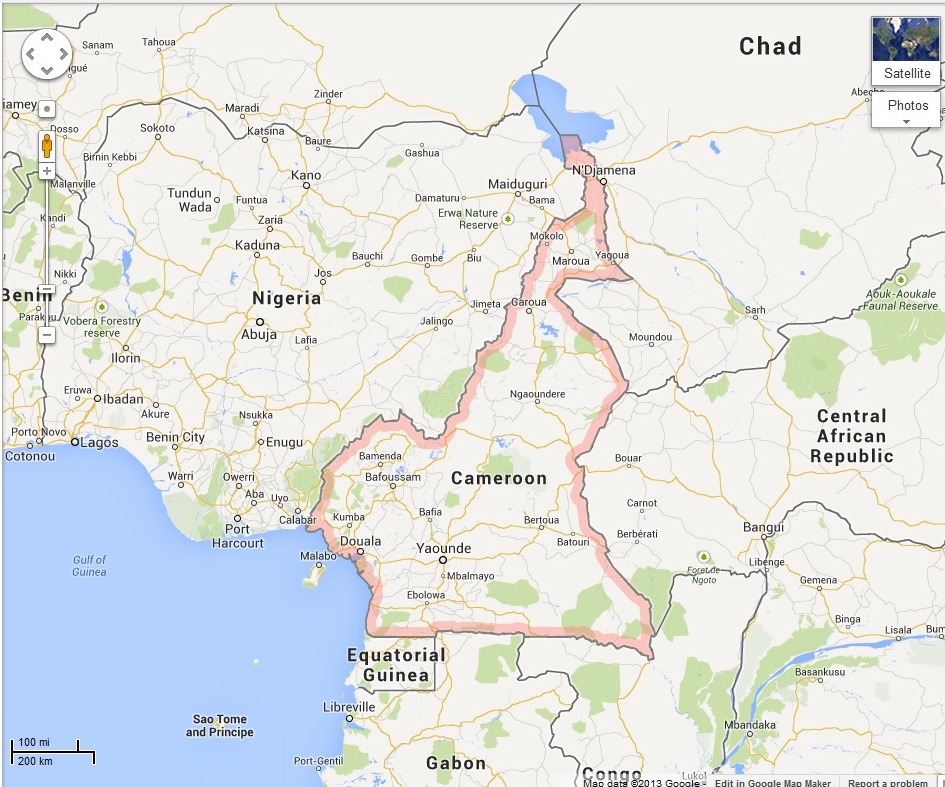
For another young lady in her late twenties, she explained to us that, “Around the parking lots in her neighborhood at Nsimeyong-damas, in Yaoundé, Centre Region, Cameroon, there is always this particular groups of young guys idling around, throughout the day,” and she has observed that “Each time, a lady pass by, one of those guys must throw a comment, words and / or beckon at the lady or make some funny sound to pull the lady’s attention or provoke her. And in the night,” she added, “These guys can be very aggressive; they have been noted for always attacking / harassing women.

Laura R. Ivy also explained, “Men whistle when you pass and if you don’t answer they insult you. It seems to lessen as you age or maybe you don’t pay attention anymore. The worse is the bikers if one of them asks you where you are going and you don’t answer you receive threats and insults name calling etc.”

“I experience this every day, and honestly it sucks, can men not leave us alone? We have reasons why we don’t want all these primitive guys around, we want mature and responsible men around us,” said Patience Flora.

To another young lady, Konda Delphine, public harassment from men is something that she’s experienced a countless number of times.

From what Berlyne and I observed, the experiences cut across. We saw the same behavior everywhere –  in big cities like Douala, Yaoundé, and in parts of a remote community in Mutengene and /or Buea. We also realized a common behavioral pattern among men of certain profession across the regions. E.g. almost all motor bikers, park loaders, market hustlers, hawkers, have similar attitude and behavior towards women.

Zoneziwoh Mbondgulo

This is article is the first of my #SSH Efforts in raising awareness and campaign against street harassment in Cameroon. Next will be a focus group discussion with some selected people who have already been contacted. And thereafter, there will be a workshop and also a public poster exhibition and flyers distribution.

Updates on this project can be found at: Women for a Change- Cameroon, or via Twitter @zofem.

Share

Filed Under: SSH programs, Stories Tagged With: cameroon, research, street harassment

« Previous Page
Next Page »

Share Your Story

Share your street harassment story for the blog. Donate Now

From the Blog

  • #MeToo 2024 Study Released Today
  • Join International Anti-Street Harassment Week 2022
  • Giving Tuesday – Fund the Hotline
  • Thank You – International Anti-Street Harassment Week 2021
  • Share Your Story – Safecity and Catcalls Collaboration

Buy the Book

  • Contact
  • Events
  • Join Us
  • Donate
  • Facebook
  • Instagram
  • Pinterest
  • Tumblr
  • Twitter
  • YouTube

Copyright © 2026 Stop Street Harassment · Website Design by Sarah Marie Lacy