• About Us
    • What Is Street Harassment?
    • Why Stopping Street Harassment Matters
    • Meet the Team
      • Board of Directors
      • Past Board Members
    • In The Media
  • Our Work
    • National Street Harassment Hotline
    • International Anti-Street Harassment Week
    • Blog Correspondents
      • Past SSH Correspondents
    • Safe Public Spaces Mentoring Program
    • Publications
    • National Studies
    • Campaigns against Companies
    • Washington, D.C. Activism
  • Our Books
  • Donate
  • Store

Stop Street Harassment

Making Public Spaces Safe and Welcoming

  • Facebook
  • Instagram
  • Pinterest
  • Tumblr
  • Twitter
  • YouTube
  • Home
  • Blog
    • Harassment Stories
    • Blog Correspondents
    • Street Respect Stories
  • Help & Advice
    • National Street Harassment Hotline
    • Dealing With Harassers
      • Assertive Responses
      • Reporting Harassers
      • Bystander Responses
      • Creative Responses
    • What to Do Before or After Harassment
    • Street Harassment and the Law
  • Resources
    • Definitions
    • Statistics
    • Articles & Books
    • Anti-Harassment Groups & Campaigns
    • Male Allies
      • Educating Boys & Men
      • How to Talk to Women
      • Bystander Tips
    • Video Clips
    • Images & Flyers
  • Take Community Action
  • Contact

Women in Pakistan leave jobs because of commuter harassment

October 21, 2011 By HKearl


via Pakistan Today

Some women leave their jobs because of the street harassment they face during their commute, according to a new article about sexual harassment on public transportation in Islamabad, Pakistan.

“This single issue is directly damaging the careers of working women,” reads the article in Pakistan Today.

I’m not surprised. I know street harassment can significantly impact women’s lives. When I conducted an informal study of more than 800 women in 23 countries and 45 US states for my book research, 9 percent of women said they had changed jobs because of harassers along their commute and, related, street harassment had caused nearly 20 percent of the respondents to move neighborhoods.

What does the harassment in Pakistan look like?

Via Pakistan Today:

“Street sexual harassment for a woman in public transport is similar to claustrophobia because she feels trapped in a small place with fear of no escape until she reaches her destination.

If a bus or train is crowded or if a woman is sitting by the window and the man harassing or assaulting her is sitting behind her, she cannot scream or raise her voice since most of the women do not want to get people’s attention in cases like these.

Faiza Bibi is a resident of Bhara Kahu which is a suburban area of the city and she has to travel daily using public transport to reach her workplace. She said most of the drivers harass female passengers; sometimes they even touch the female passenger sitting next to them on the front seats while pretending as if they were merely shifting the gear.

She complained that the behaviour of drivers, especially of the vans plying on the Route Number 127, was unbearable.

“Women have no other option since they have to sit on the front seats, next to the driver, because they are the only seats meant for women,” she explained.

She lamented that the drivers took advantage of the situation by harassing women; sometimes by touching, staring or playing loud vulgar songs but the women commuters usually avoided complaining to anyone because they felt too embarrassed to tell anybody.”

Of course Pakistan is not the only country with this problem. New York City, Boston, and Chicago all have PSA campaigns focused on sexual harassment on the buses and subways because studies showed more than 60 percent of riders faced harassment.

Many countries like Japan, India, and Brazil have women-only subway cars offered during rush hour because of the problem of sexual harassment and this is a “solution” Islamabad may turn to as well if they can get the finances for it. 92 percent of women surveyed there said they want to have women-only public transportation. But actually, what they probably want is just no harassment, not necessarily segregation. Since no one in the government seems to care about actually ending the harassment, segregation probably sounds appealing and certainly could be a short-term solution to offer them relief. But it will not fix the problem in the long run.

Fortunately, there are people speaking out against street harassment in Pakistan whose efforts may lead to more long-term change. One example is in Karachi, Pakistan, where a new NGO called Gawaahi creates media for awareness and advocacy. They recently produced two short video clips about street harassment in Pakistan as a way to start raising awareness about the problem.

Share

Filed Under: News stories Tagged With: Gawaahi, Islamabad, Pakistan, public transport, sexual harassment, street harassment, women-only

“Anita Hill stood up in 1991 and we can all stand up in 2011.”

October 16, 2011 By HKearl

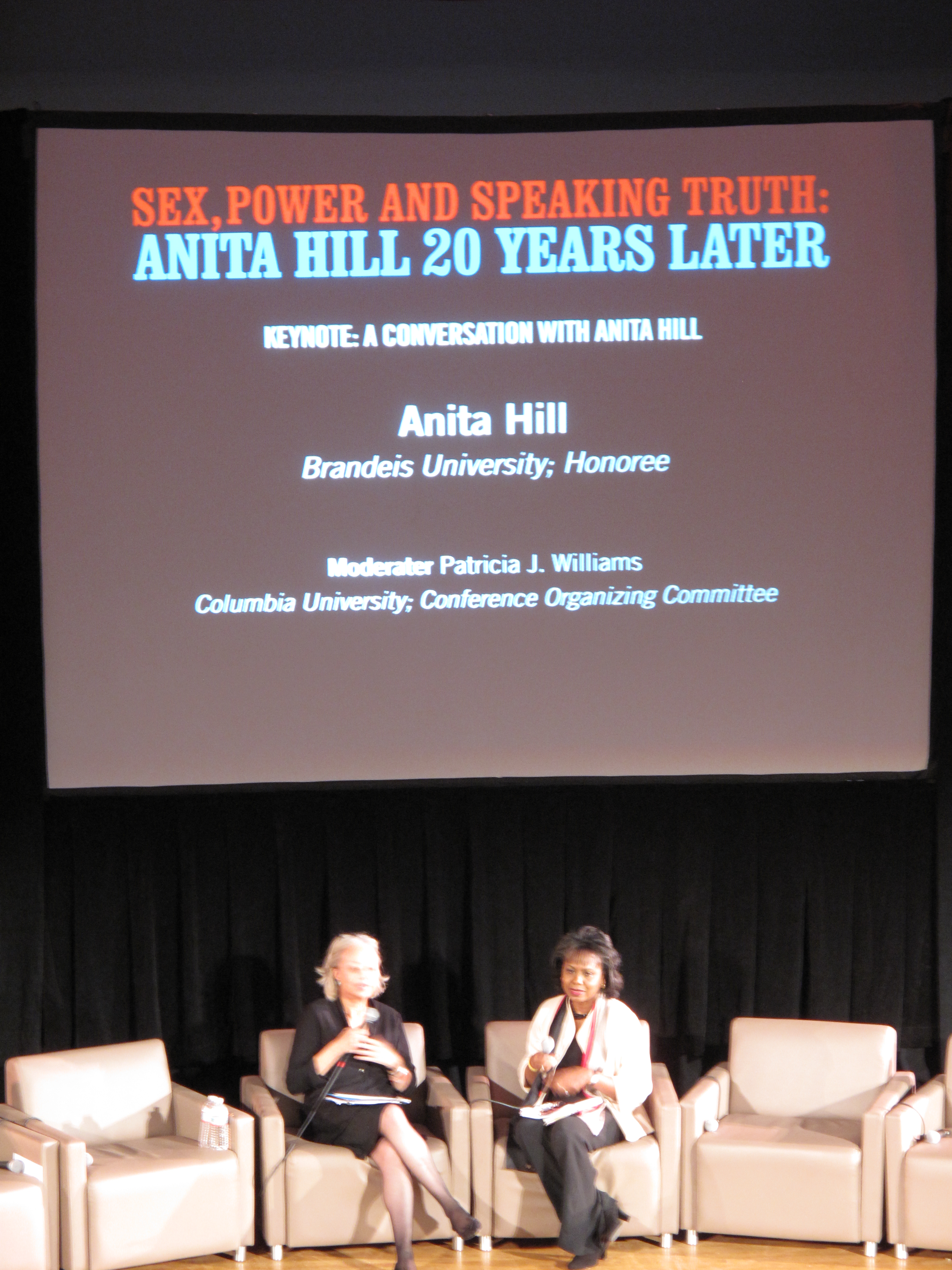
Charles Ogletree, a professor at Harvard Law School and the lead counsel for Anita Hill in 1991 spoke those words yesterday at the moving conference Sex, Power and Speaking Truth: Anita Hill 20 Years Later at Hunter College in New York City.

I agree. We all can stand up today as she did then. But, as I discuss in the latter part of the post, the knowing how to stand up in a way that will be effective and have a lasting-impact is often challenging.

The Conference

Throughout the conference, renowned lawyers, academics, and activists offered history lessons focused on what happened 20 years ago, commentary about the impact it had on current events and organizing efforts, and ideas for addressing sexual harassment in the future (though I thought the latter was a bit light on realistic ideas.)

We watched a compelling clip from Sex & Justice showing what happened 20 years ago and participated in lunchtime discussions on sexual harassment sub-topics.

If you missed it, you can watch most the conference online at C-Span.org.

To give you a taste of the day, here are some of my notes from two of the three panels and from Hill’s keynote address:

1. Charles Ogletree, Harvard Law School spoke first. He represented Anita Hill in 1991.

“What she stood for in 1991 still resonates with us…she’s in a class with Susan B. Anthony, Rosa Parks, Eleanor Roosevelt, Fanny Lou Hamer…”

Despite all of the backlash he and Hill faced, his then 12-year-old daughter told him on the phone, “I believe Anita.”

2. Lani Guinier, Harvard Law School

She talked about how Anita Hill made people “deal with the ambivalence and ignorance of the question: ‘Are you black or are you a woman?'”

“Many of us realized that not all women are white, not all blacks are men, and some of us, like Anita Hill, are very brave.”

3. Judith Resnik, Yale Law School

She examined the context of the hearing…how the male Senators on the hearing committee didn’t want to let Hill speak and then cut her defense short. While Thomas should have been on trial, they made it so Hill was.

It’s with the work of Hill and others who stood up for her and spoke out against sexual harassment that “things that are seen as ‘the way things are’ become intolerable”

4. Catharine A. MacKinnon, University of Michigan Law School

She’d been speaking out against sexual harassment since the 1970s and wrote the first book on it in 1979. During the hearing, she gave commentary on NBC.

The hearing was a “massive consciousness raising session” on an issue she’d been trying to raise awareness about for years..the hearing “made sexual harassment real to people” in a way her 1979 book did not, the EEOC guidelines did not, etc…only Anita Hill did.

“Women identified with Anita Hill…they believed her with ferocity and more said so as time and heat passed. They realized what happened to them was often as bad as what happened to her and if she could do it, they could do it too.”

“Sometimes it’s important to stand up and do the right thing, even if you lose,” she said about the DSK-Diallo sexual assault case.

5. Jamia Wilson, Women’s Media Center

“I am not Anita Hill but I could have been and that scares the crap out of me.”

Thelma & Louise + Anita Hill introduced her to victim-blaming and rape shaming. She witnessed the hearings become “a modern day witch hunt rather than the high tech lynching, as Thomas said.”

She feared she could be marked a traitor [against her race] for one day speaking out. The hearing was “intersectionality 101” for her.

6. The keynote address was a conversation between Patricia J. Williams and Hill. Here are a few notes from it:

Anita Hill spoke about the death threats, bomb threats, sh*t people mailed her and how she had to go to the grocery store knowing 7 in 10 people thought she had perjured herself…and how her family and friends helped her through it.

She talked about wanting to get her life back and resented that things didn’t go back to normal after the hearing ended. She said once she let go of that (about 6 months later) and realized she had a different life and she had to decide what shape that life would take, then she was able to move forward and also recognize that while it was an important event that shaped her life, it was just an event.

In her new book Reimagining Equality: Stories of Gender, Race, and Finding Home she writes about home and also the housing crisis in the USA.

Some of the last things she said related to her work on sexual harassment as she “helps people find their voice, talk about the issues that keep people from living full lives of equality…we should imagine a future where sexual harassment no longer exists”

7. Kimberlé Crenshaw, The African American Policy Network (You can read her speech in the current issue of The Nation).

She spoke a lot to the issue of intersectionality of race and gender.  She said the message still is “just get over it” re: sexual harassment, but “until we say it’s over, it’s not over.”

8. Virginia Valian, Hunter College

She shared stats on sexual harassment in the workplace…they’re the same today as they were 20 years ago.

She said there are several calls to action, including: 1) be smarter about how we influence people in power and how we get them into power. educate judiciary, lawyers, lawmakers, and be more systematic in our efforts 2) Form rapid response teams so we can influence the media and get the correct facts out. Giving good info to the people in power immediately.

9. Gloria Steinem

She talked about the DSK case and how the work of Hill and others allowed Nafissatou Diallo to come forward to report him. Both lost in the courts but they won in public opinion…Most importantly, this is the legacy of Anita Hill: “Thomas is on the Supreme Court but DSK will never be president of France!”

“We have the strength to go forward”

10. Devon Carbado, UCLA School of Law

“What have we learned from the Thomas-Hill hearings? That our anti-racism needs to be tied to a robust feminism and our feminist interventions must be infused with anti-racism.”

11. Julie Zeilinger, FBomb

“Gender conditioning and gender stereotyping allow sexual harassment to continue.”

“Our work isn’t yet done, plenty of us are willing to continue the fight and take Anita Hill’s legacy and run with it.”

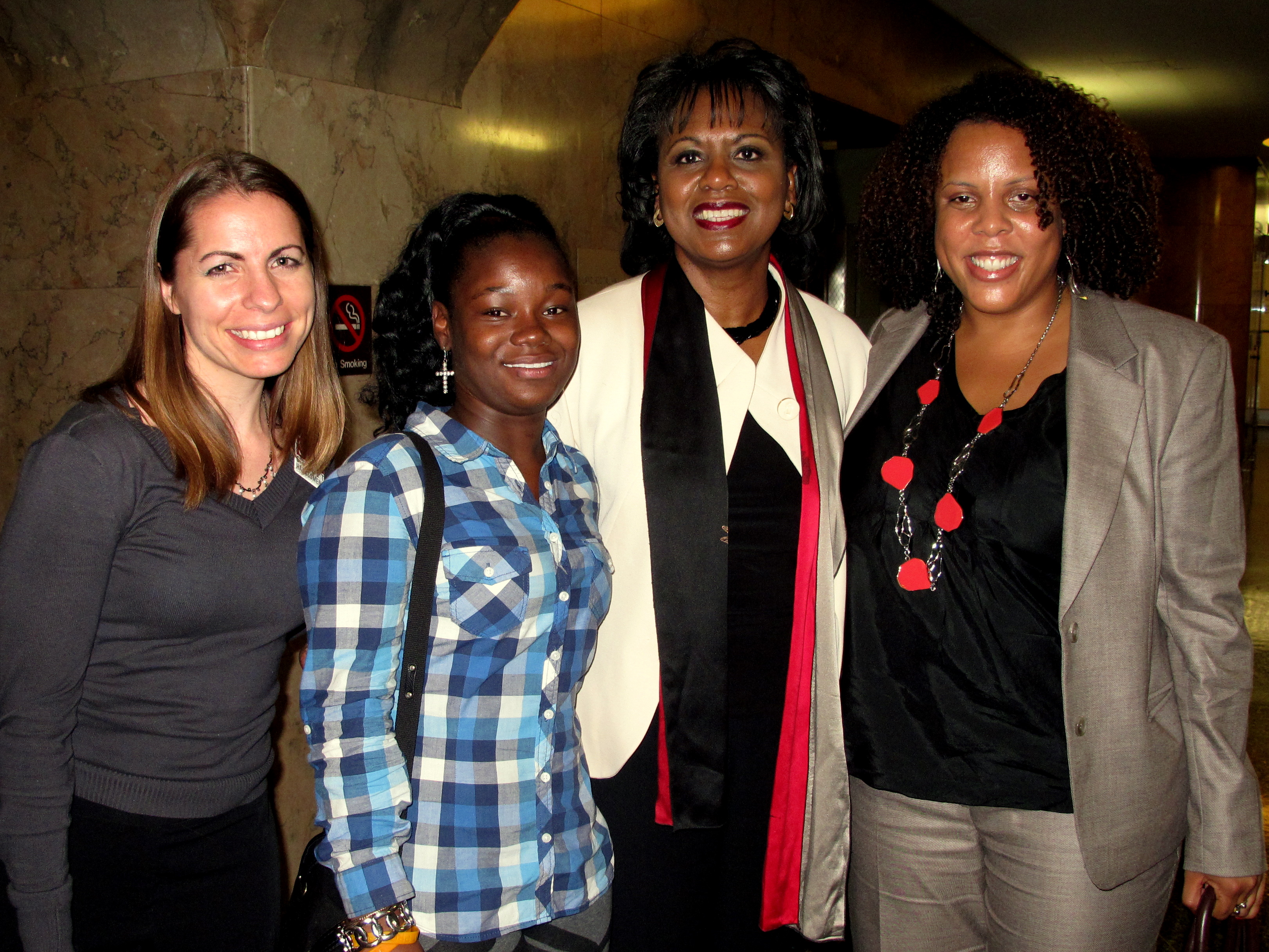
It was a day I will never forget. Especially after I had the huge honor of meeting both Steinem and Hill at an evening reception. I got to meet Hill with Joanne Smith, founder and ED of Girls for Gender Equity and one of her organizers Jodyann. Jodyann was determined to get to meet Hill and was overcome with emotion when she did. It was moving.

I’m still feeling the adrenaline and awe f meeting two feminist icons in one evening on top of meeting and reconnecting with amazing current activist/future feminist icons.

L to R: Holly Kearl, Jodyann of Girls for Gender Equity (GGE), Anita Hill, Joanne Smith the ED of GGE

What to Take Away

The conference is over. What now?

Let’s look back to Ogletree’s quote. “Anita Hill stood up in 1991 and we can all stand up in 2011.”

If you’re reading this blog, you probably want to (and do) stand up against sexual harassment—especially the kind that happens in public places—and ideally, you’d like to do so to the same extent that Anita Hill stood up against workplace sexual harassment.

But, if you’re like me, you may find that figuring out what actions will work, what efforts will be effective, and what kind of collective organizing will create long-term change is challenging. It’s especially challenging since “street harassment” is not a universal term and it’s not seen as a legitimate problem by most people. We’re still at the consciousness-raising and education stage.

To help with that stage, sites like HarassMap, Hollaback and mine collect individuals’ stories of resistance to street harassment, people write articles, tweet, and post stories on Tumblr, and numerous groups and people organize community anti-street harassment efforts. But I just don’t think they are enough to really turn street harassment into an immediately-recognized issue that is treated as seriously as workplace sexual harassment, or at least not any time soon.  There must be more we can collectively do about street harassment that is inclusive, appropriate, and effective; or one major action we can rally behind to raise awareness as people rallied behind Anita Hill. But what  is it?

Something I’m taking away from the conference is a better understanding of the workplace anti-sexual harassment movement and I hope that as I reflect on all that I’ve learned, I may come across ideas for effective, inclusive ways we can stand up against street harassment.

A related conference take away for me is a desire to learn even more about the general anti-sexual harassment movement and see what messaging, campaigns, and laws work. I know a lot of people still treat sexual harassment as a joke and it’s still a big problem at work and schools, but at least you don’t get blank stares from decision makers, academics and regular people when you bring it up (as happens with street harassment).

While learning about the anti-sexual harassment movement is not new to me, I’ve never delved very far into it. As my first step, I’m half-way through Carrie Baker’s fascinating and well-documented book, The Women’s Movement Against Sexual Harassment. Attending the Anita Hill conference was another step and now, for my next step, I plan to connect with scholars and activists I heard and met there.

Questions for You

If you attended the conference, what are your takeaways?

And, a question for anyone, do you have thoughts about what we in the anti-street harassment “movement” can learn from Anita Hill and related efforts to end workplace sexual harassment?

Share

Filed Under: Events Tagged With: 20 years later, anita hill, clarence thomas, girls for gender equity, gloria steinem, hunter college, joanne smith, sexual harassment, street harassment

Watch the Anita Hill Summit Live October 15

October 15, 2011 By HKearl

Cross-posted from what I wrote for AAUW’s blog:

Twenty years ago this week, Professor Anita Hill testified about sexual harassment before the Senate Judiciary Committee during the confirmation hearings for then-Supreme Court justice nominee Clarence Thomas. Hill used to work for Thomas and felt it was her duty to share her experiences of sexual harassment in her workplace. In the end, Thomas was still appointed as a justice, and he continues to be one today.

Two decades later, it is clear that the hearings were a pivotal moment in our nation’s history.

Working women across the nation identified with what Hill said, and her testimony opened up the floodgates. In record numbers, women shared their sexual harassment stories, and in just a few years, the number of sexual harassment complaints filed with the Equal Employment Opportunity Commission doubled.

Hill’s testimony ultimately changed how we think about sexual harassment. Before, it was seen as a personal problem and something women should handle with a sense of humor or thick skin. Hill’s testimony helped people understand that sexual harassment is discrimination and a tactic that both men and women use to oust others from a workplace.

The disbelieving, hostile way the all-male Senate Judiciary Committee treated Hill and the subsequent confirmation of Thomas to the Supreme Court led to several women being elected to the Senate the following election year in what was dubbed the “Year of the Woman.”

Tomorrow, Saturday, October 15, Hunter College in New York City is hosting a daylong summit on workplace sexual harassment, and Hill is the keynote speaker. Panelists will host sessions such as What Happened, What Does Anita Hill Mean to You, and What Have We Learned in 20 Years and What Comes Next?

Stop Street Harassment is one of the many conference co-sponsors, and we will host one of the lunchtime discussions. Ours will focus on the sexual harassment of teenagers in schools and on the streets.

For the majority of you who cannot be there, you can watch via live streaming on the conference website. If you’re on Twitter, follow @anitahill20 and view live updates by following the hashtag #AnitaHill.

Share

Filed Under: Events Tagged With: anita hill, hunter college, sexual harassment

Toronto police are at it again…

October 12, 2011 By HKearl

Greenwood College via CNews

How would you feel if someone violated your privacy and space by following you, leering at you and then looking up the skirt of your school uniform while you were going to school? Then how would you feel if the response of local police was to tell you and your classmates to stop wearing your school uniform during your commute, indirectly blaming YOU for the victimization?

That’s exactly what happened to two female students at Greenwood College, a private high school in Toronto. After a man harassed them and looked up their skirts while they were taking the subway to school, the Toronto police advised the school principal to tell the female population to put on their school uniform at school instead of at home in the morning. The principal apparently supported the sentiments and shared the message with the whole school.

Via CNews:

“This bit of guidance was given to Allan Hardy, the school’s principal, by an investigating officer from 53 Division on Thursday after two of Greenwood’s female students — both decked out in the school’s uniform of skirt, shirt and blazer — were allegedly followed around and ogled by a man while on the subway earlier that morning.

The girls, who were on their way to school at the time, were travelling northbound, Hardy confirmed, adding that the suspect had been looking up the girls’ skirts.

Hardy relayed the officer’s advice in an e-mail to parents and teachers informing them of the incident. The Toronto Sun obtained the e-mail from a confidential source.

“This person was looking up the girls’ skirts,” said Hardy, who would not divulge the ages of the two students. “So the advice is given … if they had, for example, jeans or sweatpants on, it wouldn’t be an issue.”

This is not okay.

While sadly schoolgirl outfits are inappropriately sexualized and fetishized (e.g. see Britney Spears’ “Hit Me One More Time” music video, Halloween costumes, and video games) and that sexualization and fetishization does nothing to prevent the harassment of REAL schoolgirls, telling girls to not wear their uniform on the subway is not the solution.

Street harassment—including harassment on public transit systems—happens to many high school students regardless of what they wear. It happens even when they wear jeans and sweatpants! It happens to women who wear business suits, exercise clothes, and burqas! Since it doesn’t matter what we wear so dictating clothing choices as a prevention method is NOT okay or effective. And even if it was effective, the focus should still be on the HARASSER not the person facing harassment!

When someone sent me this story this morning, I was exasperated and shocked. Of all places for a police officer to say such an inappropriate comment, it happened in Toronto?!

In January a representative of the Toronto Police stated, “women should avoid dressing like sluts in order not to be victimized.” This remarked sparked SlutWalk Toronto and scores more SlutWalks around the world.

But apparently that message wasn’t clear enough. What more do we have to do so demand that police officers in Toronto and people around the world stop telling girls and women how to dress and inspire them to focus instead on solely stopping harassers and assaulters and ending the culture that fosters such harassment and assault?

Here’s an important op-ed by Monica Bugajski in response to the police’s reaction.

[Thanks Katie B. for the news tip]

Share

Filed Under: News stories Tagged With: Greenwood College, sexual harassment, street harasasment, toronto, victim blaming

Women’s rights activists receive Nobel Peace Prize

October 7, 2011 By HKearl

Congratulations to Liberian President Ellen Johnson Sirleaf, women’s rights activist Leymah Gbowee from Liberia, and democracy activist Tawakkul Karman of Yemen for being awarded the Nobel Peace Prize today!

I’m thrilled to see their important work recognized through this prestigious award and I’m also glad to see the Nobel Committee recognize women right’s activism as peace-keeping work.

Via the New York Times:

“We cannot achieve democracy and lasting peace in the world unless women obtain the same opportunities as men to influence developments at all levels of society,” said the citation read by Thorbjorn Jagland, a former Norwegian prime minister who heads the Oslo-based Nobel committee that chooses the winner of the $1.5 million prize.

Absolutely! And sadly, today, the rates of gender-based violence including rape, sexual harassment and street harassment keep too many women from having those opportunities. Gender-based violence and harassment can make it unsafe for women to go in public places to pursue such opportunities, keep them out of certain professions or positions of leadership, and even make affected women too emotionally worn down and wary to be the amazing leaders they otherwise could be.

The work anti-violence groups do to promote women’s equality and to prevent gender-based violence is key, then, to peace and to an equitable society.

With all of the amazing work that women do around peace-keeping and peace-building, can you believe only 12 other women have ever won this prestigious award? Even though this is the 110th year it is being awarded? The last time it was awarded to a woman was seven years ago.

One of my heroes Irena Sendler, a Polish social worker, saved more than 2,000 Jewish children during the Holocaust, was nominated for the Peace Prize in 2007. Al Gore won that year instead because of his work to address Global Warming. I was disappointed that Sendler was not selected, especially after allegations about Gore sexually harassing a woman surfaced last year (his wife filed for divorce that same month).

I hope this year’s award will set a new trend for recognizing the many ways women promote peace in their homes, in their communities, in their countries, and across the globe, and honoring their importance.

Share

Filed Under: News stories Tagged With: al gore, Irena Sendler, Leymah Gbowee, Liberian President Ellen Johnson Sirleaf, nobel peace prize, sexual harassment, Tawakkul Karman

« Previous Page
Next Page »

Share Your Story

Share your street harassment story for the blog. Donate Now

From the Blog

  • #MeToo 2024 Study Released Today
  • Join International Anti-Street Harassment Week 2022
  • Giving Tuesday – Fund the Hotline
  • Thank You – International Anti-Street Harassment Week 2021
  • Share Your Story – Safecity and Catcalls Collaboration

Buy the Book

  • Contact
  • Events
  • Join Us
  • Donate
  • Facebook
  • Instagram
  • Pinterest
  • Tumblr
  • Twitter
  • YouTube

Copyright © 2026 Stop Street Harassment · Website Design by Sarah Marie Lacy