• About Us
    • What Is Street Harassment?
    • Why Stopping Street Harassment Matters
    • Meet the Team
      • Board of Directors
      • Past Board Members
    • In The Media
  • Our Work
    • National Street Harassment Hotline
    • International Anti-Street Harassment Week
    • Blog Correspondents
      • Past SSH Correspondents
    • Safe Public Spaces Mentoring Program
    • Publications
    • National Studies
    • Campaigns against Companies
    • Washington, D.C. Activism
  • Our Books
  • Donate
  • Store

Stop Street Harassment

Making Public Spaces Safe and Welcoming

  • Facebook
  • Instagram
  • Pinterest
  • Tumblr
  • Twitter
  • YouTube
  • Home
  • Blog
    • Harassment Stories
    • Blog Correspondents
    • Street Respect Stories
  • Help & Advice
    • National Street Harassment Hotline
    • Dealing With Harassers
      • Assertive Responses
      • Reporting Harassers
      • Bystander Responses
      • Creative Responses
    • What to Do Before or After Harassment
    • Street Harassment and the Law
  • Resources
    • Definitions
    • Statistics
    • Articles & Books
    • Anti-Harassment Groups & Campaigns
    • Male Allies
      • Educating Boys & Men
      • How to Talk to Women
      • Bystander Tips
    • Video Clips
    • Images & Flyers
  • Take Community Action
  • Contact

Talking Street Harassment with a Congresswoman and an NPR host

October 6, 2011 By HKearl

Eleanor Holmes Norton and Michel Martin
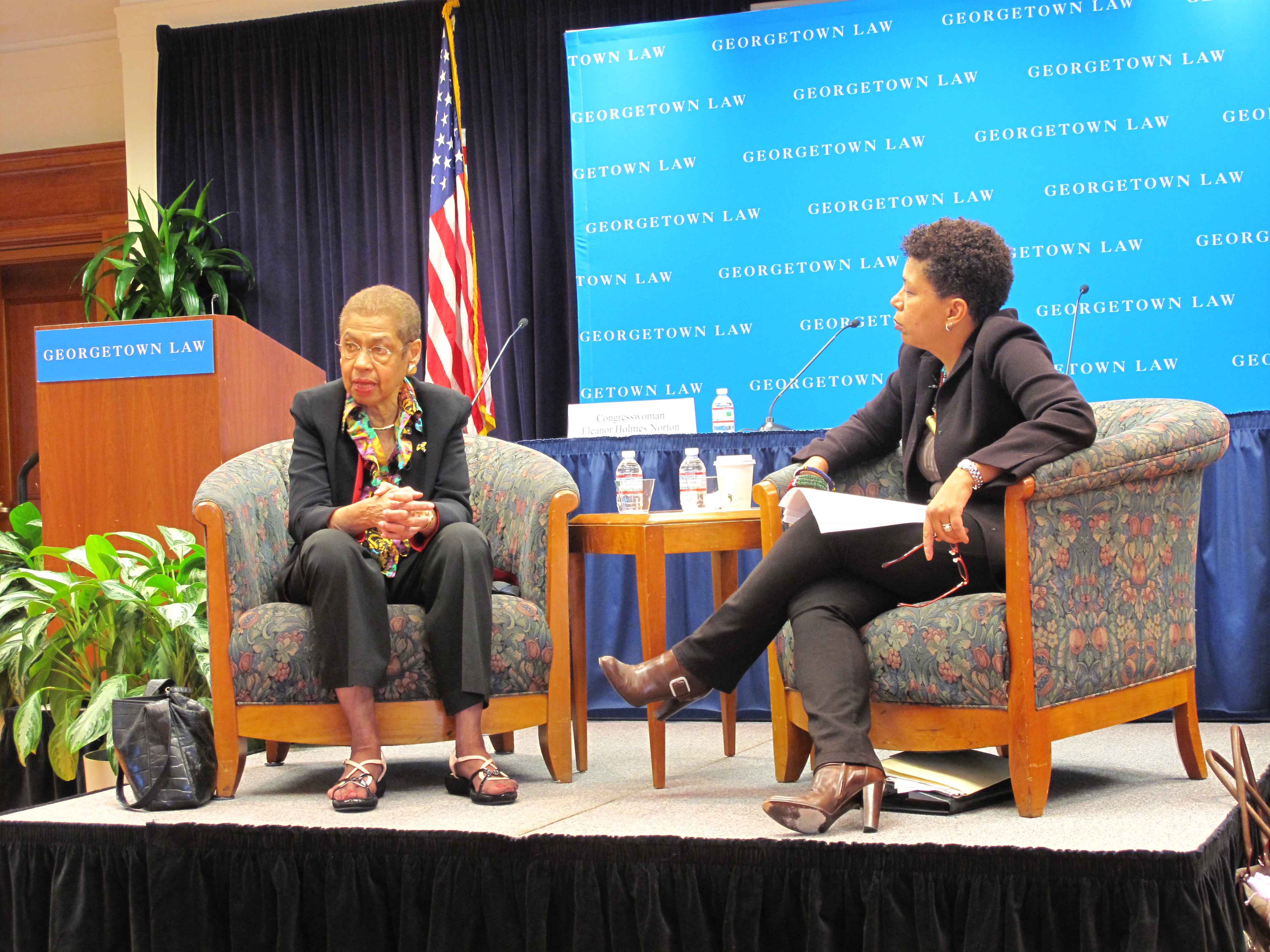
Today I talked about street harassment with Delegate Eleanor Holmes Norton (DC) and NPR’s Michel Martin, host of the afternoon show Tell Me More.

How did I get to have a conversation about street harassment with such amazing women?

Well, I had the privilege of attending a conference at Georgetown Law Center that commemorates the 20 years since Professor Anita Hill testified to the Senate Judiciary Committee about how Clarence Thomas sexually harassed her when she worked for him. Her testimony was part of his confirmation hearings for the U.S. Supreme Court. The Senators treated her abominably, and Thomas was appointed as a Justice.

Working women across the nation identified with what Hill said and seeing her talk about something so personal and taboo on live television opened up the floodgates.
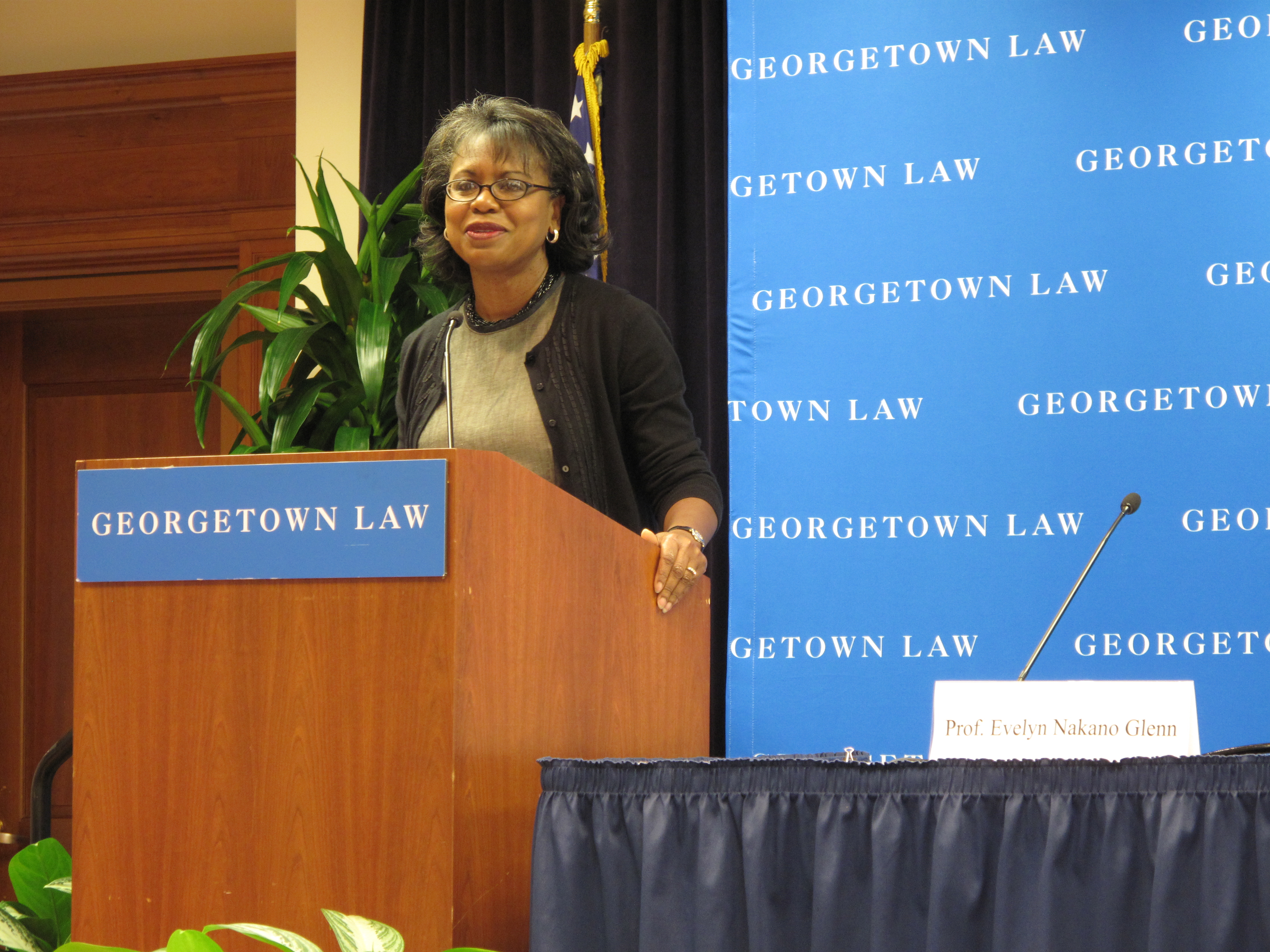
Anita Hill

Women started sharing their sexual harassment stories too. Hill’s testimony ultimately changed how we think about sexual harassment and it was a pivotal moment in our nation’s history. Plus, the way the men in the Senate treated Hill led women to vote women candidates into political office in numbers that have never been matched.

Today at the conference, law professors, media experts, and feminist activists talked about where we are today with regards to workplace sexual harassment and the impact the hearings has had on race and gender in our society. Hill was the closing speaker and it was an honor to hear from her.

But this post focuses on my conversation with Delegate Norton and Ms. Martin.

In the mid-afternoon, Martin sat down with Norton and asked her questions about what the hearing was like from her perspective as a new Congresswoman and as the former head of the Equal Employment Opportunities Commission (EEOC) who helped draft the original workplace sexual harassment policies. Martin was a white house correspondent at the time of the hearing and she shared a bit about her perspective. Both women provided fascinating insight into a national event I did not know was occurring at the time (I was eight years old) but one that paved the way for my anti-street harassment activism and the work I do at AAUW on sexual harassment in schools and the workplace.

After their illuminating conversation, there was time for questions from the audience. Without formulating my thoughts, I jumped up, amazed to have an opportunity to ask them their thoughts on applying lessons learned from workplace sexual harassment to current efforts around street harassment. I was not my most articulate and flubbed a bit, but I got into a grove during some of my responses back to them.

Norton spoke first. It quickly became clear she didn’t understand what I meant by “sexual harassment that happens in public places” and so I had to explain street harassment to this long-time feminist and leader in the sexual harassment movement. It reminded me just how normalized street harassment is and/or how rarely it must happen to someone of Norton’s privileged position if she did not know much about it despite working on sexual harassment issues, often in a leadership position, since the mid-1970s.

Martin, on the other hand, knew exactly what I was talking about and helped me explain it to Norton. In fact, Martin helped everyone in the room understand the issue vividly by sharing a story. She said when she was a white house correspondent she regularly plotted her route through Lafayette Park based on how many potential harassers she saw. She’d forgotten about having to do that, she said, but today her memory of that experience seemed to help her understand why ending street harassment matters.

While I didn’t mean for Norton to solely talk about how to use laws to address street harassment, once she knew what I was talking about, that is where her mind went because of her legal background. She said verbal comments are protected by The First Amendment (freedom of speech) and it would be difficult to prosecute strangers. A few legal scholars have written compelling articles about the law and street harassment and The First Amendment barrier can be overcome. Fighting words, hate crimes, intention to inflict emotional distress: none of these are protected by The First Amendment and a lot of street harassment could be considered one or all of those. (I wasn’t fast enough on my feet to respond with this information but Martin noted the fighting words exception and compared men calling a woman “bitch” to using racial slurs.)

Further, why is it yelling, “Fire” in a building unprotected by the First Amendment (and illegal), but a middle-age man is allowed to walk behind a college-age young woman and say, “This is what I like right here, these are the kinds of girls I want to f*ck right here. This ones’ gonna get it” and then threaten to rape her and pull down her shirt before two bystanders intervened? That’s protected by the First Amendment? By the way, even with two witnesses, the police said nothing “serious” had happened and the poor student had to continue on to class and take an exam.

That is not right.

Additionally, Independence and Columbia, Missouri, passed a city ordinance against harassing pedestrians and bicyclists from cars and Los Angeles passed one against motorists harassing pedestrians. It can be done if we want it to be done. (Again, I didn’t think fast enough to respond with this information.)

I don’t think a law would be the most effective way to stop street harassment and I know there are a lot of valid concerns with using laws to regulate street harassment and racial-profiling-happy police to enforce them. But I also think a carefully worded law could help change social attitudes and it may give some people cause to pause before harassing.

When I mentioned groping in my definition of street harassment, Norton said that was already illegal and women should report gropers. Then she stated how lots of groping occurs in “Arab countries” where women face so much oppression. I was taken aback. Yes, groping is a big problem in countries like Egypt and Yemen but, as I discuss in my book and as stories submitted to my blog regularly show, it also is in countries like Japan, Italy, and, PS, the USA! Street harassment is a global problem.

She concluded by saying she doesn’t think there can be a law to regulate street harassment, but she thinks consciousness-raising is the key and that things like SlutWalks are best because they tell men that “the behaviors are forbidden.”

While I appreciate SlutWalks (and spoke at SlutWalk DC) and love consciousness-raising tactics, they can’t be the only solution! So many street harassers are grown men who harass teenage girls. They know their behavior is wrong and that it is, in Norton’s words, “forbidden.” They are not held accountable; there are no consequences, so they continue to harass. SlutWalks alone will not change that.

I didn’t want to take up more time because others had questions but WOW was there a lot I would have liked to say.

Fortunately, Martin really did seem to understand what I was talking about and she said she’d be interested in having me on her show. I’m mailing her a copy of my book tomorrow and I hope she will decide to have me (and possibly some other local DC street harassment activists) on her show.

And if am on her show, I hope Norton will listen so she can learn more about street harassment. More importantly, I hope one day Norton can have time to speak to youth in her community who face street harassment daily so she can understand its prevalence and impact. If she understood, I think she’d be a big ally. After all, she’s been a leader on the issue of sexual harassment for nearly 40 years.

With the growing number of commemorations of the Hill-Thomas hearings (I’ll attend another conference about workplace sexual harassment with Hill as the keynote at Hunter College on October 15), I hope anti-street harassment activists can find similar opportunities to draw attention to street harassment and hopefully inspire major feminist leaders to learn more and address it, too.

Share

Filed Under: street harassment Tagged With: anita hill, eleanor holmes norton, michel martin, sexual harassment, street harassment, tell me more

Pakistan: Two films about street harassment

October 6, 2011 By HKearl

What does street harassment look like in Pakistan? Does wearing a burqa reduce street harassment?

Find out the answers in the two short films created by Naveen Naqvi, Executive Director of Gawaahi. In the text of the films “Stop Staring!” and “Stop Street Harassment,” she writes:

“Street Harassment is a global phenomenon that is largely overlooked, and even considered acceptable despite there being laws against it in many places including Pakistan. Street harassment includes making sexually explicit comments, ogling, whistling, following and groping.

In the making of these videos, we found that many Pakistani women, especially from the lower-middle classes began wearing burqas because they found the additional garment enabling in many ways. However, they find that the problem of street harassment has worsened, and even in burqas, they are harassed as they wait for buses, rickshas, taxis, or walk down the street. We found that this intimidation was experienced by women across class, age, religion and ethnicity.”

View the films (you can choose the “closed captions” option to read English subtitles) and stay tuned for an interview with Naqvi about her work to make public places safer for women in Pakistan!


Share

Filed Under: Activist Interviews, Resources, street harassment Tagged With: Gawaahi, Naveen Naqvi, sexual harassment, street harassment

Street harassment in inner-city communities

September 22, 2011 By HKearl

Street harassment is a normalized experience. Even though it negatively affects our lives, it’s seen as no big deal and the way things are. This normalization is even greater in poor inner-city communities, according to researchers Susan Popkin and Robin Smith, and the negative effect it has on girls is chilling.

On the Urban Institute blog they write:

“People living in poor inner-city communities have to cope daily with levels of violence and drug trafficking that most of us in more affluent neighborhoods can barely imagine. The families we interviewed in Chicago and Los Angeles this past summer who live in public housing or rent with Housing Choice (Section 8 ) Vouchers in poor neighborhoods readily talked about shootings and fights and boys they knew who had been shot and died. But getting them to talk about the sexual violence and harassment that girls experience was harder—not because it was a sensitive subject, but because it was so ordinary.

Dating violence is so common and so visible that the people we interviewed no longer find it shocking. And men and boys in their communities commonly make sexual comments to girls, try to grab them, and pressure them for sex. Girls aren’t safe at school either, where they risk being called “cold” or “gay” if they ignore the teasing or  “fast” or a “ho” if they respond.

Living with daily harassment, coercion, and dating violence takes a toll on girls growing up in these communities and may contribute to the high rates of depression and other health problems there. Our earlier research found that girls whose families used special vouchers to move to less poor neighborhoods were less depressed and anxious than those who stayed behind. When we asked some what was different in the new environment, they talked about how much better they felt getting away from the sexual pressure and harassment…

But not every girl can move to escape sexual torment.  Most poor families can’t afford to live in a better, safer place. Given that, we need to treat sexual coercion and harassment of girls as seriously as more visible gun violence and drug trafficking. For both, we need to come up with both criminal justice and community-building solutions that will help improve the lives of our most vulnerable youth.  If we don’t, chances are these young girls and their children will face the same limited prospects that their mothers have.”

YES. It must be taken seriously and I would love if it was addressed at the same level as gun violence and drug trafficking!

I know there are people who don’t feel comfortable addressing the violence committed by marginalized groups of men against women in their community, but that does a disservice to the women they harass and hurt. They don’t deserve that treatment. Addressing the harassment and violence may require a different approach than harassment and violence committed by non-marginalized me, but it still needs to be addressed.

To expand on that, what I’ve noticed through my research is that men who are marginalized may harass women as a way to exert power when they feel powerless in other arenas of their life. Men who are not marginalized may harass women out of their sense of entitlement. The outcome for women is the same, but again, since some of the reasoning differs, the approach to stop the harassment may need to differ, too. Differences in relationships with police and structural power, as well as possible language or cultural differences have to be taken into account as well.

For more on this topic, check out Jody Miller’s book Getting Played: African American Girls, Urban Inequality, and Gendered Violence. She similarly talks about how sexual violence in dating relationships and by men on the streets is so common for girls and young women and so normalized in their community that bystanders see it happen and don’t blink twice (although the silence of bystanders is frequent no matter the neighborhood). Compared to gang violence and drive-by-shootings boys/men cause and experience, the harassment and violence girls/women face at the hands of boys/men  is dismissed as an issue. She also highlights the negative effect it has on the lives of girls, women, and then the community at large. It’s an important read.

Share

Filed Under: News stories Tagged With: drive by, getting played, Jody Miller, Robin Smith, sexual harassment, shootings, street harassment, Susan Popkin, the hood

Victim-blaming in Indonesia sparks protest

September 19, 2011 By HKearl

“”Wear sensible clothes, don’t wear ‘inviting’ clothes. You can imagine, if [a woman] wears short skirt and sits next to the driver, it could be ‘inviting.'”

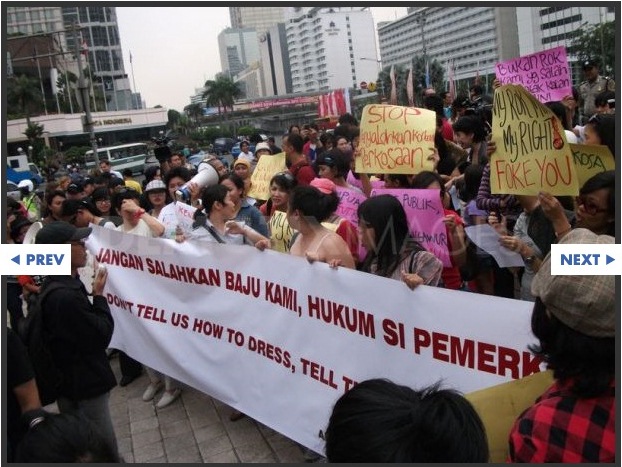
Protestors -- Image via Demotix

This is what Fauzi Wibowo, the governor of Jakarta, Indonesia, said on Friday after a bus driver raped a female passenger late at night this month and after another bus driver and unidentified perpetrators gang-raped and killed a university student.

He has since apologized for the comment.

On Sunday more than 50 people in Jakarta protested the victim-blaming comment and many women wore mini-skirts, something unusual in the most populous Muslim-majority country in the world.

They held signs that read, “Don’t tell us how to dress, tell them not to rape” and “My miniskirt is my right.”

Via the Jakarta Globe:

“‘We are here to express our anger. Instead of giving heavy punishment to the rapists, the governor blamed it on women’s dress. This is discrimination,’ protest coordinator Chika Noya told AFP.

‘Rape is a serious crime against humanity,’ Noya said, adding that the governor should guarantee women’s safety on public transport.

Protester Dhyta Caturani, dressed in a miniskirt and revealing top, said: “The way women dress is not the cause of sexual violence.”

Last year the head of Aceh Barat district stated that women who don’t wear Islamic women clothing are ‘asking to be raped.’ This statement was then rejected by Indonesian Council of Ulema (MUI).”

It is sick that a political leader like a governor would say something so harmful and wrong. Well done to the protesters in Jakarta for not letting his comment slide and for bringing international attention to the victim-blaming taking place in their country.

The protest was inspired by the SlutWalk in Toronto, held in April in response to a victim-blaming comment made by a police officer. Dozens of SlutWalks have taken place around the world to similarly speak out against the all-too-common response of blaming the victim for sexual assault or sexual harassment rather than the perpetrator.

Victim-blaming must end!

(Thanks to The Pixel Project for the story tip)

Share

Filed Under: News stories Tagged With: indonesia, Jakarta, protest, sexual harassment, slutwalk, street harassment, victim blaming

Impact of 9/11: “You look like Bin Laden’s sister”

September 11, 2011 By HKearl

Like most Americans, today I am remembering the terrorist attacks that occurred ten years ago. It’s a day that must be so painfully difficult for everyone who lost loved ones and I can’t even fathom how hard the last 10 years have been for them. No one should have to live through so much pain and sorrow.

During my reflection I’ve thought a lot about the impact of the 9/11 attacks. As we keep hearing over and over in the news, our country and our lives were forever altered, from the way we go through airports to the way we perceive our own security and sense of nationhood.

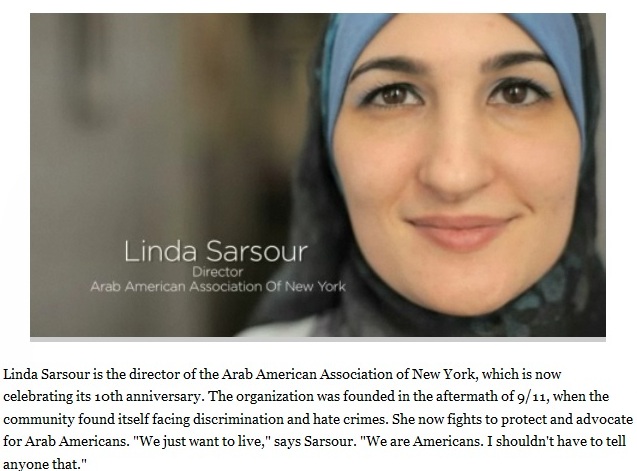
A few days ago when I was watching a powerful video clip featuring Linda Sarsour, director of the Arab American Association of New York, a few of her comments alluded to the impact 9/11 has had on the types of street harassment Muslim and Arab women face. It reminded me about some of the stories I’ve heard over the years.

Before 9/11, women who previously could wear a hijiab in public without facing harassment suddenly were told things like, “Go back to your country, stupid bitch,” by people they didn’t know on the streets. It didn’t matter to the harassers that there are plenty of “home grown” terrorists or that 99.9% of the population in every country around the world are not terrorists; they used 9/11 as an excuse and an opportunity to harass certain people, to engage in racial profiling. That is not okay.

One woman who shared a story for my Stop Street Harassment book said:

“As a Muslim woman who wears hijab (the headscarf and modest clothing), most of the feelings I have are due to religious discrimination and anti-immigrant sentiments. (Even though I am not an immigrant). I am constantly worried about being attacked verbally or physically because it has happened to friends of mine.”

And many women who do not wear hijabs but who simply have heritage in countries in the Middle East faced a different kind of street harassment after 9/11, too. I will always remember a story a woman shared during a workshop I attended at a Street Harassment Summit in New York City in 2007. She said:

“Street harassment is a huge part of my day and it makes me very angry and I think it’s always tied in with my racial identity. The worst thing that happened to me lately was I was on my way to work at a new job and I was very happy, and this guy said something to me and I kept walking and he came up around me in my face and said, ‘You look just like Bin Laden’s sister.’

My mouth was closed, and I was like, why aren’t I responding?  He continued to scream at me and I kept walking, and he said, ‘You should get home, women like you don’t work.  Don’t your men keep you locked up?  Oh that’s right; your men aren’t real men.  I’ll show you what a real man is.’

And he proceeded to tell me the actions that real men do to their women.  People on the street were stopped and were staring at me but no one said anything.”

She was visibly upset and shaken when she relayed this horrifying incident. It had layer upon layer of offensiveness and hate. Given the hostility that some Americans willfully feel toward people they perceive to be potential terrorists, these kinds of street harassment incidents can be very frightening.

So, today, as we honor and remember all of those whose lives were lost, let us also vow to make sure our country becomes free from harassment, hate, racial profiling, and hostility for everyone. Call out people who harass others, show that it’s unacceptable. Help out people facing harassment. Every person should be able to feel safe and un-harassed in public, hijab or no hijab, dark skin or light skin, gay or straight. That’s how America should be.

Share

Filed Under: street harassment Tagged With: 911, bin laden, linda sarsour, sexual harassment, street harassment

« Previous Page
Next Page »

Share Your Story

Share your street harassment story for the blog. Donate Now

From the Blog

  • #MeToo 2024 Study Released Today
  • Join International Anti-Street Harassment Week 2022
  • Giving Tuesday – Fund the Hotline
  • Thank You – International Anti-Street Harassment Week 2021
  • Share Your Story – Safecity and Catcalls Collaboration

Buy the Book

  • Contact
  • Events
  • Join Us
  • Donate
  • Facebook
  • Instagram
  • Pinterest
  • Tumblr
  • Twitter
  • YouTube

Copyright © 2026 Stop Street Harassment · Website Design by Sarah Marie Lacy