• About Us
    • What Is Street Harassment?
    • Why Stopping Street Harassment Matters
    • Meet the Team
      • Board of Directors
      • Past Board Members
    • In The Media
  • Our Work
    • National Street Harassment Hotline
    • International Anti-Street Harassment Week
    • Blog Correspondents
      • Past SSH Correspondents
    • Safe Public Spaces Mentoring Program
    • Publications
    • National Studies
    • Campaigns against Companies
    • Washington, D.C. Activism
  • Our Books
  • Donate
  • Store

Stop Street Harassment

Making Public Spaces Safe and Welcoming

  • Facebook
  • Instagram
  • Pinterest
  • Tumblr
  • Twitter
  • YouTube
  • Home
  • Blog
    • Harassment Stories
    • Blog Correspondents
    • Street Respect Stories
  • Help & Advice
    • National Street Harassment Hotline
    • Dealing With Harassers
      • Assertive Responses
      • Reporting Harassers
      • Bystander Responses
      • Creative Responses
    • What to Do Before or After Harassment
    • Street Harassment and the Law
  • Resources
    • Definitions
    • Statistics
    • Articles & Books
    • Anti-Harassment Groups & Campaigns
    • Male Allies
      • Educating Boys & Men
      • How to Talk to Women
      • Bystander Tips
    • Video Clips
    • Images & Flyers
  • Take Community Action
  • Contact

“I am a feminist, yet I am a victim”

April 30, 2012 By Contributor

This article excerpt is cross-posted with permission from the blog Organica: The Story of an Arab American Girl.

I am writing about my everyday experiences as a single woman living in Cairo, Egypt. I travel independently, run my own life and refuse to allow harassment or male behavior hinder my life. I am writing about the price I pay for braving the road, the protests, the streets, and the sit-ins. I am writing about how my feminism feels helpless and often afraid.

Here it goes: my name is Hana and I am an empowered victim.

When I lived in the United States between 2006 and 2011, I used to dream about the day I’d move back to Egypt so that I could yell and shame every man who sexually harassed me on the street. I thought it would feel empowering. I was wrong. Not only is it extremely draining and tedious, it quite often takes a scary turn. Sexual harassers thrive on getting a rise out of their prey.

This is not an article on sexual harassment, but a glimpse of my life.

On the Road:

Everyday my mother looks at me with terror: ‘khali balak men nafsik winabi ya benti’ [take care of yourself my daughter] before I leave the house, and my response is ‘Mami haye7sali eh ya3ni? Mate2la2eesh’ [Mom, what do you think could possibly happen to me anyways? Stop worrying!]. But in reality, I’m wrong and she’s right. She should be worried for my safety. I am often instructed to reconsider my outfits when I am driving alone and I argue that I am not going to let men affect my choices.

The driver-to-driver harassment is rampant in Cairo. One time while in stagnant 6th of October bridge traffic, I was texting on my phone (traffic was at a complete standstill).

The driver in the car next to mine said: “I hope this phone falls on the car mat, so that you may bend down to get it, and I’d drive into you, ya know what I mean?”

I yelled “balash elit adab w 2araf’ [I don’t want disrespect and disgust], which he responded “ba2a keda?” [Like that, eh?] – And then he followed me to my house all while making further obscene comments.

There was nothing I could do to protect myself from this bully – I was helpless.

Protests:

I moved back to Egypt on July 5th. On July 8th there was a million man march and the beginning of a sit-in. That Friday was my first ever protest in Egypt. I dressed appropriately and took to the streets with immeasurable excitement. Given that I moved back to Egypt for the revolution, I thought nothing could taint my first experience in a protest – I was wrong.

A man approached with his three friends and asked about the color of my bra – apparently he preferred white ones. I yelled and said that I would scream if he said anything which made him and his friends laugh loudly – at me – declaring that I am crazy but a ‘hottie,’ and a crazy-hottie combo would be great in bed. I pulled out my pepper spray but it failed to reach my monsters.

The day continued along the same lines, I got groped several times, one of which was actually from the front (I did not know that was even possible), and another by a 12 year old CHILD who I caught and yelled at. I was scared and felt vulnerable although equipped with my knife and pepper spray. There was nothing I could do and it felt awful.

The Streets:

There is no ‘that street’ story because there are countless street stories. They all revolve around the same thing: being verbally and quite often physically assaulted by men. Forget the catcalls, and the comments (I was once told that I am attractive, but would be much more attractive if I lost some weight), but the physical harassment is unbearable.

My street story is by no means special. I was walking home, turning at a corner, when a man’s hand came out of a car window and groped me (it was painful). The car had 4 or 5 guys and I could hear them laugh at my humiliation. I continued walking, feeling disgusted when the car appeared again, and one of the guys in the car so kindly suggested that it was obvious that I wanted to get groped again.

Yeah, that felt awful too.

…

Reality:

The worst thing that I face as a woman who refuses to let such actions hinder or inhibit her is the feeling of helplessness. I am a feminist, yet I am a victim. I know for a fact yelling back or even screaming at harassers is effective, some do actually apologize when shamed, but I also know that NOTHING will stop these men except actual punishment. I am a woman who never uses the metro, microbuses, buses and I rarely use taxis, yet I face this much harassment. I can only imagine what the women who do use public transportation face on a daily basis. I presume I’d have to multiply my experiences by a hundred.

I do not pray often, but I pray that the day comes when I feel safe walking the streets of Egypt; I walk them now anyway, but I feel weak, vulnerable and helpless and it feels awful.

–An Egyptian Woman.

Share

Filed Under: Stories, street harassment Tagged With: Egypt, groping, hana elhattab, sexual harassment, Stories, street harassment

Walk for Respect in Nepal

April 28, 2012 By HKearl

Today 500 youth participated in a Walk for Respect against street harassment/sexual harassment in Kathmandu, Nepal.

Via YouTube:

“We silently walked through footpaths carrying various banners and placards up to Kathmandu Durbar Square.

Objective
1. To sensitize the greater problem among youths as well as other people i.e. eve teasing and sexual harassment.
2. Boost the morale of the people to face the challenges in this issue
3. Aware the people of existing laws and policies of Nepal
4. Gather public support to force the government to take necessary steps in these issues.
5. Warn the culprits that their misbehaviors are illegal and they can be punished for their misdeeds.”

Via CNN:

“The main theme of our campaign is to sensitize the greater problem among youths as well as other people i.e. eve teasing and sexual harassment. We want to boost the morale of the people to face the challenges in this issue and aware the people of existing laws and policies of Nepal. Eve teasing and sexual harassment are serious violation of Human Rights. As an aware conscious citizen we cannot tolerate the violation of Human rights. That’s why this issue needs to be addressed immediately and needs to be acted ASAP.”

One of the participants Pragya shakya said, “It’s high time we raise our voices. We have been suppressed in so many ways and why should we always suffer. The Government has made the rules against eve teasing and sexual harassment so why are we keeping our silence. We will not keep our silence it’s our right to speak, walk and talk with freedom and no one can take this away from us. Like said above people have no right to tell us what to wear first they should stop thinking bad. It’s my right to be who I’m but it’s against law to make me feel harassed.”

Good for them for speaking out!

Share

Filed Under: Events, Stories, street harassment Tagged With: eve teasing, Nepal, sexual harassment, slutwalk, street harassment, walk for respect

“The veil would never protect anybody from getting harassed, not even niqab. As long as they [men] know that under that niqab or under that veil, there is a woman, they will sexually harass you”

April 22, 2012 By HKearl

Via Tunisia Live

This is a really great, thorough article about street harassment in Tunisia. I’m including an excerpt and encourage you to read it in its entirety.

Via Tunisia Live:

“…With a progressive Code of Personal Status, Tunisia is commonly regarded as the Arab world’s most advanced country in terms of women’s rights. Yet sexual harassment exists in Tunisia, too. Unlike in Egypt, sexual harassment has not entered the arena of public discourse in Tunisia, and is often dismissed as a non-issue.

A recent survey conducted by the Tunisian National Office of Population and Family (ONFP) found that physical violence against women was most commonplace, followed by psychological violence, sexual violence and last, economic violence. While the survey found that violence against women was most common in the private sphere, it also revealed that violence against women in the public sphere is sexual in 21.3% of cases, psychological in 14.8%, and physical in 9.8%.

Sexual harassment is not just physical – but includes gestural, and even verbal, harassment. According to UN Women, sexual harassment can be, “making sexual gestures with hands or through body movements,” “hanging around a person,” “sexual comments,” or “unwanted sexual looks or gestures” – not to mention rape, pressure for sexual favors, etc.

For Meriem Manar (whose name has been changed to protect her identity), a student of business and English in Tunis, sexual harassment is a daily reality. “You cannot avoid it. Men are in the street with you, and you have to go to school, you have to go to work. Because it is in our daily life, because it is our every day experience, we end up accepting it. You leave your house mentally prepared. You just deal with it,” she said.

But this comes at a certain price to her liberty. “There are places that I cannot go alone, like parks…because I know I might be not just sexually harassed, but even raped…If you walk on Avenue Habib Bourguiba at night, you will not find a single female on the street. If you are alone at night and walking in the street, and somebody sees you, they will have the idea that you are going to a nightclub, or that you are meeting your boyfriend…that you are doing something your family would not be proud of.”

For Meriem, taking public transportation can often become unbearable. The everyday hassle of public transport turns into a nightmare for women in Tunis – regardless of their age, and their dress. “The veil would never protect anybody from getting harassed, not even niqab. As long as they [men] know that under that niqab or under that veil, there is a woman, they will sexually harass you,” says Manar. While no statistics exist for Tunisia, a study conducted by the Egyptian Center for Women’s Rights, in conjunction with the United Nations Population Fund and the European Commission, found that in Egypt, 72.5% of surveyed victims of sexual harassment were veiled.

Meriem yearns for a car reserved for women, like in the Cairo metro. But according to Chiao, segregation is not the answer. “I ride in the women’s car. But I think that as a policy or a solution, it establishes very bad norms. It promotes this idea that if a woman is riding in the men’s car, then she is looking for harassment, or that she brought it unto herself.”

The Legislation

Since 2004, sexual harassment has been punishable by law in Tunisia – with one year in prison and a fee of 3,000 dinars. Halima Jouini, a founding-member of the Tunisian Association of Democratic Women (ATFD) and a volunteer at the Center for Listening and Orientation of Women Victims of Violence, qualified this law as “limited” and “incriminating” for women.

“We launched this law in 2003…it was the ATFD that led the campaign. It was relatively successful – for the first time, sexual harassment was recognized as a crime. But still we are not satisfied – the law does not protect women,” she said.

At the time of the interview, Jouini was just returning from the tribunal in Tunis, where she had been defending the case of a rape victim. The woman in question was a housekeeper, who had been raped – sodomized, in fact – repetitively by her male boss. Upon confessing this to his wife, the housekeeper agreed to film the crime as evidence to take the man to court. But once this evidence was obtained, the wife pressed charges against both her husband and the housekeeper for adultery. The man, who possessed a Canadian passport, fled the country, leaving the housekeeper in prison – where she had been held for a month as of late March.

According to Jouini, the 2004 law’s definition of sexual harassment is limited in scope – as it delimits sexual harassment as strictly a repeated action. It is currently defined as “persistence in the harassment of the other by repetition of actions, words or gestures.” Citing the case of a woman who quit her job after she was harassed once in the workplace, Jouini pointed out that some women do not put up with the harassment, and choose to put an end to it after the very first occurrence. Jouini further explained that this makes it harder to collect evidence – as it is not always easy to prove that the harassment was repetitive.

The law further provides no protection to the plaintiff and witnesses, but instead explicitly states that if a case is declared nolle prosequi, or if the defendant is acquitted, then the defendant can ask for reparation, and sue the plaintiff for defamation.

Jouini questioned why this was recalled in the body of the law – when this principle underlies all laws included in the Penal Code. “This principle exists for the whole Penal Code, but to recall it in this very article is a way to say, ‘be careful women’…it is incriminating for the plaintiff.”

The Tunisian Association of Democratic Women (ATFD) calls for a comprehensive law on sexual harassment – one that would not only be included in the Penal Code, but also in the Tunisian Labor Code. Jouini pointed out that this was already the case in Morocco. The ATFD is also lobbying to include an article against discrimination and violence in the new Constitution – Jouini added that this has happened in several countries that underwent recent transitions, like South Africa and some Latin American countries.

Last but not least, the law against sexual harassment is couched in a moralizing rhetoric – it claims to discourage the “infringement of good mores and sexual harassment.” According to Jouini, sexual harassment is “a patriarchal discriminatory practice…You can’t justify this by good mores, or the lack of….”

Share

Filed Under: News stories Tagged With: sexual harassment, street harassment, tunisia

New York City transit rider survey

April 6, 2012 By HKearl

New Yorkers for Safe Transit has a packed schedule of activism coming up, starting with surveying transit riders to document cases of gender-based harassment and violence on the mass transit system. They hope the results will help mobilize communities to join with them and take action.

The survey is anonymous and available online.

Tomorrow will be the first of several days when they will conduct off-line surveys. At 1 p.m. tomorrow, they will meet at the 36th Street subway station in Sunset Park, Brooklyn, to survey neighborhood residents. They need more volunteers to help conduct the surveys. Please contact them if you are interested in helping tomorrow or in future.

Share

Filed Under: Resources, street harassment Tagged With: New York City, new yorkers for safe transit, sexual harassment, survey

Thanks, WMATA for the new campaign against sexual harassment on the Metro!

April 2, 2012 By HKearl

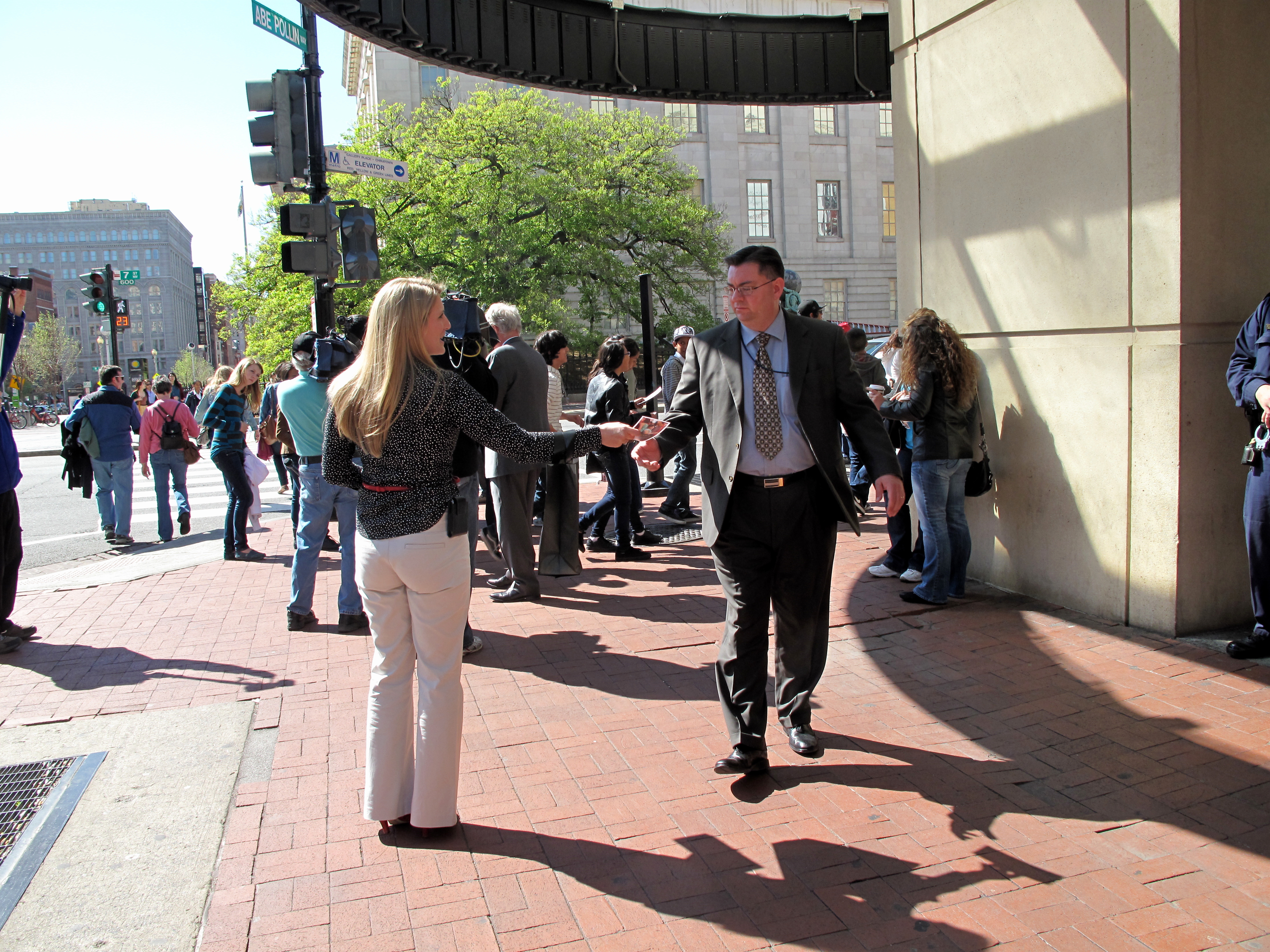
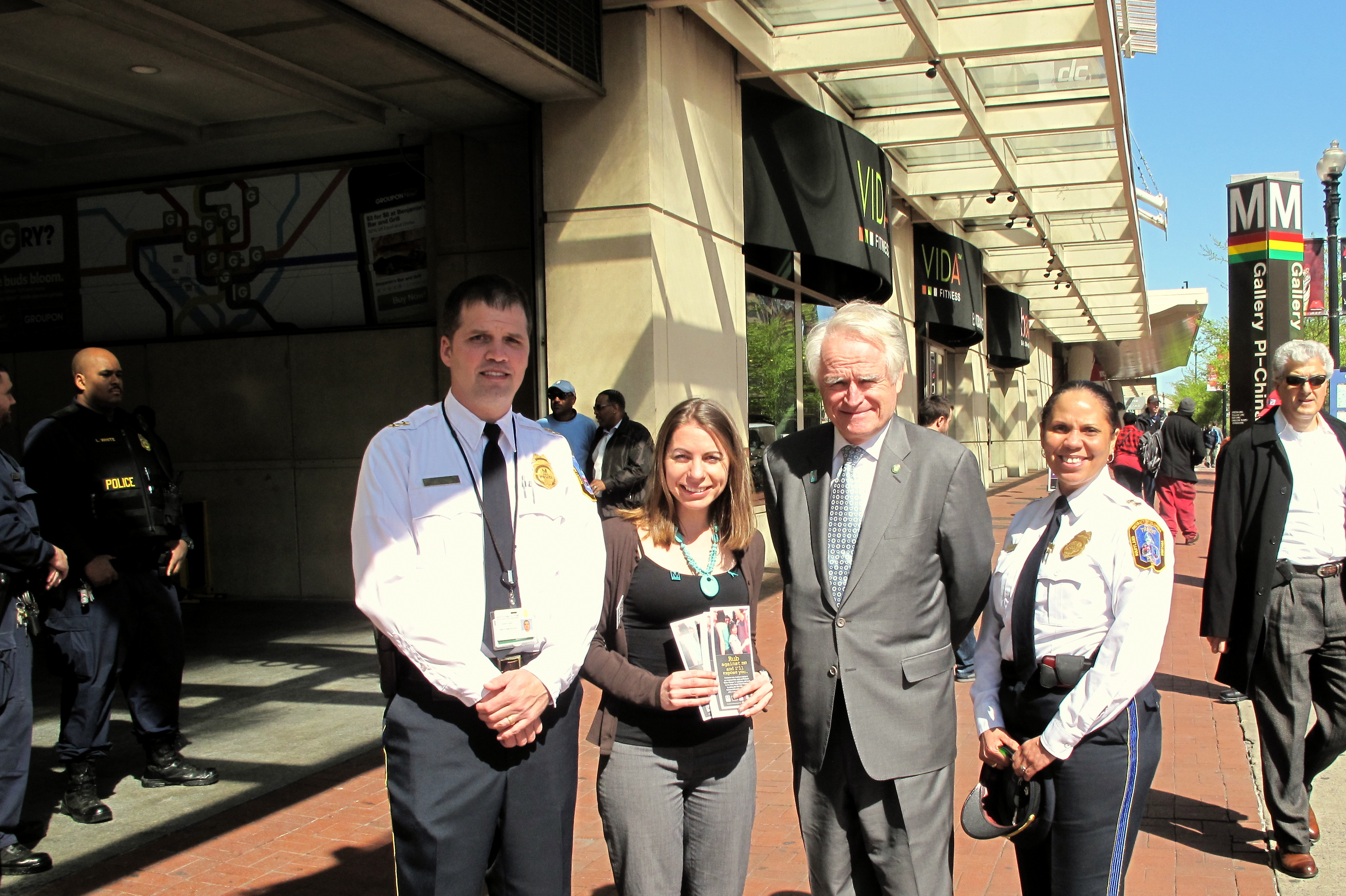
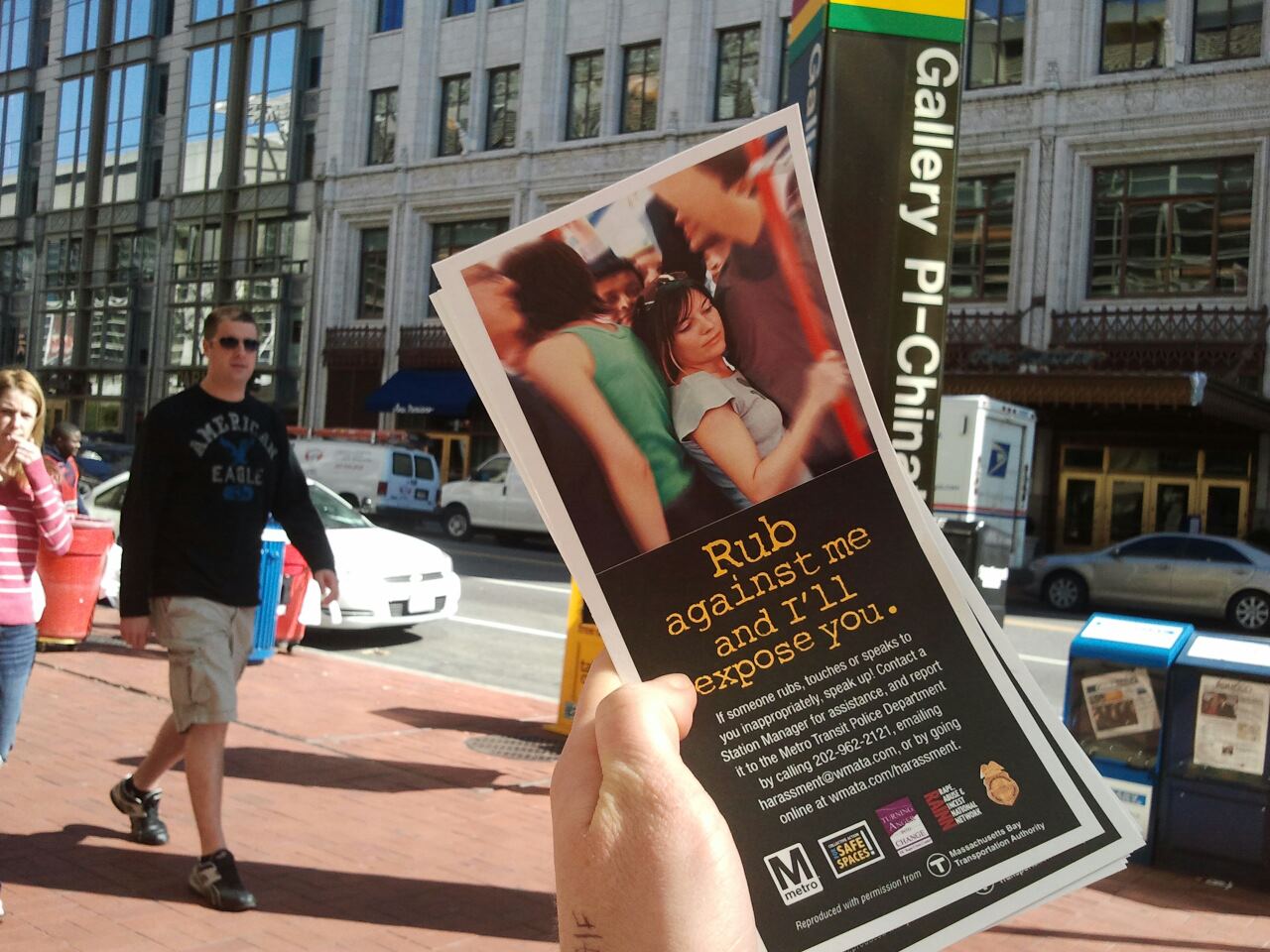
This afternoon outside the Gallery Place/Chinatown metro station entrance in Washington, DC, wearing teal “M” pins for Sexual Assault Awareness Month, Washington Metropolitan Area Transit Authority (WMATA) staff (including the General Manager and several transit police officers) joined volunteers from Collective Action for Safe Spaces (CASS), the Rape, Abuse & Incest National Network, and the DC Rape Crisis Center. We all handed out brand new fliers to passersby as part of the official launch of WMATA’s anti-sexual harassment campaign (the flier was the image on the right).

There were about ten of us who passed out the fliers for an hour to regular commuters and tourists alike. Some women eagerly grabbed the fliers when they heard about the campaign. Many men took fliers too and one man told me it was a disgrace that harassment happened. I overhead one young woman who’d picked up a flier from someone else but was passing by me say to her friend, “Oh my gosh! Finally someone is doing something about this. I deal with this all the time.” And of course, many people refused fliers before we could even tell them what it was about, but thankfully, no one was rude or harassed us.

Every major local tv station was there. While most stations only interviewed the General Manager, Fox 5 interviewed CASS board member Ben Merrion and me for their news clip.

I have to say, I am floored. I tracked the launches of the anti-sexual harassment campaigns in Boston, New York City and Chicago on my blog, and WMATA’s efforts stand out for their fast pace and thoroughness.

It was fewer than six weeks ago that six members of the public and board members of CASS testified before the DC City Council about sexual harassment on the DC-area transit system. We were nervous and felt we had to be on the defensive and explain why this issue matters, especially after we heard some of the soundbites WMATA gave the media which made it sound like they didn’t care about the issue. We didn’t have much hope that anything would come out of our testimonies, not even when WMATA said they would do something immediately. We feared that was just lip service. But then they invited us to a meeting at their offices two weeks later.

On March 7, three CASS board members met with WMATA and they gave us an overview of their campaign plans and we were blown away how responsive they were, how comprehensive their plans were, and how it had only been two weeks since we’d given testimony!

In March they quietly released a new webpage and email address (harassment@wmata.com) where people can report sexual harassment – including, for the first time, verbal harassment. The fliers we handed out today inform people about the new ways to report harassment. Additionally, a PSA ad campaign will roll out soon and WMATA is finalizing a new training video for their employees. To make the issue more accessible, the training video includes the harassment stories of several members of the public who agreed to be filmed during The REAL Metro Forum, held during International Anti-Street Harassment Week.

The WMATA task force for this issue has been great to work with, especially the project lead Caroline Lukas. They’ve treated the issue with the gravity it deserves and have asked for input throughout the process. They have obviously made the issue a top priority if they were able to launch their campaign so soon after we brought the issue to their attention. It’s also refreshing to hear them acknowledge that it will take time to get the word out and then even more time to track the effectiveness of the campaign. Caroline has assured us WMATA is in this for the long haul.

If you’re in the DC-area or know anyone who is, spread the word about the new campaign and encourage them to report anything they experience or see. Help WMATA track the problem so that they can then more effectively address it. Social change doesn’t happen overnight, but it certainly has a chance of happening faster with the help of a major institution like WMATA. Thanks, WMATA.

WMATA Media Relations Manager Caroline Lukas hands out fliers

Holly Kearl with WMATA staff, including the General Manager

Handing out fliers

Teal pin
Share

Filed Under: News stories Tagged With: PSA campaign, sexual harassment, WMATA

« Previous Page
Next Page »

Share Your Story

Share your street harassment story for the blog. Donate Now

From the Blog

  • #MeToo 2024 Study Released Today
  • Join International Anti-Street Harassment Week 2022
  • Giving Tuesday – Fund the Hotline
  • Thank You – International Anti-Street Harassment Week 2021
  • Share Your Story – Safecity and Catcalls Collaboration

Buy the Book

  • Contact
  • Events
  • Join Us
  • Donate
  • Facebook
  • Instagram
  • Pinterest
  • Tumblr
  • Twitter
  • YouTube

Copyright © 2026 Stop Street Harassment · Website Design by Sarah Marie Lacy