• About Us
    • What Is Street Harassment?
    • Why Stopping Street Harassment Matters
    • Meet the Team
      • Board of Directors
      • Past Board Members
    • In The Media
  • Our Work
    • National Street Harassment Hotline
    • International Anti-Street Harassment Week
    • Blog Correspondents
      • Past SSH Correspondents
    • Safe Public Spaces Mentoring Program
    • Publications
    • National Studies
    • Campaigns against Companies
    • Washington, D.C. Activism
  • Our Books
  • Donate
  • Store

Stop Street Harassment

Making Public Spaces Safe and Welcoming

  • Facebook
  • Instagram
  • Pinterest
  • Tumblr
  • Twitter
  • YouTube
  • Home
  • Blog
    • Harassment Stories
    • Blog Correspondents
    • Street Respect Stories
  • Help & Advice
    • National Street Harassment Hotline
    • Dealing With Harassers
      • Assertive Responses
      • Reporting Harassers
      • Bystander Responses
      • Creative Responses
    • What to Do Before or After Harassment
    • Street Harassment and the Law
  • Resources
    • Definitions
    • Statistics
    • Articles & Books
    • Anti-Harassment Groups & Campaigns
    • Male Allies
      • Educating Boys & Men
      • How to Talk to Women
      • Bystander Tips
    • Video Clips
    • Images & Flyers
  • Take Community Action
  • Contact

Metro doesn’t think sexual harassment in a problem in DC

February 22, 2012 By HKearl

Last night WUSA Channel 9 produced a news story about sexual harassment on the Washington, DC transit system. In it you can see what Metro’s stance is….that it isn’t a problem and that “one person’s harassment is another person’s flirting.” The text below the video is not a transcript, so you can gain more info by reading it after watching the video.

From around 1 – 3 p.m. EST today you can watch the DC City Council’s Performance Oversight Hearing of the Metro system (select Room 500). I’m joining several people, being led by Collective Action for Safe Spaces, in testifying about the problem of sexual harassment on the metro system because we DO think it’s a problem. We will give our recommendations for change: more data collection, a PSA campaign on how to report harassment, and more sensitivity training for metro employees.

More later on how it went and what was said. Wish us luck!

Share

Filed Under: street harassment Tagged With: DC city council, oversight hearing, sexual harassment, street harassment, WMATA, WUSA9

DC Metro does not track sexual harassment complaints

February 21, 2012 By HKearl

Tomorrow a group of Washington, DC-area residents and activists will share their experiences of sexual harassment on the DC metros and buses during the DC City Council’s performance hearing of Washington Metropolitan Area Transit Authority (WMATA). Chai Shenoy, co-founder of Collective Action for Safe Spaces/Holla Back DC! will open the testimonies and I’ll conclude them.

If you’re a DC resident who has been harassed or seen harassment occur on WMATA, you can still sign up to testify tomorrow (it will take place approximately 1-3 p.m. at the John A. Wilson Building) or write up to a 2 page testimony to submit for the record. RSVP ASAP to shannon AT collectiveactiondc DOT org

Apparently WMATA does not even track sexual harassment on their system and there is no dedicated hotline for reporting it. Unsurprisingly then, they have no PSA campaign as do many other major commuting cities. Consequently, we have three main recommendations when we testify tomorrow, including requesting a dedicated line for reporting sexual harassment and a PSA campaign telling people not to harass and what to do if they are harassed.

On Sunday, the Washington Post covered our intended action – and the story was reprinted today in the commute paper The Express. I want to respond to the following excerpt from the article (and please read the response of Collective Action for Safe Spaces and the response of a writer for the Washington City Paper.):

“Metro Transit Police Deputy Chief Ron Pavlik said his department takes reports of sexual harassment and sexual assault incidents seriously. He says the transit police have have not seen an increase in reports of indecent exposure, rape or other types of sexual assaults.

According to Metro, 84 cases involving sexual offenses were reported to Transit Police last year. They included one rape and 40 cases of indecent exposure or other sexual acts. Of the 40, 12 involved arrests.

Officials said Metro does not track sexual harassment complaints. But Pavlik said passengers who think that they have been sexually harassed should report the incident to Transit Police. Officers receive sensitivity training in handling such complaints, he said.

He cautioned, however, that a variety of behaviors could be considered harassment.

“Someone telling another person: ‘You look good. Can I have your phone number?’ — you may not like it, but I can’t arrest the person,” Pavlik said.

Reports including sexual assault and indecent exposure are investigated, he said.”

My response:

1. Wow, only sexual assaults and indecent exposure is being tracked? That’s not good enough. Most harassment is what they’re not tracking: sexual comments, sexual noises, leers, and whistles. No wonder Metro doesn’t think this is a problem — they don’t allow the full range of experiences to be reported/tracked.

2. Most gropes/grabs, a form of sexual assault, is not reported as a sexual assault because many people don’t realize that’s what it is. 84 reports of sexual offenses is likely quite low compared to the reality, then, especially when rape itself is so under-reported.

3. Without sexual harassment being tracked/reported, I guess Deputy Chief Pavlik had to use his own imagination to explain what women face: being told they look good, followed up by a polite request for their phone number. Or at least I hope that’s why he gave the example he did and not because he purposely wanted to downplay or dismiss the seriousness of sexual harassment. Regardless of his reasons, this is the outcome:

a) He simplified and distorted what actually happens in cases of harassment. Instead of someone saying,”You look good. Can I have your phone number?” (which, yes, is legal) street harassers tend to include sexually explicit language that’s inappropriate to use with a stranger and/or they often will not leave the woman alone after getting a “no” or a blank stare. Instead, the person will leer, follow, grab or continue with verbal comments until the woman feels harassed.

b) He ignored the context. A woman who has been grabbed, followed, attacked, mastrubated at or on and verbally harassed before (and most women have) may be pretty suspicious of any guy who approaches her and says a line like that, whether he intends to harass her or not.

c) He bristled up at the thought of “hitting on someone” being considered harassment and he supported the sexist idea that it’s fine (or at least legal) in all contexts to approach a woman and evaluate her looks and ask for her phone number. I bet 95% of women who ride the bus or the metro are just trying to get from Point A to Point B, not trying to get asked out on a date or have a stranger comment on their appearance. And if they do want to get asked out, they may want to be asked a few things about themselves first or have some light chitchat. Real life is not a movie or a gum commercial.

Again, if you’re a DC resident who has been harassed or seen harassment occur on WMATA, you can still sign up to testify tomorrow (it will take place approximately 1-3 p.m. at the John A. Wilson Building) or write up to a 2 page testimony to submit for the record. Let’s show them that sexual harassment is a real, widespread problem and that it constitutes more than just “Can I have your number” comments and thus, deserves real attention from WMATA and the city council. RSVP ASAP to shannon AT collectiveactiondc DOT org

Share

Filed Under: News stories Tagged With: chai shenoy, collective action for safe spaces, Deputy Chief Pavlik, sexual harassment, street harassment, WMATA

College men share tips for stopping street harassers

February 13, 2012 By HKearl

I love the work that Men Can Stop Rape (MCSR) does to challenge harmful definitions of masculinity and to empower men to be allies with women in ending gender violence. Their latest project is a new campus bystander campaign called Where Do You Stand? aimed at men.

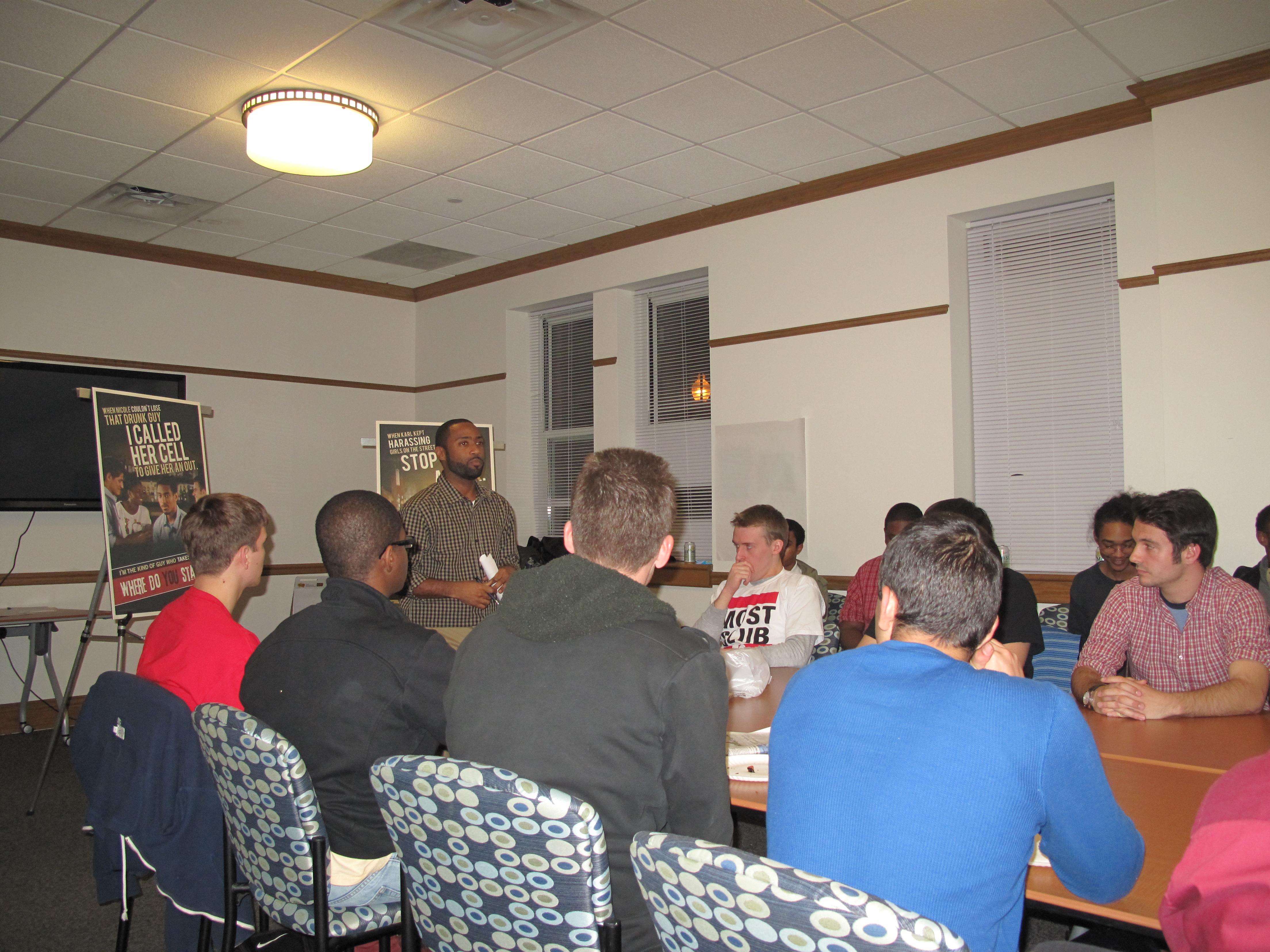
This comprehensive campaign uses billboards, posters, T-shirts, bystander intervention trainings, and peer-education sessions to equip young men with the necessary skills and tools to intervene when they see a situation that doesn’t look right, including street harassment.

On January 31, they officially launched the campaign during an MCSR bystander training for about 30 young men at Georgetown University in Washington, DC. I attended and spoke at the beginning for a few minutes.

The main portion of the workshop was role playing and brainstorming responses to scenarios.

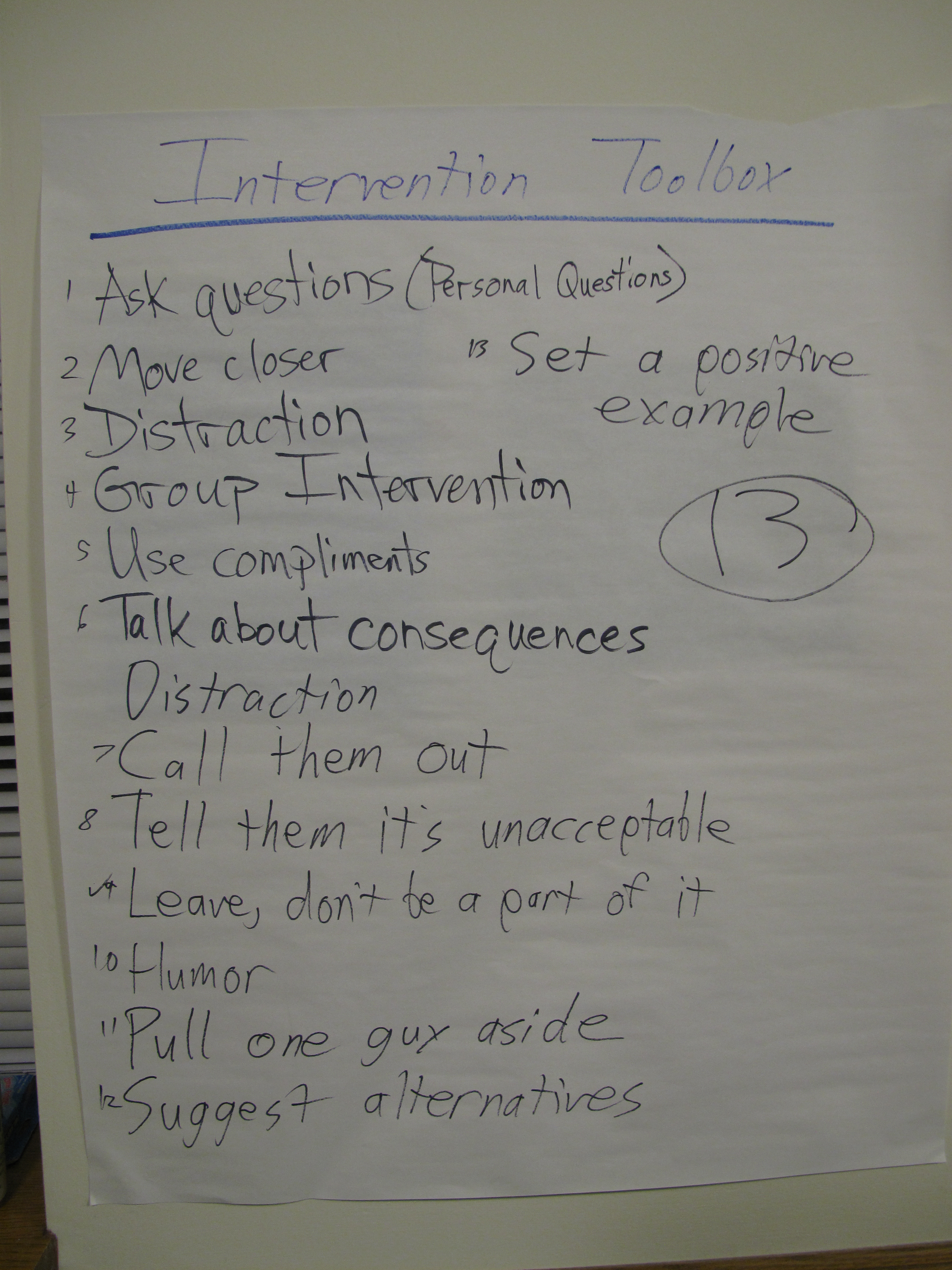
They also talked about barriers that prevent bystanders from intervening and brainstormed a list of methods for intervening, such as providing a distraction or addressing the harasser head on (see a photo of the list they created).

The first few scenarios they discussed focused on intervening in questionable situations at college parties. The last example on street harassment kept me furiously scribbling notes.

One of the facilitators described a group of men standing on a corner near a building, street harassing women going by. He asked the young men how many of them had seen that happen before and more than half of them raised their hand. Then he asked the for their ideas for dealing with this scenario. Here are some of them:

1. Say, “Yo, chill son,” to slightly call them out on the behavior.

2. Directly point out what they’re doing and say, “This is unacceptable.”

3. Use public ridicule to call them out or silence them…though a few young men pointed out that is okay if you know the harassers, but if you don’t and you call them out like that, you may “get whooped.”

4. If it’s your group of friends, tell them, “That’s not cool,” and if they keep it up, say you’re out and walk away. Chances are they’ll back down then. Another guy similarly suggested saying, “If this is how you’re going to spend your night, I’m leaving. This is not okay.”

5. Reverse catcalling the men can be effective. They don’t know how to respond or what to do.

6. If it’s a friend doing it, tell him that it’s not the right approach to take but to be the respectful gentlemen he is if he wants to meet someone.

Some other interesting things the young men said:

* Guys who catcall wouldn’t be my friends because that’s the rudest thing they can do and I’m not okay with that.

* Men catcall because there are other men around. It’s a way to demonstrate their masculinity while riding with your crew or walking down the street. So figure out why your friends feel they have to prove their masculinity to you and address that.

* If you establish yourself as a person who doesn’t laugh at catcalls, then it won’t happen around you because they won’t use that as a way to try to impress you.

* Intervening is hard, but once you do it, it will pay off. People will know you’re the guy who doesn’t like that behavior and others will call them out on it if they do it around you. Maybe they will still catcall when you aren’t around, but it’s a start. The benefits of intervening far outweigh the consequences.

I left the workshop pumped. I know there are plenty of men out there who want to help stop gender violence and harassment, but I’d never been in a room full of them before. It gives me hope! I hope you will share their bystander tips (and others from the Stop Street Harassment website) with friends and family. And if you’re on a college campus, consider bringing the Where Do You Stand? campaign to your school!

Share

Filed Under: male perspective, street harassment Tagged With: bystander, georgetown university, intervention, men can stop rape, men of strength club, sexual harassment, street harassment, where do you stand

Participate in “Got Stared At”

January 26, 2012 By HKearl

Myth: Street harassment happens because of how we dress.

Truth: No it doesn’t. Street harassment happens to people wearing school uniforms, business suits, workout clothes, hijabs, winter coats, rain coats, saris, summer dresses, and jeans. Street harassment is about power and abuse of power, inconsiderateness, the performance of unhealthy definitions of masculinity, sexism, and sometimes it’s also about homophobia, transphobia, racism, classism, ablism and more.

Action: To help combat the myth that street harassment happens because of how we dress, the amazing activist group Must Bol, based in Delhi, India,  launched a website called “Got Stared At” for International Anti-Street Harassment Week.

They’re inviting people ANYWHERE who’ve been harassed in public to submit a photo of the clothing they were wearing when it happened. You can include a story about what happened or just send the photo.

So….what were you wearing when you got stared at or street harassed?

Share

Filed Under: anti-street harassment week Tagged With: eve teasing, got stared at, must bol, sexual harassment, stared, street harassment

Hey handsy guy at the club, look out for Salwa!

January 17, 2012 By HKearl

During my college days, I stopped going to clubs with my friends because of the inevitable harassers. Just because someone is dressed up and out with friends does not mean it’s okay to rub up against them, grab them, follow them, or make them feel uncomfortable! I know many other women face this unwanted attention/harassment/and even assault too.

That’s why I’m happy to see that my favorite Lebanese feminist collective Nasawiya produced a new video about their heroine Salwa and how she stopped a sexual harasser at the club. Then, when she goes to report the harasser to the police, she stops the police officer who harassed her! (Sad but true, some police are harassers).

How have you dealt with harassers at a club or bar?

Share

Filed Under: street harassment Tagged With: adventures of salwa, lebanon, Nasawiya, public harassment, sexual harassment, street harassment

« Previous Page
Next Page »

Share Your Story

Share your street harassment story for the blog. Donate Now

From the Blog

  • #MeToo 2024 Study Released Today
  • Join International Anti-Street Harassment Week 2022
  • Giving Tuesday – Fund the Hotline
  • Thank You – International Anti-Street Harassment Week 2021
  • Share Your Story – Safecity and Catcalls Collaboration

Buy the Book

  • Contact
  • Events
  • Join Us
  • Donate
  • Facebook
  • Instagram
  • Pinterest
  • Tumblr
  • Twitter
  • YouTube

Copyright © 2026 Stop Street Harassment · Website Design by Sarah Marie Lacy