• About Us
    • What Is Street Harassment?
    • Why Stopping Street Harassment Matters
    • Meet the Team
      • Board of Directors
      • Past Board Members
    • In The Media
  • Our Work
    • National Street Harassment Hotline
    • International Anti-Street Harassment Week
    • Blog Correspondents
      • Past SSH Correspondents
    • Safe Public Spaces Mentoring Program
    • Publications
    • National Studies
    • Campaigns against Companies
    • Washington, D.C. Activism
  • Our Books
  • Donate
  • Store

Stop Street Harassment

Making Public Spaces Safe and Welcoming

  • Facebook
  • Instagram
  • Pinterest
  • Tumblr
  • Twitter
  • YouTube
  • Home
  • Blog
    • Harassment Stories
    • Blog Correspondents
    • Street Respect Stories
  • Help & Advice
    • National Street Harassment Hotline
    • Dealing With Harassers
      • Assertive Responses
      • Reporting Harassers
      • Bystander Responses
      • Creative Responses
    • What to Do Before or After Harassment
    • Street Harassment and the Law
  • Resources
    • Definitions
    • Statistics
    • Articles & Books
    • Anti-Harassment Groups & Campaigns
    • Male Allies
      • Educating Boys & Men
      • How to Talk to Women
      • Bystander Tips
    • Video Clips
    • Images & Flyers
  • Take Community Action
  • Contact

Piropos

June 29, 2009 By HKearl

From  http://blogs.ya.com/diariodegolifre/files/piropos.jpgMany women – both Latina and not – whose street harassment stories I’ve read have commented on the volume of harassment they receive from Hispanic men due to the culture of machismo. I know men of all races harass women of all races, but this viewpoint is common enough that it is one I am exploring.

A few months ago, a woman in Colombia who, as part of her PhD work, is examining how people justify violence against women in Colombia, contacted me because she was interested in my research. One of her case studies focused on a woman’s experience being groped in public by a stranger. We exchanged a few e-mails and she shared the following with me when I asked her about street harassment in Colombia.

“One more thing you might be interested in…in Hispanic countries there is a cultural history of a sort of courtship in the streets.  “Piropos” (http://www.piroposkc.com/whatis.html) are probably the best way to name this historical-cultural act. If you use the word ‘piropo,’ many people will tell you how beautiful and wonderful they are.  However, if one looks closely, there are definitions of piropo which also include unpleasant piropos, such as ‘you look like a nice f*ck’, and ‘I want to suck your …’.  There are those who would say that any piropo too directly related to sex is vulgar and uncalled for.  Also, piropos don’t have to only be verbal.  Some articles mention that they might be accompanied by a ‘touch.’  I know that many women will say they don’t mind or even like the nice piropos, but no one likes a quick stranger grope nor a vulgar comment.”

I recently read an article by Joan Fayer entitled “Changes in Gender Use of Public Space in Puerto Rico” which further educated me about “piropos,” which seems to be a tradition adopted by many (most? all?) Hispanic cultures from the Spanish. I found the article to be very useful, so I’m including highlights from it below.

Fayer says that piropos are “compliments or flattering comments traditionally given by men to women” which are “more than ever restricting equal access of women to public space. The hostile environment piropos create by making women ‘open’ to all and any other comments by men” (Fayer, 214).

Piropos were originally compliments given by aristocratic Spanish men to women as a way to admire their beauty and grace. Over time, piropos spread to other social classes and to Hispanic areas. Apparently, piropos used to be fairly prim and proper but gradually vulgar piropos creeped in so that today there’s a good mixture of both being given by men (Fayer, 216).  In fact, in Spain a law passed in 1931 prohibiting piropos and related gestures that were impolite and vulgar and violation of said law resulted in a fine or a jail sentence of 5 to 20 days (can you imagine if the US had a similar law!?!).

She  says, “Machismo, as a public act, is evident in street culture in Puerto Rico and other Hispanic countries in which men control public space not only by looking at women, but also verbally by giving women piropos – compliments that can range from the polite and poetic to the vulgar” (Fayer, 216).

“Piropos are typically given on streets by a man or a group of men as they pass by a woman or women they do not know or as the women pass them…Today piropos are usually given when walking, but it also possible for males to shout from cars to women who are walking or who are themselves in cars. Although they are more common from young men to young women, there are no age restrictions. Some men give piropos all their adult lives; however, there are some men who never give piropos. Although class distinctions may be a factor, there are men of all social classes who would never make comments about women in public” (Fayer, 217-218).

“The conventional female response is to ignore piropos, both verbally and nonverbally. The woman may be flattered, offended, or feel sexually harassed, but to respond in any way is ‘to ask for trouble.’ Women who are offended by piropos may, if possible, avoid areas in which piropos are common. Avoiding piropos ‘areas’ thus limits the access women have to public space. Recently, there has been a change in the response women make to piropos. Some female teenagers who receive vulgar piropos now turn to the males and say, ‘Would you say that to your mother/sister?’ ‘Go to hell,’ and so on. These young women are claiming more equal access to public streets; they do not just avoid piropos ‘areas'” (Fayer, 218).

“Piropos given by women on the streets can also be vulgar…however there are differences in the way women give men piropos in public space. Women almost always give piropos when they are in groups on the street or when they are in cars. For a woman to say something when she is alone would be too dangerous. The group or the car insures protection and prevents the male from interpreting the remark as an invitation” (Fayer, 219).

“Public space can also become a hostile environment when women become targets of both piropos and other types of verbal and nonverbal harassment” (Fayer, 220).

Fayer’s conclusion for the article as related to piropos is that they are largely male to female and thus permit “men to intrude and sexually harass women in their personal space in public areas. This hostile environment serves to restrict the access women have to public space…The gendered use of public space in Puerto Rico indicates that although there have been recent changes, social organization and public space continues to be male dominated” (Fayer, 223).

Does anyone know more about piropos and the way it impacts the way Hispanic men treat women in public spaces? Also, the article focused on heterosexual piropos, but are same-sex piropos ever given?

Share

Filed Under: street harassment Tagged With: Changes in Gender Use of Public Space in Puerto Rico, colombia, Joan Fayer, latin america, machismo, piropos, puerto rico, sexual harassment, spanish, street harassment

North London

June 29, 2009 By Contributor

The road close to my street in London is a constant location for harassment. Men hang out in the cafes on the road and leer at passing women in a sometimes threatening, always horrible way. My housemate understandably refuses to walk down the road, I refuse not to.

On Friday night I was walking home at 1 a.m and I was pursued by a man who kept calling out to me. He then started shouting abusively when I became nervous and sped off home, somehow he was offended that a woman walking home late alone would become nervous when pursued by a random stranger. On Sunday, returning from the shops a couple of guys harassed me and turned verbally abusive when I told them where to get off. Action really needs to be taken about this, I’ve considered complaining to my local council. Otherwise I might end up flykicking a stranger in the street!

-anonymous

Location: North London, England

(Submit your stories here)

Share

Filed Under: Stories Tagged With: gender violence, London, restricted in public, safety, sexual harassment, stalking, street harassment

Free to Enjoy Time in the Park

June 25, 2009 By HKearl

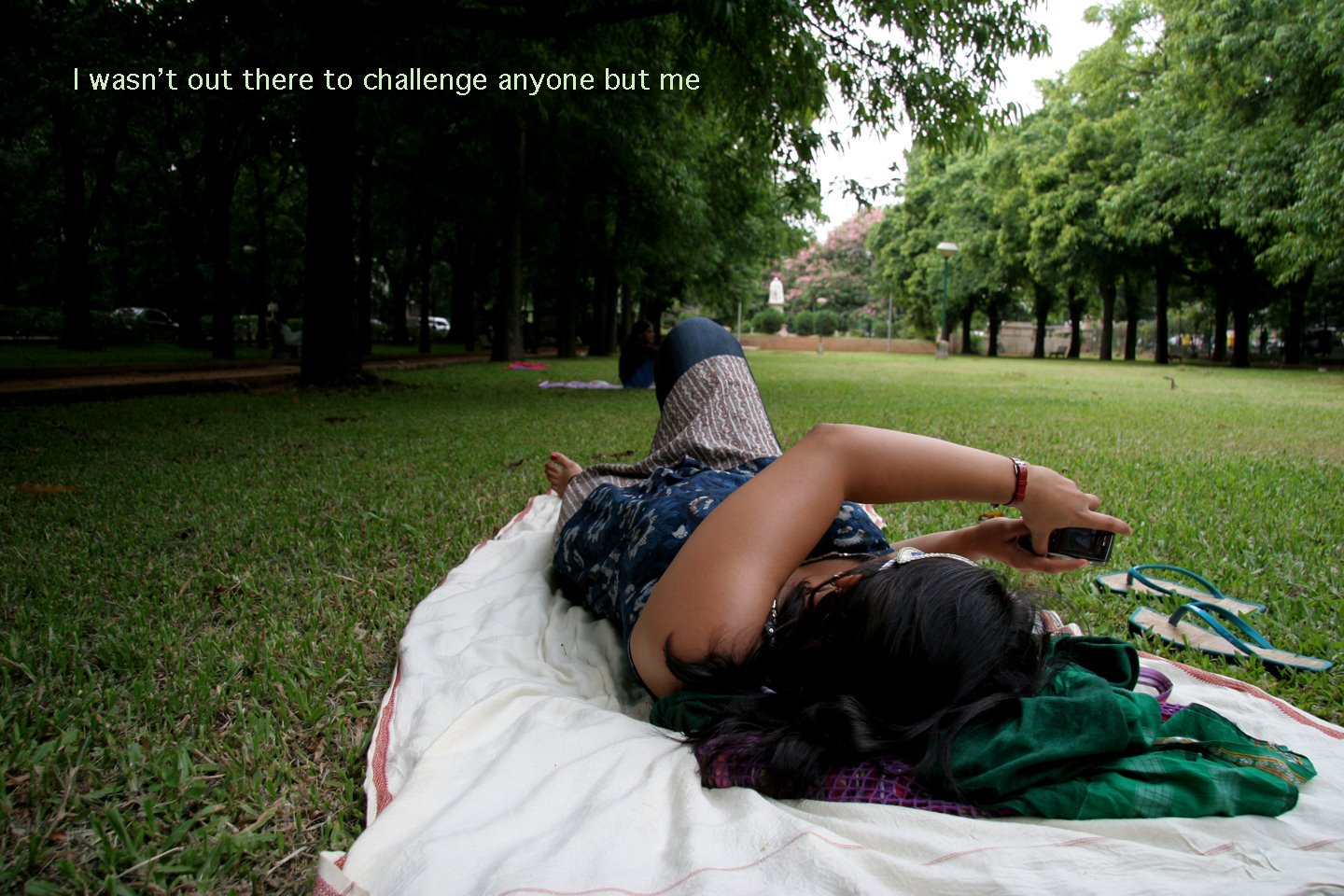
Two years ago Blank Noise Project in India asked their blog readers to submit a list of things they wished they could do in their city but didn’t because of harassment from men (for example, smile when they wanted, not have to think about who’s watching them, be able to go out at night and be safe…). This past Saturday afternoon, they invited people to come to Cubbon Park to live out their wish list, including wearing something they wished they could wear but never had for fear of harassment. This was in part a response to the recent banning of certain women’s clothings at colleges and universities as a way to combat men’s eve teasing of women.

Visit their blog to read how the experience went for some of the participants. Here’s part of one:

“I was doing much more service to myself than a social service or changing attitudes of others. I was breaking free of my own inhibitions and questioning what is ‘appropriate’ in public-like dancing in public without music; or what is appropriate because I am a woman-like lying on a park bench without meaning to ‘get laid’. I was changing my own attitude. I gained a little more confidence and trust within myself. There are some things I do anyways-like pouting etc. Now I would feel less guilty or responsible if some man stares at me for it. I just like to do it and I accept myself for it!” – Saraswathi

What would your list look like – what would you do if you could be sure no man would harass you?

Cubbon Park Blank Noise Project
Share

Filed Under: News stories Tagged With: blank noise project, cubbon park, freedom in public, sexual harassment, street harassment

Public Debate Needed in India Re: Eve Teasing

June 23, 2009 By HKearl

Today I read more about the idiotic ban of certain clothing for women in colleges in Uttar Pradesh, India, as an effort to combat “eve teasing” by men there. Via the Telegraph:

“The ban has now been extended to colleges throughout the state and has caused outrage among student groups and women’s rights campaigners who say girls are being blamed for encouraging sexual harassment. The list of ‘vulgar’ clothes which the colleges claim can provoke sexual assaults include sleeveless blouses, tight tops, miniskirts and high-heeled shoes, as well as jeans. Instead, girls should wear traditional saris or kurta pyjamas – long baggy shirts and trousers to conceal their curves…’A dress code would check eve-teasing to some extent and also ensure that girls don’t waste their time selecting what clothes to wear. If girls wore salwar-kurta or Indian clothes, cases of sexual harassment near college campuses would decrease,'” (said Meeta Jamal, Principal Dayanand College, a woman).

Many women are not standing for this:

“The comments were fiercely rejected by the campaign group Blank Noise, which organises street protests against ‘eve-teasers.’

Jasmeen Patheja, a spokeswoman for the group, said the principals had reinforced the old fashioned view that ‘women are asking for it’ by wearing provocative clothes…

She said her group’s extensive research, including a campaign to persuade women to send them the clothes they were wearing when they were sexually harassed, had shown that ‘eve-teasers’ picked on conservatively-dressed women in traditional Indian outfits just as much as those in Western clothes.

The All-India Democratic Women’s Association said it was planning a series of demonstrations against the ban, which it described as ‘dictatorial’ and ‘unconstitutional.’

College and university officials say there has been an increase in ‘eve-teasing’ – which covers a range of behaviour from unwanted flirting to serious sexual assault.

Campaigners say the increase reflects rapid social change in India, where young, educated middle-class women are enjoying greater personal freedom – choosing careers, drinking in bars, and dating without family chaperones…

Ms Patheja said the college principals were wrong to shift the responsibility for eve-teasing from the male perpetrators to the female victims. She said India needs a public debate on the difference between sexual harassment and ‘acceptable ways of wooing.’

Yay Blank Noise & the All-India Democratic Women’s Association for standing up to the idiocy!

Share

Filed Under: News stories Tagged With: banning clothing, banning jeans, Blank Noise, Dayanand College, eve teasing, Jasmeen Patheja, Meeta Jamal, sexual harassment, street harassment

CTA Tattler Calls Out Grinder

June 23, 2009 By HKearl

cta_tattler_headerBravo to the Chicago CTA Tattler blog for highlighting the Rogers Park Young Women’s Action Team’s spoken word event this Saturday and for generally addressing sexual harassment on the Chicago’s public transportation system.

For example, here’s a story from December about a serial genital “grinder.” A woman named Trish had a man grind up behind her on a crowded bus. When she yelled at him, another woman leaned over to say he had done it to her too. Trish called the police to file a report & tells readers:

“Ladies, if he bothers you, call him out, humiliate him before the rest of the bus/train car, and call the police! Note the time, date, run # and bus # and call the CTA too. Reporting is the only way to stop him. This is predatory sexual behavior, and it is NOT your fault, and the only way to protect yourself and your fellow passengers is to get the word out, to us and to the authorities.”

So often these types of articles end up having commenters say things about how women overreact, make things up, and dress provocatively to incite such behavior, so all of the positive, supportive comments were refreshing.  Three or four women even said they thought this was the same man that had grinded on them too and so now they were going to report it too. Two of my favorite comments:

“This person is a serial molester. He forced himself on me on the 147 and I know others who have had the same experience. What you need to do is report the problem to the CTA. The person I spoke with is James Higgins and he can be reached at JHiggins@transitchicago.com. He was fully aware of this individual and even sent me a photo for me to ID him. He said you can do 2 things if this happens: ask the bus drive to sound the silent alarm and a police car will meet the bus at the next stop, or call 911 and request it yourself. Apparently they don’t yet have enough evidence to convict him, so the more people who report the problem hopefully the sooner he’ll be arrested and convicted.” – Beth

“Of the women here who said it happened to them and they suspect it might be the same guy: Can you get a time consensus on when it happened to each of you? That might help in catching the guy. If he’s on there at a particular time when he does it, it might be easier to catch him. Hell, form a posse if you know when he makes his move, stake out a spot and catch him. You all will be famous heroes!” – Dude

Crazy how one man can harass so many women and still be on the loose. It illustrates really well how women fear overreacting to or being wrong about what’s happening and so they ignore it, but we need to try to get past that and face the small chance we could be wrong and report them!

Also, do buses in other places have silent alarms? Does anyone know?

Share

Filed Under: Administrator Tagged With: chicago, CTA Tattler, grinding, groping, Rogers Park Young Women's Action Team, sexual harassment, silent bus alarm, street harassment

« Previous Page
Next Page »

Share Your Story

Share your street harassment story for the blog. Donate Now

From the Blog

  • #MeToo 2024 Study Released Today
  • Join International Anti-Street Harassment Week 2022
  • Giving Tuesday – Fund the Hotline
  • Thank You – International Anti-Street Harassment Week 2021
  • Share Your Story – Safecity and Catcalls Collaboration

Buy the Book

  • Contact
  • Events
  • Join Us
  • Donate
  • Facebook
  • Instagram
  • Pinterest
  • Tumblr
  • Twitter
  • YouTube

Copyright © 2026 Stop Street Harassment · Website Design by Sarah Marie Lacy