One of the worst myths I encounter in my work to end street harassment is victim-blaming.
“Well, with the way women dress these days…” “What do you expect with the clothes you wear…” “Don’t go out alone if you don’t want men to harass you…” and “What did you expect when you went out alone after dark?”
It’s such a big part of the conversation around street harassment that it takes up considerable space in my book about street harassment.
And what I find striking and alarming is the global nature of the victim-blaming, from India and Australia, to Brazil and Lebanon, to Egypt and the UK. And of course in the USA.
 Earlier this year, then, I was thrilled to read about Scotland’s television ad campaign that aired during the World Cup called Not Ever, which focused on countering the idea that a woman is “asking to be raped” if she’s wearing a skirt, drinking, out late, etc. I would love to see a similar campaign in the US during the Super Bowl!
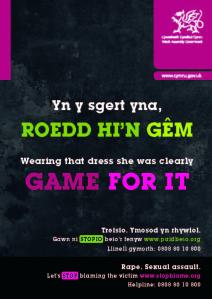
Via @thefworduk, I just found out about a similar, brand new campaign in Wales called Stop Blame. While, like Not Ever, this campaign focuses on ending the victim-blaming of rape and sexual assault survivors and victims, the commentary is largely the same as the victim-blaming that survivors of street harassment (and any form of sexual harassment) face. It is an extremely important campaign and I applaud the Welsh government for producing it.
From StopBlame.org:
This campaign asks us all to challenge the endemic culture of victim blame.
Stop blaming the victim for rape and sexual assault committed against her.
Stop handing the rapist – the assailant – excuses that serve to make his behaviour more socially acceptable.
Rape is a crime in every sense of the word- emotional, physical, psychological and legal; the most intimate violation imaginable. No woman is ever ‘asking for it’.
Rape. Sexual assault. There is NO excuse. Let’s stop blaming the victim.
Yes!
Can every government around the world please have a similar campaign? They wouldn’t end victim-blaming, but they sure would help!
