• About Us
    • What Is Street Harassment?
    • Why Stopping Street Harassment Matters
    • Meet the Team
      • Board of Directors
      • Past Board Members
    • In The Media
  • Our Work
    • National Street Harassment Hotline
    • International Anti-Street Harassment Week
    • Blog Correspondents
      • Past SSH Correspondents
    • Safe Public Spaces Mentoring Program
    • Publications
    • National Studies
    • Campaigns against Companies
    • Washington, D.C. Activism
  • Our Books
  • Donate
  • Store

Stop Street Harassment

Making Public Spaces Safe and Welcoming

  • Facebook
  • Instagram
  • Pinterest
  • Tumblr
  • Twitter
  • YouTube
  • Home
  • Blog
    • Harassment Stories
    • Blog Correspondents
    • Street Respect Stories
  • Help & Advice
    • National Street Harassment Hotline
    • Dealing With Harassers
      • Assertive Responses
      • Reporting Harassers
      • Bystander Responses
      • Creative Responses
    • What to Do Before or After Harassment
    • Street Harassment and the Law
  • Resources
    • Definitions
    • Statistics
    • Articles & Books
    • Anti-Harassment Groups & Campaigns
    • Male Allies
      • Educating Boys & Men
      • How to Talk to Women
      • Bystander Tips
    • Video Clips
    • Images & Flyers
  • Take Community Action
  • Contact

ProChange distributed 2000 cards in Dortmond, Germany

March 25, 2012 By Contributor

Editor’s Note: This guest blog post is reprinted from the ProChange Facebook page about the action they took for International Anti-Street Harassment Week 2012:

[I used Google translate….see the original German text below)
The 18 March to 24 March 2012 was the International Week Against Street Harassment. Worldwide there were events and actions. ProChange joined in and participated in it.
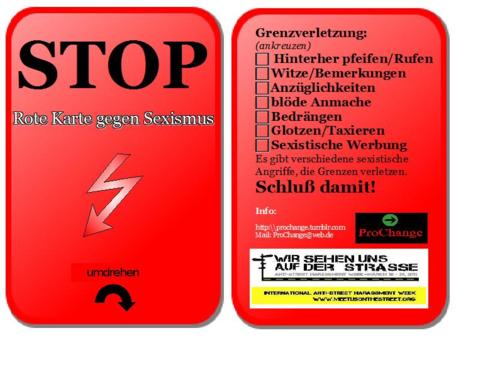
We distributed 2000 “Red Card” against sexism, “Pink Card” against homophobia, and “Purple Card” Courage for the day. At night we shared our special coasters in pubs, bar, from clubs in Dortmund, Germany. Summary, detailed report and pictures will be published soon.

Our commitment does not end with the end of the campaign week. Sexist boundary violations and sexual violence are so long on our agenda until they no longer belong to our social system, and no one is more discriminated against and degraded or have experienced even violence.

ProChange stands for change. Without you, without you, without you, there will be no change and no change!

A movement moves only by those who follow her. No one follows, there is no change. No matter how old, no matter what profession, no matter what school, no matter what gender. We want change for all.

_____________________________________________________

Vom 18. März bis 24. März 2012 war die internationale Woche gegen Street Harassment. Weltweit fanden vielfälige Veranstaltungen und Aktionen statt. ProChange schloß sich an und beteiligte sich daran. Wir verteilten 2000 “Rote Karten” gegen Sexismus, “Pinke Karte” gegen Homophobie und “Lila Karte” für Courage tagsüber. Abends legten wir in Dortmund unsere Spezialbierdeckel in Kneipen, Bar, Clubs aus. Fazit, ausführlicher Bericht und Bilder werden in Kürze noch veröffentlicht.

Unser Engagement endet natürlich nicht mit dem Ende der Aktionswoche. Sexistische Grenzverletzungen und sexualisierte Gewalt stehen so lange auf unserer Agenda, bis sie nicht mehr zu unserem Gesellschaftssystem gehören, bis niemand mehr diskrimiert und herabgewürdigt wird oder sogar Gewalt erfahren muß.

ProChange steht für den Wandel.

Ohne Dich, ohne Sie, ohne Euch, wird es keinen Wandel und keine Veränderung geben!

Eine Bewegung bewegt sich erst durch die, die ihr folgen. Folgt niemand, gibt es keinen Wandel. Egal, wie alt, egal, welcher Beruf, egal, welche Schule, egal, welches Geschlecht. Wir wollen den Wandel für alle.

Wie?

Fan auf unseren Seiten werden, posten, Inhalte teilen und kommentieren. Freunde und Bekannte dazu einladen.

Darüber sprechen im Freundeskreis, in der Schule, in der Firma usw.

Karten und Bierdeckel verteilen

Geschichten veröffentlichen: Fast jede Frau, jedes Mädchen hat wohl schon Belästigungen, Übergriffe erlebt. Manchmal ist man wütend, manchmal hilflos. Wir wollen das Schweigen brechen. Deshalb machen wir unsere Geschichten öffentlich und schreiben sie auf. Wir schreiben, was uns passiert ist und schweigen nicht mehr.

Mitarbeit direkt: Fleißige Hände, die ab und an oder auch regelmäßig unsere Arbeit unterstützen. Einfach anfragen.

Share

Filed Under: anti-street harassment week Tagged With: anti-street harassment week, germany, homophobia, Prochange, red card, sexism, street harassment

Trayvon Martin: The streets should be safe for everyone.

March 21, 2012 By HKearl

Image via USA Today

The tragic and outrageous killing of 17-year-old Trayvon Martin by a Neighborhood Watch leader in Florida because he looked “suspicious” has become national news. Martin was unarmed, carrying snacks from a local convenience store, dressed like many teenagers dress: in a hoodie. What made him suspicious seems to be that he was black. George Zimmerman, the Neighborhood Watch leader, has not been charged with a crime because he says he was acting in self-defense, despite the mounting evidence showing Martin was not a threat at all.

Via USA Today:

“The case has resonated for many who say Martin died because of stereotypes of young black men as violent criminals. The shooting is already being compared with high-profile and historic civil rights cases — for instance, a doctored photograph has circulated throughout many social media sites that compares Martin to Emmett Till, a young man lynched by white men in 1950s Mississippi.

“It’s not about these individual acts of racism,” said Mark Neal, a professor of African and African American Studies at Duke University. “It’s about the way that black males are framed in the larger culture … as being violent, criminal and threats to safety and property.”

The tragic case played out in Sanford, population 54,000, about 30 minutes north of Orlando, when Martin left his father’s home to buy candy and iced tea for his little brother at a nearby 7-Eleven…

The fatal shooting touched a chord of community outrage in Sanford on Tuesday night. The killing was “a senseless murder as far as we are concerned,” Seminole County NAACP President Clayton Turner told a capacity crowd at the start of a town-hall-style meeting at Allen Chapel AME Church.

Clayton said the Sanford city manager and mayor were unable to attend because they had been “summoned” to Washington by Attorney General Eric Holder.

“The line has been drawn in the sand,” Clayton said. “We as people of color are going to stand our ground. We are going to do it in a non-violent way, and we are going to prevail.”

Before his son’s death, Tracy Martin warned son Trayvon that being a black man in America could be dangerous.

“I’ve always let him know we as African Americans get stereotyped,” Tracy Martin told USA TODAY. “I told him that society is cruel.”

As I often say and write, people are harassed – and killed – on the streets for all kinds of reasons: racism, homophobia, transphobia, classism, xenophobia, ablism, and sexism. And too often they are harassed for a combination of those reasons. Martin’s death is a very, very sad example of the racial harassment and profiling that still occurs.

While this site focuses on harassment motivated by gender, that harassment does not happen in isolation. The issues are complex and often inter-related. And the streets should be safe for everyone.

If you’re on twitter, join the Women’s Media Center #SheParty chat today, 3-5 p.m. EST. Martin’s death, racial profiling, harassment of men of color by police and how these topics intersect with gender-based street harassment will be one of the topics of conversation.

Share

Filed Under: anti-street harassment week, News stories Tagged With: murder, street harassment, Trayvon Martin

Sh*t Men Say to Men who Say Sh*t to Women on the Street

March 20, 2012 By Contributor

Editor’s Note: Bix Gabriel and Joe Samalin are part of the NYC team that created the new video “Shit Men Say to Men who Say Shit to Women on the Street” that’s been viewed nearly 50,000 times in less than one day and was made for International Anti-Street Harassment Week.

When it’s cold, my nose turns purple. I’m self-conscious about it. To hide the offending nose, and because I was indeed cold, I wrapped half my face in a scarf as I stood in a park recently.

A man walking towards me said, “Hey, girl. You pretty under that scarf?” I stared at him for a nanosecond, then looked away. He kept at me.

“Show me your face.”

“You pretty?”

“C’mon, look at me.”

My eyes stayed down, my ears pretended deafness. He passed me and I remained still. Then I breathed. And then it came: “Yeah, thought so. You ugly.”

The irony: At that instant, my partner Joe and other guys were 50 feet away, filming the video “Shit Men Say To Men Who Say Shit to Women on the Street”. They were saying things on-camera that I wanted someone to say in life. Right then. To that guy. They were things I could have said. But I didn’t. I hate admitting it but I was afraid. And I felt helpless. And the more I think about it, the madder I get. Because this is not my job. It’s not my job to be on guard every second; to defend myself constantly; to fight against every male gaze on me, wherever I am, whatever I wear.

Whose job is it? I understand that ending street harassment is everyone’s problem. But committing it is not everyone’s choice. So I can’t accept this equation, where some men choosing to harass = unsafe streets for all women. This is why men who don’t harass have the job and the obligation – not to protect women (we can take care of ourselves; we have loads of practice) but to hold all men accountable….

When I hear stories like the one my partner Bix shared above, I am left feeling this pain and nausea in my gut, a shitty and sad feeling I carry with me. This feeling is a gift that I struggle to hold on to and fight tooth and nail to keep present in my mind and heart. Because otherwise I will forget, I will lose it, and it will become again that much harder for me as a straight, white, heterosexual and cisgendered guy steeped in privilege to keep the struggle necessary and constant, alive and vital. That is how privilege works – it is its very nature.

I have worked to prevent violence against women for years. And yet while collaborating to create this video, I have been seeing the violence men commit against women with fresh eyes. Being 50 feet away from Bix as it happened to her brought home to me how pervasive street harassment is, and how unaware of it we as men can be.

And yet this video came about the way it did because today men – straight, gay, young, old, of all races – are asking what we can do to change things. But knowing the right words means nothing without the recognition of the violence all around us and the will to challenge and stop it consistently. Not – as Bix said – to protect women, but to hold ourselves and other men accountable for our violence and our silence. That is our responsibility.

I still fail way more often than I succeed. But the times I fail and get back up and try again (which isn’t always the case and isn’t always easy to do) that is the real work. This is what we as men NEED to do in order to be true allies to the women and girls around us, whether we know them or not.

Share

Filed Under: anti-street harassment week, male perspective, street harassment Tagged With: bix gabriel, joe samalin, shit men say, street harassment

Street harassment and the dehumanization of sex workers

March 19, 2012 By Contributor

Editor’s Note: This guest blog post is written by Jessie Nicole, the current director of Sex Workers Outreach Project – Los Angeles, a nonprofit dedicated to ending violence and stigma against everyone in the sex industry and a co-sponsor of International Anti-Street Harassment Week. She earned her BA in English Literature from Florida State University and her MA in Humanities, focusing on the literature of Social Justice, from the University of Chicago. She lives in Los Angeles with her partner and their turtle, Walter.

Though I’ve experienced street harassment periodically since the time I hit puberty, one of my most memorable incidents occurred in 2009, the summer after I finished my MA. I had a cold, and was waiting in line at the bank with unkempt hair and snot dripping from my nose. An older man behind me started making small talk about the muggy Chicago weather, and despite my obvious refusal to engage in conversation, then suggested that he could increase the zeroes on my deposit slip if we came to a sort of “arrangement”. His tone and expression left little doubt what kind of arrangement he was referring to.

What this man had no way of knowing was that I was working as a full time escort at the time of that encounter. I bitterly wondered if I had a neon “whore” sign above my forehead only visible to the rest of the world. Though I was working in the sex industry at the time, this was not a professional situation. In retrospect, I can’t help but wonder how he would have reacted had I brazenly informed him of my rates. But I was ill and therefore taking time off work. This was not a consensual negotiation, nor a conversation I had entered willingly. And that is what made it harassment. I did not consent to engage in any sort of sexual negotiation.

Consent does not fluctuate depending on what someone does for a living (or is wearing, or has said previously, or chooses sexually). Whether or not someone works in the sex industry has no bearing on their ability to consent to sexual attention. While this incident in the bank was relatively minor, it is representative of a larger assumption about the accessibility of bodies, particularly sex workers’ bodies. There is a difference between consensual sex work and sexual assault, and it should not be difficult to distinguish between them. Jill Brennerman’s account of her experience as a sex worker and rape victim explicitly shows the line between a consensual sexual transaction and rape (trigger warning : graphic description of sexual assault).

The myth that sex workers cannot be sexually harassed or assaulted is rooted in the misperception that sex workers are not fully rounded people, but rather defined solely by the industry they work in. And that perception has very real and dangerous consequences. Alana Evans, when speaking about her experience with the LAPD as a rape victim, tells how she was dismissed based on her occupation.  A quick scan of the comments on the video shows that this seems to be a common perception. Because she is a sex worker, she is somehow “unrapeable.”

The dehumanization of sex workers only intensifies for people of color, those participating in outdoor sex work, and trans* or queer folk. This violence and harassment is not only socially sanctioned, but institutional. A 2006 survey conducted by a DC outreach organization that focuses on outdoor sex workers revealed that “90 percent of 149 respondents had experienced violence… and almost half said that they had been treated badly when they had sought help from somewhere (not just from police.)” While the jump from street harassment to violence against sex workers may seem extreme, the commonality of violence against sex workers should illustrate how for our community, street harassment is deeply threatening.

I should not have contemplated what I had done for a man I had never met to proposition me at the bank. It shouldn’t matter to this story that I was obviously sick and wearing sweat pants and an old t-shirt. No one should have to expect to experience sexual harassment in public as I and many others do. Sometimes it is less scary than others. Sometimes I am angrier than others. But being a sex worker has given me an entirely new perspective. I’m frequently told that I have no right to that fear or anger in response to harassment. I have nothing but rage and contempt for the underlying system that labels some bodies as having more value, and the bodies of sex workers as public domain.

Share

Filed Under: anti-street harassment week Tagged With: street harassment, SWOP-LA

Gay & Bisexual Men: Take Survey for Master’s Thesis

March 16, 2012 By HKearl

Most of the work Stop Street Harassment does focuses on the street harassment women (both trans and cis) face, but some men, especially men in the LGBQT community, face it too.

Patrick McNeil is surveying gay and bisexual men about street harassment for his master’s thesis and he’s looking for respondents from anywhere who are 18 years or older. If this applies to you, please take the 15-20 minute survey, and even if it doesn’t apply to you, please share it.

This is a very under-researched topic and your help is greatly appreciated.

Patrick will speak about his preliminary research during an Anti-Street Harassment Week event in Washington, DC, that’s free and open to the public on Wednesday, March 21. Please RSVP if you can attend. In the video below, he shares how he became involved in the topic.

Share

Filed Under: street harassment Tagged With: gay and bisexual men, street harassment, survey

« Previous Page
Next Page »

Share Your Story

Share your street harassment story for the blog. Donate Now

From the Blog

  • #MeToo 2024 Study Released Today
  • Join International Anti-Street Harassment Week 2022
  • Giving Tuesday – Fund the Hotline
  • Thank You – International Anti-Street Harassment Week 2021
  • Share Your Story – Safecity and Catcalls Collaboration

Buy the Book

  • Contact
  • Events
  • Join Us
  • Donate
  • Facebook
  • Instagram
  • Pinterest
  • Tumblr
  • Twitter
  • YouTube

Copyright © 2026 Stop Street Harassment · Website Design by Sarah Marie Lacy