• About Us
    • What Is Street Harassment?
    • Why Stopping Street Harassment Matters
    • Meet the Team
      • Board of Directors
      • Past Board Members
    • In The Media
  • Our Work
    • National Street Harassment Hotline
    • International Anti-Street Harassment Week
    • Blog Correspondents
      • Past SSH Correspondents
    • Safe Public Spaces Mentoring Program
    • Publications
    • National Studies
    • Campaigns against Companies
    • Washington, D.C. Activism
  • Our Books
  • Donate
  • Store

Stop Street Harassment

Making Public Spaces Safe and Welcoming

  • Facebook
  • Instagram
  • Pinterest
  • Tumblr
  • Twitter
  • YouTube
  • Home
  • Blog
    • Harassment Stories
    • Blog Correspondents
    • Street Respect Stories
  • Help & Advice
    • National Street Harassment Hotline
    • Dealing With Harassers
      • Assertive Responses
      • Reporting Harassers
      • Bystander Responses
      • Creative Responses
    • What to Do Before or After Harassment
    • Street Harassment and the Law
  • Resources
    • Definitions
    • Statistics
    • Articles & Books
    • Anti-Harassment Groups & Campaigns
    • Male Allies
      • Educating Boys & Men
      • How to Talk to Women
      • Bystander Tips
    • Video Clips
    • Images & Flyers
  • Take Community Action
  • Contact

“We have to not just sit and take it or ignore it”

January 5, 2012 By HKearl

Cross-posted from gawaahi.org

“Street Harassment is a global phenomenon that is largely overlooked, and even considered acceptable despite there being laws against it in many places including Pakistan. Street harassment includes making sexually explicit comments, ogling, whistling, following and groping.

In the making of these videos, we found that many Pakistani women, especially from the lower-middle classes began wearing burqas because they found the additional garment enabling in many ways. However, they find that the problem of street harassment has worsened, and even in burqas, they are harassed as they wait for buses, rickshas, taxis, or walk down the street. The women we spoke with in this series of videos had experienced intimidation that crossed class, age, religion and ethnicity.

We are grateful to the young women featured in this video — Nabiha Meher, Aroosa Shaukat and Mehreen Kasana — for having spoken to us about street harassment. They are all three journalists (as journalism is evolving) whether in the realm of social media, blogs or print.

Made by Naveen Naqvi“

You can view two other films on street harassment by Naveen Naqvi via a blog post from last October.

Share

Filed Under: Activist Interviews, street harassment Tagged With: Gawaahi, Naveen Naqvi, Pakistan, street harassment

60 men harass, grope two teenage girls in South Africa

January 4, 2012 By HKearl

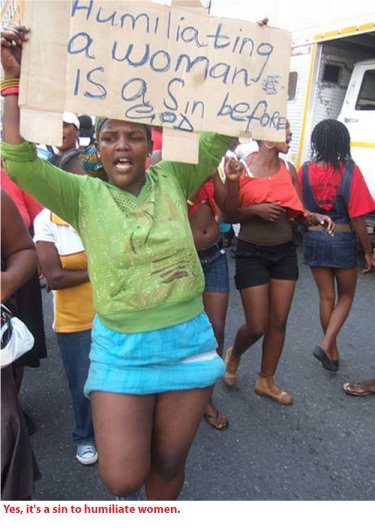
2008 Mini-Skirt March in protest of groping - via Siasa Duni's blog

1/5/12 Update: “The two teenagers who were harassed and groped by a group of men near the Noord Street taxi rank last week laid charges of harassment and intimidation at the Johannesburg central police station yesterday.

“The girls said they could remember some of the men who attacked them, so we are hopeful of their prosecution. We don’t need to arrest all the men, we only need a few to make an example,” Matshidiso Mfikoe, a member of the mayoral committee for public safety, said.”

Via IOL News:

“Two teenagers were harassed and groped in public on Friday because one of them wore a miniskirt. The Sowetan newspaper reported on Tuesday that a 17-minute long clip of CCTV footage shows one girl, wearing a black miniskirt, emerging from a shop where a crowd of between 50 and 60 men had gathered. They follow her, groped her and took photos with their cellphones, the Sowetan reported.

She screamed at her tormentors and occasionally tried to punch them as they groped her. When her friend tried to help her she was also abused.

Johannesburg metro police intervened and accompanied the girl in the miniskirt home. A nearby businessman pulled the other into his shop. Metro police arrived a few minutes later and escorted her away.

Gauteng premier Nomvula Mokonyane also condemned the incident.

“We learned with a deep sense of sadness and anger about the abuse of two young women on December 30 last year, because of their clothing,” she said in a statement.

“We condemn in the strongest possible terms the animal-like behaviour of those men involved – some old enough to be the young women’s fathers – where some males went as far as groping the young women.”

Look at this similar story, via a 2008 BBC article:

“Hundreds of South African women have marched to a Johannesburg taxi rank, where a woman was sexually assaulted for wearing a miniskirt. Nwabisa Ngcukana, 25, returned to where she was allegedly attacked by a group of taxi-drivers and street hawkers, who said she was indecently dressed.

“I came here to show the guys that I’m not scared of them – to face my demons,” she told the BBC.

The taxi drivers shouted insults at the women, some of whom wore miniskirts. Some shouted that South African women were being given too many rights….

The authorities have appealed to the taxi-drivers’ association to help find those who allegedly assaulted Ms Ngcukana and other women in recent weeks.

While some South Africans have said it is against local culture for women to wear miniskirts, the National House of Traditional Leaders last week said that women often wore short skirts in traditional ceremonies.”

What chilling behavior and what scary experiences for the young women. The silver lining is the police actually reacted and intervened in the most recent incident, as did a bystander businessman. But what will happen to the harassers and gropers? Do they just get to go on their merry way, ready to harass and grope another young woman the next day? Until there are more prevention efforts and punishments in place, what will change?

And is it time for another miniskirt march?

Share

Filed Under: News stories, street harassment Tagged With: groping, march, miniskirt, south africa, street harassment

Police officer to groped woman: “These things happen”

January 2, 2012 By HKearl

Via New York Times:

“Jill Korber walked into a drab police station in Queens in July to report that a passing bicyclist had groped her two days in a row. She left in tears, frustrated, she said, by the response of the first officer she encountered.

“He told me it would be a waste of time, because I didn’t know who the guy was or where he worked or anything,” said Ms. Korber, 34, a schoolteacher. “His words to me were, ‘These things happen.’ He said those words.”

Crime victims in New York sometimes struggle to persuade the police to write down what happened on an official report. The reasons are varied. Police officers are often busy, and few relish paperwork. But in interviews, more than half a dozen police officers, detectives and commanders also cited departmental pressure to keep crime statistics low.

While it is difficult to say how often crime complaints are not officially recorded, the Police Department is conscious of the potential problem, trying to ferret out unreported crimes through audits of emergency calls and of any resulting paperwork.

….

In the case of Ms. Korber, the police did eventually take a report of her being groped, but only after her city councilman, Peter F. Vallone Jr., intervened, she and Mr. Vallone said. In fact, Mr. Vallone said that he had grown so alarmed over how many women were being groped in his district that he contacted the 114th Precinct; his staff then asked Ms. Korber to go there again.”

Of all of the forms of street harassment that women face, groping is one form that is illegal everywhere – it’s assault! So this news that NYPD is regularly not doing anything about it when women report it is very, very frustrating. Especially because during 2011 there were multiple serial gropers in New York City, and many other New Yorkers shared stories about men who groped them in the streets.

Because so many police officers respond this way, plus the fact that some police officers are harassers, makes many people take matters into their own hands, they choose to fight back or create a community response to street harassment.

But street harassment, including groping, is a serious problem. Groping is a crime. The police need to respond appropriately, otherwise, what’s the point of having a police force? Come on, NYPD, you can do better.

Share

Filed Under: News stories Tagged With: crimes, groping, NYPD, street harassment

2011 Anti-Street Harassment Successes – Part 1

December 30, 2011 By HKearl

Reflecting on the number of people and organizations that worked hard to address and end street harassment is inspiring.  This end-of-year list is longer than last year’s list, and that’s a very good thing. Given the length, it’s divided into four posts.

Post 1 (this one): significant successes overall (e.g. new laws or awards to anti-street harassment campaigns) and 8 SSH successes.

Post 2: New anti-street harassment campaigns.

Post 3: New creative anti-street harassment initiatives.

Post 4: People who stood up to harassers.

Significant Successes:

Many major legislative bodies, organizations, authors, and news media addressed and acknowledged street harassment, bringing the issue further into the mainstream.

Laws:

1. An anti-sexual harassment bill focused specifically on groping in public places was introduced in the Chilean parliament.

2.  The Shoura Council drafted a new law in Saudi Arabia saying men who harass women in public will be fined and publicly defamed.

3.  The Los Angeles City Council (USA) passed a law making it a crime for drivers to threaten or harass cyclists. It allows victims of harassment to sue in civil court without waiting for the city to press criminal charges.

4.  The Bombay high court in India is considering “making section 354 of the Indian Penal Code, which deals with assaults or use of criminal force on women with the intent to outrage her modesty, a non-bailable offence.”

5. In Bangladesh, a court ruled that using the term “eve-teasing” to describe street harassment and sexual harassment makes light of a serious crime and ordered that it not be used anymore.

6. Plainclothes police officers arrested 100 street harassers in Kolkata, India, during a two day time period. All 100 men were caught making lewd comments to women in public places.

Studies:

1. A new study by ActionAid looks at issues of women’s safety in cities in Brazil, Cambodia, Ethiopia, Liberia, and Nepal. It concludes with recommendations for action.

2. The International Center for Research on Women released an International Men and Gender Equality Survey The report covers their three-year study of nearly 12,000 people in Brazil, Chile, Croatia, India, Mexico and Rwanda. One of the most important findings is that men who report more gender-equitable attitudes are more likely to be happy, to talk to their partners and to have better sex lives.

3. A new study of women in Tel Aviv, Israel, found that 83 percent had faced street harassment

4. In South Korea, a new study shows that 1 in 4 women experience sexual harassment on public transportation.

5. In Islamabad, Pakistan, a new study showed women face high rates of harassment on public transportation.

6. More than 70 percent of women in Sri Lanka experience harassment on public transportation, according to a study by the Legal Aid Commission.

7. Four more studies were conducted in Afganistan, Iran, Wales, and West Yorkshire (UK) on street harassment, look for the findings soon.

Awards:

1. HarassMap, an anti-street harassment group in Egypt, won the World Summit Youth Award from the United Nations.

2. Nuala Cabral’s film Walking Home won the Speaking Out Award at the Media that Matters film festival (USA)

3.  Tiye Rose Hood’s documentary Objectified received a nomination for best documentary in Academy of Art’s 2011 Epidemic Film Festival in San Francisco (USA).

Books:

1. Hey, Shorty! A Guide to Combating Sexual Harassment and Violence in Schools and on the Streets was published by the Feminist Press. Written by Joanne Smith, Meghan Huppuch & Mandy Van Deven, the book chronicles the Brooklyn, New York-based organization Girls for Gender Equity’s efforts to address sexual harassment in schools and on the streets. (USA)

2. Why Loiter?: Women and Risk on Mumbai Streets was published by Penguin Books India and authored by Shilpa Phadke & Sameera Khan & Shilpa Ranade. After three years of research, they “draw from feminist theory to argue that only by celebrating loitering—a radical act for most Indian women—can a truly equal, global city be created.” (India)

Media Coverage:

There were scores of articles about street harassment this year, and here are some of the ones that brought the issue squarely into the mainstream media:

1. BBC Magazine, Why do men shout at women on the street?

2. New York Times, Keeping Women Safe Through Social Networking

3. Washington Post, D.C.’s fight against street harassment

4. ACLU blog, “Hey Baby:” Enduring Street Harassment

5. Marie Claire magazine, Gropers, Beware

6. Guardian, Argentinian writer sacked in sexism row

7. Hey, Shorty! author Mandy Van Deven wrote a 13-post series on street harassment for the Bitch magazine blog

8 Stop Street Harassment successes:

Addressing street harassment is not my full-time job, and that makes me extra proud of these successes. Big thank you’s go out to my parents, partner, friends, colleagues, and online acquaintances who helped make each one possible.

1. Early in the year, SSH launched a male allies series on the blog

2. In the spring there was a complete website redesign and new logo

3. In just four weeks, SSH organized thousands of people around the world to participate in International Anti-Street Harassment Day on March 20

4. SSH collaborated with Holla Back DC! to organize DC’s first ever community safety audits, Our Streets, Too march, and week of street harassment logging.

5. Last month, activism on the SSH blog led Togo’s sandwich shop in California to pull an offensive ad that trivialized flashing/street harassment.

6.  SSH co-sponsored SlutWalk DC, the conference Sex, Power, and Speaking Truth: Anita Hill 20 Years Later, the event Shine the Light on Domestic Violence, and participated in Pixel Project’s Paint it Purple Campaign

7.  I gave 35 talks and did even more media interviews

8. Articles I wrote about street harassment were published in the Guardian, Christian Science Monitor, The WIP, and on the Ms. Magazine blog.

Share

Filed Under: Resources, street harassment, weekly round up Tagged With: laws, street harassment, successes

ultra-Orthodox Jewish men call 8-year-old girl “whore” as she walks to school

December 28, 2011 By HKearl

Image via Jezebel

Via CBS:

“A shy 8-year-old schoolgirl has unwittingly found herself on the front line of Israel’s latest religious war.

Naama Margolese is a ponytailed, bespectacled second-grader who is afraid of walking to her religious Jewish girls school for fear of ultra-Orthodox extremists who have spat on her and called her a whore for dressing “immodestly.“

Her plight has drawn new attention to the simmering issue of religious coercion in Israel, and the increasing brazenness of extremists in the insular ultra-Orthodox Jewish community.

“When I walk to school in the morning I used to get a tummy ache because I was so scared … that they were going to stand and start yelling and spitting,” the pale, blue-eyed girl said softly in an interview with The Associated Press Monday. “They were scary. They don’t want us to go to the school.”

The girls school that Naama attends in the city of Beit Shemesh, to the west of Jerusalem, is on the border between an ultra-Orthodox neighborhood and a community of modern Orthodox Jewish residents, many of them American immigrants.

The ultra-Orthodox consider the school, which moved to its present site at the beginning of the school year, an encroachment on their territory. Dozens of black-hatted men jeer and physically accost the girls almost daily, claiming their very presence is a provocation.

Beit Shemesh has long experienced friction between the ultra-Orthodox, who make up about half the city’s population, and other residents. And residents say the attacks at the girls’ school, attended by about 400 students, have been going on for months. Last week, after a local TV channel reported about the school and interviewed Naama’s family, a national uproar ensued.

….

Hadassa Margolese, Naama’s 30-year-old Chicago-born mother, an Orthodox Jew who covers her hair and wears long sleeves and a long skirt, says, “It shouldn’t matter what I look like. Someone should be allowed to walk around in sleeveless shirts and pants and not be harassed.”

Read the full CBS news article and read more in the Jerusalem Post and New York Times.


I applaud Naama and her mother for speaking out against the harassers and against street harassment in general. I hate that harassment happens period but I am OUTRAGED when it happens to kids and teenagers, especially when the harassers are grown men. They are bullies.

I also applaud the police for taking action:

“Police Commissioner Insp.-Gen. Yohanan Danino ordered his commanders and officers to enforce a zero-tolerance policy toward discrimination against women. According to guidelines sent by Danino to police commanders, any form of this discrimination must be treated as a criminal offense or a public disorder incident. Danino accompanied the orders with a condemnation of the phenomenon, describing “any attempt to harm the rights of women” as unacceptable.”

This story illustrates how street harassment can intersect with other forms of discrimination or conflict, such as religion. It also shows how the targets and purpose of the harassment are the same worldwide: the harassers target girls or women in public places just because they are girls or women in public places and then they shame them/threaten them/scaring them/humiliate them.

Thanks to the large number of harassers worldwide, public places are less safe and less welcoming for girls and women everywhere, including for 8-year-old girls.  That is not okay.

Is street harassment starting before puberty really the future we want for the next generation of girls?

If we don’t do something, that is their future.

Hollaback Israel is fighting street harassment in Israel. Find ideas for how you can help end street harassment in your community. Join us in speaking out against street harassment during March 18-24, 2012, International Anti-Street Harassment Week.

Share

Filed Under: News stories Tagged With: Naama Margolese, sexual harassment, street harassment, ultra-orthodox jew, whore

« Previous Page
Next Page »

Share Your Story

Share your street harassment story for the blog. Donate Now

From the Blog

  • #MeToo 2024 Study Released Today
  • Join International Anti-Street Harassment Week 2022
  • Giving Tuesday – Fund the Hotline
  • Thank You – International Anti-Street Harassment Week 2021
  • Share Your Story – Safecity and Catcalls Collaboration

Buy the Book

  • Contact
  • Events
  • Join Us
  • Donate
  • Facebook
  • Instagram
  • Pinterest
  • Tumblr
  • Twitter
  • YouTube

Copyright © 2026 Stop Street Harassment · Website Design by Sarah Marie Lacy