• About Us
    • What Is Street Harassment?
    • Why Stopping Street Harassment Matters
    • Meet the Team
      • Board of Directors
      • Past Board Members
    • In The Media
  • Our Work
    • National Street Harassment Hotline
    • International Anti-Street Harassment Week
    • Blog Correspondents
      • Past SSH Correspondents
    • Safe Public Spaces Mentoring Program
    • Publications
    • National Studies
    • Campaigns against Companies
    • Washington, D.C. Activism
  • Our Books
  • Donate
  • Store

Stop Street Harassment

Making Public Spaces Safe and Welcoming

  • Facebook
  • Instagram
  • Pinterest
  • Tumblr
  • Twitter
  • YouTube
  • Home
  • Blog
    • Harassment Stories
    • Blog Correspondents
    • Street Respect Stories
  • Help & Advice
    • National Street Harassment Hotline
    • Dealing With Harassers
      • Assertive Responses
      • Reporting Harassers
      • Bystander Responses
      • Creative Responses
    • What to Do Before or After Harassment
    • Street Harassment and the Law
  • Resources
    • Definitions
    • Statistics
    • Articles & Books
    • Anti-Harassment Groups & Campaigns
    • Male Allies
      • Educating Boys & Men
      • How to Talk to Women
      • Bystander Tips
    • Video Clips
    • Images & Flyers
  • Take Community Action
  • Contact

It’s Time to Change the Channel

October 26, 2011 By Contributor

“Freedom cannot be achieved unless the women have been emancipated from all forms of oppression” –Nelson Mandela

“Street Harassment is a serious problem. It makes us feel ashamed and afraid unnecessarily. I hate it.”

“Going for a run should not mean going on display.”

“I’ve gone from “queen” to “b*tch” in 6 seconds on the streets of Oakland.” –Voices of women on street harassment.
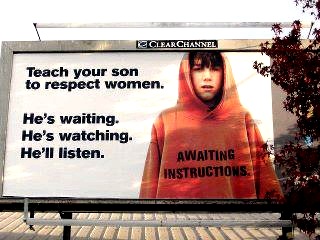
By devaluing women verbally, street harassment can contribute to situations that make it ok (in the perpetrator’s mind) to escalate into a physical confrontation, specifically if the advances are rejected.

Lately I’ve been doing some training to learn how to help male perpetrators of domestic violence learn non-abusive choices and behaviors for managing domestic conflicts and disputes.

I’ve found that just as domestic violence is about power and control, so is street harassment. And sitting at the root of these ills is male privilege.

With male privilege comes a feeling of entitlement: entitlement to sex, entitlement to being in control, having their needs as a priority, and also the expectation that when a man, or men sexually harasses a woman in public that woman should be happy to be getting some attention.

When their advances are rejected, some men call women all kind of different names in an attempt to get some power back. This name-calling also serves to send a message to women which says that their worth is defined by how satisfied a man is with them.

Living in a culture that has very specific rules and expectations regarding what is feminine and masculine, and one that reinforces in overt and subtle ways the subordination of women contributes to the problem, and many images in the media give the message that its ok to treat women like objects, reinforcing the idea of male entitlement & superiority, and subjugation of women.

Check out this preview for an interesting documentary that examines those images called “Miss Representation.”

Miss Representation 8 min. Trailer 8/23/11 from Miss Representation on Vimeo.

Moving to action

“Allies are needed to fight against every type of oppression. We must use our privileges to level the playing field.  Just as people of color should not be solely responsible for ending racism, just as people in the LGBTQ community should not be solely responsible for ending homophobia, women should not be solely responsible for ending sexism in its many forms.” —Excerpted from (N.A.H.) Blog Post: “It’s Not a Compliment, its Harassment“

It’s time to “change the channel” in our minds and actions. Today, many men are still taught in covert and overt ways that being masculine means suppressing emotions and having power over others.

In my training to work to help male perpetrators of domestic violence learn non-abusive choices and actions in managing conflicts in their relationships, we focus on honesty and accountability. That means being honest about the abuse, and holding ourselves accountable for the choices we make.

We also talk about changing the perception that men are entitled to have power “over”, to one in which fosters equality and shared responsibility as they work “with” their partners. Changing that perception involves questioning our status quo.

Down with the “boys will be boys” mentality. Let’s step outside of the box. Who says catcalling a woman in the street and then calling her a b*cth if she ignores you or stands up for herself is what makes you a man? Who says emotional or physical abuse is the “manly” way to assert oneself in conflict?

It’s time to create a new definition of “manhood”: one which values non-violence, respect, and equity over domination and control.

Men have a lot to gain, but more importantly a lot to give by working against street harassment and other forms of sexism and working toward gender equality.

We can play critical roles in challenging it not only in our personal lives, but in institutions as well. We can teach our young men that it’s NOT ok to harass or hit women. We can also offer counter-narratives that teach them to value the women in their lives for who they are.

We can also be honest and hold ourselves accountable by challenging the “conventional wisdom” and working against giving ourselves an out by assuming “that’s just the way it is and always will be” when it comes facing street harassment and other forms of sexism.

Men can also remain honest and accountable by acknowledging their own privilege. Although we have the privilege to not have to worry about being catcalled on the street, I think a part of being a good ally is staying in the conversation, and doing whatever we can in our lives to use our influence to advocate for justice and equality for women.

Let us move forward from saying “that’s just the way it is” to asking ourselves “What can I do to help?”

Encourage me as I encourage you in this difficult but worthy work towards peace.

Grace & Peace,

Relando Thompkins, MSW—Servant Leader, Teacher, Learner, Social Change Agent and Writer for the Blog: Notes from an Aspiring Humanitarian (N.A.H.)

This post is part of the weekly blog series by male allies. We need men involved in the work to end the social acceptability of street harassment and to stop the practice, period. If you’d like to contribute to this weekly series, please contact me.

Share

Filed Under: male perspective Tagged With: male allies, Relando Thompkins, street harassment

Women in Pakistan leave jobs because of commuter harassment

October 21, 2011 By HKearl


via Pakistan Today

Some women leave their jobs because of the street harassment they face during their commute, according to a new article about sexual harassment on public transportation in Islamabad, Pakistan.

“This single issue is directly damaging the careers of working women,” reads the article in Pakistan Today.

I’m not surprised. I know street harassment can significantly impact women’s lives. When I conducted an informal study of more than 800 women in 23 countries and 45 US states for my book research, 9 percent of women said they had changed jobs because of harassers along their commute and, related, street harassment had caused nearly 20 percent of the respondents to move neighborhoods.

What does the harassment in Pakistan look like?

Via Pakistan Today:

“Street sexual harassment for a woman in public transport is similar to claustrophobia because she feels trapped in a small place with fear of no escape until she reaches her destination.

If a bus or train is crowded or if a woman is sitting by the window and the man harassing or assaulting her is sitting behind her, she cannot scream or raise her voice since most of the women do not want to get people’s attention in cases like these.

Faiza Bibi is a resident of Bhara Kahu which is a suburban area of the city and she has to travel daily using public transport to reach her workplace. She said most of the drivers harass female passengers; sometimes they even touch the female passenger sitting next to them on the front seats while pretending as if they were merely shifting the gear.

She complained that the behaviour of drivers, especially of the vans plying on the Route Number 127, was unbearable.

“Women have no other option since they have to sit on the front seats, next to the driver, because they are the only seats meant for women,” she explained.

She lamented that the drivers took advantage of the situation by harassing women; sometimes by touching, staring or playing loud vulgar songs but the women commuters usually avoided complaining to anyone because they felt too embarrassed to tell anybody.”

Of course Pakistan is not the only country with this problem. New York City, Boston, and Chicago all have PSA campaigns focused on sexual harassment on the buses and subways because studies showed more than 60 percent of riders faced harassment.

Many countries like Japan, India, and Brazil have women-only subway cars offered during rush hour because of the problem of sexual harassment and this is a “solution” Islamabad may turn to as well if they can get the finances for it. 92 percent of women surveyed there said they want to have women-only public transportation. But actually, what they probably want is just no harassment, not necessarily segregation. Since no one in the government seems to care about actually ending the harassment, segregation probably sounds appealing and certainly could be a short-term solution to offer them relief. But it will not fix the problem in the long run.

Fortunately, there are people speaking out against street harassment in Pakistan whose efforts may lead to more long-term change. One example is in Karachi, Pakistan, where a new NGO called Gawaahi creates media for awareness and advocacy. They recently produced two short video clips about street harassment in Pakistan as a way to start raising awareness about the problem.

Share

Filed Under: News stories Tagged With: Gawaahi, Islamabad, Pakistan, public transport, sexual harassment, street harassment, women-only

“Anita Hill stood up in 1991 and we can all stand up in 2011.”

October 16, 2011 By HKearl

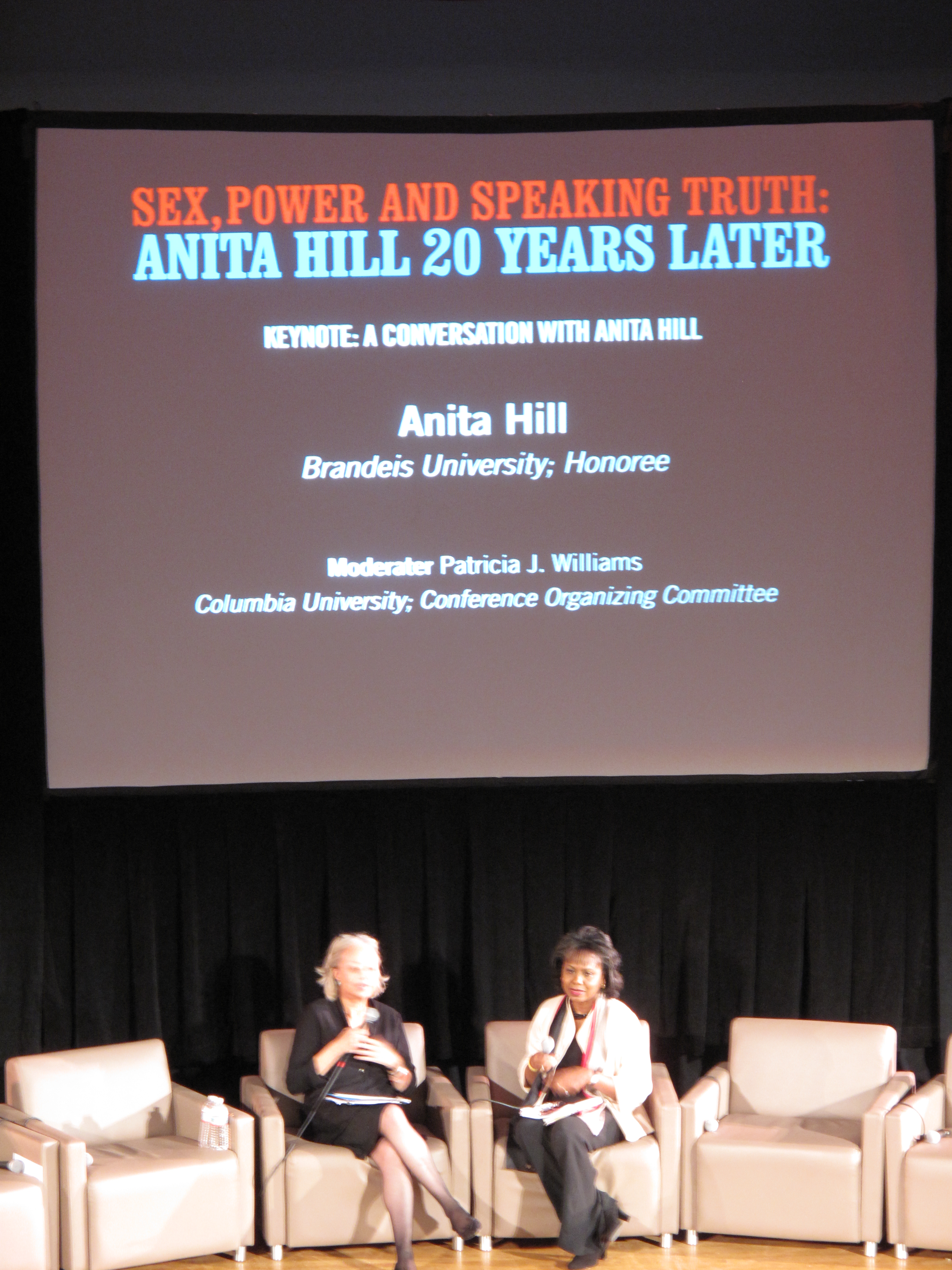
Charles Ogletree, a professor at Harvard Law School and the lead counsel for Anita Hill in 1991 spoke those words yesterday at the moving conference Sex, Power and Speaking Truth: Anita Hill 20 Years Later at Hunter College in New York City.

I agree. We all can stand up today as she did then. But, as I discuss in the latter part of the post, the knowing how to stand up in a way that will be effective and have a lasting-impact is often challenging.

The Conference

Throughout the conference, renowned lawyers, academics, and activists offered history lessons focused on what happened 20 years ago, commentary about the impact it had on current events and organizing efforts, and ideas for addressing sexual harassment in the future (though I thought the latter was a bit light on realistic ideas.)

We watched a compelling clip from Sex & Justice showing what happened 20 years ago and participated in lunchtime discussions on sexual harassment sub-topics.

If you missed it, you can watch most the conference online at C-Span.org.

To give you a taste of the day, here are some of my notes from two of the three panels and from Hill’s keynote address:

1. Charles Ogletree, Harvard Law School spoke first. He represented Anita Hill in 1991.

“What she stood for in 1991 still resonates with us…she’s in a class with Susan B. Anthony, Rosa Parks, Eleanor Roosevelt, Fanny Lou Hamer…”

Despite all of the backlash he and Hill faced, his then 12-year-old daughter told him on the phone, “I believe Anita.”

2. Lani Guinier, Harvard Law School

She talked about how Anita Hill made people “deal with the ambivalence and ignorance of the question: ‘Are you black or are you a woman?'”

“Many of us realized that not all women are white, not all blacks are men, and some of us, like Anita Hill, are very brave.”

3. Judith Resnik, Yale Law School

She examined the context of the hearing…how the male Senators on the hearing committee didn’t want to let Hill speak and then cut her defense short. While Thomas should have been on trial, they made it so Hill was.

It’s with the work of Hill and others who stood up for her and spoke out against sexual harassment that “things that are seen as ‘the way things are’ become intolerable”

4. Catharine A. MacKinnon, University of Michigan Law School

She’d been speaking out against sexual harassment since the 1970s and wrote the first book on it in 1979. During the hearing, she gave commentary on NBC.

The hearing was a “massive consciousness raising session” on an issue she’d been trying to raise awareness about for years..the hearing “made sexual harassment real to people” in a way her 1979 book did not, the EEOC guidelines did not, etc…only Anita Hill did.

“Women identified with Anita Hill…they believed her with ferocity and more said so as time and heat passed. They realized what happened to them was often as bad as what happened to her and if she could do it, they could do it too.”

“Sometimes it’s important to stand up and do the right thing, even if you lose,” she said about the DSK-Diallo sexual assault case.

5. Jamia Wilson, Women’s Media Center

“I am not Anita Hill but I could have been and that scares the crap out of me.”

Thelma & Louise + Anita Hill introduced her to victim-blaming and rape shaming. She witnessed the hearings become “a modern day witch hunt rather than the high tech lynching, as Thomas said.”

She feared she could be marked a traitor [against her race] for one day speaking out. The hearing was “intersectionality 101” for her.

6. The keynote address was a conversation between Patricia J. Williams and Hill. Here are a few notes from it:

Anita Hill spoke about the death threats, bomb threats, sh*t people mailed her and how she had to go to the grocery store knowing 7 in 10 people thought she had perjured herself…and how her family and friends helped her through it.

She talked about wanting to get her life back and resented that things didn’t go back to normal after the hearing ended. She said once she let go of that (about 6 months later) and realized she had a different life and she had to decide what shape that life would take, then she was able to move forward and also recognize that while it was an important event that shaped her life, it was just an event.

In her new book Reimagining Equality: Stories of Gender, Race, and Finding Home she writes about home and also the housing crisis in the USA.

Some of the last things she said related to her work on sexual harassment as she “helps people find their voice, talk about the issues that keep people from living full lives of equality…we should imagine a future where sexual harassment no longer exists”

7. Kimberlé Crenshaw, The African American Policy Network (You can read her speech in the current issue of The Nation).

She spoke a lot to the issue of intersectionality of race and gender.  She said the message still is “just get over it” re: sexual harassment, but “until we say it’s over, it’s not over.”

8. Virginia Valian, Hunter College

She shared stats on sexual harassment in the workplace…they’re the same today as they were 20 years ago.

She said there are several calls to action, including: 1) be smarter about how we influence people in power and how we get them into power. educate judiciary, lawyers, lawmakers, and be more systematic in our efforts 2) Form rapid response teams so we can influence the media and get the correct facts out. Giving good info to the people in power immediately.

9. Gloria Steinem

She talked about the DSK case and how the work of Hill and others allowed Nafissatou Diallo to come forward to report him. Both lost in the courts but they won in public opinion…Most importantly, this is the legacy of Anita Hill: “Thomas is on the Supreme Court but DSK will never be president of France!”

“We have the strength to go forward”

10. Devon Carbado, UCLA School of Law

“What have we learned from the Thomas-Hill hearings? That our anti-racism needs to be tied to a robust feminism and our feminist interventions must be infused with anti-racism.”

11. Julie Zeilinger, FBomb

“Gender conditioning and gender stereotyping allow sexual harassment to continue.”

“Our work isn’t yet done, plenty of us are willing to continue the fight and take Anita Hill’s legacy and run with it.”

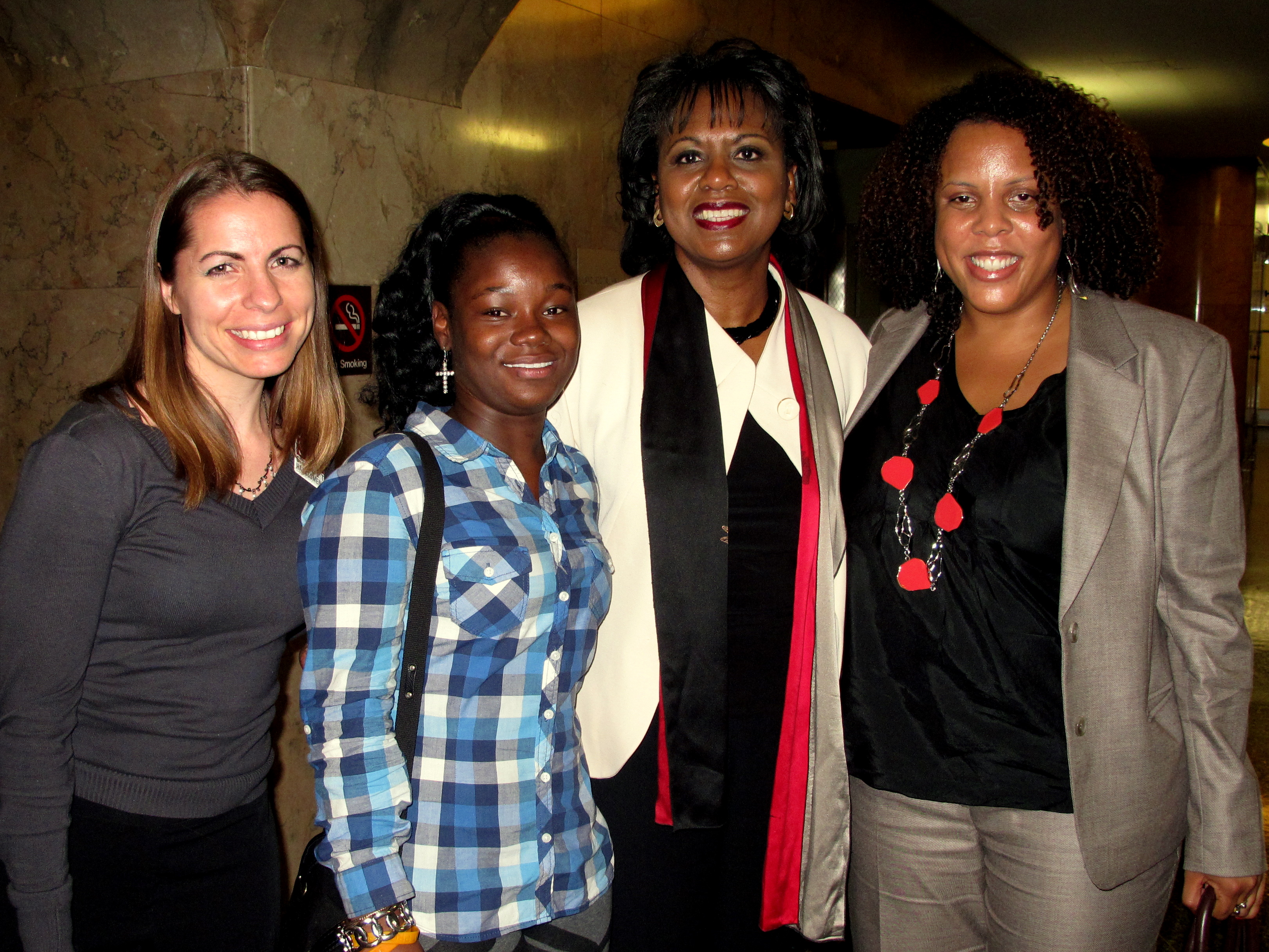
It was a day I will never forget. Especially after I had the huge honor of meeting both Steinem and Hill at an evening reception. I got to meet Hill with Joanne Smith, founder and ED of Girls for Gender Equity and one of her organizers Jodyann. Jodyann was determined to get to meet Hill and was overcome with emotion when she did. It was moving.

I’m still feeling the adrenaline and awe f meeting two feminist icons in one evening on top of meeting and reconnecting with amazing current activist/future feminist icons.

L to R: Holly Kearl, Jodyann of Girls for Gender Equity (GGE), Anita Hill, Joanne Smith the ED of GGE

What to Take Away

The conference is over. What now?

Let’s look back to Ogletree’s quote. “Anita Hill stood up in 1991 and we can all stand up in 2011.”

If you’re reading this blog, you probably want to (and do) stand up against sexual harassment—especially the kind that happens in public places—and ideally, you’d like to do so to the same extent that Anita Hill stood up against workplace sexual harassment.

But, if you’re like me, you may find that figuring out what actions will work, what efforts will be effective, and what kind of collective organizing will create long-term change is challenging. It’s especially challenging since “street harassment” is not a universal term and it’s not seen as a legitimate problem by most people. We’re still at the consciousness-raising and education stage.

To help with that stage, sites like HarassMap, Hollaback and mine collect individuals’ stories of resistance to street harassment, people write articles, tweet, and post stories on Tumblr, and numerous groups and people organize community anti-street harassment efforts. But I just don’t think they are enough to really turn street harassment into an immediately-recognized issue that is treated as seriously as workplace sexual harassment, or at least not any time soon.  There must be more we can collectively do about street harassment that is inclusive, appropriate, and effective; or one major action we can rally behind to raise awareness as people rallied behind Anita Hill. But what  is it?

Something I’m taking away from the conference is a better understanding of the workplace anti-sexual harassment movement and I hope that as I reflect on all that I’ve learned, I may come across ideas for effective, inclusive ways we can stand up against street harassment.

A related conference take away for me is a desire to learn even more about the general anti-sexual harassment movement and see what messaging, campaigns, and laws work. I know a lot of people still treat sexual harassment as a joke and it’s still a big problem at work and schools, but at least you don’t get blank stares from decision makers, academics and regular people when you bring it up (as happens with street harassment).

While learning about the anti-sexual harassment movement is not new to me, I’ve never delved very far into it. As my first step, I’m half-way through Carrie Baker’s fascinating and well-documented book, The Women’s Movement Against Sexual Harassment. Attending the Anita Hill conference was another step and now, for my next step, I plan to connect with scholars and activists I heard and met there.

Questions for You

If you attended the conference, what are your takeaways?

And, a question for anyone, do you have thoughts about what we in the anti-street harassment “movement” can learn from Anita Hill and related efforts to end workplace sexual harassment?

Share

Filed Under: Events Tagged With: 20 years later, anita hill, clarence thomas, girls for gender equity, gloria steinem, hunter college, joanne smith, sexual harassment, street harassment

TONIGHT: NYC, Shine the Light on Domestic Violence

October 12, 2011 By HKearl

Domestic violence impacts 1 in 4 women (and many men). Like street harassers, perpetrators of domestic violence engage in the harassing or violent behaviors not because of anything their target has done but because of their desire to exert power over the person. And most abusers, just like most harassers, get away with it, in part because of our culture of gender inequality and disrespect for women and the lack of prevention methods or penalties for abusers.

Fortunately, many organizations, people, and even governments speak out against domestic violence and work to make it unacceptable. October is Domestic Violence Awareness Month and the government of New York City is taking action.

Tonight, you can help the Manhattan Borough President’s Office Shine the Light on Domestic Violence at Times Square in New York City. Meet there at 6:30 p.m. to hear speakers and receive information on what domestic violence is and what to do about it.

Stop Street Harassment is one of the many co-sponsors of the event and two of SSH’s male allies/volunteers (who each wrote male ally blog posts earlier this year: Alan Kearl | Nick W) will attend and help pass out informational packets, so look for them and say hello!


Share

Filed Under: Events Tagged With: domestic violence, manhattan borough president's office, shine the light, street harassment

Safe Streets AZ gathers info, creates network of support to end harassment

October 8, 2011 By HKearl

Safe Streets AZ is a pilot program of Southern Arizona Center Against Sexual Assault that launched in July to address public harassment, particularly harassment aimed at lesbian, gay, bisexual, transgender and queer-identified youth and young adults. Stephanie Arendt is the Senior Prevention Educator at SACASA and agreed to talk to Stop Street Harassment about the new program.

Stop Street Harassment (SSH): Hi Stephanie! Before we begin, please tell us a little bit about yourself.

Stephanie Arendt (SA): I have been actively involved in violence prevention in one form or another for the past eight years, and my main passion is in creating youth-driven primary prevention. Since graduating from Northern Arizona University I have interned with the Feminist Majority Foundation, worked in crisis response and advocacy, and developed programming for various youth populations, including high-risk and LGBTQ youth. In my role as Senior Prevention Educator with the Southern Arizona Center Against Sexual Assault (SACASA) I implement youth-focused programs based on Peer Educator models, and am constantly seeking and creating opportunities to integrate art, social media, and technology into our violence prevention efforts.

SSH: What is the goal of Safe Streets AZ and how does it work?

SA: The ‘big picture’ goal is a shift in the way that people think about and respond to public harassment. We want to instigate the move towards a culture where sexual violence of any kind, including street harassment, is not only not tolerated but unthinkable. Safe Streets AZ is one of the first steps toward that goal in that it gathers information about public harassment and builds readiness. It provides a platform for community members to share their stories, get support, and –together- help end public and street harassment.

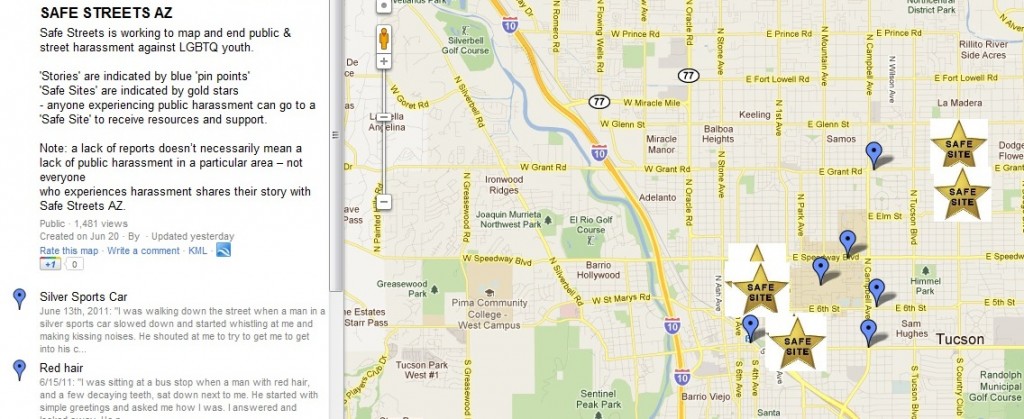
Safe Streets AZ is a program of the SACASA and funded by the Alliance Fund Queer Youth Initiative. The program is two-fold: 1) gathers information and 2) creates a network of support. Although geared towards LGBTQ youth and young adults, anyone who has experienced public harassment of any kind can share their story –publicly or anonymously—and connect to local and national resources, including crisis advocacy services.
They can also connect to Safe Sites; a growing web of partner businesses and organizations where anyone experiencing harassment can go to feel safe and get resources. Safe Sites are mapped along with reported incidents on an interactive Google map, making them readily identifiable and accessible.

SSH: Did anything particular spark/inspire the creation of Safe Streets AZ?

SA: For me, it was the surprising lack of information and data about public and street harassment that really propelled me into helping to create Safe Streets AZ. We had a lot of anecdotal information and our cursory focus groups and conversations told us that public harassment is a recurring safety issue in our community, particularly for LGBTQ and female-identified people. But when we looked at the local and state level for data and resources specific to street and public harassment we came up blank. There is little to no information that speaks to the prevalence of public harassment or its impact, particularly upon minority communities.

We knew that before we could start looking to solutions, we had to get a better understanding of what is going on in our area, and Safe Streets AZ grew out of this need. On a personal level, I am also deeply inspired by the ground-breaking work of other activists like Emily May of Hollaback! and the ability to connect to and learn from a greater, growing movement against street and public harassment.

SSH: Gathering data is always an important first step toward creating solutions. I’m intrigued by the “Safe Sites” program, can you please tell me more?

SA: In creating the program we quickly realized that gathering and mapping stories –although a key way to raise awareness and build readiness- would not be enough. Opportunities needed to be available now for community members to step up and address the issue.

We created the Safe Sites component so that local businesses, organizations, and the individuals that work in them have a hand in creating a safer community. Prior to launching the program I met with several local businesses to get their feedback, and I know that their perspectives and buy-in has really contributed to the success of this aspect of the program. The result is a web of partner sites throughout the community where someone experiencing harassment can ask for help/identify that they are being harassed, and receive resources and short-term safety. This last part is especially important for youth and young adults who are being harassed because they can access Safe Sites and wait in safety for a short period –until their ride comes, until they feel it’s safe to leave, etc- without fear of being asked to leave due to ‘loitering’.

The degree to which local businesses and organizations have not only supported but embraced Safe Streets AZ has been unexpected and completely inspiring. So far Safe Streets AZ has been endorsed by the Pima County Small Business Commission, the Southern Arizona Chambers of Commerce Alliance, Pima County Public Libraries, Friends of the Pima County Public Libraries, and several locally-owned businesses. We also have partnerships with other non-profits and agencies, including Wingspan, Tucson’s LGBT Community Center, which are critical to shaping the program.


SSH: That’s amazing! What would you say the community response has been to Safe Streets AZ overall?

SA: The response on this program has been incredibly encouraging. About two days after the first story on Safe Streets AZ aired on KOLD 13, I received the most heart-warming phone call. A parent of an openly LGBTQ middle-school student in one of our districts called just to thank me and SACASA for Safe Streets AZ. She told me about how her 12 year old daughter has been harassed on multiple occasions in and out of school –some of them because of her sexual orientation- and was happy that resources are available.

The question I do get the most from community members and some of our Safe Site partners is, “adults and people of all sexual orientations and backgrounds are harassed – is this program also for them?” And the answer is, “of course.” Women, youth, and LGBTQ-identified individuals are more frequently the targets of public harassment, but as we expand the program we also want to expand the message that Safe Streets AZ is for everyone, and anyone can share their story, connect to resources, and join the movement.

SSH: Wonderful. What aspect of Safe Streets AZ is most interesting/exciting to you?

SA: The most exciting aspect is that Safe Streets AZ connects the gaps between private and public spaces. In schools as well as the workplace, there are policies in place specifically geared towards protecting individuals from harassment. How well these are enforced varies, but similar protections are not available for most public spaces. There are no clear cut channels to address the kinds of street and public harassment that are committed on a daily basis. The Safe Sites aspect of the program brings businesses into the mix to start bridging those gaps, and allows us to incorporate available technologies from blogs to QR codes.

SSH: Where do you hope to see the program in a year?

SA: Over the next 6 months the primary plan for Safe Streets AZ is to gather as much information as we can regarding the frequency and kinds of public harassment being perpetrated in our community, and then take a really good look at what the information is telling us.

The next step is to meet with law enforcement, public officials, and service agencies and use this localized data to start developing specific ways to address public and street harassment in Arizona. I also hope to see the Safe Site aspect of the program grow to include more business partners as well as an active bystander intervention training component. The goal is to empower community members of all ages to share their experiences and to call out harassment how-and whenever possible.

SSH: Anything else you’d like to add?

SA: One of the biggest benefits of programs like Safe Streets AZ is that it helps us start making connections between street and public harassment and other forms of sexual violence. Until recently, street and public harassment have not been included in most sexual violence prevention efforts, even though the majority of street harassment is rooted in (perceived or actual) gender, sex, sexual orientation, and sexuality of the perpetrator as well as the person being harassed. By continuing to connect these issues we can make stronger cases for primary prevention programs and solutions that address violence on multiple levels.

Find Safe Streets AZ on Facebook.

Stephanie is right on about the lack of information on street harassment, the need for more data, the need for businesses and local community groups to become involved in creating solutions, and in the need for traditional sexual violence prevention efforts to include street harassment. Well done, Safe Streets AZ and Stephanie!! As they continue forward, their work has the potential for being a model other cities can use to effectively track and then address street harassment on the local level. A multi-layered, community response is the only way street harassment has any chance of ending.

Share

Filed Under: Activist Interviews Tagged With: LGBQT, safe streets az, Southern Arizona Center Against Sexual Assault, stephanie arendt, street harassment

« Previous Page
Next Page »

Share Your Story

Share your street harassment story for the blog. Donate Now

From the Blog

  • #MeToo 2024 Study Released Today
  • Join International Anti-Street Harassment Week 2022
  • Giving Tuesday – Fund the Hotline
  • Thank You – International Anti-Street Harassment Week 2021
  • Share Your Story – Safecity and Catcalls Collaboration

Buy the Book

  • Contact
  • Events
  • Join Us
  • Donate
  • Facebook
  • Instagram
  • Pinterest
  • Tumblr
  • Twitter
  • YouTube

Copyright © 2026 Stop Street Harassment · Website Design by Sarah Marie Lacy