• About Us
    • What Is Street Harassment?
    • Why Stopping Street Harassment Matters
    • Meet the Team
      • Board of Directors
      • Past Board Members
    • In The Media
  • Our Work
    • National Street Harassment Hotline
    • International Anti-Street Harassment Week
    • Blog Correspondents
      • Past SSH Correspondents
    • Safe Public Spaces Mentoring Program
    • Publications
    • National Studies
    • Campaigns against Companies
    • Washington, D.C. Activism
  • Our Books
  • Donate
  • Store

Stop Street Harassment

Making Public Spaces Safe and Welcoming

  • Facebook
  • Instagram
  • Pinterest
  • Tumblr
  • Twitter
  • YouTube
  • Home
  • Blog
    • Harassment Stories
    • Blog Correspondents
    • Street Respect Stories
  • Help & Advice
    • National Street Harassment Hotline
    • Dealing With Harassers
      • Assertive Responses
      • Reporting Harassers
      • Bystander Responses
      • Creative Responses
    • What to Do Before or After Harassment
    • Street Harassment and the Law
  • Resources
    • Definitions
    • Statistics
    • Articles & Books
    • Anti-Harassment Groups & Campaigns
    • Male Allies
      • Educating Boys & Men
      • How to Talk to Women
      • Bystander Tips
    • Video Clips
    • Images & Flyers
  • Take Community Action
  • Contact

Archives for September 2016

Spain: Using Festive Events to Tackle Violence Against Women

September 28, 2016 By Correspondent

Alice C.R., Barcelona, Spain SSH Blog Correspondent

Trigger Warning – Sexual assault
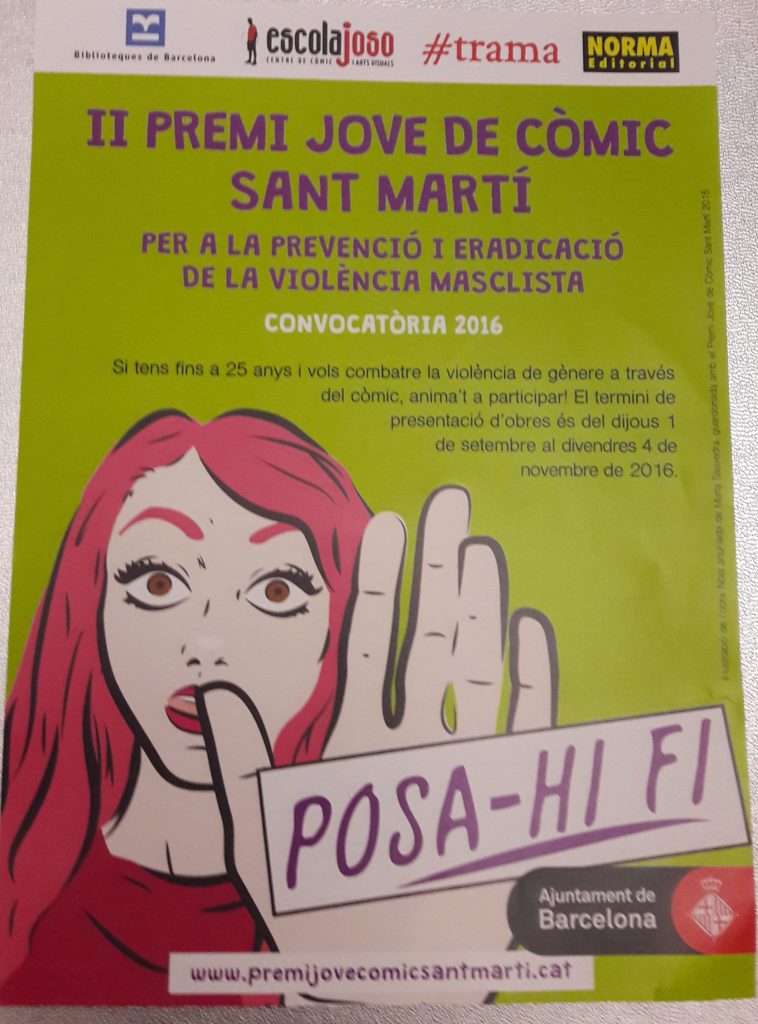
jovecomicsFor many people, Barcelona is the sunny, party city by the sea. And it is true that the city offers a large range of activities throughout the year (and not only parties and night clubs, by the way), but some events are bigger than others.

This last weekend, for instance, has been one of the most festive of the year in Barcelona. Every 24th of September the city celebrates La Mercé, the Patron Saint of Barcelona and the city holds a four days street festival in her honour. Concerts, exhibitions, street arts, dance, fireworks and the traditional Castells (human towers, catalan tradition delared Intangible Cultural Heritage in 2010 by UNESCO) attract thousands of both local people and tourists. This kind of big celebration is also a good opportunity to tackle street harassment and assaults by making people aware of these issues and their dangerousness and offer appropriate support to the victims.

This is crucial. And for good reason. Recent news remind us almost every single day how sexual assaults are shockingly common and how stereotypes and myths about them are still deeply ingrained.

We have all heard here about the San Fermin rape case and sexual assaults. Especially the one where five men gang raped a young woman. The police arrested one of them while he was sleeping in his car and the others were enjoying a street party. And this was not the first time it happened. Every year, the San Fermin counts at least with one case of rape.

Another case made the headlines recently in Barcelona — a city councilwoman reported a sexual assault attack by night in a zone where people use to go out.
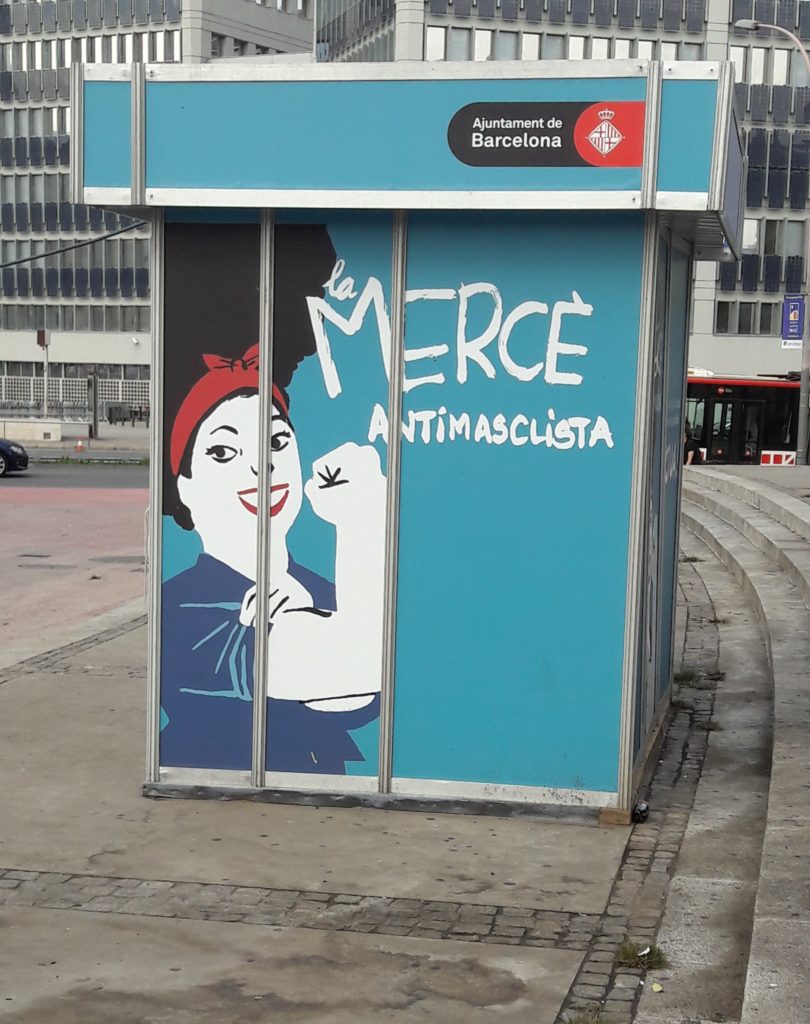
la-merceThese are just two examples where one occurred during a big wild and controversial festival and the other happened at night to a public figure. And that is an issue by itself. It seems that only specific assaults are revealed and discussed, those that happen at night, during wild parties when we perfectly know that assaults can also (and mainly) occur by day, on the way to work and can be committed by an acquaintance. It is important to recognize that the stories in the media about sexual violence are only the top of iceberg.

Unfortunately, both in the articles and in the comments left by readers, there was body shaming, slut shaming, incredulity, and doubt about the facts described by the victim. We learned, for instance, that the gang rape victim might have given a kiss before being raped. How is that relevant!?

That is why initiatives like Sanfermin sin agresiones sexuales , LaMercé anti masclista and Bcn Antimasclista are vital. In a world where victims are blamed for being assaulted, where they are revictimized, information and support must be provided.
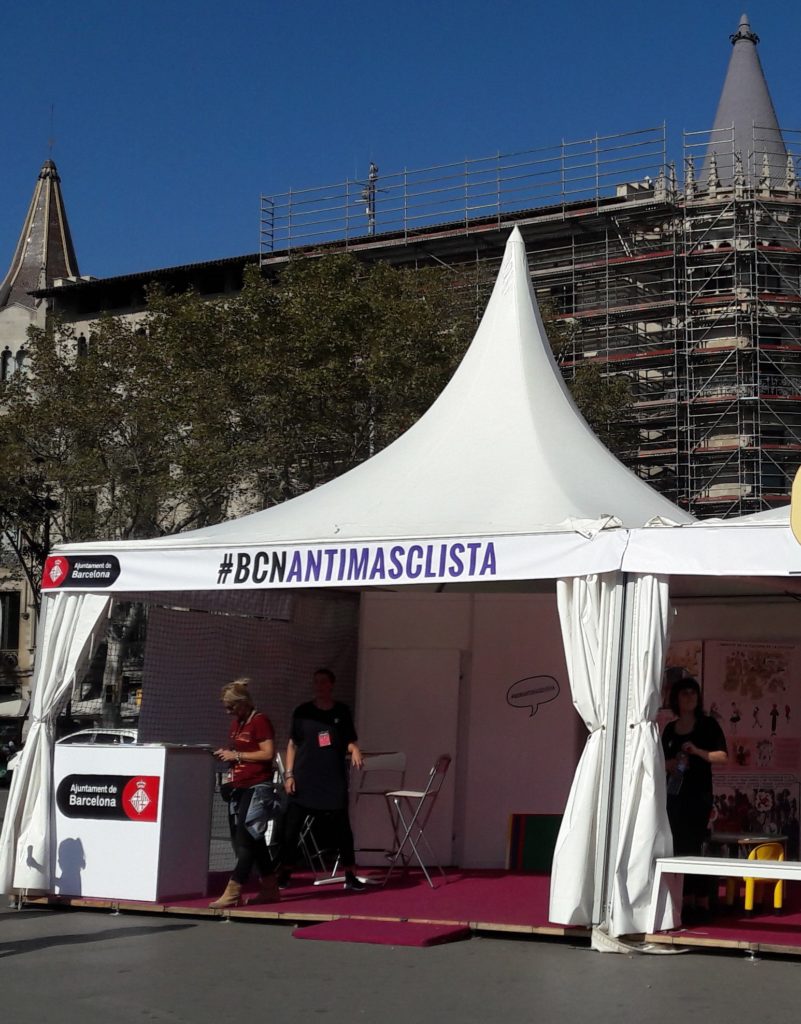
bcn-antimasclistaI was out celebrating for La Mercé and I must say it was quite comforting to see two stands where I could get information about all the different associations of the city and which one I should contact in case of sexual assault, domestic violence, physical and/or psychological abuses, where I could get a hotline number in case of emergency, where I could report any incident. When looking all the leaflets and ask for general information I could speak with someone who asked me if I needed some specific information or help and where I could make a test to see if I were in an abusive situation and which organization I should contact if so. I know these organizations and I got help from some of them. They are doing a wonderful job but not everyone knows them and this makes the issue visible and makes it easier to speak out.

There is still a long way to go. This summer, the city of Tarragona launched a campaign about consent called Respetame (respect me). Of course a man thought it would be very appropriate to write an article about how women say “no” as a game and that all they want is to get the harrasser trying harder. He compared it to the business law of market where a man’s goal is to turn a “NO” into a “yes”. The city councilwoman who has been assaulted pointed out some failures in the process of reporting an attack.

It is still very common to hear victim-blaming and victim-shaming comments.

But by using event such annual festival to give basic information about how to recognize a situation of abuse, to provide addresses and contacts to seek help, to give the opportunity to speak out, we are on a good way to tackle sexual violence. Hopefully.

Hotline Assistance 24/24 in 124 languages : 900 900 120
http://dones.gencat.cat/ca/ambits/violencia_masclista/recursos_atencio/telefon_900/  

Alice likes researching, analyzing and writing about Women’s Rights, gender bias, and intersectionalism with a special focus on sexual violence, rape, rape culture, the impact of street harassment and how the media deals with these issues. She is currently working on a new project focused on how some media participate in the revictimization of victims. Follow her and her projects on her Facebook page and via Twitter @Alyselily.

Share

Filed Under: correspondents

“When I get catcalled, I feel like there is something wrong with me”

September 26, 2016 By Contributor

I’m a 15 year old girl who lives in Belgium, in a small town near to Ghent where I have been harassed a lot.

The first time I was verbally harassed I was going to a local bakery. I wore black jeans, a very warm shirt and my coat with some black boots. I was 13-14 and I had never experienced a catcall towards me. While I was walking to the bakery, an old man with a beer can in his hand made this disgusting noise which made me feel very dirty as if I had done something to deserve that awful sound and the looks he gave me. When I was home I almost cried.

I know if people would read this they will say: “Well, he didn’t touch you or he didn’t rape you…He just complimented you on your looks”. No he didn’t rape me but does that mean that it has to go to that point to be a real problem? And no it is not a compliment I don’t need to be complimented by older men when I’m walking down the street so it could remind me that I am beautiful.

A couple of days ago I forgot my key so I had to wait on my brother in front of my front door until he came to let me in. So while I was waiting I remembered I was listening to ‘Since I’ve been loving you’ by Led Zeppelin because I remember that at my favorite line in the song I heard a car pulling up. There were at least 6 construction-workers in there, at that moment I knew they won’t let me just wait so while they passed me nothing happened but when they came back they honked at me. Again I felt disgusting, I just looked down at my phone thinking: “Not again.” Because at the same spot four weeks earlier I forgot my key (It happens sometimes) so I had to wait on my brother. A car full of construction-workers pulled up and honked.

I don’t know what they expect me to do, should I say: “Wow thank you sir for honking at me from your car, I feel so much better now!” Or should I just give them the finger, but no that is to dangerous so I just ignore it, but while I ignore it, I still don’t feel better.

When I get catcalled, I feel like there is something wrong with me. I get catcalled more here in the west than on holiday in my native country, Albania. Of course men there like to comment on women as well but I’ve never had an experiences that embarrassing other than here in Belgium.

I wanted to share a story from a friend of mine who at 15 was almost kidnapped on her way home. She was on her way home from a friend’s house while all of a sudden a car creeped next to her. He rolled down his window and said in Dutch: “What will you do for money?”

Of course she didn’t respond and she was really scared, so that’s when she walked faster. The man got out of his car and grabbed her hand. My friend was lucky that she had just passed a bar when the scene was happening so a guy stepped out of the bar and slammed him to the ground while another woman called the police. The man was not arrested but it was know that he had done such things before but the police didn’t have enough evidence to arrest him. It made me feel sick, I cried because that day it could’ve been the last time I would’ve seen my friend.

I’m sorry for the long post but I really wanted to share this story because it makes me feel really bad when I get these comments on the streets.

Greeting from Belgium

– HK

Location: Near Ghent, Belgium

Need support? Call the toll-free National Street Harassment hotline: 855-897-5910

Share your street harassment story for the blog.
See the book 50 Stories about Stopping Street Harassers for idea
s.

Share

Filed Under: Stories, street harassment

Canada: Sexual Harassment in Montreal and Efforts against It

September 25, 2016 By Correspondent

Alexandra Jurecko, Montreal, Canada, SSH Blog Correspondent

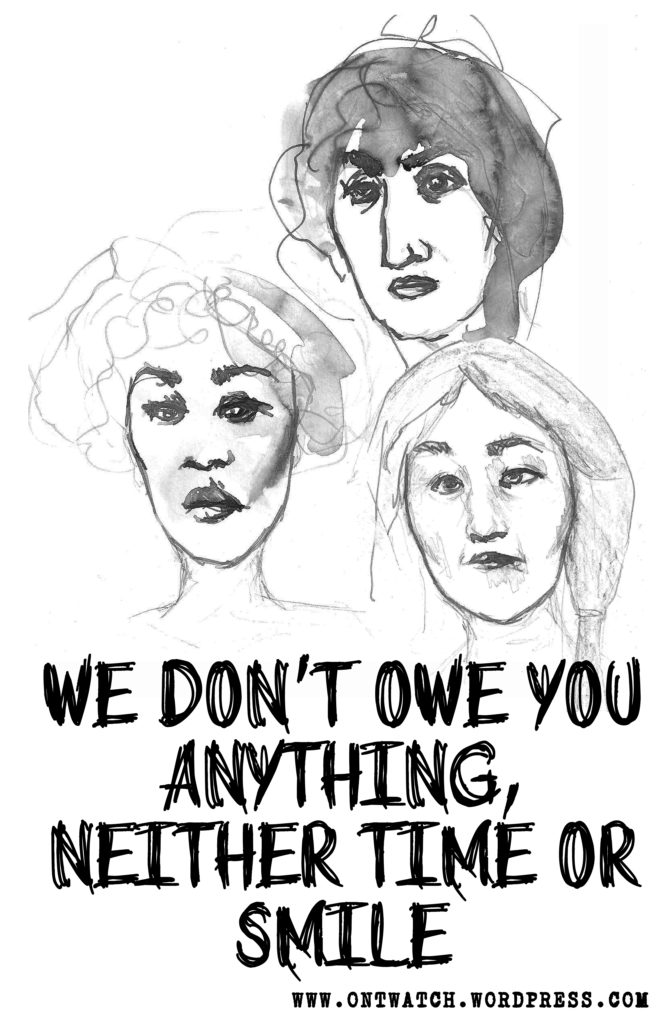
In 2014, a poster campaign on Montreal streets proclaimed “We don’t owe you anything, neither time or smile”. The posters were circulated by a wordpress blog called ontwatch, and are still available for download on their site.

Montreal is often praised for its efforts in promoting women’s safety in the city’s public spaces, and examples of such programmes include the creation of glass-walled metro exits for greater visibility, or the between stops drop off-services provided to women travelling on city buses at night. While Montreal has taken steps to increase the safety and mobility of women, this does not mean that gender-based harassment is a thing of the past. Not even close.

Sexual assault, cat calling, groping, sexist slurs, and all the other forms of gender-based harassment are still a daily fare for many women, members of the LGBTQ community and even men across the city. As accusations of violent sexual assaults frequently find their way into the local news, experiences of street harassment or non-violent assault are often only shared on social media.

During this year’s International Anti-Street Harassment Week, Women in Cities International in partnership with Lucie Pagès and Noémie Bourbannais, took to the streets to raise awareness for street harassment issues in Montreal. In the resulting video, many of those interviewed shared their personal stories of street harassment, describing their experiences as “uncomfortable”, “demeaning” and even “threatening” at times.

After this year’s Osheaga festival, a well-known music and arts event held every summer in Montreal, a concert-goer took to social media to share her experience of sexual assault and to criticize the festival staff for their lack of support: “Getting drugged at a festival against your will and without your knowledge, with the premise of potentially taking advantage of your vulnerability is NO JOKE, and should never be brushed off as it is a serious security concern and a violation of someone’s body”.

Earlier this year, after recording an ever-increasing number of sexual harassment complaints on public transport, Montreal police have launched a campaign calling on transit users to report all such incidents to the police. According to a report published by the Montreal public transport agency, Société de transport de Montréal, 30 accounts of sexual touching and 35 complaints of exhibitionism have been reported by metro users in 2015. However, reading through the hundreds of entries on Montreal HollaBack, a blog mapping accounts of street harassment across the city, it becomes painfully clear that this is just the tip of the iceberg.

As numerous as the stories of sexual assault are, as great are also the efforts of those who work to end gender-based harassment in the city. Non-profit networks such as Women in Cities International with the support of local activist groups lead the way in raising awareness for sexual violence issues in Montreal. As Kathryn Travers from Women in Cities International says, “Once you open your eyes to this, you can’t close them again”.

In the following weeks, I would like to take this opportunity to talk about street harassment in Montreal by sharing the stories of Montrealers who have experienced gender-based assaults and who are speaking out against it.

Alexandra is a freelance writer and recent graduate of Heidelberg University in Germany, where she earned a BA in South Asian Studies and English Literature. Having moved across the pond to live and work in Montreal, she now focuses on refreshing her French skills while volunteering her time to various community-outreach programs. You can follow her on twitter @alexjurecko.

Share

Filed Under: correspondents, street harassment

New UK Video: Because I am a Woman

September 24, 2016 By HKearl

“The video features women across the county sharing language they hear on a daily basis and the behaviour they have been subjected to, simply because they are a woman.
 
From stories of women being followed and verbally assaulted to examples of ‘everyday sexism’ and street harassment, the video shows the seriousness of the issue and the reality of how often this happens.
 
Nottinghamshire Police takes all reports of misogyny hate crime very seriously and we want to encourage women to report anything which makes them feel uncomfortable, threatened or intimidated, either by calling 101 or by visiting the True Vision website at www.report-it.org.uk”
Share

Filed Under: Resources, street harassment

“I don’t want to have to add police officers to the list of people to avoid”

September 23, 2016 By Contributor

Today, three days after the explosion in Chelsea, NYC, I had an appointment on 23rd Street right across from where the bomb went off. There were cops everywhere today. As I exited the 23rd Street station there were four male cops standing on the stairway leading out of the subway talking to one another. Two on each side. As I got almost to the top of the stairs, one of the cops said, “Good morning”, but not in the tone where someone is genuinely wishing you a good morning. It was in the tone that meant something else entirely. It even had that inflection that suggested I owed him a reply. The other three just went quiet as I kept going. I was so annoyed that at a time when people are still somewhat on edge, the people that are supposed to be there to keep us safe make us feel just the opposite.

Of all the street harassment I experienced, I don’t want to have to add police officers to the list of people to avoid. In the larger scope of things it’s nothing compared to the reasons other people have to fear the police, but it’s just another way we are constantly made to feel unsafe in public spaces.

– Ali

Location: New York City, NY

Need support? Call the toll-free National Street Harassment hotline: 855-897-5910

Share your street harassment story for the blog.
See the book 50 Stories about Stopping Street Harassers for idea
s.

Share

Filed Under: Stories, street harassment

« Previous Page
Next Page »

Share Your Story

Share your street harassment story for the blog. Donate Now

From the Blog

  • #MeToo 2024 Study Released Today
  • Join International Anti-Street Harassment Week 2022
  • Giving Tuesday – Fund the Hotline
  • Thank You – International Anti-Street Harassment Week 2021
  • Share Your Story – Safecity and Catcalls Collaboration

Buy the Book

  • Contact
  • Events
  • Join Us
  • Donate
  • Facebook
  • Instagram
  • Pinterest
  • Tumblr
  • Twitter
  • YouTube

Copyright © 2026 Stop Street Harassment · Website Design by Sarah Marie Lacy