• About Us
    • What Is Street Harassment?
    • Why Stopping Street Harassment Matters
    • Meet the Team
      • Board of Directors
      • Past Board Members
    • In The Media
  • Our Work
    • National Street Harassment Hotline
    • International Anti-Street Harassment Week
    • Blog Correspondents
      • Past SSH Correspondents
    • Safe Public Spaces Mentoring Program
    • Publications
    • National Studies
    • Campaigns against Companies
    • Washington, D.C. Activism
  • Our Books
  • Donate
  • Store

Stop Street Harassment

Making Public Spaces Safe and Welcoming

  • Facebook
  • Instagram
  • Pinterest
  • Tumblr
  • Twitter
  • YouTube
  • Home
  • Blog
    • Harassment Stories
    • Blog Correspondents
    • Street Respect Stories
  • Help & Advice
    • National Street Harassment Hotline
    • Dealing With Harassers
      • Assertive Responses
      • Reporting Harassers
      • Bystander Responses
      • Creative Responses
    • What to Do Before or After Harassment
    • Street Harassment and the Law
  • Resources
    • Definitions
    • Statistics
    • Articles & Books
    • Anti-Harassment Groups & Campaigns
    • Male Allies
      • Educating Boys & Men
      • How to Talk to Women
      • Bystander Tips
    • Video Clips
    • Images & Flyers
  • Take Community Action
  • Contact

Archives for September 2016

“I asked him what the F is wrong with him”

September 22, 2016 By Contributor

I was getting lunch at the Wawa when a man who was working on the construction site next to the Wawa held the door for me to walk through. When I thanked him, he said, “You’re welcome beautiful,” so when I opened the second door I half closed it behind me before he went to walk through as a way to let him know that the behavior was unwanted. He followed me towards my car from a distance and whistled at me not once but twice. I felt disgusting and actually wanted to change my clothes even though there was nothing wrong with what I was wearing. I asked him what the F is wrong with him and told him that I am a human being not an object.

– MC

Location: Warminster, PA

Need support? Call the toll-free National Street Harassment hotline: 855-897-5910

Share your street harassment story for the blog.
See the book 50 Stories about Stopping Street Harassers for idea
s.

Share

Filed Under: Stories, street harassment

South Africa: How Johannesburg Infrastructure and Transport Systems Contribute to Street Harassment

September 20, 2016 By Correspondent

Nyasha Joyce Mukuwane, Johannesburg, South Africa, SSH Blog Correspondent

Johannesburg is marketed as a world-class African city. In many ways it is, with a burgeoning middle class population and tourist and cultural attractions. High rise buildings in Sandton have turned it into a millionaire’s playground and it has been named Africa’s richest square mile. Precincts such as Maboneng are where the hipsters and the creative go to play and the nightlife extends very late via restaurants, pubs and clubs all over Johannesburg.

However, what is not world-class is the treatment of women on the streets who are running, walking, and going about their daily lives. What the tourist bureaus don’t show is the vulnerability of women and children in poorer areas who have to travel a long distance to school, the clinic and to places of employment. The average under-privileged woman experiences constant street harassment and threats of potential violence against her.

Johannesburg has been identified as a disorderly city with the worst instance of urban sprawl in South Africa, therefore a car is a necessity. It is a necessity as a 90 minute commute is halved with a car. Simple daily tasks such as school runs, grocery shopping and attending classes are completed easily. Owning a car in Johannesburg helps you keep up with the fast pace of the city, allowing you to enjoy what the city has to offer and most importantly, a woman’s  exposure to harassment on the streets is reduced. Urban sprawl and the public transport system leave women vulnerable to street harassment.

Public transport system

Owning a car is simply out of reach for women who are lowly paid without steady streams of income. The majority of people who need to commute around Johannesburg make use of mini buses which are called taxis. These taxis transport people from farm holdings, informal settlements, townships and urban areas. They are convenient and relatively inexpensive. However many women have been harassed, humiliated, groped and assaulted by taxi drivers and other male passengers.

The train can also be another harrowing experience. The most horrifying tale I heard is a woman realizing that a stranger had ejaculated on her skirt in a packed train ride. Personal space does not exist aboard a Metrorail train. In stark contrast to the sleek, smooth running Gautrain, most disadvantaged women use the Metrorail to get around. The Gautrain has stops at 10 stations where only privileged people would find it convenient, like heading to financial hubs or the airport.

The typical work day of a woman in a township called Orange Farm would have her wake up before dawn to get a taxi. The majority of Orange Farm doesn’t have streetlights. The first taxi of the day that will drop her off at the Metrorail station as it is too far to walk. Besides that, there is long grass along the road. The train takes her to the CBD where she takes another taxi to get to her place of employment in Sandton. All modes of transportation will pose their own potential threats of harassment and sexual violence against her. It will take at least two hours for her to get to work in the morning if there are no incidents with the train schedule or  traffic. Then she has to travel another two hours again after work, in the dark, 6 days a week, every month – all the time.

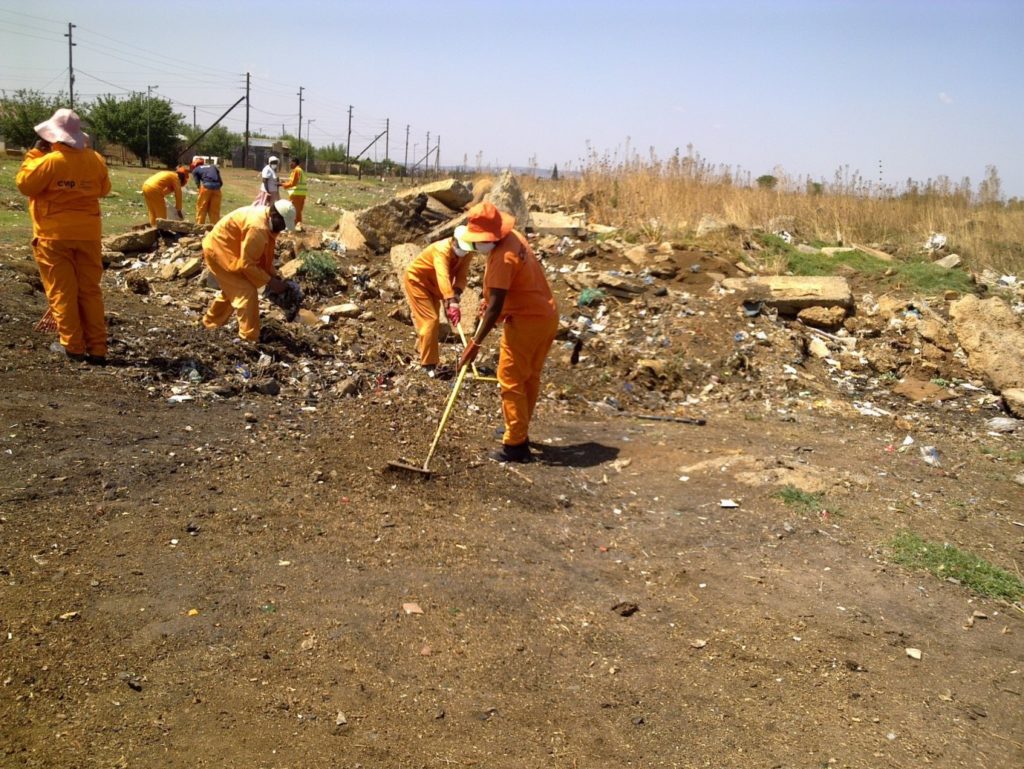
Street harassment is not necessarily seen as an issue to be dealt with by authorities and often law enforcement is not proactive but rather reactionary to incidences of escalated street harassment, such as assault or rape. The Nisaa Institute for Women’s Development works in Orange Farm where community members identified a stretch of veld with dumped garbage and long grass where men are raping and mugging women and a woman’s dead body had been found previously. With Nisaa’s support, community members mobilized themselves and cleared the area of debris and long grass. City officials and the local councillor promised that a park w0uld be put in place to make the area safer. That was in 2013 and they are still waiting. The community members have since become demoralized.

nisaainstitute

Picture courtesy of Nisaa Institute for Women’s Development

Disadvantaged women face street harassment everyday because of the spaces they occupy and the modes of transport they use. Townships were deliberately placed in inconvenient areas to keep people of colour from spaces of privilege by the apartheid government. A privileged woman is not completely immune to street harassment but her material possessions such as a car and the exclusive spaces in which she moves around in create a buffer against street harassment — whether real or imagined. She has the luxury of letting her guard down once in a while. In a literal tale of two cities, I ask again: Is Johannesburg truly a world-class African city?

Nyasha is the public awareness coordinator at the Nisaa Institute for Women’s Development in Johannesburg, South Africa, where the main goal is counselling and sheltering survivors of domestic abuse. She has edited two books by survivors that are available to download for free from the website www.nisaa.org.za.

Share

Filed Under: correspondents, street harassment Tagged With: public transit, south africa, taxi, train, walk

United Kingdom: Freshers’ Week & Ending Sexual Harassment

September 19, 2016 By Correspondent

Ness Lyons for UNmuted Productions, UK, SSH Blog Correspondent

freshersToday marks the start of Freshers’ Week here in the UK. Over 400,000 undergraduates begin their first week of their first term of their first year at university. A longstanding institution, ‘Freshers’ Week’ – or ‘Welcome Week’, to give it it’s formal name –  is fun, flirty and fabulous. A lot of planning goes into making it so and this year, more so than any other, a lot of effort has also gone into ensuring students’ sexual safety.

“Freshers Week is a celebration so please treat it as such,” states the website for Sussex University’s Student Union.  “Respect other students, their bodies and their choices.  If you’re initiating sexual activity with someone, make sure they are as into it as you are, and that they have the freedom and the capacity to make that decision themselves.”  There’s an unfortunate irony in that statement; this is the same university that last month made a decision to continue to employ a lecturer convicted of assaulting his student girlfriend.

The website Unilad has also done a U-turn when it comes to its attitude towards female students. Four-and-a-half years ago, the site was temporarily suspended after making a joke that encouraged rape during Freshers’ Week.  This autumn however, it’s turned over a new leaf. Unilad has paired with the charity Drinkaware to raise awareness of ‘booze-fueled sexual harassment’; their research shows more than half of 18-24 year old female students have experienced sexual harassment on a night out. Unilad and Drinkaware are campaigning to get young people to ‘call out’ such incidents by using the hashtag #GropeFreeNights.

Drinkaware has also launched a non-virtual initiative to protect drunk students from harassment. The Drinkaware Crew are specially trained staff who will patrol student nightclubs and drinking venues in four areas of the UK, including South Wales. Their aim, according to South Wales Police and Crime Commissioner Alun Michael, is to “support customers who are vulnerable as a result of drinking too much and prevent them from potentially becoming victims of crime.” While this quote gives the impression the Drinkaware Crew are there to protect all students from all types of crime, including petty theft, the sober fact is they’re in South Wales because of a series of sexual assaults that took place in Cardiff city centre during the 2015 Freshers’ Week period.

Following the attacks, the police, councils, universities and student bodies in both Cardiff and Swansea formed a task force to prevent the same from happening again this year. Aside from the Drinkaware Crew, they have implemented a Safe Taxi Scheme and Student Safety bus to help students get home safely. While these are all good practical initiatives, further progress has been made by Cardiff University in launching a ‘No Joke’ anti-lad culture campaign in April of this year and NUS Wales running consent workshops. Instead of simply removing potential victims from harm of sexual harassment and assault, it is after all far better to remove the actual risk and that’s what we should see more of.

Ness Lyons is a playwright, filmmaker and spoken word poet. She runs UNmuted Productions, is a member of Soho Theatre Writers’ Lab and is currently developing a script with an award-winning production company. Follow her work at: nesslyons.net and on Twitter: @lyonsness

Share

Filed Under: correspondents, Resources Tagged With: campaigns, sexual harassment, UK, university

“I felt like a piece of meat”

September 18, 2016 By Contributor

I was in a mall parking garage, walking to my car, when two men drove by me. One wolf whistled at me. I yelled at him to “f**k off,” and he yelled back at me: “I was calling you cute, f**king bitch!” I cried afterwards. I felt demeaned and objectified. I felt like a piece of meat. I cried over the fact I was scared and belittled, and reduced to a sexual OBJECT even though I am a human being. I cried over the fact that women are treated like this, and worse, every single day. I cried over the fact there are men in this world who hate women. I cried over the fact that there are people in power in the American government, the country that is supposed to be the most free in the world, who actively try to restrict women’s rights. I cried over the fact that I live in a sexist world.

Optional: What’s one way you think we can make public places safer for everyone?

Teach men to treat women with respect.

– Katy

Need support? Call the toll-free National Street Harassment hotline: 855-897-5910

Share your street harassment story for the blog.
See the book 50 Stories about Stopping Street Harassers for idea
s.

Share

Filed Under: Stories, street harassment

“I felt good about speaking up for myself”

September 15, 2016 By Contributor

I leave home pretty early for work, somewhere between 5:20 and 5:30 am. Anyway I braced myself for the typical AM catcalls before stepping foot out of the door. I made it halfway up the street and hadn’t heard any misogynistic or derogatory remarks and so I thought to myself, “I’ll be okay, so far so good.”

Nope. my optimistic thought immediately vacated as soon as I heard the honk of a horn. The honk came from a black truck who I assumed was only occupied by just the driver alone. I continued to walk further down the street where I came upon the 7-11. I braced myself once again because this 7-11 in particular tends to have an unwelcomed crowd of men just “hanging” out there at odd hours of the night. Anyway I soon realize that the same black truck that honked at me was sitting in the parking lot including not only the driver but three other passengers. GREAT. Next thing I hear is, “Good morning sexy!” Normally I would ignore situations like this because men tend to be bold because they’re in their vehicle, a confined space where they feel safe enough to make unflattering remarks. Ironic. I couldn’t keep walking this time, I was so fed up. I snapped and said, “Shut-up. Just shut the f*** up!”. Silence. They didn’t say anything else to me. I felt good about speaking up for myself but I do wish I didn’t have to go to those lengths to get respect and a peace of mind.

Ever since I snapped a lot of the catcalling I normally experience in the morning and leaving work has declined tremendously. I think the worst part of catcalling, street harassment, etc. is that 98% of the time the perpetrator is a black male. I’m sure I’m not the only one to attest to this. I’m black as well and it just saddens me to know how disrespected the black female is in America, even by her own race.

– Mercedes

Location: Washington, DC

Need support? Call the toll-free National Street Harassment hotline: 855-897-5910

Share your street harassment story for the blog.
See the book 50 Stories about Stopping Street Harassers for idea
s.

Share

Filed Under: race, Stories, street harassment

« Previous Page
Next Page »

Share Your Story

Share your street harassment story for the blog. Donate Now

From the Blog

  • #MeToo 2024 Study Released Today
  • Join International Anti-Street Harassment Week 2022
  • Giving Tuesday – Fund the Hotline
  • Thank You – International Anti-Street Harassment Week 2021
  • Share Your Story – Safecity and Catcalls Collaboration

Buy the Book

  • Contact
  • Events
  • Join Us
  • Donate
  • Facebook
  • Instagram
  • Pinterest
  • Tumblr
  • Twitter
  • YouTube

Copyright © 2026 Stop Street Harassment · Website Design by Sarah Marie Lacy