Our friends Sayfty in India are hosting a 24-hour tweetathon for International Women’s Day 2015. We are hosting the 4 – 4:55 p.m. EDT on Monday, March 9.
Use the hashtags #Sayfty4women #IWD2015 to participate.

Making Public Spaces Safe and Welcoming
Our friends Sayfty in India are hosting a 24-hour tweetathon for International Women’s Day 2015. We are hosting the 4 – 4:55 p.m. EDT on Monday, March 9.
Use the hashtags #Sayfty4women #IWD2015 to participate.
Our board member Dr. Laura S. Logan, an Assistant Professor of Sociology at Hastings College, wrote “Street Harassment: Current and Promising Avenues for Researchers and Activists” for the current issue of the academic journal Sociology Compass. In it she makes the case for why researchers in particular need to focus on street harassment. A short exceprt follows, here is the full article.
“…researchers should focus on street harassment for several reasons…because it is on a continuum of violence against and oppression of femininities and the people associated with femininities. It is also on a continuum of violence against people of color, particularly when we consider institutional racism and the risks of criminalization associated with being in public space if one is, for instance, a Black man or woman. Street harassment is part of a larger culture that values in deed if not always in word men’s sexually predatory behaviors, sexual assault against women and children, women’s subordination and marginalization in politics, the second shift and the wage gap, victim blaming, the murder of transgender women, bashing gay men, repelling girls from math and science before they even get to high school, increasingly limited access to reproductive health care, racial profiling, and more. Research indicates that street harassment limits women’s presence in public space – where the work of politics and social change is most likely to take place – and that women think about harassment, fear it, and plan for it, even in its absence (Gardner 1995). Street harassment is more than a nuisance, more than a threat, more even that the violence that sometimes accompanies it….
Street harassment conveys the message that harassers are entitled to own public space and in a sense to control and violate the people in that space. The message to targets of street harassment is that they should hide, be afraid, pay attention to what potential street harassers want them to do, and wear and say and be. Street harassment robs people of safety, agency, power, and opportunity. Increasingly, activists are writing about and rallying together to address street harassment. It is time that more researchers joined them.”
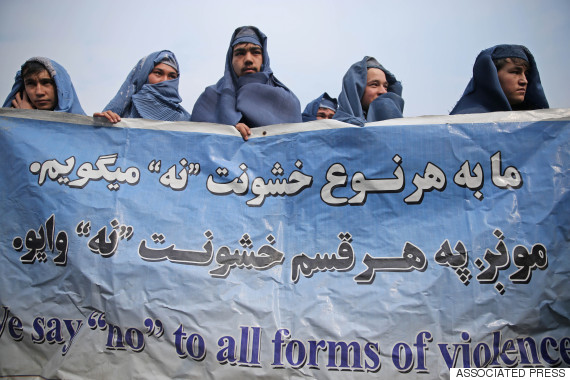
“A group of Afghan men marched through the capital, Kabul, on Thursday to draw attention to women’s rights by donning head-to-toe burqas that for many people worldwide have come to symbolize the suppression of women.
The hardline Taliban forced women to wear burqas in public during their rule in the 1990s and concern is growing in Afghanistan and among its allies that gains for women made since the 2001 U.S.-led ouster of the Taliban are at risk. The men marched under a leaden sky, with the bright blue burqas falling over their heads down to muddy sneakers and boots.
The demonstrators, associated with a group called Afghan Peace Volunteers, said they organized the march ahead of International Women’s Day on March 8.”
Meanwhile, in India, 8 young men on bikes harassed 20 schoolgirls who were riding a bus on their way home from their Board exams. The bus drivers stood up for the girls and the young men escalated their actions, injuring the bus drivers. One girl was also injured when the young men pelted the bus with rocks.
Parents of the girls registered complaints and two of the young men have been found and arrested.
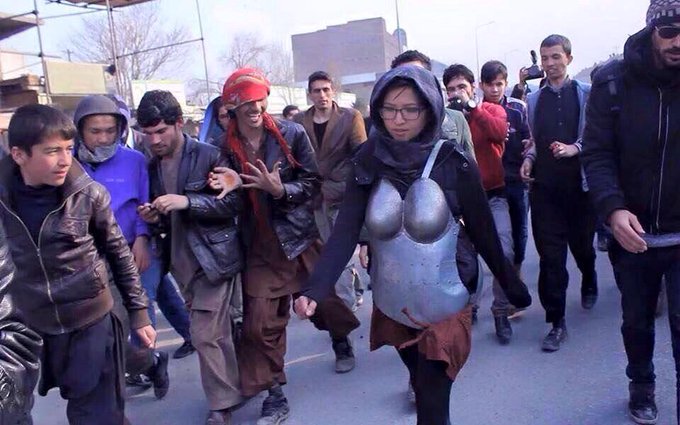 Images and news of Kubra Khademi’s protest in Kabul, Afghanistan have been spreading online. She explained in an interview for this article why she chose to walk through the streets wearing metal armor:
“She first experienced street harassment when she was only four or five; a man touched her backside and she couldn’t say or do anything about it. At that young age, she wished she had an armored shirt so she couldn’t feel the touch of the man. As she grew older, she realized there was another body part of her that caught the attention of men: her bosoms. She says she experienced more street harassment on the streets of Kabul as she grew older. Her experience with street harassment motivated her to make the armored costume, adding that ‘I want people to remember my work, and they will remember my work…I wanted people to start talking about street harassment,’ and she succeeded in that.'”
Today I found out that a lot was happening that we didn’t see in the photos. Men were harassing her, insulting her, throwing rocks at her, and groping the female friends who came to support her. She planned to walk for 10 minutes but after just 8 ran into a taxi to escape the harassment. And even then, men hit the taxi with their hands. That wasn’t the end of it: “After her performance, angry men showed up at her door. Since then, the young artist has been forced into hiding at friends’ homes in the suburbs of Kabul.”
It takes a lot of courage to speak out in the face of that level of backlash and hate. I applaud her efforts, hope she can feel safe soon, and that her bravery will ultimately contribute to a cultural shift in how women and girls are treated in public spaces.
