• About Us
    • What Is Street Harassment?
    • Why Stopping Street Harassment Matters
    • Meet the Team
      • Board of Directors
      • Past Board Members
    • In The Media
  • Our Work
    • National Street Harassment Hotline
    • International Anti-Street Harassment Week
    • Blog Correspondents
      • Past SSH Correspondents
    • Safe Public Spaces Mentoring Program
    • Publications
    • National Studies
    • Campaigns against Companies
    • Washington, D.C. Activism
  • Our Books
  • Donate
  • Store

Stop Street Harassment

Making Public Spaces Safe and Welcoming

  • Facebook
  • Instagram
  • Pinterest
  • Tumblr
  • Twitter
  • YouTube
  • Home
  • Blog
    • Harassment Stories
    • Blog Correspondents
    • Street Respect Stories
  • Help & Advice
    • National Street Harassment Hotline
    • Dealing With Harassers
      • Assertive Responses
      • Reporting Harassers
      • Bystander Responses
      • Creative Responses
    • What to Do Before or After Harassment
    • Street Harassment and the Law
  • Resources
    • Definitions
    • Statistics
    • Articles & Books
    • Anti-Harassment Groups & Campaigns
    • Male Allies
      • Educating Boys & Men
      • How to Talk to Women
      • Bystander Tips
    • Video Clips
    • Images & Flyers
  • Take Community Action
  • Contact

DC: Volunteer with RightRides DC!

October 22, 2014 By HKearl

From our DC friends Collective Action for Safe Spaces:

On Friday, October 31, we’re launching RightRides DC, our groundbreaking new, grassroots program to provide free, safe, late-night rides home for women and LGBTQ people. The number one thing we need to make this service a huge success? YOU! We’re still in need of dispatchers, drivers and navigators. Each car will have a driver and a navigator, so apply with a friend!

Be a part of something big. Sign up to volunteer now!

When Do You Need Me to Volunteer?

Volunteers must attend our training session on Thursday, October 23, and must be available to volunteer during RightRides operating hours from 11:30 pm to 3:30 am on October 31. All volunteers will be provdied with a free Zipcar membership as well as free transportation home!

What Do I Need to Do?
Volunteers will be paired up in driver/navigator teams (yup, that means you can sign up for shifts with a friend!) to operate three donated Zipcars. Prefer not to drive? That’s OK, we need dispatchers, too! Volunteers must have a valid drivers license, be able to attend our October 23 volunteer training, and pass a background check. They also should be able to commit to volunteering on at least two service dates this year.

Why Should I Volunteer?
Staying safe can end up unfairly costing women and LGBTQ folks in time, opportunities, and cold hard cash. RightRides DC, the first service of its kind in the city, is an important first step in addressing the “safety gap” in DC’s public transportation. Do good to your community and be a part of something big!

P.S. Be sure to RSVP to our RightRides DC Launch Party on Wed., 10/29 at Right Proper Brewing Company!

And don’t forget to save the RightRides DC number in your phone now; call or text 202-556-4232 for a free, safe ride home from 12am-3am on October 31. Tell your friends!

Share

Filed Under: Events, Resources, street harassment

Racial Discrimination + Street Harassment

October 21, 2014 By HKearl

This Huffington Post article, written by our board member Patrick McNeil, is excerpted with permission.

“Today marks 20 years since the United States ratified an international human rights treaty aimed at protecting people from racial discrimination (it’s called the Convention on the Elimination of all forms of Racial Discrimination, or CERD).

The committee that monitors implementation of the treaty met in Geneva earlier this year, and it dedicates an entire section of its observations and recommendations to violence against women.

In acknowledging steps the United States has taken to reduce how often violence against women occurs, the committee said it “remains concerned at the disproportionate number of women from racial and ethnic minorities, particularly African-American women, immigrant women, and American Indian and Alaska Native women, who continue to be subjected to violence, including rape and sexual violence.” That includes — as advocates know all too well — street harassment….

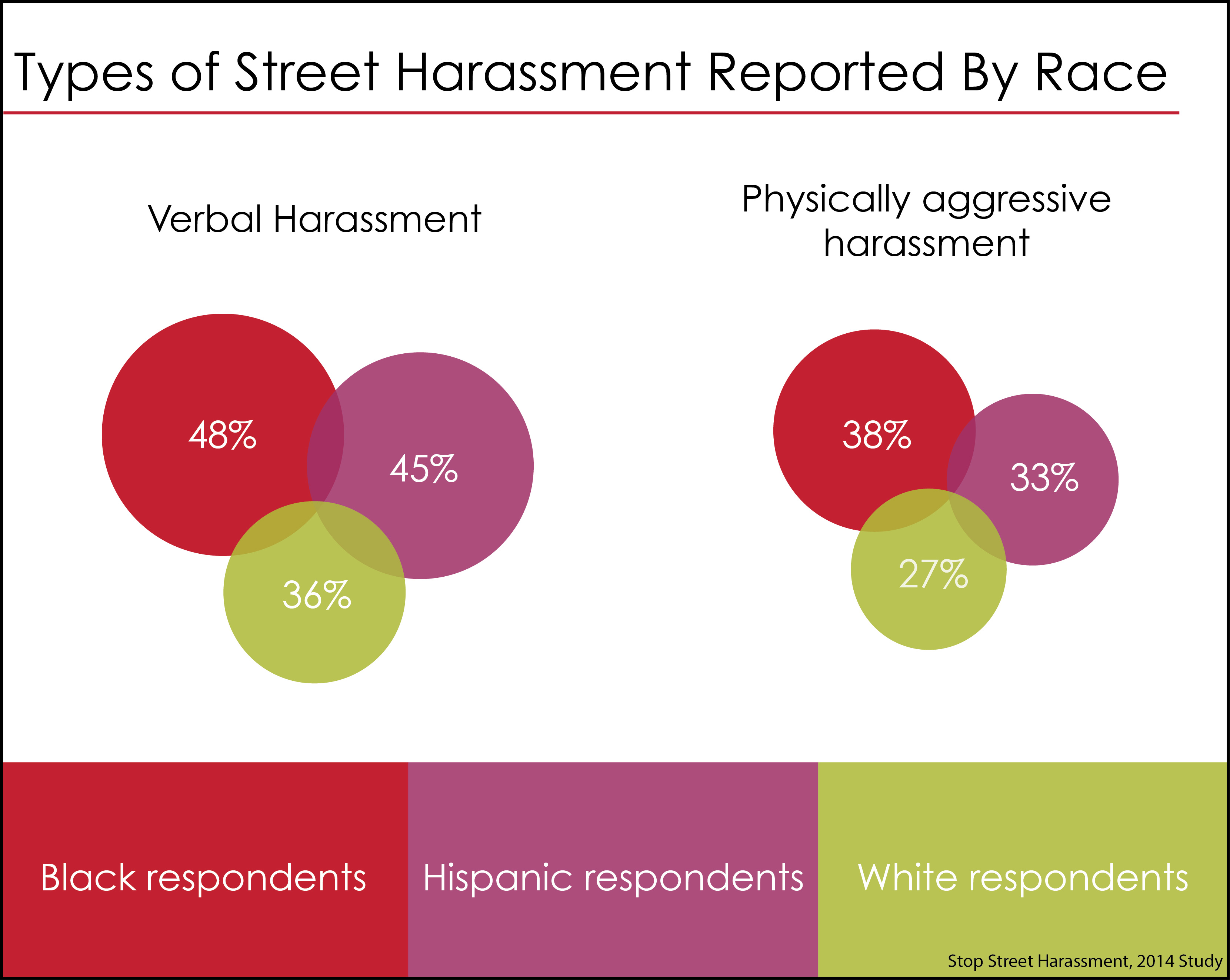
In a national study released earlier this year, SSH found that Black and Hispanic respondents were more likely to say they’ve experienced street harassment (though due to sample size, the racial categories were combined for women and men). And the incidents normally aren’t isolated. Compared to white people, people of color were more likely to report experiencing it sometimes, often or daily (41 percent vs. 24 percent), while white people were more likely to say they’ve experienced it once or rarely.

While the study’s sample is limited, what it suggests is a story we see all too often: women of color in public spaces being harassed — or worse.

Earlier this month, a woman named Mary Spears was killed in Detroit after saying no to a man’s advances and refusing to give him her phone number, prompting Mychal Denzel Smith to ask — who cries when black women die from street harassment?

“Mary Spears’s right to move about freely in the world was denied to her, her life taken from her, and there are no marches,” Smith said. “There are no widespread calls to protect the autonomy of black women and their bodies. The community leaders haven’t deemed this unacceptable and a fate no one should ever face simply because they reject a man’s advances.”

Perhaps street harassment — and these sometimes ugly, horrifying extensions of it — isn’t what the CERD committee had in mind when writing about the ongoing violence enacted toward women in the United States. But it certainly should be.

The committee also urged the United States to “undertake awareness raising campaigns on the mechanisms and procedures available to seek remedies for violence against women.” Organizations like SSH, Hollaback and others are doing just that. Their efforts to teach men and boys not to harass — we should all hope — will lead, someday, to that permanent, systemic change we need to achieve safer public spaces for all.”

Share

Filed Under: national study, race, street harassment Tagged With: CERD, racial discrimination

Street Harassment and the Law: Global Edition

October 15, 2014 By HKearl

Via Hollaback!

“A new report released today offers the first ever global legal resource on street harassment. Led by NGO Hollaback! and the Thomson Reuters Foundation and coordinated by global law firm DLA Piper, the “Know Your Rights” guide compiles the latest legal definitions and information on all forms of street harassment across 22 countries and in 12 languages. A monumental undertaking, the guide involved the efforts of 11 legal teams working in collaboration around the world.

You can download a PDF of the guide here: Street Harassment – Know Your Rights‘”

If you’re in the USA, you can find state-by-state information in our Know Your Rights: Street Harassment and the Law released last December. It’s also available as a PDF.


Share

Filed Under: hollaback, SSH programs, street harassment

News from Belgium, Saudi Arabia, and USA

October 15, 2014 By HKearl

BELGIUM:

“Brussels police write up an average of two fines a day for verbal abuse, mostly targeted at women and gay people. Verbal abuse, such as cat- or name-calling, is prohibited in the capital since a law against street harassment was passed earlier this year.

“We forward all complaints to the prosecutor, but perpetrators often go unpunished for lack of evidence,” commissioner Christian De Coninck told Het Laatste Nieuws. “An officer can only take action immediately if he happens to overhear something, which has happened 18 times over the past eight months.” The perpetrators were given a so-called GAS fine of between €50 and €250.

The police and Brussels-City mayor Yvan Mayeur urge victims of harassment to always file a complaint. “The more insight we get into how, where and when this is happening, the better we can tackle the issue,” said De Coninck. “Everyone should feel safe on our sidewalks.”

SAUDI ARABIA:

“Saudi Arabia is considering hefty fines and jail sentences of up to five years for sexual harassment, it is reported.

Proposals to tighten punishment for unwanted sexual advances follow a surge in the harassment of women at workplaces, streets and shopping malls, says Arab News website.

These proposals are included in a bill that is being considered by the Social Affairs Committee of the Shura Council. It is a consultative body which has the power to propose draft laws, but not approve them. Saudi Arabia is an absolute monarchy where the king has a monopoly of power.”

USA:

“One woman in Detroit was shot and killed after refusing to give a stranger her phone number. Another woman in New York got her throat slashed for refusing to go on a date with a stranger.

Those are just two examples of violence perpetrated against women over the past week. And while those cases grabbed news headlines, other acts of aggression on the street may have very well gone unreported. Advocates working to stop street harassment say the two incidents are a clear illustration of why catcalls and come-ons aren’t harmless for the people on the receiving end.”

USA:

“My name is Kara and I live in Uptown. For the past two months I’ve been working on a campaign to raise money for CTA ads that discourage harassment.

Street harassment is a major issue for me on my block and commute to work, and I wanted to do something to promote awareness. I’ve been working with the CTA’s advertising company on this project, and they seem very willing to help.

I just launched the fundraising page a few days ago, and today I’m having the first meeting with a group of interested people on fundraising ideas and ad content.

If you’re interested in helping/donating/attending the meeting, email me at ctacouragecampaign@gmail.com.”

Share

Filed Under: News stories, street harassment

Seattle street harassers used to face this punishment…

October 15, 2014 By HKearl

In the late 1800s and early 1900s, street harassers were called “mashers” across the USA. In Seattle, if you were convicted of being a masher, you may have to put in time on the chain gang! Wow.

Via CrossCut.com —

“Even though Seattle was awash in prostitution, behavior toward ‘proper’ ladies had to be protected at all costs, especially as the city’s middle class expanded. Two young men in Ballard were sentenced to the gang for getting a 16-year-old Ballard girl drunk on beer.

The Seattle Times defended a chain gang sentence for another young man who was arrested for “annoying a young woman on a Seattle street.” The paper editorialized, “That penalty, too, may seem severe to some, but it does not to any man with a wife or daughter who is occasionally compelled to be upon the streets of this city alone. The offense of the ‘masher’ is akin to that of the rapist. There is only a difference in the quality of the nerve displayed. The penalty under the law is, unfortunately, too light.”

In 1907, police chief Charles “Wappy” Wappenstein decided to crack down on men and boys who harassed proper ladies on the street — a bit ironic for a policeman who was later prosecuted and jailed for taking bribes from prostitution interests in the city. Wappy threatened to start a “second chain gang to be made up of dudes and brainless individuals who have the mashing habit.” He said, “It would be a joy to me to see a finely dressed young man…working alongside a hobo, chained together with irons….”


Share

Filed Under: SH History, street harassment Tagged With: history, mashers, seattle

« Previous Page
Next Page »

Share Your Story

Share your street harassment story for the blog. Donate Now

From the Blog

  • #MeToo 2024 Study Released Today
  • Join International Anti-Street Harassment Week 2022
  • Giving Tuesday – Fund the Hotline
  • Thank You – International Anti-Street Harassment Week 2021
  • Share Your Story – Safecity and Catcalls Collaboration

Buy the Book

  • Contact
  • Events
  • Join Us
  • Donate
  • Facebook
  • Instagram
  • Pinterest
  • Tumblr
  • Twitter
  • YouTube

Copyright © 2026 Stop Street Harassment · Website Design by Sarah Marie Lacy