• About Us
    • What Is Street Harassment?
    • Why Stopping Street Harassment Matters
    • Meet the Team
      • Board of Directors
      • Past Board Members
    • In The Media
  • Our Work
    • National Street Harassment Hotline
    • International Anti-Street Harassment Week
    • Blog Correspondents
      • Past SSH Correspondents
    • Safe Public Spaces Mentoring Program
    • Publications
    • National Studies
    • Campaigns against Companies
    • Washington, D.C. Activism
  • Our Books
  • Donate
  • Store

Stop Street Harassment

Making Public Spaces Safe and Welcoming

  • Facebook
  • Instagram
  • Pinterest
  • Tumblr
  • Twitter
  • YouTube
  • Home
  • Blog
    • Harassment Stories
    • Blog Correspondents
    • Street Respect Stories
  • Help & Advice
    • National Street Harassment Hotline
    • Dealing With Harassers
      • Assertive Responses
      • Reporting Harassers
      • Bystander Responses
      • Creative Responses
    • What to Do Before or After Harassment
    • Street Harassment and the Law
  • Resources
    • Definitions
    • Statistics
    • Articles & Books
    • Anti-Harassment Groups & Campaigns
    • Male Allies
      • Educating Boys & Men
      • How to Talk to Women
      • Bystander Tips
    • Video Clips
    • Images & Flyers
  • Take Community Action
  • Contact

Our New National Study on Street Harassment Found….

June 3, 2014 By HKearl

FOR IMMEDIATE RELEASE
06/03/14

Contact: Holly Kearl, hkearl@stopstreetharassment.org, (571) 449-7326

Two in Three American Women Experience Sexual Harassment and Assault in Public Spaces

Stop Street Harassment Releases a Groundbreaking National Report

RESTON, VA — From “hey baby” to homophobic slurs, from following to groping, sexual harassment and assault in public spaces by strangers, or “street harassment,” is experienced by more than 107 million women in the United States, according to a study released today by the nonprofit organization Stop Street Harassment (SSH). GfK conducted the 2,000-person nationally representative survey in early 2014.
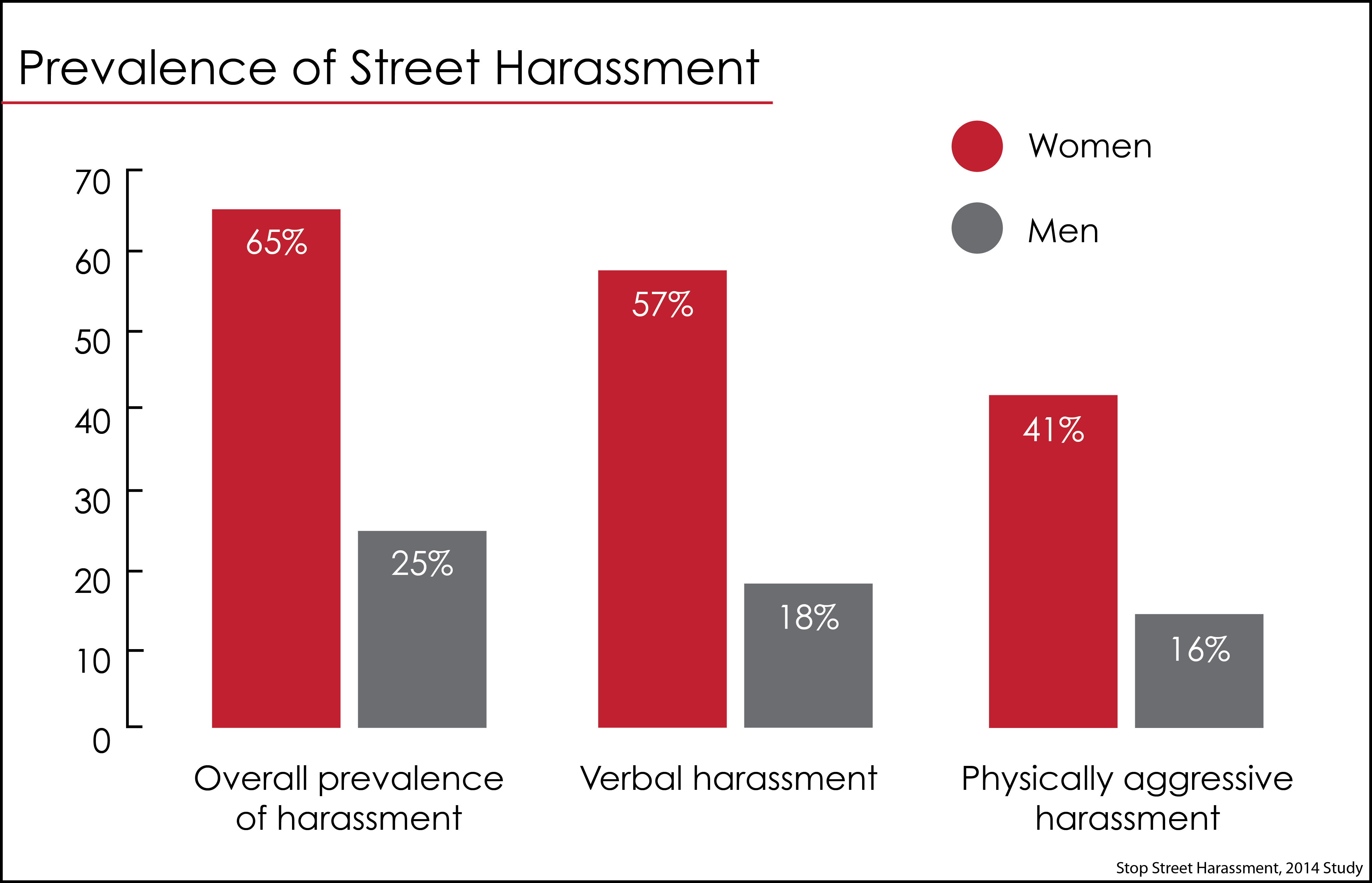
Half of all women had been harassed by age 17 and most women were somewhat or very concerned that the harassment would escalate into physical violence. Most harassed women also reported changing their lives in some way because of it, including avoiding locations where they had been harassed, no longer going places alone, and even moving neighborhoods or quitting jobs.

Some men also reported experiencing street harassment, especially men who identified as gay, bisexual or transgender. Being the target of a homophobic or transphobic comment (9%) was the most common experience for all harassed men. Half of respondents said their harassment started by age 17, and many men changed their lives because of the harassment they experienced.

The overwhelming majority of both women and men identified one man or a group of men as the perpetrator of harassment.

“It is shameful that millions of people are harassed by men simply for being in public spaces while they travel to and from school, work, stores, and events,” said Holly Kearl, executive director of Stop Street Harassment and author of two books on the subject. “If we want to see the United States achieve equality for all, it is imperative that communities — and we as a nation — address this pervasive human rights violation.”

While verbal comments were the most common form of harassment, an alarmingly number of women had faced more severe forms, too. Among all female respondents, 23% had been purposely sexually touched, 20% had been followed, and 9% had been forced to do something sexual.

“Street harassment is a pervasive form of sexual violence that has a profound impact for those who are harassed, their friends and families, and their community. Failing to address this systemic problem continues to perpetuate the belief that this behavior is acceptable,” said Michele Black, PhD, a SSH report advisor and the lead author of the U.S. Centers for Disease Controls (CDC) National Intimate Partner and Sexual Violence Survey 2010 Summary Report. “It is important that bystanders step forward and show that street harassment will not be tolerated,” the recently retired CDC epidemiologist said.

The report also includes stories from 10 focus groups conducted across the nation as well as recommendations for what we all can do to address this problem. There are separate recommendations directed to educators, community leaders, transit authorities, law enforcement, business owners, and individuals, complete with examples of promising and replicable initiatives.
The full report and a two-page executive summary are available for download on the SSH website.

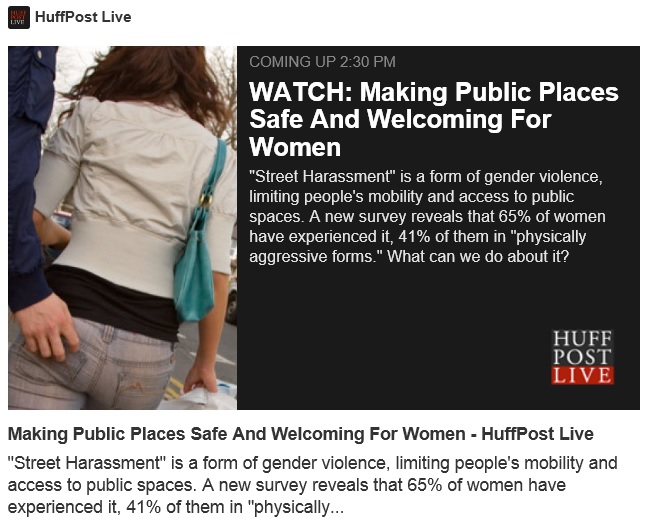
HuffPost Live will air a segment on the report at 2:30 p.m. EDT today.

 

Share

Filed Under: national study, SSH programs, street harassment

What Some of the People Who Don’t “Get” Street Harassment Say

May 30, 2014 By HKearl

After going through The OpEd Project‘s public seminar about how to have a public voice, including how to write op-eds, in 2010, I began writing op-eds on street harassment. I quickly learned not to read the comments, but today, as I did research for an op-ed, I went back to the comments of my second op-ed — the first one where I shared a street harassment experience. Ugh, most of them are upsetting.

I was 27 years old, on a business trip in Oregon, and had a scary experience while running. In my op-ed, which opened with that experience, I connected my verbal harassment experience to recent stories of men raping and murdering women runners to explain why my experience scared me. I concluded with suggestions for what needed to change so that women runners would be safer.

Most of the commenters were quite upset with me and very dismissive. These are excerpts of just a few of their charming remarks:

“Wait til you lose your looks, become middle aged and the male attention stops. Then you’ll really have something to complain about. Lighten up honey.”

“If common cat calls bother her then she should grow a thicker skin and if she is scared then she should learn to protect her self. She should be happy that she has the ability to run and is pretty enough to get a cat call once in a while.”

“Find an appropriate place to run where other runners go. If you choose to just run along the side of the road in spandex or tight shorts, you will receive catcalls. That is just human nature.”

“Ms. Kearl, your picture, unless it’s been photoshopped, suggests you’re attractive. I assume that at least one reason you run is to remain so. If you’d like to avoid whistles, stop running and put on fifty pounds.”

“I would like all women to express their appreciation of my physique when they pass me. I feel harassed when they dont. I am thinking of writing a book which details the harassment of this silence. I call it “Start Public Complements: Making Public Places Welcoming for Men”. I want laws passed that make it illegal for women to pass a man and not make a positive comment about their physical features”

“Boo hoo lady get over your self. Life must be hard for you with your big problems. Grow a thicker skin and learn how to protect your self.”

“A review of Ms Kearl’s web page makes one think that Ms Kearl must seek out this type of harassing response in order to support her thesis for the book. Male predators are a very serious social danger, especially to younger women and this questionable attempt for publicity only demeans the real problem and the need to combat it. (I hope the obvious satire of the above comment helps you to appreciate how misguided Holly’s position is!)”

When I’m in the thick of street harassment activism and largely surrounded by people who get it, I can forget how many people simply do not. They think it’s no big deal, a compliment, or our fault.

In reading these comments, I am very glad that the national report on street harassment will be out on Tuesday proving this is a pervasive problem that negatively impacts people’s (primarily women’s) lives. I hope it can make a difference!

Share

Filed Under: Stories, street harassment

Men Harass and Attack Transgender Women in Atlanta

May 28, 2014 By HKearl

Trigger Warning —

A group of men on a MARTA train in Atlanta, Georgia harassed two transgender women, theb stripped one nude and violently attacked them both. The men ignored the women’s requests to stop. Bystanders, the women said, did nothing to help and some videotaped the attack. Allegedly MARTA staff did nothing when the women tried to report it, but now, after their story has received media attention, MARTA is looking into what happened.

It’s too late though. Both women are moving away from Atlanta after the attack. “I don’t feel safe here,” one of the women said.

The attack began with the type of harassment familiar to many transgender people:

“[They] just kept of asking us was we real,” said Janell Crosby. “Like really trying to get us. ‘Are you real?’ ‘Are y’all this or that?’ Just trying to embarrass us.”

“They were trying to find out if we are men or women,” said Tyra Woods. “I shouldn’t have to disclose who I am to an innocent person who I’m not even interested in talking to.”

Exactly. Their attention, time, and personal history is not the business of random people they encounter in public spaces. They — and everyone — should have the right to be safe and respected in public spaces and have the freedom to just be themselves. And they — and we — need bystanders, transit agencies and law enforcement officers to take street harassment seriously and take appropriate action.

Share

Filed Under: LGBTQ, News stories, street harassment

Men are NOT Entitled to Our Attention, Bodies, or Lives

May 27, 2014 By HKearl

In the wake of the UC Santa Barbara shooting by a man angry at women and the shooting in Stockton, California, where a man allegedly fired his gun at three women Saturday morning who refused to have sex with him and his friends, a lot of people are speaking out about how common it is for some men to feel entitled to women’s attention and bodies.

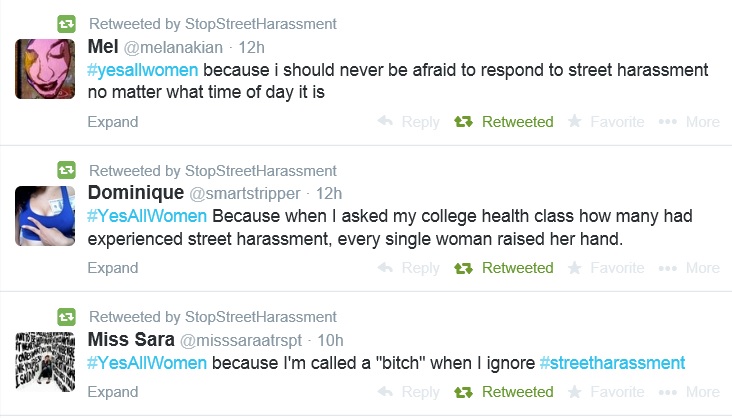
In addition to articles on news sites and posts on blogs on this topic, people are taking to Twitter and speaking out using the hashtag #YesAllWomen.

Also, Deanna Zandt started a new Tumblr called When Women Refuse (Trigger Warning), detailing the violence men incite on women for refusing their sexual advances.

Street harassment is coming up a lot in these conversations because it is a very clear manifestation of this type of behavior. I see this this all the time in the stories I hear and collect on this blog.

1 – In the first place, most street harassment is the outcome of men feeling entitled to comment on, follow and touch women (and men) they do not know, without their permission.

2 – Then, when women refuse to say thank you to the harasser, give him their phone number, agree to sex, smile when he tells them to or otherwise refuses men’s demands, some men get angry and call women stuck up or a bitch, push them, chase them, throw garbage at them*, run them over and shoot them. This is insane. It needs to STOP.

SSH is releasing a huge national report on street harassment in one week. It includes summaries of 10 focus groups and these kinds of stories came up many times. I hope the report can contribute valuable information to this conversation and show why male feelings of entitlement to women needs to be addressed.

Men are never entitled to women’s attention or bodies. This is an important message that we must all spread. Women’s lives depend on it.

* See the full film for the garbage story

Share

Filed Under: national study, News stories, street harassment

Holla:Rev 2014

May 27, 2014 By HKearl

Today is the second Holla:Revolution, an afternoon of speakers, spoken word and dance about street harassment resistance, organized by Hollaback! in New York City.

If you’re not there, you can watch via the livestream (2-5 p.m. EDT) and follow the conversation on Twitter, @iHollaback using #hollarev.

Speakers include many of our friends and allies, like Sally Kohn, Tatyana Fazlalizadeh from Stop Telling Women to Smile, Charla Harlow of the Harlow Project, Soraya Chemaly, and more!


Share

Filed Under: street harassment

« Previous Page
Next Page »

Share Your Story

Share your street harassment story for the blog. Donate Now

From the Blog

  • #MeToo 2024 Study Released Today
  • Join International Anti-Street Harassment Week 2022
  • Giving Tuesday – Fund the Hotline
  • Thank You – International Anti-Street Harassment Week 2021
  • Share Your Story – Safecity and Catcalls Collaboration

Buy the Book

  • Contact
  • Events
  • Join Us
  • Donate
  • Facebook
  • Instagram
  • Pinterest
  • Tumblr
  • Twitter
  • YouTube

Copyright © 2026 Stop Street Harassment · Website Design by Sarah Marie Lacy