• About Us
    • What Is Street Harassment?
    • Why Stopping Street Harassment Matters
    • Meet the Team
      • Board of Directors
      • Past Board Members
    • In The Media
  • Our Work
    • National Street Harassment Hotline
    • International Anti-Street Harassment Week
    • Blog Correspondents
      • Past SSH Correspondents
    • Safe Public Spaces Mentoring Program
    • Publications
    • National Studies
    • Campaigns against Companies
    • Washington, D.C. Activism
  • Our Books
  • Donate
  • Store

Stop Street Harassment

Making Public Spaces Safe and Welcoming

  • Facebook
  • Instagram
  • Pinterest
  • Tumblr
  • Twitter
  • YouTube
  • Home
  • Blog
    • Harassment Stories
    • Blog Correspondents
    • Street Respect Stories
  • Help & Advice
    • National Street Harassment Hotline
    • Dealing With Harassers
      • Assertive Responses
      • Reporting Harassers
      • Bystander Responses
      • Creative Responses
    • What to Do Before or After Harassment
    • Street Harassment and the Law
  • Resources
    • Definitions
    • Statistics
    • Articles & Books
    • Anti-Harassment Groups & Campaigns
    • Male Allies
      • Educating Boys & Men
      • How to Talk to Women
      • Bystander Tips
    • Video Clips
    • Images & Flyers
  • Take Community Action
  • Contact

Part 2: Redefining Rape and Street Harassment: 1880-1920s

October 3, 2013 By HKearl

“Want to take a ride, little girl?” ~ Street harasser from the early 1900s.

As more and more scholars are uncovering, street harassment is not a new social problem. Stanford University Professor Estelle Freedman is one of the latest people to explore this in a chapter of her new book Redefining Rape: Sexual Violence in the Era of Suffrage and Segregation (the major themes of the book and two lessons for today are covered in Part 1).

Street harassment predates this time period and poor women who have always been in public places for work have likely always faced street harassment (and worse), but once middle-class women began experiencing it in large numbers in the late 1800s and early 1900s, they made it a visible problem.

By the late 1800s and early 1900s, a growing number of people lived in cities instead of farms or small villages and many white men used the new anonymity a city afforded them to harass women without facing consequences. Around this time period, more middle-class women of all races were in public spaces unaccompanied by men as they went to work, shops, and the theater, and as “unescorted women,” some men saw them as “fair game.” Phrases used by street harassers sound the same as today: “Hey, baby,” “Hey, honey,” “How much for you?”

Upset by this unwanted attention, many middle class women — both white and black — spoke out and took action, making it visible in newspapers and other publications.

Via Stanford University

Dr. Freedman graciously spoke with me by phone to answer a few questions for this article and sent me a complimentary copy of the book to raffle off!

1. HK: While the chapter focuses mostly on street harassment in the early 1900s, you found references to it in the 1770s when women expressed their concerns about “sexual dangers” in public spaces and spoke about their desire to have the “liberty to travel freely.” Did you find it surprising that very similar language to what anti-street harassment activists use today to talk about equality in public spaces was used hundreds of years ago by women? Why or why not?

EF: I’m not entirely surprised. Women began to use the language of rights in different historical periods in different cultures. In England and the United States, at the time when women were moving into the public sphere in larger numbers it was also a time of democratic revolutions and women said, “We deserve our rights, too.”

While street harassment was probably going on consistently through the centuries, the condemnation of harassment strongly correlates with the height of the suffrage movement in the early 1900s — and in more recent decades, with the feminist movement — and other claims to space and rights.

2. HK: Throughout your chapter, you cite newspaper articles featuring women who verbally and physically fought back against street harassers and even reported them to the police using laws like disorderly conduct so that the harasser faced a fine or a night in jail. Do you have a favorite story among the many you read?

EF: Two stories come to mind right away. One is from 1924 in New York City when a black woman was riding the subway and a white man from a southern state is trying to pick her up as a prostitute. When she refused his attention, he told her that if they had been in Georgia, “I would have you strung up.” A white woman who witnessed this joined her and detained him until the police arrived and arrested him. This is a really rare example of a black and a white woman cooperating together and bringing in the authorities. It was very striking and atypical.

Another story I like is in Chicago around 1906-1908 when women held self defense classes in parks for other women. The idea was to help them feel less fearful in the streets, to walk with confidence, and to give them a sense of their physical power while in public spaces.

3. HK: After World War I, there was a shift in how street harassment was viewed by the public. For a few decades leading up to the war, street harassment was largely seen as inappropriate and women who fought back were applauded, but then there was a shift to where it was seen as flirting and something women asked for by being unaccompanied in public spaces. There was also a heightened concern for the men accused of being harassers. Can you talk a little bit more about why this shift happened and its legacy?

EF: The new sexual values at that time that acknowledged women’s sexual agency and that encouraged women to not accept that they were passive objects of men’s desires was double edged: in some ways it empowered young women to feel able to be active sexual agents but it also meant that the line between wanted and unwanted sexual attention could be blurred. Once flirting became seen as acceptable public behavior between young people in public places, it became easier for street harassers to say, “I wasn’t doing anything wrong. I was just flirting,” and that was taken as an acceptable response.

In the early 1900s, there were police women (mostly white) who went undercover and arrested men who harassed them. One of the reactions to this was the concern that men were being victimized by women who didn’t like men or by women who didn’t understand the new sexual mores. There was a growing belief that female police officers were arresting men for behaviors that should no longer be criminalized.

In short, the new morality just after WWI made it harder to always know when the line has been crossed between wanted and unwanted attention.

In the white press, there were still some stories about women who fight back and they were applauded for doing so, but after the 1910s, there were fewer stories supporting women’s self defense and more sympathetic stories about men fearing being false accused.

Many African Americans migrated north during this time period and in the black press, however, there was actually an increase in articles focused on white men harassing black women and girls, treating them like prostitutes. The black presses called out white men for this behavior and fought to establish black women’s respectability.

4. HK: Today, sometimes men of color are disproportionately blamed for street harassment and depicted as street harassers. I found it interesting, then, to learn that in the time period you examined, the majority of news stories and reports featured white men as harassers – of both white and African American women.  Can you share why this was, and how it ties into the larger issues of race in your book?

EF: In the newspapers, early nineteenth century mashers were all white and for good reason. For a black man to even chance looking at white woman on the street could lead to lynching. They had much less opportunity to be harassers. It would have been highly dangerous. [The newspapers typically only depicted white men as harassers of black women, too. While black women faced street harassment by black men, they largely kept quiet for fear of fueling the myth that black men were sexual predators.]

By type casting white men as a masher, it reinforced the idea that white men are harassers and black men are rapists. Keeping white men in the role of minor offenders masked white men’s more sever offenses against white and black women.

5. HK: Right now, there is a huge resurgence in attention to the issue of street harassment and what we can do about it. What is one lesson you think we can learn today from how the issue was treated and addressed in the late 1800s to early 1900s?

EF: One lesson is that you can’t separate the issue of street harassment from the larger issue of inequality. Women are underrepresented in legislatures, leadership, and are underpaid, and as long as women occupy a subordinate position economically and politically, they’re going to remain more sexually vulnerable.

Whenever women are mobilizing politically to get more rights, they also seem to have more of a vocal voice opposing sexual violence and street harassment. We need to keep the vulnerability of sexual assault and street harassment within the larger grid of women needing more economic and political leadership. We can’t treat it as separate.

Just passing laws doesn’t make a difference; we have to have a cultural shift, too. It’s really those deeper cultural values that can undermine the legal changes. Keeping an eye on what’s happening in the larger culture around sexuality is important and the more that women gain economically and politically, the more they can gain sexually.

You can find other scholarly articles, books, and theses about street harassment in the Stop Street Harassment resources section.

DRAWING:

Dr. Freedman donated a copy of her book (value $35) for me to give away in a drawing! Because of the cost of shipping the heavy book internationally, I am limiting this to people with U.S. addresses.

There are two ways to enter your name into the random drawing, you can:

1. Tweet out an article or resource from the SSH blog and add @stopstharassmnt #Mashers to it.
2. Submit a street harassment story or street respect story to the blog (include an email address and note in the “other” field you want to be included in the drawing).

I will hold the drawing on October 18.

Share

Filed Under: Activist Interviews, SH History, street harassment Tagged With: Estelle Freedman, history, mashers, Redefining Rape

“Thrashing the Mashers”: Notes from Dr. Estelle Freedman’s Talk

October 3, 2013 By HKearl

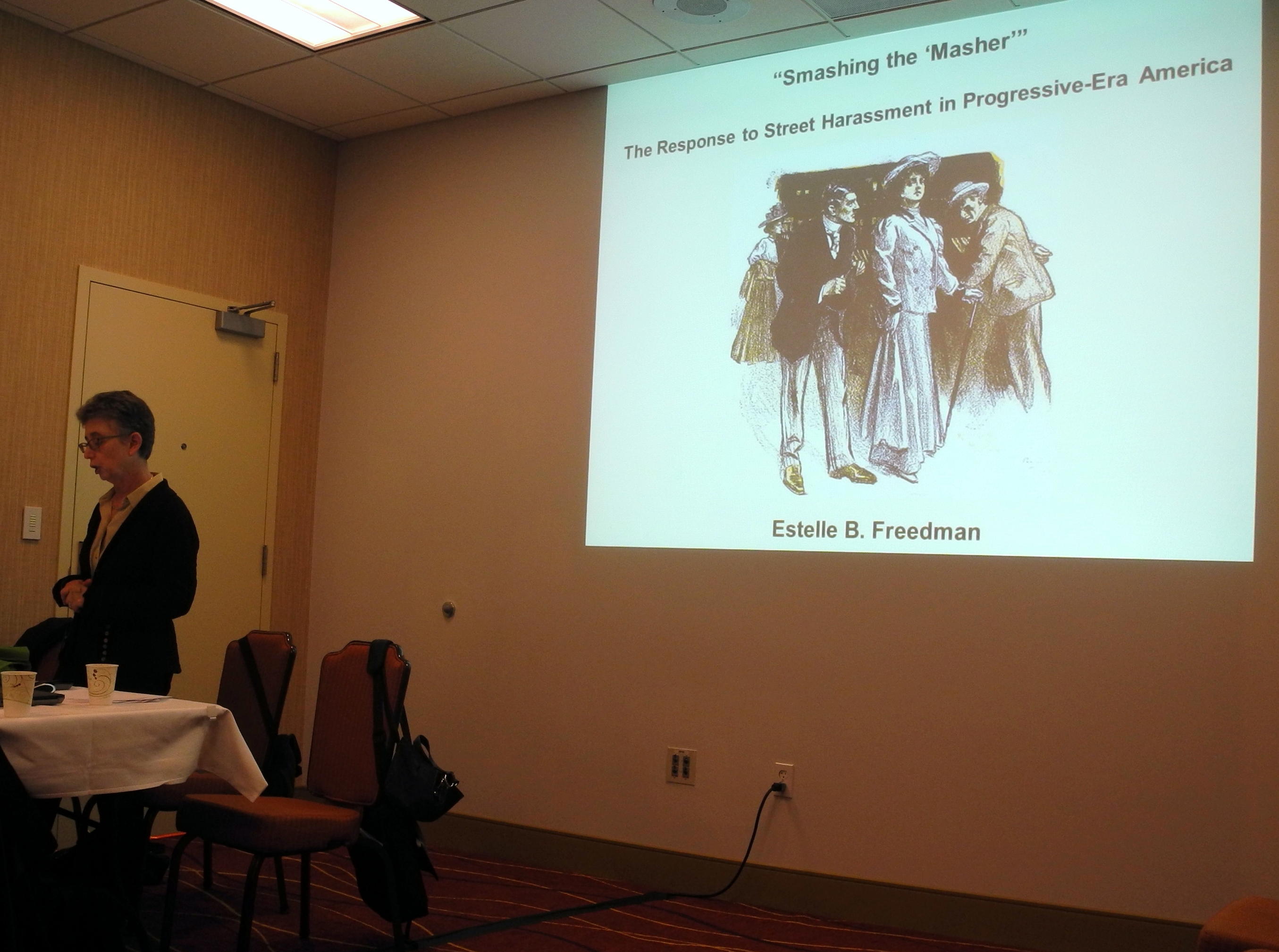
Dr. Freedman presenting on “mashers” at the 2012 National Women’s Studies Association Conference

I was so thrilled to meet Stanford University Professor Estelle Freedman last year at the National Women’s Studies Association Conference and hear her presentation about street harassment in history, the focus of a chapter in her book Redefining Rape: Sexual Violence in the Era of Suffrage and Segregation.

I promised not to publicly share very much about what I learned then until her book was released last month, and now the time has come!

These are really interesting tidbits from her talk that I want to share —

* In the 19th century, “Mash” was a crush. A masher may write a love letter. On stage, actresses were the objects of mashers. Then mashers became a description for men who have affairs and/or men who imagined themselves “ladykillers” or “Don Juans.” Men who went to brothels might also be called mashers.

* In the mid to late 1800s, women who were in public unescorted were seen as “public women” aka prostitutes. They were seen as “fair game” by men on the streets.

* As more poor and middle class women entered public spaces unaccompanied by a man to go to work or to go shopping or to the movies, the  mashers were seen as a problem because they “flirted” with women, invite them, ingratiate themselves to them, and touch them at a theater.

* Newspapers started talking about the need to protect women from mashers (by other men) and there was advice given to women about looking serious, having a mantle of reserve, etc to deter men from approaching them.

* The mashers were largely white middle class men, in contrast to the “sexual predator” of black men. When black men were in the news, it was generally for rape, contributing to the idea that they were worse sexual predators than white men. Lynching of black men covered in papers in contrast to not doing much about white mashers or rapists.

* In early 1900s, we started to see more information about women who fought back – “thrashing the street mashers.” There is a shift from the need to protect women to women being self-reliant.

* In 1905-06 there were a series of murders of white women in Chicago, which led to a panic over protecting women. There was a crack down on men loitering on the streets and more police officers. Some women rejected male protection and said they need political rights to advocate for themselves. They become subjects versus objects in the conversation.

* 1905, a Philadelphia stenographer took boxing lessons from her brother and knocked out a masher. She advocated for other women to do the same and advocated for the Society for the Suppression of the Masher.

* There were women who advocated for women to exercise and get strong so they could resist street harassment.

* In 1914, a niece (by marriage) of the president of the USA was so fed up with being harassed that she said she’d send the next man who harassed her to jail. The next man was a Dr. and he went to jail for 10 days.

* By 1916, there were 300 female police officers across the country: mostly white but some black women in cities. Addressing complaints of mashers was often one of their purposes.

* After WWI, there was a more benign image of the masher, in part because of more relaxed views on courtship and dating. By the 1925 there was a stall of recruitment of female police officers because people were balking at the idea of undercover women arresting men who “flirted” with them on the streets.

* “Ofay Mashers” were white men who harassed black women. The Black Press drew a lot of attention to the street harassment and rape of black women by white men. Men often solicited women, assuming they were prostitutes [still happens today] and would walk through the neighborhoods approaching women, or, later, drove through the neighborhoods and pulled over to harass. Not much is available about black men harassing black women – perhaps it didn’t happen much or there was racial solidarity that kept women from speaking out when it happened.

* As more women wanted to be in public spaces alone, mashers were seen as a real problem. However, after a few decades, the fears of mashers gave way to acceptance of it as flirting.

* Today, as then, we have a common goal of contesting male privilege/access to public spaces through speaking out against street harassment.

Also, check out Part 1 and Part 2 of my review of her book and interview with her about the chapter on street harassers.

After hearing her talk, my domestic partner Mark and I have done several hours of research at local universities on street harassment in history. I hope to create an online exhibit and timeline in 2014. Stay tuned.

Share

Filed Under: SH History

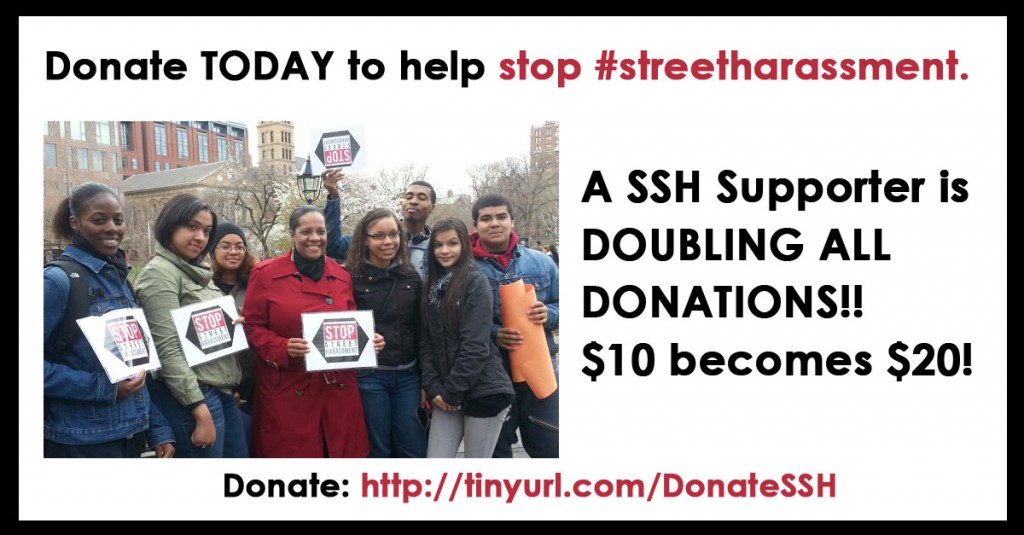
Donate and Double Your Impact Today!

October 2, 2013 By HKearl

Stop Street Harassment is run primarily on volunteer hours and donations from community members so we are thrilled that a generous community member is currently matching all donations made to Stop Street Harassment!

Please consider donating. The minimum amount is $10…which would become $20 and would pay for two hours of our intern’s time or nearly one month for one blog correspondent.

What do your funds go toward?

1. The first-ever, large scale national study on street harassment in the USA. (Total cost: $47,000. We need to raise $30,00 more)

2. The Safe Public Spaces Mentoring program. (Total cost already covered this year: $750. We want to expand next year to fund 10 sites, $5,000)

3. Blog Correspondents program. (Total cost: $2250, 15 correspondents each receive $25 per month)

4. Part-time intern pay — right now SSH’s interns are researching and writing a Legal Know Your Rights Toolkit with state-by-state information on relevant laws you can use to report street harassment and how to report. (Interns are paid $10/hour and work an average of 15 hours per week.)

Thank you!


Share

Filed Under: SSH programs

Philadelphia Survey, City Council Hearing & More

October 2, 2013 By HKearl

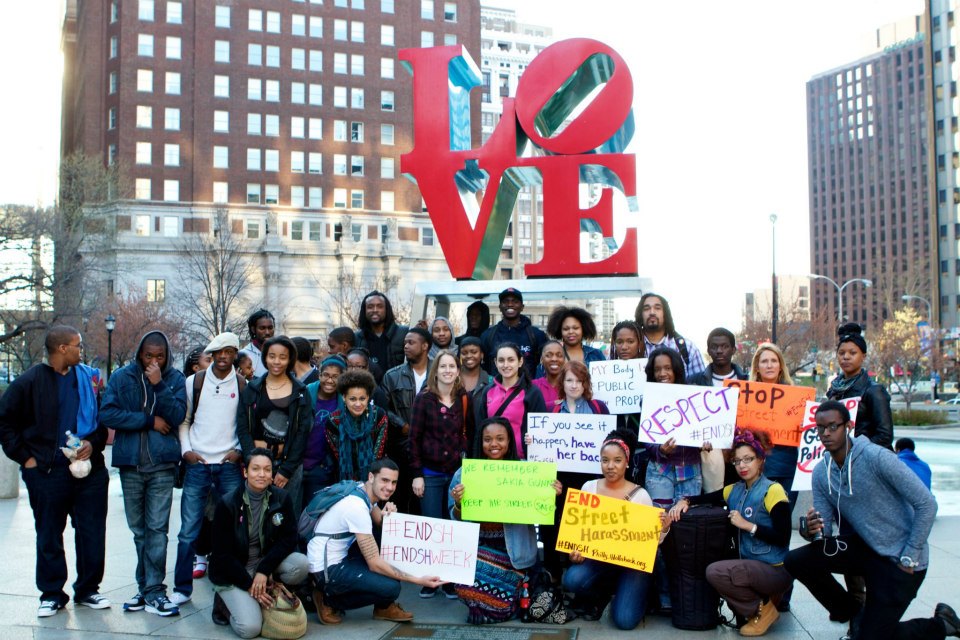
Hollaback! Philly, FAAN Mail and other groups took part in International Anti-Street Harassment Week in April 2013. Photo by Craig Carpenter.

From comic books to subway ads about street harassment, Hollaback! Philly regularly undertakes creative and compelling work. Here are a few current and upcoming things they’re doing!

1 – Survey:

Right now, they’re conducting an online survey for Philadelphia residents — please take it if you live in Philadelphia!

2 – Event with SSH:

On November 6, they will join me and FAAN Mail at the Wooden Shoe Book Store at 7 p.m. for a community discussion about street harassment. The comic book artist will be signing copies of it and I’ll be talking about/signing copies of my book 50 Stories about Stopping Street Harassers. RSVP for the free event.

3 – City Council Hearing:

The most exciting news of all is that they are working with the City Council to hold a street harassment hearing!!

The hearing will be held on November 7, 10 a.m. and Hollaback! Philly will present their survey results. Many members of the public have already signed up to share their stories. One of the main recommendations they’ll all make is for the City Council to sponsor community safety audits.  I will also testify to bring a national and international context to the issue.  Stay tuned for more information closer to the date.

4 – iReport:

Finally, check out this CNN iReport about Hollaback! Philly’s awesome work!

Share

Filed Under: News stories, SSH programs, street harassment

Report: Street Harassment in Boston

September 30, 2013 By HKearl

Hollaback! Boston surveyed more than 500 people about street harassment. Check out their survey results.

Read more in the Metro. and via SSH Blog Correspondent Delia’s article.

Share

Filed Under: Resources, street harassment

« Previous Page
Next Page »

Share Your Story

Share your street harassment story for the blog. Donate Now

From the Blog

  • #MeToo 2024 Study Released Today
  • Join International Anti-Street Harassment Week 2022
  • Giving Tuesday – Fund the Hotline
  • Thank You – International Anti-Street Harassment Week 2021
  • Share Your Story – Safecity and Catcalls Collaboration

Buy the Book

  • Contact
  • Events
  • Join Us
  • Donate
  • Facebook
  • Instagram
  • Pinterest
  • Tumblr
  • Twitter
  • YouTube

Copyright © 2026 Stop Street Harassment · Website Design by Sarah Marie Lacy