• About Us
    • What Is Street Harassment?
    • Why Stopping Street Harassment Matters
    • Meet the Team
      • Board of Directors
      • Past Board Members
    • In The Media
  • Our Work
    • National Street Harassment Hotline
    • International Anti-Street Harassment Week
    • Blog Correspondents
      • Past SSH Correspondents
    • Safe Public Spaces Mentoring Program
    • Publications
    • National Studies
    • Campaigns against Companies
    • Washington, D.C. Activism
  • Our Books
  • Donate
  • Store

Stop Street Harassment

Making Public Spaces Safe and Welcoming

  • Facebook
  • Instagram
  • Pinterest
  • Tumblr
  • Twitter
  • YouTube
  • Home
  • Blog
    • Harassment Stories
    • Blog Correspondents
    • Street Respect Stories
  • Help & Advice
    • National Street Harassment Hotline
    • Dealing With Harassers
      • Assertive Responses
      • Reporting Harassers
      • Bystander Responses
      • Creative Responses
    • What to Do Before or After Harassment
    • Street Harassment and the Law
  • Resources
    • Definitions
    • Statistics
    • Articles & Books
    • Anti-Harassment Groups & Campaigns
    • Male Allies
      • Educating Boys & Men
      • How to Talk to Women
      • Bystander Tips
    • Video Clips
    • Images & Flyers
  • Take Community Action
  • Contact

India: “Braveheart,” #DelhiGangeRape Victim Dies

December 29, 2012 By HKearl

“I want to live,” said “Braveheart” to her mother and brother.

“Braveheart,” one of the nicknames given to an unidentified 23-year-old woman, was in an intensive care unit after six men brutally gang-raped and attacked her on a moving bus in Delhi, India, two weeks ago.

They targeted her because she was traveling alone with a male friend to whom she was not married or related. The men harassed her at first to punish her and when her friend stood up to them, they assaulted him and took her to the back of the bus and raped and beat her. More than an hour later, they threw them, unconscious, off the bus, where a passerby found them and called for help.

On Thursday, Braveheart was transported to a hospital in Singapore because she needed a multi-organ transplant and she was suffering from brain injuries and lung and abdomen infections.

Her wish, her hope to live makes the news of her death that much harder to hear, that much harder to comprehend.

The six men who attacked her have been indicted and they now will be charged with murder. But it is little consolation.

In a city where rape—a vastly underreported crime—is reported every 18 hours and in a country where there were more than 24,000 reported rape cases in 2011, Braveheart’s ordeal is not unusual.

When many women routinely kill themselves after being harassed, groped, or raped by men, it’s not even unusual that she is dead.

In early December, a 16-year-old girl committed suicide after a man tried to hold her against her will on her way home from school. In mid-December, a 17-year-old girl set herself on fire and died from the burns after a boy in the area repeatedly harassed her. In late December, a 17-year-old girl killed herself after she was allegedly gang-raped and then pressured by police to drop the case and marry one of her attackers.

It’s also not unusual that her male friend was beaten up for standing up for her. Many men are routinely hurt and even murdered for challenging street harassment. A father told two young men to stop harassing and following his daughter and the men beat him up.  A 30-year-old man stood up to young men he observed street harassing girls during a procession. Later, in retaliation, they stabbed him to death. A 20-year-old man confronted a group of boys who were harassing his female friend and stabbed him to death, too.

What is unusual about Braveheart’s story is the outcry her rape, her fight to live, and now her death, have sparked.

Every day since her case became public, hundreds and then thousands of people marched, protested, and held vigils in Delhi and in other cities across India. Even when police prohibited gatherings of more than five people, protestors would not be deterred and stood up to water cannons and attacks. Since her death, even more have taken place.

What I also hope will be unusual about her story is that real change will occur to make India safer for women.

Over the last few months, because gender violence is such an obvious problem in India, various promising government initiatives have been announced to address sexual harassment, especially in public places, as many see that as a potential precursor to rape, just as it was in the case of Braveheart.

In Uttar Pradesh’s Meerut town, the police started posting photos of street harassers as a way to shame them and deter future harassment incidents. In Madhya Pradesh, the Chief Minister announced in November that anyone found guilty of street harassment would be denied a passport and driver’s license. In Guwahati, the police force introduced a special all-women division in November to focus on street harassment and assault.

Most important, in November, India’s Supreme Court acknowledged that sexual harassment is a rampant problem, especially on the streets and on public transportation, and one that negatively impacts the lives of the harassed persons. They issued a country-wide standard for addressing the problem.

In Delhi specifically, over the past week, many protest leaders have met with police and government officials and these are some of the proposed measures. 1) More police night patrols; 2) More investigation of bus drivers and their assistants; 3) Banning buses with tinted windows or curtains; 4) Posting photos, names and addresses of convicted rapists on an official website; 5) setting up a committee to speed up trials of sexual assault.

In a meeting with police, the group I Stand for Safe Delhi said they proposed additional measures, such as sensitization training for the police force, crime mapping in the city, and more female police officers.

In November, India’s Supreme Court acknowledged that sexual harassment is a rampant problem, especially on the streets and on public transportation, and one that negatively impacts the lives of the harassed persons. They issued a country-wide standard for addressing the problem.

Street harassment and rape are about a lack of respect for women and about abuse of power though and until there is a shift in how women are viewed and treated, these measures will not be enough, though they are a good start.

There are two other measures that I hope can help create that shift.

The International Center for Research on Women runs a successful program in India called Parivartan. It targets 10 to 16 year old boys in Mumbai and uses the popular sport cricket to challenge them to question traditional notions of manhood in their society and teach them about respecting women and girls and preventing violence against them. In 2013, this program will launch in Delhi. It is important to change the mentality of young men so they learn to respect women.

Because so often the response to men harassing and raping women is measures restricting women’s ability to be in public, the Indian group Blank Noise has launched a #SafeCityPledge to encourage women to be in public. The more women there are in public places, the more people will be used to seeing them there and not challenge their presence, and the safer those places become for everyone. I agree.

So, what is your #SafeCityPledge? What will you do to help make your community safer?

Share

Filed Under: News stories

2012 #EndSH Successes Part 5: Twenty-Five Stories

December 28, 2012 By HKearl

At the end of every year, I like to look back, document and reflect on everything that has transpired in the global movement to end street harassment and assault. Yesterday I wrote about 10 of Stop Street Harassment’s achievements. Today, I’m posting a five-part series about the highlights of ALL activism that happened this year (PDF format). WHAT A YEAR!

Post 1: New anti-street harassment campaigns, new initiatives within existing campaigns, and protests.

Post 2: Creative anti-street harassment initiatives.

Post 3: Government initiatives/collaborations

Post 4: New studies, reports, and significant news articles.

Post 5 (this one): Stories about 25 people who stood up to street harassers this year.

1. In Seattle, Washington, as a woman walked down the street she heard a man shout, “Hey baby, hey baby…” from across the street. When she ignored him, he ran across the street and started following her shouting, “Hey what’s wrong with you, you prejudice? You’re prejudice aren’t you…” (she was white and he was black). She got mad and shouted, “Yes I’m prejudice,” and he looked shocked. Then she said, “I’m prejudiced against men who stand on street corners shouting at women!” His shocked expression changed to one of thoughtfulness and as he turned away he said, “I’m going to think about what you just said.”

2. When a man groped Dawn as she walked to her bus stop in London, she pulled her headphones out and screamed “HOW DARE YOU GROPE ME, YOU DISGUSTING MAN!” A man two metres in front heard her and shouted at the groper, “What are you doing? How would you feel if it was your sister?” The groper looked shocked and ran off.

3. JR was at a gas station payphone in Memphis, Tennessee, when she said a guy getting gas started cat calling her. She was enraged and yelled back at him, “Are you f-ing kidding me?? Has that EVER really worked for you???” He jumped in his truck and left.”

4. When Maureen was at Home Depot in Maryland, she heard a voice behind her say, “Looking good, little mama.” She whipped my head around and without hesitation responded, “Excuse me? I’m not your little mama, don’t think you can speak to me that way. Move along.” He was obviously shocked that she called him out and embarrassed, because everyone else in the isle turned around and stared at him.

5. After observing men at a construction site in London harassing women day after day, Jen filled out a comment card and emailed the company. She received this message from the Head of External Communications, “Dear Jen, I want to let you know that the investigation has begun and whilst we carry out the investigation, the individual is not currently working at our site… thank you for bringing this to our attention. Our Project Director and I would be more than happy to meet with you if you wish.”

6. A woman riding the CalTrain leaving San Francisco, California, was told by a man who’d been leering at her, “Nice legs, very sexy.” She give him a death stare and he turned around, but then leers at her a few more times. When she got up to leave the train, she stood by him and calmly but firmly and loudly said, “The reason I did not respond to you is because what you said to me was sexually aggressive and made me feel threatened…” He apologized and seemed really ashamed and she felt better.

7. Priscilla Dang was running in Vancouver, Washington, when two teenage boys bicycled past her and one of them groped her. She knows kung-fu and she “pushed one of the teenagers to the ground and made him apologize. When the second teenager called her a derogatory term, Dang says she snapped, hitting him in the face several times while simultaneously dodging his punches. According to The Columbian, when he pulled out a knife she used his bike as a shield until a passerby showed up and called 911…The 18-year-old suspect is now facing fourth-degree assault charges, while the 16-year-old will be judged by a juvenile prosecutor.”

8. When a construction worker in Melbourne, Australia, looked HD up and down and told her she looked hot, she replied loudly “I don’t know who you are. We’re not friends.” all without breaking stride.

9. A man on a bicycle sexually assaulted Liz Gorman was sexually assaulted in Washington, DC’s Dupont Circle. She reported the incident to the Metropolitan Police Department and wrote about her experience on the blog of Collective Action for Safe Spaces. Within days, the post had set off a viral reaction, both locally and nationally. It was republished by The Washington Post, Jezebel and Fem2.0. It has been reported on by The Washington Post Local (front page Metro section!), WJLA, WTTG FOX, DCist, DCblogs and the Washington City Paper. The police were eventually able to find her assailant and he admitted to assaulting numerous other women.
DC Breaking Local News Weather Sports FOX 5 WTTG

10. Jackie in Savannah, Georgia: “I was walking home from school and a car followed alongside me for about 10 minutes, constantly asking me if I wanted a ride several times. The last time he asked I looked him in the eye and said, “You’re obviously not going any faster than I am, so why would I want a ride?” He sped away.”

11. In Manhattan, Athena told a harasser he had “bad manners” after he yelled, “I love you and that ass too,” at another woman who had just passed by him.

12. A group of young men harassed a 50-year-old woman named Anne as she walked into a grocery store in Lindsay, Ontario, Canada. The manager of the store refused to do anything about it, so she decided to stop giving him her business and he lost her as a customer.

Photo by Mark Garfinkel, via the Boston Herald

13. In Boston, a young woman would not let a public masturbator intimidate her during her trolley ride home from work. Instead she went into “She-Hulk” mode and lunged at him as he tried to run away. She called the police and he was arrested under the charge of “open and gross lewdness” and was ordered to stay off the public transportation system in the future.

14. In Brooklyn, New York, Kendalle was harassed by a construction worker who made graphic and disgusting noises and motions at her and commented on her legs. She told him, “That’s disgusting. Keep it to yourself” and kept on walking.

15. A man in Austin, Texas, asked to see a woman’s breasts when she approached her car, parked on the road. She paused and then said, “Actually that’s not okay because what you just said is harassment.” He claimed he was flirting and she said, “No, that’s not flirting, because you just made me into a sexual object and that is not okay.” They argued back and forth for a bit and then she said, “Just because I am a woman alone on the street doesn’t mean you can talk to me like that.” He said, “Well if that’s how you’re going to look at this then I can’t win…” She concluded by saying, “That’s how I’m looking at it.”

16. “A bus driver who used to tease female passengers by passing lewd comments and playing vulgar songs learnt the lesson of his life when he was beaten blue and black by two female passengers at [the] Bhatinda bus stop [in India].”

17. A woman was at a nightclub in Vancouver when a man approached her and engaged her in small talk. She politely responded back but then he said, “Nice tits.” She was shocked but looked him right in the eyes, and said, “Yours are pretty nice too.”  Once he comprehended what she said, he was surprised, left her alone and then left the club altogether.

18. When she was on her way to meet a female friend, a woman was harassed by a man on a bus in Edinburgh, Scotland. The woman ignored him. When she and her friend came across him later, he harassed her again, so the friend confronted him. She told him that was he did was street harassment and that he shouldn’t harass women. As she said this, she pointed her finger at him “like he was a naughty child” and kept her voice steady despite her nerves. He stopped and walked away.

19. Yvonne likes to tell her harassers, “I don’t exist for you!” Once when she said this to a man harassing her at the bus stop, he was dumbfounded and walked away.

20. As “Rat Girl” walked through her neighborhood in Brooklyn, New York, an older man walking toward her waved his hand in her face as he passed by and said, “Good evening to you, with your sexy ass.” She stopped, turned around and said in a very loud voice, “That is incredibly rude!” He yelled at her as he walked away but she simply shouted back, “Don’t harass women on the street anymore!”

21. After a group of men started to cat-call a male ally’s friend, he noticed that she was feeling deeply uncomfortable. He asked her if he could do anything to help. She said yes. So he asked the harassers, “Who here respects women?” They looked around confused. He said, “It was quite a wonderful sight to see a group of harassers vexed about the answer to an easy question of respect.”

22. DG is an officer in the Navy and as she walked to an event in uniform in San Diego, California, a man asked her for money. When she turned him down, he told her she “had a tight ass and nice tits, and [she] could give him those.” Another man on the street said, “She doesn’t deserve that. She is an officer in the US Navy and she has given enough.” She thanked him.

23. A group of people were sitting outside a pizza place in Launceston, Tasmania, and as women walked by, the men in the group harassed them. DM observed them harassing other women and then was harassed by them, too. Once she got to safety, she called a friend, got the phone number for the pizza place and reported the men to the owner. She was pleased with his response: “I have been keeping an eye on them and it has been worrying me. Thank you for calling – that’s it, I will tell them to leave. Thank you for talking to us about it.” And she now goes out of her way to eat there since the establishment supports ending street harassment.

24. Emily was driving with the windows down in Sarasota, Florida, and she pulled up beside a pickup truck at a stop light. The two men inside the truck began whistling at her and laughing. She turned off her radio, turned to them and said, “You know, it’s really offensive when men whistle at a woman like she’s an animal. I don’t appreciate that. What you’re doing is called street harassment and it is unacceptable.” The driver said, “I’m sorry ma’am. I’ll stop tonight.”

25. Lauren Bravo in London put on her cape and became a street harassment crusader who used the “fake friend” tactic when she saw a man harassing a woman on a busy road one evening. She said, “I caught the girl’s eye and mouthed, “Are you ok?” to which she shook her head…“There you are!” I cried, launching myself on her.“Hi!” she faked, as I dragged her away. Then we stood together on the pavement miming friendly chat like a couple of am-dram actors, while Slug Man stared, lingered, and eventually slithered off back to his cabbage patch.”

Share

Filed Under: street harassment

2012 #EndSH Successes Part 4: Studies, Reports, Articles

December 28, 2012 By HKearl

At the end of every year, I like to look back, document and reflect on everything that has transpired in the global movement to end street harassment and assault. Yesterday I wrote about 10 of Stop Street Harassment’s achievements. Today, I’m posting a five-part series about the highlights of ALL activism that happened this year (PDF format). WHAT A YEAR!

Post 1: New anti-street harassment campaigns, new initiatives within existing campaigns, and protests.

Post 2: Creative anti-street harassment initiatives.

Post 3: Government initiatives/collaborations

Post 4 (this one): New studies, reports, and significant news articles.

Post 5: Stories from 20 people who stood up to street harassers this year.

Studies & Reports/Thesis:

1. Canada/USA/Global: Women in Cities International partnered with UN Habitat, and Plan International – Because I am a Girl to write the report Adolescent Girls Creating Safer Cities: Harnessing the Potential of Communication for Development.

2. Canada: Women in Cities International also released the report Tackling Gender Exclusion: Experiences from the Gender Inclusive Cities Programme.

3. Croatia: Hollaback! Croatia informally surveyed 500 people (mostly women) online about street harassment in 2012. They found that 99 percent of women experienced some form of street harassment in their lifetime, and 50 percent experienced it by age 18.

4. India: About 92 percent of 5,000 women working in sectors like information technology, hospitality, civil aviation and call centers reported feeling unsafe while travelling to their homes after sunset, according to a nationwide survey by the Associated Chambers of Commerce & Industry of India’s Social Development Foundation. The women live in Delhi-NCR, Mumbai, Kolkata, Bangalore, Hyderabad, Ahmedabad, Pune and Dehra Dun.

5. India: When 1000 women in Mumbai were surveyed, 80 percent said they had been street harassed. “The maximum cases of verbal and physical harassment take place in crowded areas such as trains and railway platforms,” said Shurbhi Sharma, member of We The People Foundation, which conducted the survey recently.

6. Poland: Hollaback! Poland informally surveyed 818 people and found that 85% of female respondents had experienced street harassment in public spaces in Poland, as had 44% of men.

7. Turkey: Hollaback! Istanbul informally surveyed 141 college students about their experiences with street harassment. They found that 93 percent had been street harassed and 69 percent experience street harassment at least on a monthly basis.

8. UK: The Ending Violence Against Women Coalition released two studies about street harassment in London. One study found that 43 percent of women had been harassed during the previous year and the second one honed in on harassment that takes place on public transportation.

9. UK: Hollaback! Gwynedd, Wales, partnered with two student unions and surveyed 400 students about their experiences with street harassment.

10. UK: Jennifer Harrison wrote her graduate thesis on street harassment issues: “Gender segregation on public transport in South Asia: A critical evaluation of approaches for addressing harassment against women.”

11. USA: Ninety-five people responded to the online survey following a Bay Citizen story about unwanted sexual behavior on Muni, BART and AC Transit. Fifty-one percent of respondents said they had experienced unwanted sexual behavior on public transit. Only 6 percent reported it.

12. USA: Patrick McNeil conducted research as part of his master’s thesis at The George Washington University about the street harassment of gay and bisexual men. He surveyed 331 men around the world, and about 90 percent said they are sometimes, often, or always harassed or made to feel unwelcome in public spaces because of their perceived sexual orientation – a figure that is far too high.

13. USA: In partnership with Hollaback!, researchers from the Worker Institute at Cornell asked 110 New York City-based social service providers whether or not they receive reports of street harassment, and if so, how they respond to those reports. They found that more than 86 percent of respondents had received reports of street harassment from a client, constituent or consumer.

14. USA: Laurel Long wrote her college thesis on street harassment at Goucher College in Baltimore, Maryland.

Select Important Articles (in no particular order):

{Unwinona}, “I debated whether or not to share this story.“

LAist, “Women Share Their Stories Of Sexual Harassment (And Worse) On Public Transportation”

The Guardian, “Wolf-whistling is just the start – harassment is not harmless”

CNN, “Hey baby! Women speak out against street harassment”

Sparkwood & 21, “The Story of My Sexual Assault on Muni in San Francisco”

The Bay Citizen, “Why Transit Riders Don’t Report Unwanted Sexual Behavior“

Sparkle All Day, “The Punch Heard Round The World”

The Guardian, “How to stop sexual harassment on public transportation“

International Business & Law, “Brussels’ Offensive-Language Fines Highlight Widespread Sexual Harassment“

The Voice of Russia, “Sexual harassment in Russia“

The Jerusalem Post, “Egyptian women battle harassment on the streets“

The F Word Blog, “Spanish feminist subjected to harassment campaign”

Le Nouvel Observateur, “Harcèlement de rue : les femmes racontent le machisme“

The Atlantic, “Violent Protests in India Over Rape Case”

Global Press Institute, “Women Break Silence About Sexual Harassment on Nepali Buses“

USA Today, “Arab women cry for end to harassment“

Eliminating the Impossible, “Street Harassment 102: When You’re Blind and a Woman“

Fair Observer, “Natasha Smith: Is This Egypt?”

Week Woman, “My Hijab, My Body – A Muslim Feminist on Street Harassment in Argentina“

Heeb Magazine, “A Woman’s Guide to Hasidic Street Harassment”

Open Democracy, “Street sexual harassment: breaking the silence in Yemen”

The Daily Star Lebanon, “Public masturbation: Where sexual harassment meets disorder”

Libya Herald, “Sexual harassment of Libyan women”

Welcome to Kosovo 2.0, “Kosovo’s Streets: A woman’s perspective“

IRIN, “NEPAL: Women demand end to sexual harassment“

High on Cliches, “Wie verhalte ich mich möglichst nicht wie ein Arsch?“

Tunisia Live article about street harassment.

Time, “Ladies First: Czech Railways Rolls Out Female-Priority Compartments“

Jeddah Mind Trick (Saudi Arabia), “Walking While Covered”

Empty Nest Expat, “Breaking the Silence on Street Harassment in Istanbul“

Latin America, “Argentina: Women suffer from sexual harassment on the street, a social problem”

Clutch Magazine, “Hey There Pretty Lady: How Street Harassment Affected My Body Image and How I Overcame It”

The March 2012 issue of Cosmo magazine includes advice for dealing with gropers. Read an extended version of SSH founder Holly Kearl’s advice on the SSH blog.

Crates and Ribbons, “The Kissing Sailor, or “The Selective Blindness of Rape Culture”

Share

Filed Under: street harassment

2012 #EndSH Successes Part 3: Government Initiatives/Collaborations

December 28, 2012 By HKearl

At the end of every year, I like to look back, document and reflect on everything that has transpired in the global movement to end street harassment and assault. Yesterday I wrote about 10 of Stop Street Harassment’s achievements. Today, I’m posting a five-part series about the highlights of ALL activism that happened this year (PDF format). WHAT A YEAR!

Post 1: New anti-street harassment campaigns, new initiatives within existing campaigns, and protests.

Post 2: Creative anti-street harassment initiatives.

Post 3 (this one): Government initiatives/collaborations

Post 4: New studies, reports, and significant news articles.

Post 5: Stories from 25 people who stood up to street harassers this year.

UN meeting

1. Global: In May, municipal authorities from cities around the world met in Nairobi, Kenya, to discuss how to make cities safer and more sustainable, particularly for women and children. This was the annual meeting of the five-year Safe Cities Global Programme, launched in 2010 by UN Women. It’s taking innovative approaches to making public spaces safer in five pilot cities: Cairo in Egypt; New Delhi in India; Quito in Ecuador; Port Moresby in Papua New Guinea and Kigali in Rwanda. Studies conducted in 2011 by UN Women in these five cities showed that many women and girls experience sexual harassment or violence in public spaces on a daily basis.

2. Global: Various Hollaback! leaders met and worked with government officials to address street harassment, including Hollaback! Gwynedd, Wales, Hollaback! Edinburgh, Hollaback! Brussels, AtreveteDF (Mexico City), Hollaback! Philly, and Hollaback! New York. (Read their State of the Streets 2012 report for more information.)

3. Belgium: Over the summer, college student Sofie Peeters’ documentary about street harassment went viral, launching an international discussion about the topic and leading the government of Brussels to pass legislation addressing it.

4. Bolivia: Because of many women involved in politics in Bolivia report harassment at public events and in public spaces, Bolivia’s Legislative Assembly approved the Law against Harassment and Political Violence against Women. UN Women: “The new law provides a two to five year prison sentence for anyone who pressurizes, persecutes, harasses or threatens an elected woman or those exercising public functions. The penalty for practicing physical, psychological or sexual aggression is three to eight years in prison.”

5. Egypt: In a country where very few street harassers are punished through the court system, many people celebrated with a Cairo court sentenced a man to a two-year prison term as well as a LE2,000 ($330) fine for grabbing a young woman’s bottom while she was waiting for a cab.”

6. Europe: Twenty-five members of the Council of Europe have now signed the “Council of Europe Convention on preventing and combating violence against women and domestic violence,” which was written in April 2011. (See which countries have already signed it.)

Countries that sign the Convention agree to pass legislation or criminalize or impose sanctions against different types of gender violence, including domestic violence, honor killings, stalking, and sexual harassment. Here’s the exact language about sexual harassment, which presumably includes street harassment since it does not say the sexual harassment must occur in workplaces or schools:

“Parties shall take the necessary legislative or other measures to ensure that any form of unwanted verbal, non-verbal or physical conduct of a sexual nature with the purpose or effect of violating the dignity of a person, in particular when creating an intimidating, hostile, degrading, humiliating or offensive environment, is subject to criminal or other legal sanction.”

In order to enter into force, it needs 10 ratifications and it does not yet have them.

7. India: In Uttar Pradesh’s Meerut town, the police started posting photos of street harassers as a way to shame them and deter future harassment incidents.

The Virangana force in Guwahati. Via Rediff.com

8. India: In Madhya Pradesh, the Chief Minister announced in November that anyone found guilty of street harassment would be denied a passport and driver’s license.

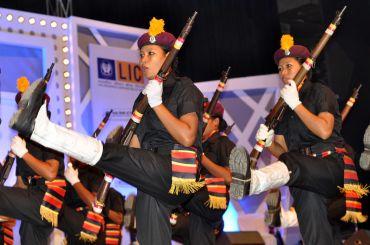
9. India: In Guwahati, the police force introduced a special all-women division in November called Virangana to focus on street harassment and assault. The 100 women were specially trained and carry swords.

10. India: In November, India’s Supreme Court acknowledged that sexual harassment is a rampant problem, especially on the streets and on public transportation, and one that negatively impacts the lives of the harassed persons. So the Supreme Court issued a country-wide standard for addressing the problem.

11. Russia: This year the feminist group RosNahal tackled street harassment. They made a video about it and engaged in lobbying and activism that has led the Russian government to take notice. “Russia’s ruling party has decided that Russia needs a separate article prosecuting sexual harassment in its administrative code while the logistics for enforcing and proving such offences are still up in the discussion. Russia’s ruling party has suggested a steep fine of up to 50,000 rub which is about 1,000£ to punish any would-be sexual harassers.”

12. Saudi Arabia: The Shura Council in Saudi Arabia finalized the draft of an anti-sexual harassment.

13. UK: The Ending Violence Against Women Coalition successfully pressured several of the candidates who ran for mayor of London in May to put street harassment on their agenda, but sadly, none of those candidates were elected.

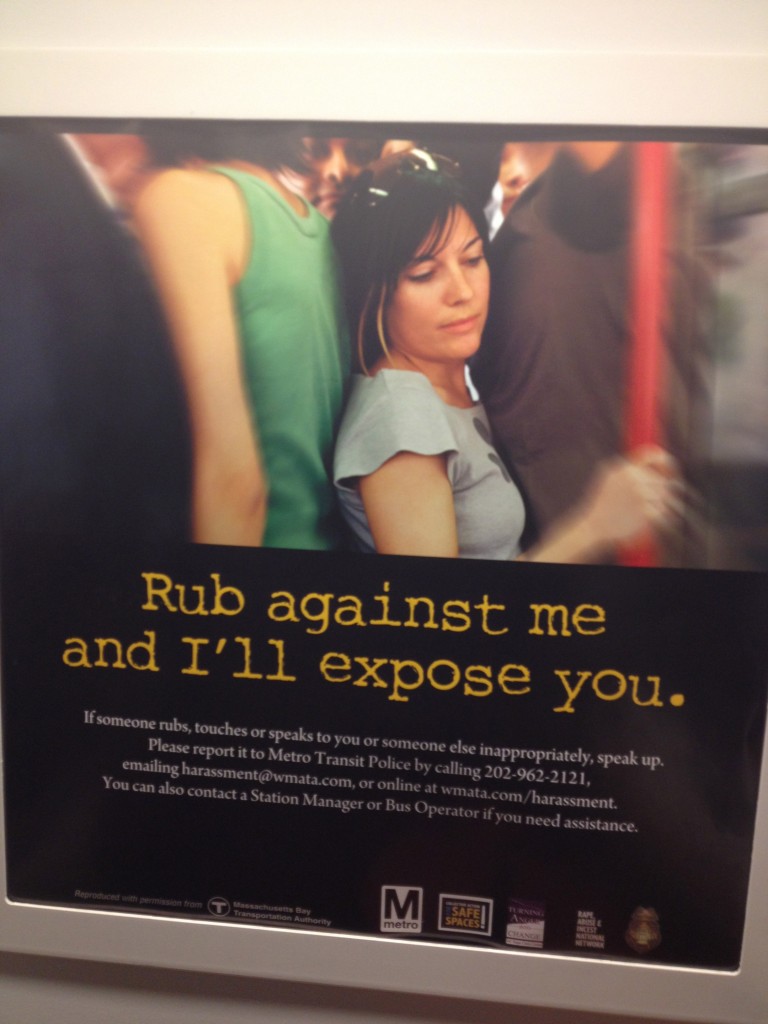
14. USA: After unsuccessfully trying to meet with the transit authority in Washington, DC, to discuss sexual harassment on their system, I joined a small group of people and testified about the problem before the Washington, DC City Council in February (the team was led by Collective Action for Safe Spaces). Ward 4 City Council Member Muriel Bowser was disturbed by the stories and statistics and told the transportation authority to do something! Two weeks later, they had formed a taskforce and got to work changing how they track and respond to harassment complaints, creating an online reporting form, and launching a poster campaign.

15. USA: At the urging of Collective Action for Safe Spaces and Stop Street Harassment, in Washington, DC, Ward 4 City Council Member Muriel Bowser introduced legislation that will make it easier to prosecute people who expose themselves in public (e.g. public masturbators and flashers). It is still pending.

16. USA: New York is considering a bill that would make harsher punishments for engaging in unwanted sexual touching in public spaces.

Share

Filed Under: street harassment

2012 #EndSH Successes Part 2: Creative Initiatives

December 28, 2012 By HKearl

At the end of every year, I like to look back, document and reflect on everything that has transpired in the global movement to end street harassment and assault. Yesterday I wrote about 10 of Stop Street Harassment’s achievements. Today, I’m posting a five-part series about the highlights of ALL activism that happened this year (PDF format). WHAT A YEAR!

Post 1: New anti-street harassment campaigns, new initiatives within existing campaigns, and protests.

Post 2 (this one): Creative anti-street harassment initiatives.

Post 3: Government initiatives/collaborations

Post 4: New studies, reports, and significant news articles.

Post 5: Stories from 25 people who stood up to street harassers this year.

1. Afghanistan: Young Women for Change released two short films about street harassment.

2. Afghanistan: Talalo, an Afghan graffiti band, fought street harassment by putting messages on street walls.

3. Azerbaijan: Jake Winn, a Peace Corps volunteer and a youth development facilitator in northern Azerbaijan helped his male students make an Anti-Street Harassment video. The title, “Ay Gardash! Kishi Ol!”, can be translated to, ‘Hey man, be a gentleman!” Peace Corps is working on distributing the video throughout the country, along with a lesson plan and discussion questions for other volunteers to use with their own students. Download the lesson plans: Street Harassment Lesson Plan (English) | Street Harassment Lesson Plan (Azerbaijani)

4a. Belgium: For Meet Us on the Street, Hollaback Brussels held a chalk walk where they visited places they’d been harassed and reclaimed those spots by telling their stories aloud and writing in chalk that they reclaim the area. They’ve held additional chalk walks since then.

4b. Belgium: Over the summer, college student Sofie Peeters’ documentary about street harassment went viral, launching an international discussion about the topic and leading the government of Brussels to pass legislation addressing it. View the full video with English subtitles:

5. Canada: METRAC released a free “Not Your Baby App” to provide responses you can use when experiencing harassment

6. China: After a subway company in Shanghai, China, blamed women for “causing” sexual harassment in June, two young women went to a subway station and wore a “black veil over their face, stepped into a crowded subway station with signs that read, ‘I want my coolness under the sun, but not the pervert in the subway,’ and ‘I can reveal myself, and you cannot bother me.’”

7. Egypt: Anum Khan created the Egyptian version of the video “What Men Say to Men Who Harass Women on the Streets” in Egypt.

8. Egypt: Youth in Egypt created a short movie about street harassment and verbal abuse.

9. Germany: Because soccer/football is so popular in Germany, the group ProChange decided to use the concept of “red cards” as a creative way to speak out against street harassment. In the spring, they distributed 2000 “Red Card” against sexism, “Pink Card” against homophobia, and “Purple Card” Courage. They also distributed special coasters in pubs, bar, from clubs in Dortmund, Germany.

10. India: In early 2012, male ally Dhruv Arora launched the website GotStared.At where people can post photos of the clothes they were wearing when harassed along with their story. What really went viral though were graphics with clever messages against victim-blaming, which, once posted on Facebook, were shared widely. In the fall, GotStared.At won the prestigious UN World Summit Youth Award in the category Power 2 Women!

11. India: Mumbai Boss asks, “What’s the best way to deal with eve-teasers? A full body wax, one tight slap and flour grinding are some of the many punishments suggested in this video survey of Mumbai women.”

12. Israel: In response to ultra-Orthodox Jewish men who called an 8-year-old a whore as she walked to school in Israel, in January, a group of 250 women from  Bet Shemesh held a Flashmob dance in the city square, protesting women’s exclusion from the public domain and the harassment of women and girls who do go in public.

13. Istanbul: When Hollaback Istanbul launched the Hollaback! Green Dot Bystander Campaign, they created a companion video with male allies letting harassed persons know they “have their back.”

14. Lebanon: The Adventures of Salwa Campaign released a video about Salwa taking on harassers at a club. She also reports the harasser to the police and then has to stop the police officer who harassed her!

15. Pakistan: In Karachi this spring, students at university SZABIST hosted a “How to respond to harassment” session, a self defense class, and they created a PSA about harassment.

16. Pakistan: Naveen Naqvi created a powerful PSA video about street harassment for gawaahi.org.

17. South Africa: Filmmaker Pascale Neuschäfer created a powerful short film about street harassment in her community last year and in January, she created a new PSA against street harassment. It was filmed during the SlutWalk in Capetown last year.

18. UK: Those Pesky Dames posted this video: “Look at the legs on that” – street harassment needs to stop

19. UK: Isobel Williams created an amazing design project to address street harassment for school. She designed a booklet about the issue that includes a card which women can carry and give to a harassing man as a decoy. The card lists a website and if they visit the site, they can view a short film offering them a chance to gain a reality check on their actions.

20. UK: Hollaback Edinburgh created a humorous, “Said No One Ever” Tumblr. Read an interview with the creator.

21. USA: Bix Gabriel and Joe Samalin are part of the NYC team that created the viral video “Shit Men Say to Men who Say Shit to Women on the Street” for International Anti-Street Harassment Week. In September, the video won the US government’s “Seeing My World through a Safer Lens Video Contest“

23. USA: One woman launched a Tumblr where she records everything men say to her on her way to the train.

24. USA: Aqueelah Grant wrote a practical book about how to deal with crimes on the street, including street harassment called HoodRules. Here’s an interview with her.

25. USA: There’s a new tumblr called Street Harassment Fashion that challenges victim-blaming. Read an interview with the founder.

26. USA: Tatyana Fazlalizadeh is an oil painter/illustrator whose work focuses on portraiture and social/political themes. She’s the artist behind popular anti-street harassment fliers found in Philadelphia, New York City, and Washington, DC. Read an interview with her.

27. USA: Earth Angel created a petition to tell Planet Fitness Gym to deal with harassers at their facility after they ignored her complaints about harassment.

28. USA: Jennifer Phan made a video about street harassment for a sociology class assignment.

29. USA: HappRat is posting her street harassment experiences on a map to show all of the places and times she’s harassed. Read an interview with her.

30. USA: In June, Queerocracy, a New York City-based grassroots organization, presented QRASH Course: Queers Resisting All Street Harassment, an afternoon-long training event for people who witness and experience street harassment in the NYC area.

31. USA: The FX show Totally Biased with W. Kamau Bell covered street harassment!

32. USA: In April, Mary wrote a summer street harassment poem.

33. USA: Collective Action for Safe Spaces & Voices of Men rode the Washington, DC, Metro and collaborated to perform a skit about harassment to bring attention to the issue. They performed it several times on several cars and received positive feedback.

34. USA: You can now view the full anti-street harassment documentary “War Zone” online.

35. USA: During the spring semester, San Jose State University’s Women’s Resource Center did a lot to address gender violence. They created a mural, they put on a production of the Vagina Monologues, created a Tunnel of Oppression (800 people walked through it) and they made several videos about street harassment.

36. USA: Council Member Julissa Ferreras and Hollaback! led an historic community safety audit on Saturday, May 5th in Queens, New York.

37. USA: Denice Frohman, Poet, performs “Dear Straight People” and takes on people who harass lesbians.

38. USA: FAAN Mail and Hollaback Philly created a video where teenage girls “draw from personal experience and testimony to illuminate what gender-based street harassment sounds like.”

39. USA: High school students in Chicago created a 30-second anti-street harassment PSA through Free Spirit Media

40. USA: Hollaback Bmore talked about street harassment with the girls from St. Francis Community Center and helped them relieve their frustration with street harassers with….a water balloon fight!

41. USA:  Ines Ixierda in the Queer Women of Color Media Arts Project created a film about street harassment through the stories of Woman of Color and their strategies for self-defense and self-determination.

42. USA: CATCALLED is a collection of women’s stories about street harassment in New York City. For two weeks this August, eleven women in the city kept a log of their harassment experiences, and how the presence (or absence) of catcallers affected their actions.

43. USA: A woman in the USA has recorded more than 50 of her experiences of street harassment over the past few months.

44. USA: SlamPow! Production use humor + anti-street harassment messaging in their creative video “Meat.”

45. USA: Students made this video for their college class HONS201: “Feminism, New Media and Health.”

46. USA: Watch Chescaleigh talk catcalls.

47. Yemen: The Safe Streets campaign released a video about street harassment.

48. I am Not an Object Tumblr’s founder developed a series of 600 “catcalling cards.” They are tiny letterpress cards with a fake number that women who are being followed / aggressively harassed by catcallers can give away so the perp will leave them alone. Once the perpetrator calls the number, he will hear a recording of women telling their harassers exactly what they think of them.


Share

Filed Under: hollaback, male perspective, Resources, street harassment, year end

« Previous Page
Next Page »

Share Your Story

Share your street harassment story for the blog. Donate Now

From the Blog

  • #MeToo 2024 Study Released Today
  • Join International Anti-Street Harassment Week 2022
  • Giving Tuesday – Fund the Hotline
  • Thank You – International Anti-Street Harassment Week 2021
  • Share Your Story – Safecity and Catcalls Collaboration

Buy the Book

  • Contact
  • Events
  • Join Us
  • Donate
  • Facebook
  • Instagram
  • Pinterest
  • Tumblr
  • Twitter
  • YouTube

Copyright © 2026 Stop Street Harassment · Website Design by Sarah Marie Lacy