• About Us
    • What Is Street Harassment?
    • Why Stopping Street Harassment Matters
    • Meet the Team
      • Board of Directors
      • Past Board Members
    • In The Media
  • Our Work
    • National Street Harassment Hotline
    • International Anti-Street Harassment Week
    • Blog Correspondents
      • Past SSH Correspondents
    • Safe Public Spaces Mentoring Program
    • Publications
    • National Studies
    • Campaigns against Companies
    • Washington, D.C. Activism
  • Our Books
  • Donate
  • Store

Stop Street Harassment

Making Public Spaces Safe and Welcoming

  • Facebook
  • Instagram
  • Pinterest
  • Tumblr
  • Twitter
  • YouTube
  • Home
  • Blog
    • Harassment Stories
    • Blog Correspondents
    • Street Respect Stories
  • Help & Advice
    • National Street Harassment Hotline
    • Dealing With Harassers
      • Assertive Responses
      • Reporting Harassers
      • Bystander Responses
      • Creative Responses
    • What to Do Before or After Harassment
    • Street Harassment and the Law
  • Resources
    • Definitions
    • Statistics
    • Articles & Books
    • Anti-Harassment Groups & Campaigns
    • Male Allies
      • Educating Boys & Men
      • How to Talk to Women
      • Bystander Tips
    • Video Clips
    • Images & Flyers
  • Take Community Action
  • Contact

Participate in Research

August 13, 2015 By HKearl

If you identify as female and are at least 18 years old, you can help out with this street harassment study.

“My name is Jana Menssink, I am a provisionally registered psychologist and am currently completing my second year of the Doctor of Psychology (Health) at Deakin University in Australia. As part of my research project, I am undertaking a study to examine women’s experiences of unwanted sexual behaviour in public spaces (e.g. public transport) and in private spheres (e.g. workplaces). Additionally, the survey assesses women’s psychological wellbeing (including stress, anxiety and body-image) and coping strategies.

The findings of the study will contribute to advancing research on sexual harassment, particularly in raising awareness and developing prevention strategies…

Even if women have not experienced any unwanted sexual behaviour they are still eligible to participate. Please find attached the plain language statement that explains the purpose of the study and the requirements for participants. Participants will be required to complete an online survey available through this link: http://www.deakin.edu.au/psychology/research/jana_menssink/

The study takes approximately 20-40 minutes to complete. The study is completely voluntary and anonymous, and has received ethics approval from the Deakin University – Human Research Ethics Committee (DUHREC).

If you have any further questions regarding the study, please do not hesitate to contact myself or the research supervisors Prof. Ricciardelli (03) 9244 6866 lina.ricciardelli@deakin.edu.au, or Dr. Satyen (03) 5227 8452 lata.satyen@deakin.edu.au.”

Share

Filed Under: street harassment

Volunteer with us as a Blog Correspondent!

August 3, 2015 By HKearl

Do you feel passionately about ending street harassment and do you like to write? We need YOU!

Stop Street Harassment is one of the top street harassment websites in the world and we’re recruiting new members for our first Blog Correspondents Program cohort of 2015. This is an unpaid, volunteer opportunity. Build your resume and add your voice to the global conversation about this important topic!

Your words will be read: the SSH blog receives up to 30,000 unique readers per month.

Assignment:

From September to December 2015, correspondents in our third cohort must commit to writing one blog post per month about street harassment issues in their community, region or country, for four posts total. The topics could include incidents of street harassment covered in the news, activism to stop it, interviews with street harassment activists, and street harassment in popular culture, traditions or the news. You can also write pieces that tie street harassment to relevant related issues (such as racial profiling/racism, online harassment, and campus rape).

We aim to have geographic diversity among our cohort members. People of all genders, ages, regions are welcome to apply.

Applying:

If you would like to join our final Blog Correspondents cohort of the year, please complete this short application form by August 20. Applicants will be notified by August 22 and the selected cohort will be announced by the end of August.

Note: If you prefer to write in a language other than English, please also indicate what language is most comfortable for you and you can send your writing sample in that language.

Please apply and/or share with others who may be a good fit!


Share

Filed Under: correspondents, SSH programs

Early Aug 2015 News Roundup

August 2, 2015 By HKearl

Here are a few news stories and initiatives from the week.

Women runners, here’s a survey on street harassment!

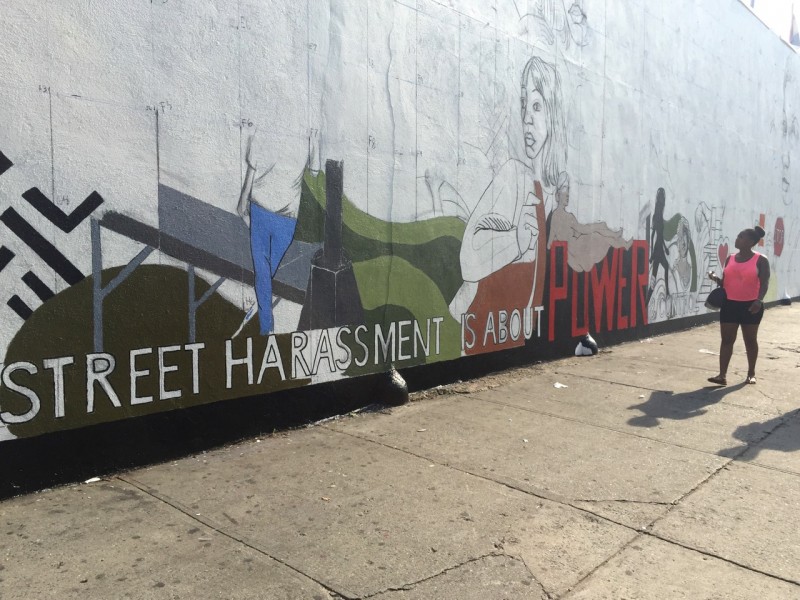
“Brooklyn High-Schoolers Sexually Harassed While Painting Mural About Sexual Harassment”

Brooklyn mural by high school students. Via Patch.com

“Along the bottom of the mural is the phrase, “Street harassment is about power and control.”

Although some men passing by on Myrtle just yell and whistle from afar, some come up to talk to the artists.

”Guys will walk by and say, ’You ladies shouldn’t be doing this, it’s too much for you, it’s too heavy, you need help,’” says Ponce.

Sometimes this leads to a conversation about street harassment. “People aren’t aware that it’s a problem,” says Ponce. ”They say, ’It’s a compliment, just take it.’”

Although Ponce doesn’t believe the mural has changed anyone’s habits just yet, she says some of the same guys who used to harass them are more respectful now as they walk by.

“It feels like you’re making an impact,” she says.

You can scope out the mural for yourself at 1102 Myrtle Avenue, along the wall of the Food Bazaar Supermarket. The girls expect to finish by August 24.”

“Why That Viral [Cosmo] Video of Men Reacting to Street Harassment Isn’t Praise-Worthy”

“While it’s no doubt that the producers’ intentions weren’t malicious – they wanted to highlight how pervasive (and f**ked up) the everyday whistles, taunting and stalking women encounter is – was having heterosexual dudes validate our day-to-day experiences really the best way to combat this gendered violence? In other words, should we be criticizing sexism by perpetuating it in another form?

The sexual intimidation straight women meet each time they step out of their homes should not have to be substantiated by their male companions. Her voice, alone, should be enough for her partner, and the rest of society, to take her experiences and frustrations as valid.

We’re ready for a street harassment video without paternalism, where women – including bisexual, lesbian, queer and trans women, because this is far from just a straight women’s issue – don’t need men to ensure that our daily harassment is believed.

Also, it would be great to have a video that didn’t overwhelmingly depict men of color as the perpetrators, because, news flash: white dudes aren’t santos and do hiss, jeer, harass, touch and stalk women as well.”

“LISTEN gets Vic government on board in push against sexual harassment and assault in music venues and festivals”

“The LISTEN collective [in Australia], a group of musos and industry professionals who are also passionate advocates for gender equity in Oz music, are taking active steps to deal with the situation. Importantly, they’ve just persuaded the Honourable Jane Garrett, Minister for Justice, to convene a task force to implement policy addressing sexual harassment and sexual assault at music venues and festivals.”

“How to Deal With Street Harassment When Traveling”

“On the flip side, it’s important to learn how to shut down unwanted attention not just with body language but verbally as well. Oftentimes in Western cultures, women are taught to be polite even when we feel uncomfortable in a situation. If someone is pestering you for attention, for your phone number or for anything else, it’s perfectly alright to shut them down with a simple no and to walk away if they won’t take no for an answer. Don’t feel obligated to continue a conversation with anyone who makes you uncomfortable. It’s not rude—it’s perfectly appropriate.”

“Could catcalling become illegal in Austin, Texas, and elsewhere?”

“Men are the primary perpetrators of street harassment against both women and men (and it is largely men in the LGBTQ [lesbian, gay, bisexual,transgender, and queer] community who are harassed compared with their heterosexual male peers),” she adds. “We need programs educating young men on issues of respect and consent, we need social shaming of harassers, and we need men to model respectful behavior to their friends and family members.”

“Public Property”

“There is a clear difference between striking up a polite conversation with somebody whilst both inhabiting a public space and utilising that public space as a tool to enable inappropriate commentary.”

“10 ultra-regressive scenes from Bollywood movies that encourage you to be a creep

Share

Filed Under: News stories, street harassment

Austin Woman Takes on Street Harassment

July 31, 2015 By HKearl

Learn how runner Anna Aldridge in Austin, Texas, got a mechanic shop to start addressing street harassment! Now she wants to work to address the issue city-wide.

You can sign her petition: http://tinyurl.com/p9bt58a

Also you can learn more about the problem overall via this Christian Science Monitor article from today. Hopefully the city council and others will take notice and do something!

Share

Filed Under: News stories, street harassment

USA: “All it takes is one voice in a crowd of many”

July 31, 2015 By HKearl

Liz Merino, Massachusetts, USA, SSH Blog Correspondent

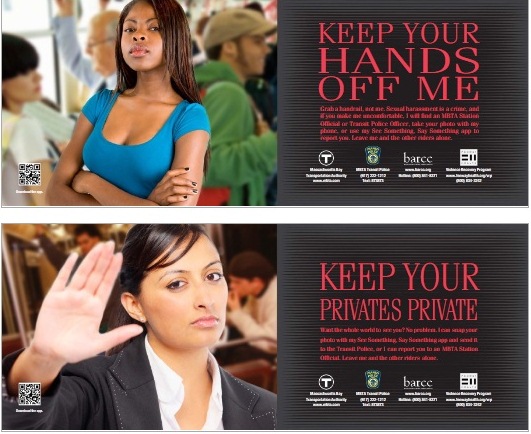
Boston anti-harassment transit ads, 2013
Boston transit ads, 2013

According to the Massachusetts Bay Transportation Authority’s 2014 Ridership and Service Statistics, more than one million riders use its urban services every week. This includes the Red and Orange Line, as well as the system’s many buses and trackless trolleys.

I am only one of those riders, and I am a woman. Taking public transit as a woman in the dog days of summer isn’t easy. Let me rephrase that, being a woman on public transit is never easy, but the summer makes it a hell of a lot worse.

“It makes me really uncomfortable how people feel so comfortable with just shouting degrading things to you or things like, ‘Hey, do you want a boyfriend?’ or ‘Where’s that smile?’ It really turns you off from riding public transportation, but with most people, that’s their only option getting to work or wherever they need to go,” said NYC resident Maddie Michalik

The bus stop that I wait at every day to take into the city is on a main stretch of road, busy with the typical morning rush hour found anywhere across the U.S.

I’m sure the harassment I face can be found there too.

Men slow down their cars and yell at me out their window as they pass by. Some I can’t understand, their words garbled by wind, others I find I’m able to tune it out, but then there are other things I hear but for now I won’t repeat.

Others just stare. I know what you’re thinking. What do I mean staring? How can someone staring be harassment, especially from across the street in a car, a bus, a truck a anything?

A stare may not seem like anything but for men that harass and see women as nothing but something to look at and f***, it is. Their eyes are lecherous, undressing me, a once over that lasts as long as a red light but feels like forever leaving me sweating but still wishing I was wearing a parka instead of a skirt and a top.

Fully dressed I seemingly feel completely exposed.

At the bus stop I have nowhere to go, and these men know it. As they continue to stare, I look away, put up my book, stare at the sun and wait for the sidewalk to swallow me whole. Or I did.

I’ve started to stare back. Sometimes I wave like I’m a woman in the circus, a one-lady show hard and fast until they look away. My personal favorite is giving the finger or looking away blatantly as if they are not even there. I told my friend this and she worried for my safety.

A man rebuffed for his advances, unwanted at that, is a scary thing. A man with a grudge and a sense of entitlement to a body that isn’t his, a woman’s worst fear. I stand in the same spot every day.

What if they come back for me?

“I want to be just like every other commuter, pedestrian and jogger in the park. Can women be anonymous, invisible sometimes? Is that too much to ask?” asked Boston resident Lisi when asked about her experience with harassment.

In some aspects, though, it is getting better. The street harassment dialogue, the stories, social media posts and personal accounts are getting louder. Now, they can’t be ignored.

The other day on the Orange Line a man sat in one of the seats reserved for those that are handicap, close to the door and easy accessible. It’s also a spot to see everyone who gets on and off the train.

Standing three seats over, I watched as he tried to talk to a woman with headphones in. She wasn’t interested and shook her head, so he reached out and tried to grab her. Before he made contact, she moved away and the jostle of her body alerted the other passengers, including myself, that something was amiss.

The doors opened and she got off, another woman taking her place. Again the man tried to talk to this new woman, and again she just wanted to ride to her destination and not be bothered, like everyone else. When she didn’t respond to him speaking, he reached out to touch her too, and before my mouth opened, the lips of another parted and what she said made the whole car turn.

“Hey, you don’t touch her, or me or anyone else. If you want something you use your mouth and if someone doesn’t want no part of it, you leave them be. But you respect their personal space, you hear?”

He sat and stared, and two stops later he was gone.

All it takes is one voice in a crowd of many to say what so few can sometimes manager to utter on their own. As a woman, it made me happy to see a fellow woman stick up for someone else, but it made me happier that the whole car was in agreement with what she had said.

It can be easy in situations like this to turn away, it’s uncomfortable and awkward, and sometimes to speak up, it can even be dangerous. But when nothing is said instead, the behavior seems to be accepted as normal. Street harassment, touching someone without consent, yelling and hollering, groping and staring, whistling and whispering isn’t normal.

Speaking up can be hard, but saying something makes a difference even if it’s small or seems insignificant. Saying something means it’s happening, and it’s wrong, but you see it and won’t let it continue. Using your voice, no matter how loud or soft, speaks volumes for those who at the moment cannot find their own.

Liz is a recent graduate of Hofstra University with a Bachelor of Arts Journalism degree. She is currently a staff writer for a marketing agency in Boston. Follow her on Twitter @slizmerino and Instagram @elizabethmerino93.

Share

Filed Under: correspondents, street harassment

« Previous Page
Next Page »

Share Your Story

Share your street harassment story for the blog. Donate Now

From the Blog

  • #MeToo 2024 Study Released Today
  • Join International Anti-Street Harassment Week 2022
  • Giving Tuesday – Fund the Hotline
  • Thank You – International Anti-Street Harassment Week 2021
  • Share Your Story – Safecity and Catcalls Collaboration

Buy the Book

  • Contact
  • Events
  • Join Us
  • Donate
  • Facebook
  • Instagram
  • Pinterest
  • Tumblr
  • Twitter
  • YouTube

Copyright © 2026 Stop Street Harassment · Website Design by Sarah Marie Lacy