By Zoneziwoh Mbondgulo, Buea, Cameroon, SSH Safe Public Spaces Mentee
 It is estimated that about 1 in 3 women worldwide experience sexual or physical violence at least once in their lives. And over 80 percent of women across the globe have also experienced at least one or two or several forms of street harassment from men they do not know, and Cameroon is no exception.
In Cameroon, street harassment is still an overlooked issue. It is common seeing men and even young boys feeling it’s ok to publicly abuse or harass a lady. This long age act on women and girls is more or less seen as a norm to a social issue that must be address.
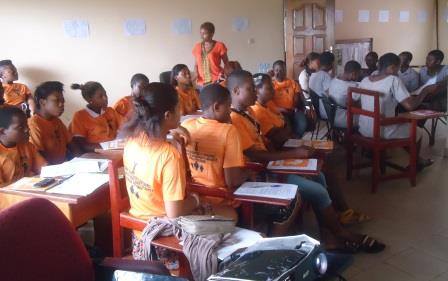
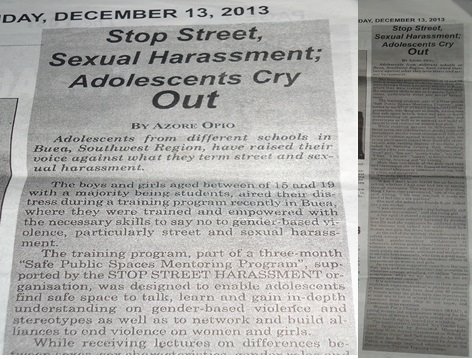
In Buea, Cameroon, on November 30, 2013, during the 16 Days of Activism Against Gender Violence, over 25 boys and girls within the ages of 15-19, the majority been students from different schools across Buea, were trained and empowered with the necessary skills to say no to gender-based violence, particularly, street and sexual harassment.
The training program which was part of 3 months, Safe Public Spaces Mentoring Program, supported by the STOP STREET HARASSMENT organization, was hosted by Women For A Change, Cameroon (WFAC), a young women-led organization working for the promotion of women and girls sexual and reproductive health rights.
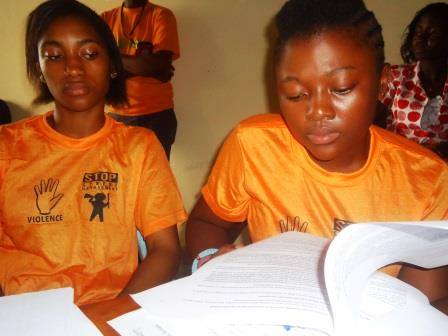 Designed to enable adolescent girls and boys find safe space to talk, learn and gain in-depth understanding on gender based violence and stereotypes; as well as to network and build alliance to end violence on women and girls.
The training opened with participants asked to complete the sentence, connecting to the UN’s suggestion to wear orange to stand up against violence: #Iwearorangebecause….
Rocard, 18 years #Iwearorangebecause ” I am a boy and i stand for equality” #16DAYS #16DAYSOFACTIVISM
#Iwearorangebecause ‘I m a girl and i stand for equality” Fatima 17 years
“#Iwearorangebecause I have a voice and it should be heard” Gobina, 17years
Next, participants shared their fears and expectations from the training. The majority feared that a day would not sufficient to gain enough knowledge and skills to effectively mentor peers, raise awareness, and/or educate the public, families and friends on the negative consequences of gender-based harassment of girls/women. One participant said, “I am always shy and often feel inferior to speak up. I need to take part in many more of such programs so I gain self-empowerment and boldness to speak up.”
Nonetheless, their expectations kept them hopeful that by the end of the day, they would have acquired the necessary tool to face some of their fears, and most importantly they would know how to use the skills gained and reach out to a wider population.
The training, which lasted for six hours, included three lecture seminars, a series of role play, debates, interactive sessions, and Q&A.
The first lecture seminar, facilitated by me, explained to participants some KEY GENDER CONCEPTS – like differences between sex and gender; examples of sex characteristics and gender roles and stereotypes; what’s gender-based violence and different forms of violence against women and girls – with a particular focus on street and sexual harassment.
During the lecture seminar 1, a participant was nominated by the group to chair and moderate a group discussion, where everyone present was asked to take time to reflect on a situation where s/he thought they experienced / witnessed gender based violence – principally street and sexual harassment- and how they overcame / addressed it.
THE REFLECTIONS
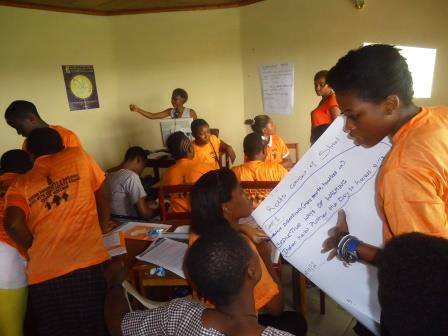 More than 2/3 of the girls said they had experience one or two forms of harassment – be sexual advances or unwanted touch, both in public and on campus – and when this happens sometimes they just ignore or throw insult back at the harasser. The most common experiences were – whistling, abusive jokes and comments like ‘African baby’, ‘small girl’ ,’ fine ass’, ’ pretty butts’, ‘ my size’, ‘V boot’ ‘a say ehh’ ,’sssshh’ ,’ehhh’ , and at times forceful holding, catcalling, touching, ‘air-kiss’…
Two girls, aged 16 and 17, shared individual experiences with harassment online which include sexist comments and unwanted sexual attention. E.g, one said how a guy she doesn’t know texts her on Facebook asking whether she had ever had sex or sexting through messaging. “This was the most disgusting thing I have ever experience” she explains. “I feel very insulted; it made me kind of feels like a sex-machine”
When it happened, she continues “I had to ask my friends if I looked like a sex worker”. “I was severely affected – psychologically and sometimes traumatized,” she added
One boy, aged 18 shared a negative experience of how he had once been sexually harassed by another man and how his experience with the lesson gathered at the training has helped him understand how women and girls feel when harassed.
Another participant aged 19 spoke of her experience face-to-face with sexism. She explains, “Last youth year, I practiced and rehearsed to perfection to act the role of the president for a drama my school was to perform. But, I was discriminated against by being given the role of a secretary. The teacher said to me that ‘a woman can’t be a president’, he even went on to ask me if the president of Cameroon was a woman.”
“I was bittered about the choice, and the fact that I was deny simply because I was a woman not based on competence”, she added, “Whereas the boy who took the role couldn’t deliver compared to me. Everyone knew I was good at my role and if allowed to act the role of the president, I was going to deliver so well”.
 “In my village,” another attendee said, “Education is meant only for boys. They say because boys inherit, so let more privilege be given to a boy. After my first school, I was asked to go to the market and sell and hope for the day where a man will get married to me. My dad preferred to sponsor my male siblings to boarding schools; he will send girls to day schools.
“At first, in our house,” another said, “Boys wouldn’t cook. Cooking was meant for girls only. But gradually, I used my position as a senior sister, to bring balance in the kitchen. Now at home the boys do cook.”
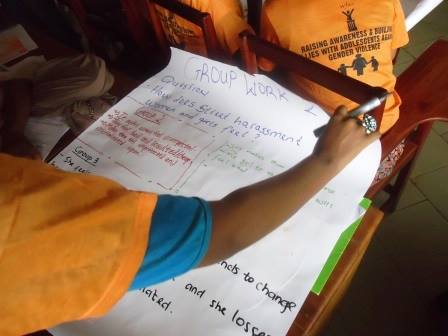
After the first lecture seminar, participants were assigned to group tasks. Each group expected to brainstorm and seek solutions towards combating street harassments and sexual gender based violence on women and girls. Solutions proposed were: government must establish gender-sensitive mechanisms to effectively address gender based harassment and violence on women and other minority groups as a security issue. Participants also suggested that “more public awareness, seminars and workshops to educate boys especially, who form a great number of the harassers, on the secondary effects of harassment on women and girls”. An exceptional suggestion from the boys group that “girls and women shouldn’t pay attention to what ever strange whistling, catcalling”, “sometimes, when we are ignored, we feel extremely sad and useless!” the boys said.
The next lecture seminar followed shortly after the break and the topic was on Dealing With Sexual Harassment in School in Just Seven Steps. The session was very interactive, and also had group works.
 The last lecture seminar of the day was facilitated by Ms. Amshatu Verbe, a visual impaired educationist at the Government Teachers Training College, Buea, and her presentation was focused on self-esteem as an effective tool and weapon adolescents must have while addressing gender based violence (street and sexual harassment)
In culmination, participants expressed satisfaction and attainment of their expectations. Since the training, many have joined our WFAC page on the social media, through which we continue to engaged and share knowledge on weekly basic, on best ways to increase public awareness on gender based harassment, get boys involved as allies and above all gained empowerment as advocates against Violent on Women and Girls.
Updates on this project can be found at: Women for a Change- Cameroon, or via Twitter @zofem.
