• About Us
    • What Is Street Harassment?
    • Why Stopping Street Harassment Matters
    • Meet the Team
      • Board of Directors
      • Past Board Members
    • In The Media
  • Our Work
    • National Street Harassment Hotline
    • International Anti-Street Harassment Week
    • Blog Correspondents
      • Past SSH Correspondents
    • Safe Public Spaces Mentoring Program
    • Publications
    • National Studies
    • Campaigns against Companies
    • Washington, D.C. Activism
  • Our Books
  • Donate
  • Store

Stop Street Harassment

Making Public Spaces Safe and Welcoming

  • Facebook
  • Instagram
  • Pinterest
  • Tumblr
  • Twitter
  • YouTube
  • Home
  • Blog
    • Harassment Stories
    • Blog Correspondents
    • Street Respect Stories
  • Help & Advice
    • National Street Harassment Hotline
    • Dealing With Harassers
      • Assertive Responses
      • Reporting Harassers
      • Bystander Responses
      • Creative Responses
    • What to Do Before or After Harassment
    • Street Harassment and the Law
  • Resources
    • Definitions
    • Statistics
    • Articles & Books
    • Anti-Harassment Groups & Campaigns
    • Male Allies
      • Educating Boys & Men
      • How to Talk to Women
      • Bystander Tips
    • Video Clips
    • Images & Flyers
  • Take Community Action
  • Contact

Rape Culture is Global: Help Me Prove That, No—It Is Never What You Wear

January 13, 2013 By Contributor

By @MsEntropy

Lauren Wolfe, founder of the project Women Under Siege, issued a recent call to declare 2013 as the year to end rape.  The comments to her CNN post prove revealing—more than a decade into the twenty-first century, the discourse that facilitates rape culture is alive and well. Wolfe’s activism predates the horrific gang rape of Indian university student Jyoti Singh Pandey, but press coverage of the atrocity, and the debates it stimulated demonstrate that we—globally—have a long way to go.

Spiritual leader Asaram Bapu posthumously chastised the gang rape victim, Jyoti Singh Pandey, arguing that she should have grasped the hands of her attackers, called them “brother,” and begged them to salvage her “dignity.” A defense attorney for those accused in the Delhi attack, which resulted in the death of the young woman, recently declared that the victim was “wholly responsible” for her actions, as “respectable ladies” allegedly don’t get raped. In the wake of protests against this vicious assault, debates began spreading like wildfire about appropriate punishment, rape prevention and—stunningly—“culture” as an explanation.  The recent decision (to many, including myself, questionable) of Egyptian activist Alia al-Mahdy to ally herself with FEMEN has similarly provoked debates on “culture,” sexual mores, and additionally thrown back into the mix assumptions about an alleged linkage between clothing and harassment. Al-Mahdy first came to fame over a nude self-portrait posted on her blog; she later stood naked outside an Egyptian Embassy in Sweden to protest the Islamist nature of the proposed Constitution.  Egyptians debated whether or not al-Mahdi’s action merited stripping her of citizenship.

The horrific gang rape in Delhi, and the debates over Alia al-Mahdy’s alliance with FEMEN are not the only arenas in which rape culture, feminism and violence against women merit our attention.  For many Americans, we need to look at our own backyard just as much.  Remember Senate candidate Richard Murdock’s idea that pregnancy as a result of rape is a “gift from God?” What about Todd Akin’s inflammatory comments about “legitimate rape,” and his claim that women have a mysterious defense mechanism to “shut the whole thing down?” Georgia Representative (and obgyn) Phil Gingrey has appeared in a surreal, belated defense of Akin’s statements.

As a woman who has lived in the United States, France, Morocco, Algeria, Egypt and Tunisia—I am here to tell you: harassment is ubiquitous.  No—it does not matter what we wear. Manifestations of discrimination and sexual harassment may take a variety of forms, but the all-too often unacknowledged abuse of power dynamics does not.

In light of all of these news stories, I decided to tackle one aspect to the discourse around rape culture, namely, the idea that what one wears matters in terms of drawing or repelling sexual assault and or harassment.  Although I usually use Twitter as a mechanism for commentary on Middle Eastern and North African political affairs, I was prompted to take on this aspect of rape apologism when I came across the following series of Tweets:
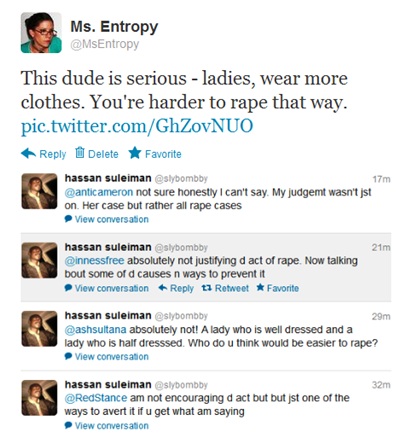
Twitter user @slyombby does not appear to be cognizant of the manner in which the “clothing” debate feeds into rape culture; in his mind, he is not passing “judgment,” but rather—discussing what he feels is a fact: that more clothes somehow means more protection from assault. This is, frankly, simply not the case.

In response, I posted a series of Tweets to my own account with the caption, “I was sexually harassed/assaulted wearing this. Was it my clothing? #EndSH.” The five pictures included a spectrum of clothing, worn in different countries, at different ages in my life—ranging from a baby photograph to a recently taken image:
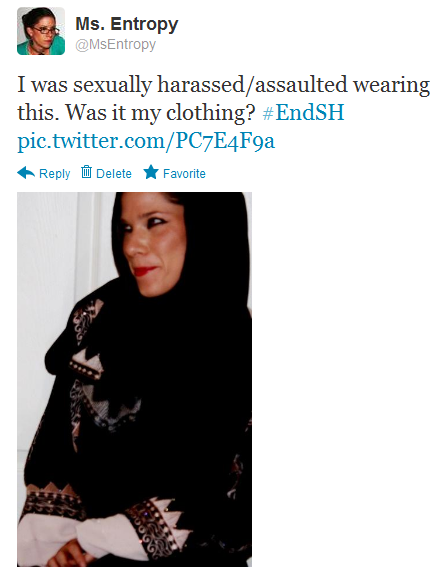
To be fair, I received several heartening responses from both women and men.  Some eagerly took the idea that “clothing matters” to task; others seemed shocked at the question—and failed to detect the irony and sarcasm behind it.  However, responses such as the following firmly convinced me that we—women and men—urgently need to debunk the myths that sexual violence can be correlated with clothing, and that it is a phenomenon uniquely facing women:
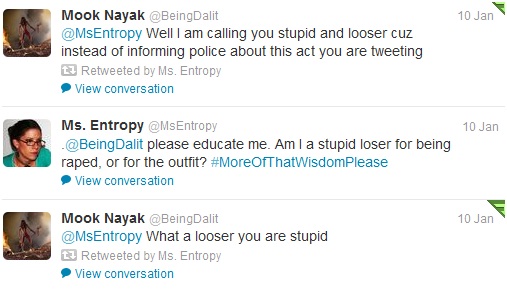
Twitter user @BeingDalit attacked me as a “stupid looser” [sic] for discussing my personal history, rather than going to the police (an assumption entirely of his own making).  He went on in a later exchange to accuse me of seeking attention, although how a mention of childhood sexual abuse fits into that, I’m not entirely clear. This accusation, however, does merit a brief analysis.

For both men and women who have encountered sexual violence and harassment, speaking out is a difficult action.  This is particularly the case for male victims, who are often far more reticent to relate their own experience of trauma.

I would like to call on others—critically, men and women—to post similar photos using the tagline, “I was sexually harassed/assaulted wearing this. Was it my clothing? #EndSH.” If you feel more comfortable blurring your face, do so.  I do, however, think contributions from both genders, in a variety of cultures and spanning the range of clothing choices can make a difference.  Refuse to take the shame of others as your own, and no—it is never, ever what you wear.

Share

Filed Under: street harassment Tagged With: clothes, rape, rape culture, victim blaming

“That was the point that I began to dislike…being in a crowd with men”

January 12, 2013 By Contributor

I was quite young, perhaps around 7 or 8 years old (not entirely sure). My parents and I had gone to a famous temple in South India (could have been Guruvayur, or possibly Tirupati). There were throngs of people in the temple, as it was during some festival or other. We were all waiting for the sanctum to be opened, I guess, and the moment the priests opened the doors, there was a great surge of people moving forward and I got separated from my parents by a middle-aged man wearing the garb of a devotee who came between me and them. He got his hand between my legs and squeezed painfully, all the while chanting the praise of God, pretending that he wasn’t doing what he was doing. I didn’t like it but I didn’t know why, and I couldn’t squirm away because I was hemmed in.

Finally I cried out for my dad, partly because I was afraid of being lost and partly because I thought it would make the man stop – and luckily it did. I didn’t tell my parents anything because I didn’t know how to express it, because I was afraid I’d done something wrong… even when I didn’t know what that wrong was. I think that was the point that I began to dislike going to the temple, and being in a crowd with men.

– Shammi Edwards

Location: South India


Share

Filed Under: Stories, street harassment

“When you stare at women like that it makes you look like a creep”

January 9, 2013 By Contributor

As soon as I got on this bus I could see this guy on the bottom deck leering and looking me up and down as I walked past him to sit at the back. I figured I was only going a very short way so wouldn’t sit elsewhere just to avoid him, but in that short time he continually craned his neck round to stare and leer at me, wanting me to know exactly what he was doing and enjoying making me feel uncomfortable.

When I had to get off I said as I walked past, “When you stare at women like that it makes you look like a creep.” I was expecting him to be abusive back (he had that aura about him where you can usually predict it), but it was still surprising how angry he instantly got. These are the bits of his speech that I can remember (there was much more…): “I wasn’t fucking looking at you – I was looking at her [indicating a girl sat directly behind him and out of his line of vision]. You’re fucking butter! [whatever THAT means] Fucking four eyes – you think it’s Halloween or something? [whilst I used to hear this line when I was a teenage goth, I think it’s the first time I’ve had it simply for having glasses!] You’re fucking butter! Think I’d look at you? Ugh!”

I laughed at his Halloween comment, told him whoever he was looking at he was still a creep (notice he didn’t even deny gawping at women), and loudly told him to “Stop harassing women” as I stepped off the bus and walked away. The bus would usually come past me to its next stop, but it didn’t, so I wonder if the driver was remonstrating with him for his pleasant little outburst. I don’t know – I didn’t look back 🙂

Less than a minute after I’d got off the bus. I picked up an Evening Standard and one of the main stories in there was about the rapper Dappy spitting and swearnig at two girls when they ignored his advances (for which he was in court). This behaviour is so common, it’s almost a cliche.

Did I have to say anything? No. But I am getting sick to death of being intimidated in my daily life by people like this. I was catching the bus after leaving the gym – I go to a women-only gym that’s not in the most convenient of locations anyway, rather than exercise outdoors or in a mixed gym, and I refuse to feel like I also can’t do that because of these creeps.

– Jen

Location: London, 38 bus to Victoria

Share

Filed Under: Stories, street harassment

USA: ESPN Commentary About Alabama Player’s Girlfriend Unnecessary

January 8, 2013 By Contributor

By Lauren Duhon, Baton Rouge, La., Stop Street Harassment Correspondent

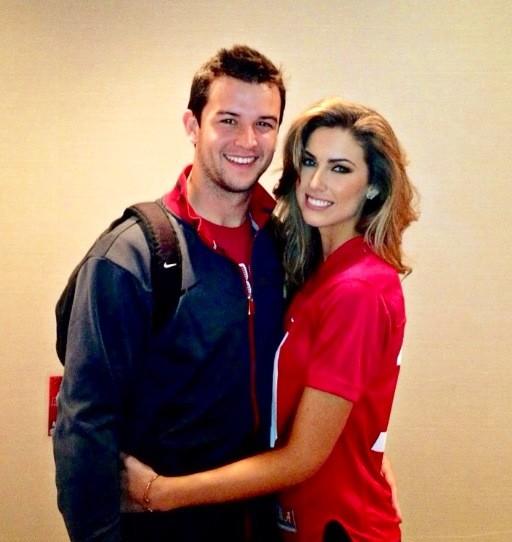
Image from Katherine Webb’s Twitter Account

As the nation watched the Bowl Championship Series National Championship game last night between the University of Notre Dame and University of Alabama, I’m sure fans only expected to watch a football game between the top two teams in the nation. What they also saw, however, was a continuous string of remarksby ESPN commentators about Alabama quarterback A.J. McCarron’s girlfriend Katherine Webb.

During the first quarter of the game, commentator Brent Musburger made remarks about Webb, who is also Miss Alabama, like she was a trophy. “You quarterbacks get all of the good looking women,” he said, as he urged young boys watching to play football in order to date attractive women.

Throughout the game, the camera did close up shots of Webb, bringing more and more attention to the Auburn University alumna.

I watched the game with some of my friends who contributed to the commentary while practically drooling every time she appeared on the screen. When I got angry and asked why they thought that was okay, they answered, “Because she is hot” numerous times.

I couldn’t understand their behavior. The unnecessary comments and explicit names they called her continued until the end of the game (ending in a victory for Alabama).

Then the sexist comments moved online. Webb’s Twitter account went viral in a matter of hours and gained nearly 170,000 followers and there were many creepy tweets directed at her.

Webb hasn’t made a comment about the coverage, but today ESPN released a statement:

“We always try to capture interesting storylines and the relationship between an Auburn grad who is Miss Alabama and the current Alabama quarterback certainly met that test. However, we apologize that the commentary in this instance went too far and Brent understands that.”

Despite the apology, this isn’t the first time Musburger has made inappropriate comments during a game, nor do I think it will be the last time that a sports commentator does so, especially since few people have spoken out against his behavior. On the contrary, I’ve read multiple comments on websites like Bleacher Report from people saying they love him for his antics.

So I am speaking out: no one should be gawked at on national television without their permission, including by ESPN commentators. No one should have to virtually be catcalled by teenage boys and middle-aged men online without their consent.

Our society needs to stop justifying these actions. They help shape a society in which many men think it’s okay to say disrespectful things to women on the streets, on television, and online without much consequence. If I were Webb, I would come out with a statement to discourage these men, because I wouldn’t want to be pinned as anyone’s prize.

Lauren Duhon is a student journalist from LSU in Baton Rouge, La.

Share

Filed Under: correspondents Tagged With: aj mccarron, brent musburger, ESPN, football, katherine webb

“What could possibly happen out in the open with people around?”

January 8, 2013 By Contributor

I was on the LIRR train going home from work and started to fall asleep while reading. A huge guy sat across from me but I didn’t really think anything of it since there was another guy sitting two seats away from me. I mean, what could possibly happen out in the open with people around?

The guy started bumping his foot into mine, which I moved twice away from him. Then he reached down to presumably tie his shoe and he “accidentally” brushed his fingers against my shin (I was wearing a dress)… I got mad and started to move like I was going to get off the train. Then the coward suddenly bolted and got off the train before I could make my next move.

Infuriating! Especially since I am a health professional and was working on something related to my career— it seems some creeps treat all women with disrespect.

– Leia

Location: LIRR train leaving Penn Station

Share

Filed Under: Stories, street harassment

« Previous Page
Next Page »

Share Your Story

Share your street harassment story for the blog. Donate Now

From the Blog

  • #MeToo 2024 Study Released Today
  • Join International Anti-Street Harassment Week 2022
  • Giving Tuesday – Fund the Hotline
  • Thank You – International Anti-Street Harassment Week 2021
  • Share Your Story – Safecity and Catcalls Collaboration

Buy the Book

  • Contact
  • Events
  • Join Us
  • Donate
  • Facebook
  • Instagram
  • Pinterest
  • Tumblr
  • Twitter
  • YouTube

Copyright © 2026 Stop Street Harassment · Website Design by Sarah Marie Lacy