• About Us
    • What Is Street Harassment?
    • Why Stopping Street Harassment Matters
    • Meet the Team
      • Board of Directors
      • Past Board Members
    • In The Media
  • Our Work
    • National Street Harassment Hotline
    • International Anti-Street Harassment Week
    • Blog Correspondents
      • Past SSH Correspondents
    • Safe Public Spaces Mentoring Program
    • Publications
    • National Studies
    • Campaigns against Companies
    • Washington, D.C. Activism
  • Our Books
  • Donate
  • Store

Stop Street Harassment

Making Public Spaces Safe and Welcoming

  • Facebook
  • Instagram
  • Pinterest
  • Tumblr
  • Twitter
  • YouTube
  • Home
  • Blog
    • Harassment Stories
    • Blog Correspondents
    • Street Respect Stories
  • Help & Advice
    • National Street Harassment Hotline
    • Dealing With Harassers
      • Assertive Responses
      • Reporting Harassers
      • Bystander Responses
      • Creative Responses
    • What to Do Before or After Harassment
    • Street Harassment and the Law
  • Resources
    • Definitions
    • Statistics
    • Articles & Books
    • Anti-Harassment Groups & Campaigns
    • Male Allies
      • Educating Boys & Men
      • How to Talk to Women
      • Bystander Tips
    • Video Clips
    • Images & Flyers
  • Take Community Action
  • Contact

USA: Flash Mob Against Harassment on the CTA

November 7, 2014 By Correspondent

Sarah Colomé , IL, USA, SSH Blog Correspondent

Cold air, don’t care. Chicago’s time honored tradition of social protest reared its glorious head on Wednesday, November 5th, sparking public conversation about street harassment on the Chicago Transit Authority (CTA) train system. Bridging passion, activism, and love of music, members of the Courage Campaign: CTA claimed a section of the Red Line as their own, breaking into a flash mob advocating public safety awareness.
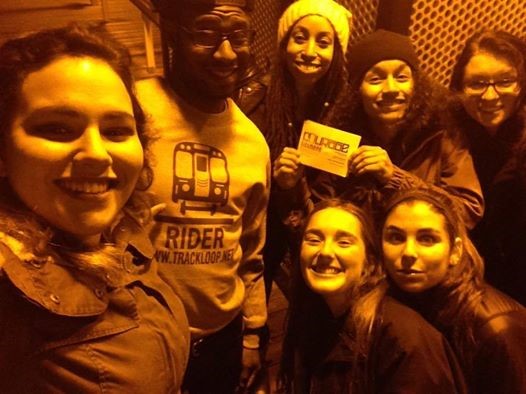
Members of the Courage Campaign: CTA take a quick selfie before the flash mob begins.

Commonly referred to as the “el” or “L” the city of Chicago houses the second largest mass transit system in the country, according to the American Public Transportation Association. With an annual ridership of 229.12 million on the train system alone, in person contact — whether consensual or not — is a frequent reality for those who depend on public transportation in the city.

Frustrated with the lived realities of so many who traverse the transit system each day, Courage Campaign: CTA founder Kara Crutcher decided to take action in order to address these stories of harassment. “I’ve experience and heard horror stories from tons of people taking the CTA,” Crutcher explains on the campaign’s Facebook page.  ”Commuters have been physically, sexually and verbally abused on the CTA, and it’s unacceptable. Everything begins with awareness.” 

Awareness was to be had, and in droves when Crutcher and other Courage Campaign participants exploded into their flash mob. Using an adaption of Aretha Franklin’s timeless song “Respect,” the group swapped in the word “courage” for “respect,” ending with the call to action: “We have the courage to stop harassment on the CTA – do you?”

Watching the video, we see the scene open with a young man incessantly hitting on a young woman before the mob broke into their courage song.

Crutcher explains, “The best part was seeing how uncomfortable everyone was initially – and no one said anything.” Noting several reactions, she noticed people seeing the exchange, shifting uncomfortably, and looking around, but many clapped in support at the end of the skit.
Partnering with a photographer, among other campaign members, the concept of a flash mob was derived on the premise that the action would “be helpful in pushing this project forward,” particularly after seeing the popularity of a similar flash mob done by the Lion King cast on a New York subway in early August. As a dancer in college, Crutcher knows the power of performance.

Produced as collaborative effort, the flash mob finished each of the performances by providing campaign flyers, hoping to entice more support and awareness about the campaign, and the issue of harassment overall. The flyers included actions items, contact information and the campaign’s logo, which serves as a sort of homage to the city of Chicago. Hoping to gain momentum from civic pride Crutcher explains, “I think that is what will make this strong – people are so loyal [to this city.]”

For more information on Courage Campaign: CTA or to contribute to their cause, visit their Facebook page, and follow them on Twitter at @CourageCTA.

Sarah is a progress-focused educator and advocate dedicated to building strategic coalitions centered on creating social change who serves as an adjunct professor in DePaul University’s Peace, Justice and Conflict Studies department. You can follow her updates on Linkedin or hear her perspectives on Twitter.

Share

Filed Under: Activist Interviews, correspondents, public harassment

Sri Lanka: The psychological effects of street harassment

November 3, 2014 By Correspondent

Menusha Gunasekara, Matale, Sri Lanka, SSH Blog Correspondent

Yesterday I was terrified with fear and uncertainty. What was disturbing my mind, my confidence and my dreams was seeing my harasser that day. It was not an unexpected event since I knew the harasser lived in the same area I live; I knew someday I would see him again. Unconsciously, I was checking the vehicle number of every red-colored three-wheeler taxi that passed me in the road. I was trying to avoid seeing him, but yesterday I failed.

Two years ago I was harassed by a taxi driver. Not just one time but three times. Although my mother got involved and met with the perpetrator, I never felt I was safe at home. For almost one year I had nightmares about worst-case scenario related to this incident. It was producing a lot of anger inside me.

Many think of street harassment as just an everyday “normal event” but the psychological trauma from a single incident can ruin your life. Nobody would think my hesitation and my reluctance to go in the village area alone comes from the negative side effects of street harassment. On top of that, my knee injury puts me in a vulnerable stage reminding me that I cannot even run for my safety. As a result, after coming home from university, I feel like I have been sentenced to house arrest. The freedom I had to stroll wherever I want seems far away in Sri Lanka.

Moving on from the personal experience to the increased number of harassment incidents in public places, including public transportation, I am aware that my experience is not just a single event alone. Although after the Wariyapola incident there was public and media dialogue about taking actions and social awareness on street harassment, that voice has disappeared. The wave of media attention has gone until the next incident, and there is no steady attention to combat the gendered mentality or to support women who faced street harassment.

A few days ago, I learned about a new initiative from the Women & Children Bureau that allows you to report sexual harassment on public transportation. They have created a SMS service to collect data and an easy way to complain about harassment through the following number: 0716550000. Let’s think positively that this initiative will be reached by the public since many women use mobile phones. At least it is a better way to report to a responsible authority than by going to a police station.

Still, the support for mental trauma has not been addressed by any authority. Places where women can have easy access to counseling and advice to deal with the negative emotions that can hinder their productivity and self-esteem should be established. As the President Rajaphaksha recently claimed that Sri Lanka is a better place for women & children to live in Asia, I just want to remind the responsible authorities, NGOs and public that that statement can be misleading if the root of the problem of harassment is not addressed.

Public awareness and actions are the impetus for creating safe environment for women and everyone.

Menusha is a recent graduate of Asian University for Women, Bangladesh and holds a B.S in Public Health. She is an advocate for Peace and Human Rights, Women Issues and Environmental Protection. She can be reached via LinkedIn.

Share

Filed Under: street harassment

USA: Benefits to Ending Harassment

November 2, 2014 By Correspondent

Daniel Burdick, CA, USA, SSH Blog Correspondent

My previous contribution to this blog entitled, “Men Harassing Women Represents a Loss for Everyone,” due to size limitations, contained little elaboration about why this title statement makes sense.  The question could be asked: what possible effect could a few incidents of harassment make to those with apparently no personal involvement?  Why should we men concern ourselves with the sophomoric behavior of a few other men towards women?

In the words of anthropologist Margaret Meade: “Every time we liberate a woman, we liberate a man.” (La Abogada,1967)

Please allow me to separate the topic of gender-based street harassment (GBSH) away from the general context of women’s equal rights, if this is at all possible.  Simply, my intent here is to channel the GBSH dialog within an even broader context of social equality for all people.

Harassment is one of those bad behaviors that tends to be marginalized because the harm it causes is psychological, cumulative, and therefore intangible.  We were all taught at the playground, often teary-eyed, the “Sticks and Stones” rhyme where “words will never hurt me.”  Unfortunately, words are exactly what inflict us with a variety of mental health issues.   Among the negative attitudes which promote turmoil in relationships is low self-esteem.  When someone becomes convinced they have shortcomings regarding appearance and personality, they are very likely to over-compensate for it with various forms of clinical narcissism. (Not to be confused with narcissism, the vice.) This is highly evident in the current popularity and pervasiveness of self-improvement products and strategies.

A story of street harassment, the toll it takes away from our simple friendships, and the tyranny of the clothing industry…  One of my car-free female friends was very late to attending a casual soiree one evening, much to my dismay.  It was revealed later that while she was on her way, some strange male had made a judgmental, derogatory critique of the comfortable tights she wears while riding her bicycle.  She responded by returning to her home in humiliation in order to change her clothes, and apparently experienced other changes there as well.  This happened months ago, and now I know by how she has altered her dressing strategy that she may still bear the pain from whatever was said.  I feel physical pain myself when I imagine this happening to her.  Not all of us are able to find, much less afford, stylish clothing that fits our diversely-shaped bodies perfectly and thus free of attracting misguided commentaries of how we present ourselves, including other unwanted attention and victim-blaming.  (The hyper-critical fashion-entertainment scrutiny of celebrities only amplifies this disturbing trend.)

Then there is a social media contact (another inspiration for my involvement with SSH) who occasionally vents understandable rage by posting online flames about the street harassers she regularly encounters when accessing public transit.  Simultaneously, she is quick to disavow any sympathy or connection whatsoever for what she considers as “feminism,” at least openly among her friends and contacts in the social media forum.  While I would like to ask her to elaborate further about this, I expect probable sarcasm and less-than-honest responses… as besides being pressed for time, she apparently must also bear more than her fair share of an emotional load to try explaining this to some guy who claims he is doing research for some blog article.

While I certainly respect this woman’s privacy and only seek to improve her situation by documenting her observations; although until she offers to share her thoughts openly and unsolicited, she represents a person unable to contribute to the human cause of equality – apparently due to the perceived social stigma of being intimidated by harassment.  She is not the only woman I’ve encountered who actively seeks disassociation with “the movement,” which seems to be judged by some to exist for others who are somehow inferior to themselves.  However, this person’s apparent method of coping with her harassers, while valid, is similar in endearment value as the car engine-revving, horn-honking and intentional tire-squealing.

I’m by no means a mental health professional, yet no one really has to be in order to identify many other methods we cope with issues caused by street harassment.  The bottom line is the culture of street harassment and related posturing seems to affect both men and women toward acquiring overly competitive, detrimentally aggressive attitudes toward each other that make it difficult to initiate and share the intimacy and connections we all crave.  Male friends often confide in me regarding their frustration with establishing equitable relations with women; yet it’s simultaneously and painfully obvious why women must often respond to even well-intended men with mistrust, the avoidance of contact, and even hostility.

Please consider the plight of women who enter the male-dominated fields of scientific research and academia. This is a crucial area where humanity desperately needs the brightest people who are not only trained intellectuals, but possess common sense and social balance. Research shows that many women who possess these qualities are realizing this career path isn’t workable for them, due to an atmosphere of harassment and gender-biased competition, among other reasons.  One can only begin to imagine the loss of discoveries, breakthroughs, and other possible benefits to our existence that are lost.  There are potentially so many fabulous minds that are oppressed, discredited, and forced away due to stupid, selfish remarks and innuendoes.

What I’m honestly trying to accomplish amounts to convincing other guys that we actually share an important stake (other than that hopeful side effect of attracting a mate of sufficient intelligence to enable establishing a survivable, sustainable relationship) within the context of street harassment, and that the quality of our lives and relationships will improve if we can somehow jump-start a process to stop street harassment from continuing its heinous oppression of women.  I wouldn’t be out here trying to help put an end to it I didn’t think this was a realistically possible goal offering significant benefits.

Daniel is a longtime activist for peace, the environment, and social equality. He currently works as a design engineer and is an avid bicyclist.

Share

Filed Under: correspondents

Bolivia: El extremismo de una idea primitiva

October 29, 2014 By Correspondent

Andrea Flores Hernández, Santa Cruz, Bolivia, SSH Blog Correspondent

Image via Illustration Friday

59 mujeres. 59 mujeres de distintas regiones del país, de distintas edades, con distintas ambiciones. Todas ellas fueron víctimas de feminicidio en el primer semestre de este año. El feminicidio, se refiere al asesinato de mujeres por razones de género, y este tipo de asesinato ha cobrado más vidas femeninas que aquellos por inseguridad ciudadana.

Si bien el 9 de marzo de 2013, el Presidente de Bolivia, Evo Morales, promulgó la ley n° 348 “Ley Integral para garantizar a las mujeres una vida libre de violencia”, aún falta mucho por hacer. La burocracia frena a la justicia y esto ocasiona que muy pocos casos terminen con una sentencia. “Mientras no se implemente la Ley 348 y la mujer no tenga que peregrinar institución por institución para ser atendida cuando va a denunciar  violencia de género; y  la policía, fiscales y jueces dejen los prejuicios machistas, va a ser muy difícil que los casos de violencia contra la mujer lleguen a sentencia. Hay que cambiar la mentalidad colonizada y patriarcal de nuestra sociedad.” sentencia Carmen Sandoval, abogada con amplio conocimiento sobre la violencia contra la mujer boliviana.

Es bueno que existan leyes que protejan a la mujer. Pero, ¿no sería excelente si esa ley no tuviera motivo para existir? Quizá suene utópico, irreal, o algo imposible; pero el imaginar una mejor sociedad ¿no es acaso el origen de comenzar acciones que la hagan posible?

En Bolivia, las autoridades denuncian y condenan la violencia contra la mujer, pero pocos alzan la voz en contra del diario acoso callejero, que también es violencia. ¿Por qué? ¿Acaso hemos tomado el acoso como algo “normal” en nuestra sociedad?

El feminicidio es la manera más extremista del hombre para demostrar que la mujer es un objeto, y la manera cotidiana de demostrar esta idea es el acoso en las calles. ¿Por qué debemos esperar a que una mujer sea víctima mortal para recién comenzar a hacer algo?

La idea de que la mujer es un objeto es el verdadero virus de la sociedad. Un hombre que piense que esa idea es verdadera jamás podrá respetar plenamente a una mujer. Un hombre que vea a la mujer como objeto nunca comprenderá que la mujer es un ser independiente de él.

No dejemos que las víctimas de feminicidio que hay en tu país o en el mío, se conviertan solamente en cifras. No dejemos que se conviertan en simples números que alimentan los miles de reportes acerca del tema. No olvidemos que luego de la cifra se encuentra la palabra “mujeres”. No olvidemos que esa palabra contiene fuerza, voluntad, sueños y deseos. Para esas 59 mujeres víctimas de feminicidio todo eso se extinguió. Pero nosotras seguimos aquí. Y mientras sigamos aquí, actuemos. Hagamos algo por evitar que otras mujeres se conviertan en víctimas. Hagamos algo para que tú y yo no seamos víctimas. Tratando de eliminar esta idea despreciable de ver a la mujer como mero objeto, extinguiremos de a poco la violencia más cotidiana, como es el acoso callejero, hasta la más extremista, como es el feminicidio.


Bolivia: The extremism of a primitive idea.

59 women. 59 women from different regions of the country, of different ages, with different ambitions. All these women were victims of femicide in the first half of the year. Femicide refers to the murder of women because of their gender, and this type of murder has claimed more lives than those of insecurity.

Even though the 9 of March 2013 the President of Bolivia, Evo Morales, promulgated the Law No. 348 “Integral Law to guarantee women a life free of violence,” much remains to be done. The bureaucracy slows justice and this causes very few cases end with a conviction. “While Law 348 is not implemented and the woman does not have to “pilgrimage” institution by institution, to denounce violence; and the police, prosecutors and judges do not leave male prejudices, will be very difficult for this type of violence come to judgment. We must change the colonized and patriarchal mentality of our society.” Says Carmen Sandoval, a lawyer with extensive knowledge on violence against Bolivian women.

It is good that there are laws to protect women. But would it not be great if that law had not reason to exist? It may sound utopian, unrealistic, or impossible; but imagine a better society is not perhaps the origin of starting actions that make it possible?

In Bolivia, authorities denounce and condemn violence against women, but few of them speak out against daily street harassment, which is also violence. Why? Have we taken the harassment as “normal” in our society?

Femicide is the most extreme way of a man to show that the woman is an object, and the daily way to prove this is the harassment on the streets. Why should we wait for a woman to be fatality to start doing something?

The idea that the woman is an object is the real virus of the society. A man who thinks that this idea is true will never fully respect a woman. A man who sees women as objects will never understand that woman is a human being independent of him.

Do not let the victims of femicide in your country or mine, become only numbers. Do not let them become simple numbers that feed the thousands of reports on the subject. Do not forget that after that number is the word “women.” Do not forget that words have power, will, dreams and desires. For these 59 women victims of femicide are dead. But we’re still here. And while we’re still here, we have to act. Let’s do something to prevent other women from becoming victims. Let’s do something in order that you and I cannot be victims. Trying to delete this despicable idea of seeing women as mere objects, we will slowly extinguish the daily violence, such as street harassment, to the more extreme, as is the femicide.

Andrea is in her second year of university, studying Social Communication. You can follow her on Twitter: @AndreaFlores116

Share

Filed Under: correspondents, street harassment

USA: Why #Ferguson matters

October 27, 2014 By Correspondent

Angie Evans, Washington, DC, SSH Blog Correspondent

Walking across the street to pay the parking meter, a man pulled to curb. I kept my “resting bitch face” on but he still rolled down his window to invite me for a ride. He made sure to comment on my pretty face. I wish this was a rare occurrence; but it isn’t. I wish I could say I was wearing something low cut or short; but I wasn’t. I wish I looked too good that day; but I didn’t. I always wonder what I could do differently when these things happen and realize the answer is nothing.

As a woman, you experience a daily barrage of commentary on all things. You can expect the opinion of strangers whether you smile out of politeness or frown as a defense mechanism. As I walked to a coffee conversation about #FergusonOctober and away from my harasser, the parallels between the microaggressions I experience as a white woman on the street and the institutional racism African Americans have grappled with for centuries that spurred the murder of Michael Brown were obvious. Racism and sexism leave us vulnerable and often disempowered in a society that normalizes both problems

One outcome of institutionalized racism is police harassment. There is no denying that black youth are portrayed negatively in the media. For every positive story about an African American thought leader, writer, or everyday joe, there are half a dozen stories reinforcing racial stereotypes about criminal activity or academic failure. And although you wouldn’t know it from watching the news, the majority of all violent crime in the US is committed by white people – not young black men.

Police are fed the same media we are though, so it’s not surprising that an 18-year-old black kid and a white cop would feel tension around one another. And it’s also not shocking that the media engaged in victim-blaming when the #Ferguson story came out. They wanted to find some way to justify this young man’s death…but lets be real, even if the kid had robbed a store, there was no justification for killing him. No law makes that moral.

A group of women in skirts doesn’t provide the grounds for catcalling anymore than black kids hanging out on the sidewalk warrants police harassment and violence.

As more African American families have been sharing their own stories of racially-motivated harassment in recent months, people like me are realizing that what happened in Ferguson wasn’t a one time event. Thanks to more video recordings, we can even see some of these stories. Like when a video was released earlier this month showing a police officer breaking the window of a black family’s car in order to pull the man in the passenger seat from it. Why did the officer stop the car? Because the driver wasn’t wearing her seat belt. Unfortunately the situation escalated quickly. With stories about young black men being killed by police officers are pouring forward left and right, the family was scared and even called the police station from inside the vehicle.

Perhaps the cop who broke through the window isn’t a bad guy. Perhaps the passenger isn’t an angel. But the real problem isn’t the players in this story, the problems are that police disproportionately target persons of color and many African Americans justifiably fear white police officers.

You can’t have a true democracy if one group lives in fear of another and yet, that is our society.

This kind of police violence is a symptom of racism and also poor training, recruitment, and a lack of accountability. If you want to learn more about what can be done to end police harassment, read the suggestions in SSH Blog Correspondent Sarah’s post from earlier this month, for example, offering community-wide trainings on how to report police abuse in your area.

Angie is a community organizer and social worker. Last year she quit her job to travel around the world with her husband. They have just returned and are continuing to write about travel and adventure at http://whereisseangie.com

Share

Filed Under: correspondents, News stories, public harassment, race

« Previous Page
Next Page »

Share Your Story

Share your street harassment story for the blog. Donate Now

From the Blog

  • #MeToo 2024 Study Released Today
  • Join International Anti-Street Harassment Week 2022
  • Giving Tuesday – Fund the Hotline
  • Thank You – International Anti-Street Harassment Week 2021
  • Share Your Story – Safecity and Catcalls Collaboration

Buy the Book

  • Contact
  • Events
  • Join Us
  • Donate
  • Facebook
  • Instagram
  • Pinterest
  • Tumblr
  • Twitter
  • YouTube

Copyright © 2026 Stop Street Harassment · Website Design by Sarah Marie Lacy