• About Us
    • What Is Street Harassment?
    • Why Stopping Street Harassment Matters
    • Meet the Team
      • Board of Directors
      • Past Board Members
    • In The Media
  • Our Work
    • National Street Harassment Hotline
    • International Anti-Street Harassment Week
    • Blog Correspondents
      • Past SSH Correspondents
    • Safe Public Spaces Mentoring Program
    • Publications
    • National Studies
    • Campaigns against Companies
    • Washington, D.C. Activism
  • Our Books
  • Donate
  • Store

Stop Street Harassment

Making Public Spaces Safe and Welcoming

  • Facebook
  • Instagram
  • Pinterest
  • Tumblr
  • Twitter
  • YouTube
  • Home
  • Blog
    • Harassment Stories
    • Blog Correspondents
    • Street Respect Stories
  • Help & Advice
    • National Street Harassment Hotline
    • Dealing With Harassers
      • Assertive Responses
      • Reporting Harassers
      • Bystander Responses
      • Creative Responses
    • What to Do Before or After Harassment
    • Street Harassment and the Law
  • Resources
    • Definitions
    • Statistics
    • Articles & Books
    • Anti-Harassment Groups & Campaigns
    • Male Allies
      • Educating Boys & Men
      • How to Talk to Women
      • Bystander Tips
    • Video Clips
    • Images & Flyers
  • Take Community Action
  • Contact

Ireland: Granny is keeping the streets safe.

September 15, 2014 By Correspondent

Yvonne Ní Mhurchú, Limerick, Ireland, SSH Blog Correspondent

By Sean Curtin/Fusionshooters

It 11:05 a.m. on Friday, September the 5th in Limerick city and I have just had the most enjoyable half hour walk from the centre to my house.  I know what you’re thinking, “I bet that’s because she wasn’t harassed once” and you would be right, sort of!  It was also because the streets were almost deserted.  This year Limerick was chosen to be Ireland’s first National City of Culture, because of this there have been tons of festivals and events going on around the city since January and this particular weekend was no exception.  September 5th to 7th sees the arrival of a Giant Granny puppet (with the street theatre company Royal de Luxe), who is 25feet tall and even comes with her own wheelchair.  She will spend the next few days wandering around the city and as a result there have been a number of major road closures, making the streets practically empty.

As I walked home partly amused by the novelty of not having to worry about traffic as I crossed the road, it also dawned on me that my fear of getting harassed in the street was gone too.  The city looked like it usually does around the 4 a.m. – 5 a.m. mark, when most people are sleeping, only now it was bright.  I love to walk home after a night out if the weather is nice (which is rare in Limerick!) but I would never dream of walking home at night on my own, regardless of how empty the streets were.  I am unable to do that as there is always that underlined fear that I might get attacked.  Of course I know that if I were to get attacked it would not be my fault, but I cannot imagine other people feeling the same.  But I digress.

Limerick. Via Flickr

Right now, I don’t want to dwell on victim blaming, street harassment or rape culture.  I just want to keep the feeling I had today on my walk home with me for as long as possible; my nice, leisurely stroll home.  No harassment, no crossing the road un-necessarily, no dodging people, no planning alternative routes, no special ‘safety measures’ for peace of mind, no folding my arms to try and hide my chest from view.  It was just, calm.

I imagine that is how it must feel for men when they walk around.  No fear and complete anonymity.  How lucky they are to be able to take something like that for granted.  To just be allowed go about their business and not be made to feel uncomfortable or questioned or told to smile.

So, I guess what I am saying here is, for a woman to feel 100% comfortable walking home alone it takes extraordinary circumstances such as giant puppets and road closures.  I know it sounds absolutely ridiculous when I put it like that, but that is actually what happened today.  For the first time, ever, I didn’t feel nervous or constantly look to see who was behind me, my head was held high as I looked straight ahead, I didn’t get nervous once, I just, walked.  Thanks Granny!

Yvonne volunteers as a SATU (psychological support) worker for her local Rape Crisis Centre and is an advocate for women’s issues and equality. You can follow her, her feminist group or her anti-harassment campaign on twitter: @YvonneNiMhurchu, @lmkfeminist and @GNOLimerick.


Share

Filed Under: correspondents, Stories, street harassment

USA: The Hidden Struggles of PTSD

September 13, 2014 By Correspondent

Sarah Colome, Chicago, USA, SSH Blog Correspondent

Image via Flickr

The young college fraternity boys yelled from their second story balcony in gloomy Ann Arbor, MI as they began pre-gaming for the first football game of the season. A comfortable morning with fresh grass underfoot, I jumped – a stronger reaction than expected by both myself, and my companions.  I quickly realized that the boys were screaming at friends walking along the sidewalk, most likely headed to a competing party to partake in pre-game festivities. They weren’t even talking to me. Why then, was I still so internally shaken?

We often attribute experiences of PTSD to survivors of sexual assault, but rarely do we hear that attribution accepted in relation to those who have been bombarded by street harassment. In my 28 years of life, it has only been in recent years that I began reframing my experiences of walking down the street to suggestive commentary, solicitations, and cars creeping along the street to match my stride, as street harassment. You see, we become so conditioned to the threat of violence, that even a matching tone and approach can trigger an automated response.

My external self remained calm, composed, and keenly aware of my surroundings, a skill I adopted early in life. Meanwhile, I tried to calm my heart rate. I do not view all men as predators, as I think this perspective breeds a fear that diminishes the potential for discourse, healing, and allyship. Yet, the socialization we’ve been raised in, justifying the perception that women’s bodies are something to be bought, sold, or won, has created a dynamic where these street actions are viewed as acceptable. Often termed “rape culture,” this normalization discourages discussion and advocacy that challenges the problematic norm that ultimately results in 1 in 5 women (likely, more) experiencing sexual violence in their lifetime.

I was surprised at the time, by my reaction.  I volunteer in hospitals as a medical advocate for sexual assault victims, have worked in high crime areas, and have a lifetime of experience with street harassment and assault. Of all people, I should be able to process and discard these threats, or in this case, perceived and inaccurate threats. That’s what we’re supposed to think. Because if we start openly identifying the experiences of sexual violence survivors with a term that we attribute to war combatants, then we might need to start taking their pain seriously. But then, I suppose a cultural shift of healing starts with me owning my own trauma, as invisible to myself as it may be.

For more information on Post Traumatic Stress Disorder and it’s manifestation in survivors of sexual assault and harassment, visit RAINN’s website which lists multiple resources for help.

Sarah is a progress-focused educator and advocate dedicated to building strategic coalitions centered on creating social change who serves as an adjunct professor in DePaul University’s Peace, Justice and Conflict Studies department. You can follow her updates on Linkedin or hear her perspectives on Twitter.

Share

Filed Under: correspondents, Stories, street harassment

Cameroon: Media and Police Perpetuates Street Harassment

September 10, 2014 By Correspondent

Ngwentah Berlyne Ngwalem, Buea, Cameroon, SSH Blog Correspondent

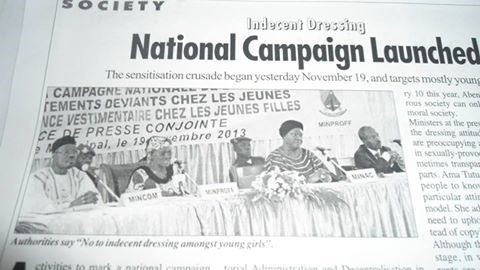
“Five ministers sat together and passed the dress code law which focused on women’s dressing but not on men’s acts of violence against women. This law gave rise to false media claims of women’s dressing causing rape and harassment.”

Every article that I have read in newspapers like “Cameroon Tribune” blames women for being “created female’’ as the sole or biggest reason for why they are sexually harassed in the streets by random men who claim to be distracted by their mode of dressing. The message that is sent is that women should remain at home-locked up, in the kitchen cooking because their mere presence in streets is a distraction to men.

My colleagues Zoneziwoh M. Wondieh and Patience Lum and I have been working on addressing harassment. We have found that many men take it as a right to attack women and claim it is because they are indecently dressed and a distraction. But everything in life is a distraction but it is ones decision whether to let it be a point of focus and act on their feelings or thoughts. We pass and meet thousands of people each day. Everything that is different from what you normally see around might cost you to look, admire or desire it but it is not your right to offend or attack based on your fixed ideas, feelings and thoughts on how things should be. These includes people with a lighter and attractive skin complexion, physically attractive looking people, extremely tall or huge people, Dwarfs, Albinos and people of different races.

With these differences if someone were to harass, attack or rape any of these individuals and give the excuse that it is because these people are attractive or distracted them because they look different will the perpetrator’s excuse not be dismissed and they be punished with the reason that those people are who they are not by their making and do not deserve to be harassed because it is the looker’s responsibility to contain themselves? And that the harasser has a mind to think for themselves?.

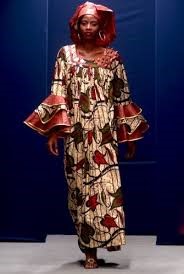
“Kabas are traditional Cameroonian/African dresses that does not show a woman’s body shape. Only Women wear Kabas.”

How is it possible that people consider a woman’s dressing as a possible cause of rape and sexual/street harassment and refuse to see that this whole issue is about power and control given that women in Kabas , Nuns, Children and others who are modestly dressed get raped and  harassed?

Another big problem is that police officers are the ones enforcing the dress code. There is no woman/girl I have seen or spoken to who feels safe in the hands of policemen. Girls who get held by policemen for either forgetting their National Identity cards when traveling or sometimes some possible made up reason like mode of dressing or disrespectful behavior towards the police or another individual often complain about those police men married or not chatting them up instead of doing their jobs. It will be worse for you as a woman if you resist their sexual advances.

People ignore the fact that these policemen’s jobs also involve single and married policemen asking for several women’s numbers or making unwanted sexual advances towards them. It involves policemen harassing women under the pretext of implementing the dress code law.

How does it help when such attitudes are not strongly condemned and the policemen not punished, instead women are told they are the cause of their sexual harassment either by forgetting their National Identity Cards or by their mode of dressing? Policemen are being encouraged and taught to know that they are above the law in Cameroon and can violate people’s rights. Men should be taught to take responsibility for their actions. I find the undefined dress code law very confusing and misleading.

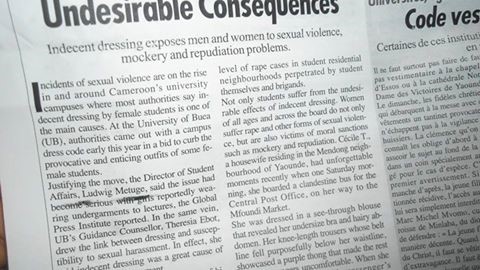
“Read the article not just the heading to see that the whole focus is made on women’s dressing as a cause of violence against them.”

Media coverage of dress code in Cameroon encourages people to shame, humiliate and act violently towards women. Women’s problems and difficulties handling harassment in Cameroon does not arise from their dressing, it comes from people’s twisted views about the world and the woman’s place in society. Instead of being taught to be responsible citizens, young people are being taught to continue with the old tradition of policing women’s lives and bodies. They are taught to violate other people’s rights simply because they are of the wrong sex and will eventually be set free because those group of people whose rights are being violated fall under the underprivileged gender with laws constructed for them to follow with the false notion that it is being done for their own good. Patriarchal norms have made it possible for women to get blamed whether or not they do obey, or do not obey and get attacked.

The media and government of this country should change their language and start talking about ways to punish perpetrators of such crimes, not punish the victims, and teach the perpetrators to live in a society full of different types of people, to understand that everyone has equal rights and the law to protect them.

Berlyne is a Cameroonian-based women’s human rights activist, passionate and determined to put an end to social injustice of any kind. You can find her on twitter @Luvequalityrule and Facebook.

Share

Filed Under: correspondents, street harassment

Australia: The Slippery Slope of Street Harassment

September 6, 2014 By Correspondent

Corina Thorose, Melbourne, Australia, SSH Blog Correspondent

Street harassment is a hot topic at the moment. It seems like everywhere I look, people are discussing it. What it is, who commits it, whether it is an offence, or whether it is actually a compliment. I watched a segment on a panel show the other day, when the subject came up, and to my surprise, every single one of the women on the panel, declared wolf whistles to be a compliment. The women in question ranged from forty to seventy years of age, and each one said that they wish they still got whistles, that at this stage in their lives, they were no longer appreciated as being attractive, or deemed worthy of a cat call.

Well, this was food for thought.

I’m in my late twenties, and it’s never occurred to me what it would be like to be someone who doesn’t turn heads. What it must feel like to be undervalued because of your age. I felt bad for not considering every angle. But then something else happened.

One of the women asked, “Why do we have to pester men to change all their behaviour?”

Why?

Because f*ck you, that’s why.

Because the first time I got whistled at, I was twelve years old. My breasts had just come in, and maybe I looked a little older, but I can’t explain the feeling of shame that came over me as I heard that holler for my body.

Because the second time I experienced street harassment, I was thirteen. A road worker leered at me for so long, I felt frightened, even though he didn’t say anything to me. Did he know how young I was? Did he care?

Because when I was fourteen, a carful of teenager boys pulled over and asked me if I wanted a lift. What on earth possessed them to do that? What part of their brains told them that that was a good idea? And what would have happened to me if I had said yes?

Because when I hear a whistle, or am the subject of a look that lingers way too long, I feel devalued. Great, you think I’m attractive. I’ll file that under things I don’t give a f*ck about and move on. By all means, take a look. I looked at you. We’re programmed to notice members of the opposite sex, or even members of the same sex if we are so inclined. But we are not programmed to behave like horny animals. We don’t grunt and mark our territory. We have evolved.

Let’s say we stop “pestering the men about their behaviour.” Let’s say we okay the wolf whistle. If we okay that, let’s okay the the comment on my skirt. Let’s okay the narrative on how hot my tits look today. Let’s okay the guy who touched my arse because I’m wearing tight pants. Let’s okay the guy who won’t take no for an answer because he bought me the drink and I had a cheeky pash with him.

It’s a slippery slope. Street harassment is not a compliment. It needs to stop being the norm. It is a crime.

Corina is a journalist who is currently in a Masters’ program in Professional Writing. Follow her work on social media: @BrandosBride, www.facebook.com/theirownbells, instagram.com/theirownbells

Share

Filed Under: correspondents, Stories, street harassment

USA: Decreasing harassment and increasing resiliency

September 1, 2014 By Correspondent

Kirstin Kelly, Monterey, California, USA, SSH Blog Correspondent

About a month ago, University of Tennessee researchers Dawn Syzmanski and Chandra Feltman published an article entitled “Helping Women Overcome the Anguish of Unwanted Sexual Advances.” The article professes that women who experience street harassment fall into two major categories: those who are resilient and those who are not. Immediately after publication, Syzmanski and Feltman faced backlash from people who felt the article was supporting victim-blaming mentalities by suggesting that people who are more resilient are better able to cope with the stress of unwanted sexual advances than people who are not.

Normally, I agree with people who caution against products or research that could perpetuate victim blaming because I, like most others, believe that pressuring those engaged in harassing behaviors is far more important than teaching would-be-victims to avoid responsibility. I fully agree that the onus of responsibility should be on the aggressors, not their victims. But this study is fundamentally different to me.

First, the idea of resiliency is widely accepted among psychologists as a way of understanding why certain people respond to stressors by using them as springboards while others experience overwhelming negativity as a result of the same type of occurrence.

Second, victim blaming usually refers to advice or products to help would-be-victims avoid situations that might lead to harassment or even assault. These are obviously problematic because they place the onus of responsibility on the victims to avoid situations in the first place, but ignore the reality that harassment and assault can happen to anyone at any time in any place under any circumstances.

Resiliency could be a useful tool in helping to combat the effects of street harassment because it helps survivors heal from trauma, which could include unwanted sexual advances, but it is victim blaming to suggest that people who lack resiliency will have a harder time. Similarly, since resiliency can be helpful in healing from a number of different traumas, it is not asking potential victims to alter their behavior in order to avoid negative situations.

There is nothing victims can do to keep themselves completely safe, but aggressors have the ability to stop their behavior. Social pressure definitely needs to be placed on the aggressors to stop the behavior, but in the meantime, research that helps us understand how victims can recover from their experiences is valuable. I think it’s helpful to encourage people to increase their resiliency regardless of their perceived susceptibility to aggressive behavior. Likewise, I think aggressors should be discouraged from continuing together.

Perhaps these two approaches work best when combined as a holistic approach to addressing rape culture and street harassment.

Kirstin is a Master’s Student in Nonproliferation and Terrorism Studies at the Monterey Institute of International Studies and a news editor at the Women’s International Perspective (The WIP). You can follower her on Twitter at @KirstinKelley1, where she regularly posts about human rights issues around the world.

Share

Filed Under: correspondents, Resources, street harassment

« Previous Page
Next Page »

Share Your Story

Share your street harassment story for the blog. Donate Now

From the Blog

  • #MeToo 2024 Study Released Today
  • Join International Anti-Street Harassment Week 2022
  • Giving Tuesday – Fund the Hotline
  • Thank You – International Anti-Street Harassment Week 2021
  • Share Your Story – Safecity and Catcalls Collaboration

Buy the Book

  • Contact
  • Events
  • Join Us
  • Donate
  • Facebook
  • Instagram
  • Pinterest
  • Tumblr
  • Twitter
  • YouTube

Copyright © 2026 Stop Street Harassment · Website Design by Sarah Marie Lacy