• About Us
    • What Is Street Harassment?
    • Why Stopping Street Harassment Matters
    • Meet the Team
      • Board of Directors
      • Past Board Members
    • In The Media
  • Our Work
    • National Street Harassment Hotline
    • International Anti-Street Harassment Week
    • Blog Correspondents
      • Past SSH Correspondents
    • Safe Public Spaces Mentoring Program
    • Publications
    • National Studies
    • Campaigns against Companies
    • Washington, D.C. Activism
  • Our Books
  • Donate
  • Store

Stop Street Harassment

Making Public Spaces Safe and Welcoming

  • Facebook
  • Instagram
  • Pinterest
  • Tumblr
  • Twitter
  • YouTube
  • Home
  • Blog
    • Harassment Stories
    • Blog Correspondents
    • Street Respect Stories
  • Help & Advice
    • National Street Harassment Hotline
    • Dealing With Harassers
      • Assertive Responses
      • Reporting Harassers
      • Bystander Responses
      • Creative Responses
    • What to Do Before or After Harassment
    • Street Harassment and the Law
  • Resources
    • Definitions
    • Statistics
    • Articles & Books
    • Anti-Harassment Groups & Campaigns
    • Male Allies
      • Educating Boys & Men
      • How to Talk to Women
      • Bystander Tips
    • Video Clips
    • Images & Flyers
  • Take Community Action
  • Contact

Belgium: Femme de la Rue: A woman in the street

August 13, 2014 By Correspondent

 Dearbhla Quinn, Dublin Ireland/Brussels, Belgium, SSH Blog Correspondent

I thought it would be appropriate, for my final article, to go back to what initially compelled me to volunteer for this position. Street harassment is something that most women and LGBTQ+ people I know have experienced since their early teenage years, however I was not prepared for the extent of this harassment that I would face on a daily basis when I first moved to this city. Often termed the ‘Heart of Europe’, Brussels is a beautiful and historic city endowed with a vibrant multitude of cultures, languages and people. I was quickly drawn into and wooed by the beauty and energy of what is possibly Europe’s most underrated city.

When I first moved to the district of Chatelain I was instantly enchanted. The square where I lived surrounded a beautiful old church and the streets were filled with quirky cafes, restaurants, quaint shops and even a shisha bar; it was everything I’d hoped home on ‘The Continent’ (what we Irish call mainland Europe) would be. Street harassment is such an almost mundane, everyday occurrence that it took me a few weeks to realise just how much more of it I was experiencing, but also just how intimidating and enraging I found it. I became aware of my increasing tendency to tense up as I left my apartment and actively, almost obsessively avoid eye contact with any male passerbys. I had to suppress my natural instinct to look up, respond when someone called out to me, and i began to walk quite fast. The final straw was one night when I was walking home from the metro and for the second time that month a car drove very slowly beside me for the entire terrifying walk home. The day before I had a man follow me off a tram and I’d had to ask him to leave and then hide in a kebab shop until he did so that he wouldn’t know my address, but the white Ford transit van with its strange serial killer association, crawling by a 5km an hour, its driver staring at me jolted me into indignance. I sent out a few angry tweets to share my frustration and by total chance came across one about this correspondence programme, just in time to sign up.
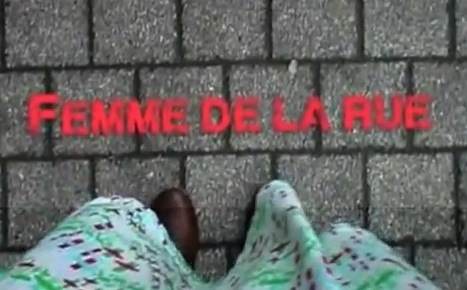
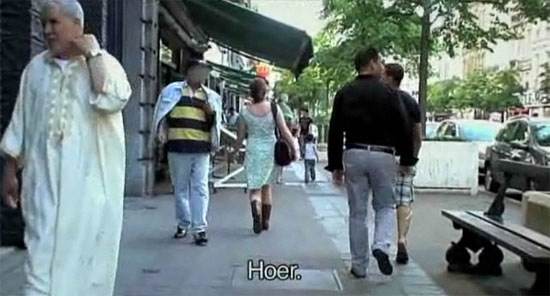
As well as giving me the opportunity to write and hopefully to contribute in some small way to the global movement against street harassment, this programme has inspired me to seek out activists and discover their stories. It was inspiring to hear about the dedication and commitment of the Hollaback girls, both Belgium and Ireland based, and my discovery of the film “Femme de la Rue” was the final assurance that i was not alone in my conviction that Brussels has a problem with street harassment and that it is an insidious, imitating part of women and LGBTQ+ people’s lives here.

Sofie Peeters, a Belgian film student chronicled her own struggle with street harassment on the streets of Brussels in this highly original and thought provoking documentary. Through the creation of her thesis Soffie shone a well needed light on this issue and in doing so gave both victims and perpetrators a chance to tell their stories. Both of the activists I interviewed mentioned the difficulty in engaging with harassers, Soffie Peeters addressed this, and her interview with a former harasser is possibly one of the most notable aspects of this film. The final message however is clear, concise and spot on, women deserve respect on the streets and to accept harassment is to lose a vital battle on the road to equality.

Dearbhla graduated from BESS (Business and Sociology), in Trinity College Dublin, last year. She currently lives in Brussels, Belgium, where she has a think-tank internship working in the areas of gender, equality, and employment. Follow her on Twitter @imoshedinheels and her blogs.


Share

Filed Under: correspondents, Stories, street harassment

USA: “It’s hard to fight an enemy that has outposts in your head”

August 13, 2014 By Correspondent

Jessie Koerner, Denver, Colorado, USA, SSH Blog Correspondent

Bakken oil field via Billings Gazette

Some days the patriarchy slaps me in the face: the recent Hobby Lobby decision in the Supreme Court, the fact that Hollywood refuses to acknowledge the results of years of Bechdel Test results, the *minor* issue that rape offenders are so often excused and so rarely prosecuted. Some days the fact that society wants me to be a living, breathing mannequin creeps up on me.

In June, I wrote about how the city of Denver must have agreed to take a time out from harassing women on the street. I’ve been travelling between Colorado, North Dakota and Montana for work ever since, and to be honest, haven’t spent much time outside the office, a car, airport, or rural oil pads. It wasn’t until I was playing blackjack in a Dickinson, North Dakota, hotel that I had a thought so out of left field, I blamed it on the SoCo and 7s I’d been drinking at the table. Why is no one hitting on me?

There’s some context here that I should probably fill you in on that has nothing to do with my inflated ego. The Bakken oil field, which spans eastern Montana, to southern Alberta, and western North Dakota is the place to be if you’re in oil and gas. The addition of its one million barrels (42 gallons in a barrel) a day is what’s catapulting the United States to the top of the oil producing nations list. The Bakken boom is also responsible for a huge influx of people to western North Dakota, and at least initially, most of that population consisted of men.

If you’re reading this blog, I’m assuming you have some idea of what happens when you combine a male population influx, and money – think Super Bowl, World Cup, etc. Prostitution. And if the FBI, and human rights organizations are to be believed (obviously), around 75-80% – conservative estimates – of those prostitutes are trafficked. So this is a problem in the Bakken. A huge problem. In addition, I’ve talked with multiple people, including a police investigator in Dickinson, who say that girls who live in the western North Dakota area refuse to go to bars any more because they’re sick of being hit on and harassed.

So this detour in information has brought us back around to that night at the blackjack table, where I lost five whole dollars to Dickinson charities (I’m a conservative and blasé gambler… what can I say). Why are none of these douchecanoes hitting on me? Nevermind the fact that I was with my (dude) boss, another (guy) coworker, and kept yelling at every guy who sat down to “stop telling me how to bet, dear God, I will do what I want!” because, shocker, all these strange men wanted to impart their knowledge of a game of randomness.

In and of itself, this can be chalked up to a bruised ego and a bad hair day. However, I’ve been back to running around Denver for a couple of weeks now after that night, and I find that same thought creeping into my head: Why isn’t anyone harassing me? I signed up for this blogging position because I was harassed in the worst ways prior to this. Am I not pretty any more? OMG is this why I’m still single?

These ridiculous (and they are absolutely, utterly ridiculous) thoughts crept into my head, uninvited and completely automatically. Why is my subconscious whining about NOT being harassed on my daily walk from my parked car to Starbucks to the office? WHY IS THIS HAPPENING?!

Sneaky, sneaky patriarchy, I have internalized you, despite all the feminist bones in my body, and my empowering upbringing, and my long-time mantra of “leave me alone, I will do what I want!” When and if this happens to you, I’ll be here in my own little support group, and while I hope not to have other members, the door is always open.

This is, to me, the most insidious part of street harassment. The fear, the anxiety, the utter frustration with the situation, the split second inner debate of “should I/shouldn’t I confront this douchecanoe?” can, in most cases, be left on the street – until the next time. The unexpected self-objectification that results from the constant barrage of catcalls and objectification by men when going about our every day lives reminds me of a Sally Kempton quote that has long been accurate for me: “It’s hard to fight an enemy that has outposts in your head.”

Women alter every day behavior to avoid the experience of being harassed. Changing routes; planning ahead for the experience – “I will walk past my final destination so this harasser doesn’t know where I’m going”; avoiding working out in public, and joining a gym; changing outfits to avoid the catcalls, these are just a few examples. The constant imposition of a flight-or-fight response for walking down the street is stressful enough. Then, after so much of this, the normalization of being harassed, and the societal expectation that victims should just deal with it quietly as a part of the social compact, we get to take it home. We get to deal with the internalization of yet another message that we are an object in the world rather than a person.  AND we get told to take it as a compliment.

Even after the immediate threat has passed, the reverberations lay in wait, and reveal themselves to all of us who’ve experienced street harassment when we least expect it. They show up when we think we’ve finally gotten a reprieve from the exhausting spectacle that is being a woman in public.

Jessie is a longtime human rights activist with a feminist focus. She founded the Amnesty International chapter in college, is an active participant in JustWorld International, and manages the social media accounts for the Global Women’s Network and winnovating.com, where she also blogs.  Find her on Twitter and Instagram, @pearlsandspurs.

Share

Filed Under: correspondents, street harassment

Australia: How “That Girl” turned into #YesAllWomen!

August 4, 2014 By Correspondent

Corina Thorose, Melbourne, Australia, SSH Blog Correspondent

The first time I got a proper look at bona fide sexual harassment, I was about fifteen years old. Out with a group of friends, we had somehow gotten into a club, where we were enjoying being grown ups in our finest heels, skirts and halter tops. We looked like smouldering adults, but we were careful never to cross the line into Trashy.

Which is more than we could say for That Girl.

She was in a boob tube and a micro-miniskirt. Her eyes were heavily painted, and she had sex-me boots on. She was Trashy. She was Asking For It.

We observed her as our evening went on. She was groped by several guys, and she was getting angry with all of them, yelling at them all and even aggressively shoving a few of them away. We shook our heads and tsked, wondering why she was dressed like that if she wasn’t interested in men touching her. Didn’t she know clothes like that Invited Certain Attention?

It wasn’t until later in life when the groping started happening to me that I started to reassess things. I was not doing anything to Provoke it. There was no discernible pattern – it was occurring when I was drunk, sober, with friends, alone, in jeans, in a skirt, daytime, nighttime, in heels, in flats. I had become That Girl – and I had no idea how.

The answer has come to me over a lifetime of fighting these cretins off. I took the question to some of my girlfriends, and yes, even a male friend, and they were kind enough to share their own experiences of being That Girl.

Jane

“I was in Argentina with a girlfriend, and we were catching the train into the city. The carriage was packed, so we had to stand up, and the guy behind me was standing way too close to me. He was holding a briefcase and he slowly put it under my skirt and was started pushing it up. At first I thought it was an accident so just I stepped away from him, but he stepped close again and kept doing it. I pushed him away but that didn’t stop him either so I looked him straight in the eye and told him to fuck off, but that didn’t work either. In the end, I was so upset that my friend and I just got off at the next stop to get away from him. She flipped him off and yelled ‘Fuck you!’ at him, but he was totally unfazed by it.”

Kate

“I was on my way to work, so it would have been about 8:30am. I got off the train and Parliament station and a guy on the carriage got off behind me. I didn’t think anything of it until it became clear that he was following me. I kept looking back at him, making it clear that I knew he was there, but he didn’t seem to care, he just kept staring at me really intensely. He followed me all the way to the office and into the building. When I got in the elevator he followed me in and I pushed him out as hard as I could. The doors closed and I got up to our floor safely, but he waited for me in the foyer all morning. I told my boss and we called the police and they moved him on, but as he hadn’t done anything to me, there was nothing they could charge him with. He came back and waited for me again a few times, but I always gave him the slip. He gave up eventually, but I still look for him everywhere I go.”

Natalie

“I was working at a festival, and I was in charge of the set up and shut down of our stall. At the end when I was packing up, I knelt down to pick up some of our equipment and an old man who was sitting next to me says, ‘That’s what I like, a woman on her knees.’ I was so shocked I couldn’t even respond. You’d think someone of his generation would be a little classier!”

Tess

“I’m a big chested woman, and I cannot walk down the street without being gawked at. It’s not like when someone checks you out and you feel a bit chuffed about it, it’s outright staring, enough to make me really uncomfortable. One time I was out with some girlfriends and I had a pash with this guy who seemed really nice. He asked for my number and I gave it to him, and the first thing he did was text me a picture of his dick and then ask for a picture of my breasts.”

Jules

“I was eighteen and at a nightclub. This guy asked if he could have a kiss and I said no. When he asked why not, I said I had a boyfriend. He said no one would ever know and he’d make it worth my while. I was too young to know what to say or how to deal with it, so I just thanked him politely and walked away. I was really mad though, why did he feel so entitled to me?”

Hayley

“I was at the casino with a big group of friends, but I went off to go to the bathroom. When I walked in, I thought it was empty, but there was a man in one of the cubicles and he jumped out and grabbed me. I started screaming and fought him off, but I was drunk and lost my balance. He scratched up my neck really badly but luckily security got there and he ran off.”

Tom

“I was on a plane flying to Adelaide and one of the stewards was flirting with me. I thought he was cute, but I wasn’t really interested, so I was relieved when he didn’t ask for my number. He must have checked the flight registry though, because he got my last name and looked me up on Facebook! What a violation of my privacy.”

Erin

“I tried online dating and this guy who seemed perfectly nice at first told me he was going to bed to masturbate over me.”

Olivia

“I was a first time mum and I was walking my baby in her pram down the street. A boy of about sixteen rode past on his bicycle and pinched my bum. I punched him in the back and chased him down the street yelling at him.”

Jen

“My friend and I were travelling and we’d just gotten to Ottawa. We’d been out clubbing one night and on our way home stopped by the McDonald’s. We walked through the drive through but the sensor didn’t know we were there, so we waved at the car behind us to come up. It turned out to be a carful of young guys who thought, I dunno, that we were summoning them for sex. When they pulled up next to us they started saying the most revolting things, calling us cunts and telling us to suck their dicks.”

Sarah

“My girlfriend and I were trying to flag a cab down. A random car drove past and yelled ‘Sluts!’ out the window.”

Rebecca

“It was early in the morning, about 6:00 I think. I was on my way to the gym before work but on the way there, this car stopped beside me and the guy said something to me, but I just ignored him. He got out of the car and started following me. He was being really aggressive so I started to run. He caught up with me and grabbed my arm and I started screaming, but because it was so early, there was no one around. He kept telling me to shut up but I kept screaming and finally this couple turned up and started yelling at him. He got back in his car and drove off, but before he did he looked at me and said, “I’m going to remember your face.’ Thankfully, I’ve never seen him again.”

After speaking to my friends, I came to a conclusion I should have that day when I was fifteen. It doesn’t matter what you wear, where you are, or how much you’ve had to drink. We can all, at any time, be That Girl. Our bodies belong to us, and no one is entitled to objectify or touch them without our consent. Period.

I don’t mind being That Girl. What I can’t stand is That Guy.

That Guy is the one who won’t look away, who invades your personal space, or yells something out the window of his car as he drives past. That Guy is the reason I walk home from work with my keys in my fist and my phone in my hand instead of my bag. That Guy is the reason I go to the bathroom in groups, and why I don’t go jogging at night. That Guy has sent me home in tears many times, feeling ashamed of what I am wearing and making me believe that I am Asking For It.

Don’t be That Guy.

#YesAllWomen.

Corina is a journalist who is currently in a Masters’ program in Professional Writing. Follow her work on social media: @BrandosBride, www.facebook.com/theirownbells, instagram.com/theirownbells

Share

Filed Under: correspondents, Stories, street harassment

USA: Anti-women trolls try to hijack #YouOkSis Twitter discussion

July 17, 2014 By Correspondent

Brittany Oliver, Baltimore, MD, USA, SSH Blog Correspondent

Fighting street harassment was never an easy job.

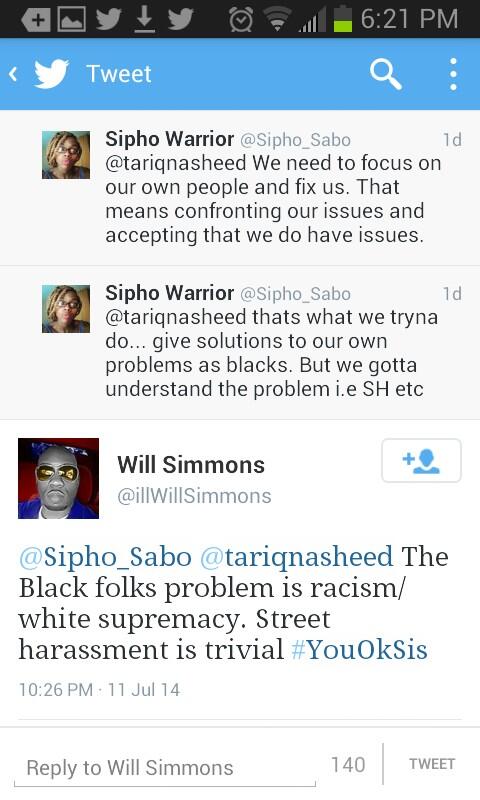
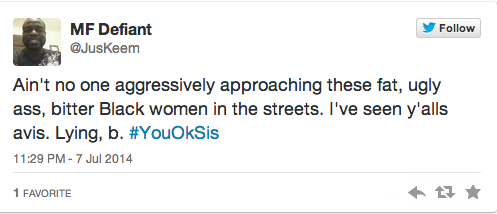
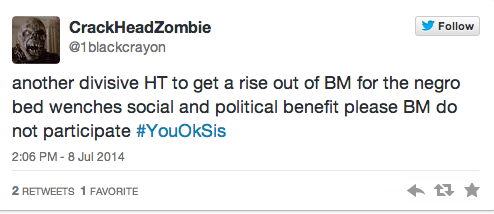
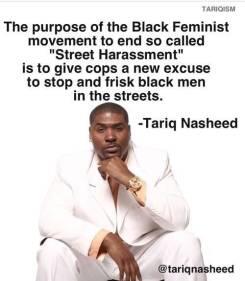
In case you missed it, Feminista Jones, a popular blogger, Black feminist and creator of the #YouOkSis hashtag, faced harsh backlash from Internet trolls for starting a discussion on how Black men should support Black women to combat street harassment. As motivating as this sounds, some people just couldn’t handle women speaking out and it took a turn for the worst.

With what was supposed to be a virtual space to express our frustrations to create dialogue, men immediately attacked Black women and their allies. At some point, I decided to join in on the conversation and the same thing happened to me.

How bad was it? You be the judge.

In defense of the movement, I tweeted back at trolls and was called an “angry Black feminist” who was on a mission to help organizations like Stop Street Harassment (SSH) put Black men in jail.

Really? Is that the best they could come up with? The work I do during the day consists of upholding racial equality and combating racism in all forms, especially within the criminal justice system. And believe me, the LAST thing I want is for the prison population to increase. That made absolutely no sense and is a cop out from the real problem: men not taking responsibilities for their actions.

This debate made me think about a film I saw in college called “Tough Guise: Violence, Media & the Crisis in Masculinity,” which is headlined by activist and educator Jackson Katz. Katz argues that the epidemic of male violence that plagues American society needs to be understood and addressed as part of a much larger cultural crisis in masculinity and I couldn’t agree more.

We live in a society that tells women and girls to dress a certain way to avoid unwanted attention and abuse. It blames victims first and asks questions later. It teaches men that they are entitled to women’s bodies and showing aggression is the “American” way.

Because the hashtag #YouOkSis wasn’t about the trolls, they were determined to ruin a time of solidarity. What people need to realize is that Stop Street Harassment has given me more support than any man ever has. Now, let that sink in for a minute.

If street harassment didn’t exist, why are organizations like SSH and Hollaback! Baltimore doing work on these issues? Why is visual artist Tatyana Fazlalizadeh traveling around the country to wheat paste portraits quoting things women want to say to their harassers? Street harassment is not an illusion and these are real issues and challenges we face every day.

In 2014, SSH commissioned a 2,000-person national survey in the USA and found that 65% of all women had experienced street harassment, while 25% of men were harassed. With all of the research it took to get these results, why would anybody make this stuff up?

Instead of Black men supporting Black women on this issue, sadly some of them let us down once again. When was the last time you heard a woman deny a man’s experience of being stop and frisked by the police? Most likely never.

And although anti-women trolls hijacked the #YouOkSis hashtag, they proved exactly why the fight to ending street harassment continues.

So, what’s next? Continue to stress the importance of ending street harassment among your family, friends and allies in your community because as you can clearly see, the work is far from over.

Brittany Oliver is a recent graduate of Towson University and works in the non-profit communications sector and supports local anti-street harassment advocacy through Hollaback! Baltimore. She blogs at http://btiarao.wordpress.comand publicly rants on Twitter, @btiarao.

Share

Filed Under: correspondents, Stories, street harassment

USA: #YouOkSis Street Harassment Tweet Chat

July 14, 2014 By Correspondent

Kirstin Kelly, Monterey, California, USA, SSH Blog Correspondent

As an editor for The Women’s International Perspective, I often find myself involved in Twitter chats and campaigns that deal with social issues, especially issues pertaining to the treatment of women around the world.  On July 11, I participated in one such chat using #YouOKSis (here is the recap). It quickly became clear that this was not your ordinary Twitter chat.

The sheer numbers of trolls and naysayers making themselves heard was truly astounding.  The #YouOKSis chat was intended to be a discussion about street harassment faced by Black women.  In particular, it called for men of color to engage in bystander intervention when they witness women of color being harassed.  These kinds of conversations are important.  Stop Street Harassment’s recent National Street Harassment Report demonstrated that persons of color face harassment at higher rates than their white counterparts and that overwhelmingly it is men who do the harassing, regardless of the victims’ gender.

The #YouOKSis chat aimed to address this problem on two fronts.  It first and foremost provided a space for women of color to share their experiences.  #YesAllWomen, a campaign in which I also took part, similarly invited women to share their experiences.  However, it did not address how race plays a role in a person’s experience with street harassment the way #YouOKSis did.  The second critical component of the #YouOKSis chat which is largely absent from other similar conversations is that it attempted to educate men on how they can actively become part of the solution by intervening on behalf of people facing harassment.

Participating in both of these conversations provided me with a tiny window into the complexities of issues that are both racial and gendered.  #YouOKSis drew a level of harassment I could not have expected.  Not only were people complaining in the usual manner that women sharing their experiences were creating problems where previously there hadn’t been any, being whiny, or failing to recognize that not everyone is guilty of harassment, but many of them were critiquing participants for turning on their own race.

The viciousness of these attacks is exactly why campaigns like #YouOKSis are important.  We need to do more to create safe spaces for people to share their stories about how race, sexism, and classism affect their lives because without fostering a better dialogue, any attempt made to solve these problems will be limited by the experiences of the organizers.

Furthermore, a lot of the criticism was coming from men who felt attacked, pointing out that not all men are guilty.  To me, it seemed the larger point of the conversation was not to hate on men for harassing women, but rather to help educate men that are not allies yet and to further empower those that already are by giving them more to go on than simply “don’t harass people.”  For social issues that are gendered, engaging the entire population, those with group identities most common to aggressors is critical.  Male allies are just as important to changing the norms of acceptable behavior as women; they do make up half the population after all!

My guess is that allies both from within and outside of racial groups are similarly critical in creating the changes that are so desperately needed.

Kirstin is a Master’s Student in Nonproliferation and Terrorism Studies at the Monterey Institute of International Studies and a news editor at the Women’s International Perspective (The WIP). You can follower her on Twitter at @KirstinKelley1, where she regularly posts about human rights issues around the world.

Share

Filed Under: correspondents, Stories, street harassment

« Previous Page
Next Page »

Share Your Story

Share your street harassment story for the blog. Donate Now

From the Blog

  • #MeToo 2024 Study Released Today
  • Join International Anti-Street Harassment Week 2022
  • Giving Tuesday – Fund the Hotline
  • Thank You – International Anti-Street Harassment Week 2021
  • Share Your Story – Safecity and Catcalls Collaboration

Buy the Book

  • Contact
  • Events
  • Join Us
  • Donate
  • Facebook
  • Instagram
  • Pinterest
  • Tumblr
  • Twitter
  • YouTube

Copyright © 2026 Stop Street Harassment · Website Design by Sarah Marie Lacy