• About Us
    • What Is Street Harassment?
    • Why Stopping Street Harassment Matters
    • Meet the Team
      • Board of Directors
      • Past Board Members
    • In The Media
  • Our Work
    • National Street Harassment Hotline
    • International Anti-Street Harassment Week
    • Blog Correspondents
      • Past SSH Correspondents
    • Safe Public Spaces Mentoring Program
    • Publications
    • National Studies
    • Campaigns against Companies
    • Washington, D.C. Activism
  • Our Books
  • Donate
  • Store

Stop Street Harassment

Making Public Spaces Safe and Welcoming

  • Facebook
  • Instagram
  • Pinterest
  • Tumblr
  • Twitter
  • YouTube
  • Home
  • Blog
    • Harassment Stories
    • Blog Correspondents
    • Street Respect Stories
  • Help & Advice
    • National Street Harassment Hotline
    • Dealing With Harassers
      • Assertive Responses
      • Reporting Harassers
      • Bystander Responses
      • Creative Responses
    • What to Do Before or After Harassment
    • Street Harassment and the Law
  • Resources
    • Definitions
    • Statistics
    • Articles & Books
    • Anti-Harassment Groups & Campaigns
    • Male Allies
      • Educating Boys & Men
      • How to Talk to Women
      • Bystander Tips
    • Video Clips
    • Images & Flyers
  • Take Community Action
  • Contact

Cameroon: Media and Police Perpetuates Street Harassment

September 10, 2014 By Correspondent

Ngwentah Berlyne Ngwalem, Buea, Cameroon, SSH Blog Correspondent
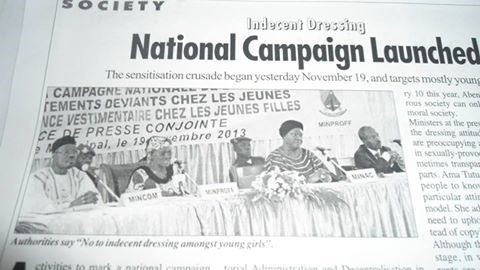
“Five ministers sat together and passed the dress code law which focused on women’s dressing but not on men’s acts of violence against women. This law gave rise to false media claims of women’s dressing causing rape and harassment.”

Every article that I have read in newspapers like “Cameroon Tribune” blames women for being “created female’’ as the sole or biggest reason for why they are sexually harassed in the streets by random men who claim to be distracted by their mode of dressing. The message that is sent is that women should remain at home-locked up, in the kitchen cooking because their mere presence in streets is a distraction to men.

My colleagues Zoneziwoh M. Wondieh and Patience Lum and I have been working on addressing harassment. We have found that many men take it as a right to attack women and claim it is because they are indecently dressed and a distraction. But everything in life is a distraction but it is ones decision whether to let it be a point of focus and act on their feelings or thoughts. We pass and meet thousands of people each day. Everything that is different from what you normally see around might cost you to look, admire or desire it but it is not your right to offend or attack based on your fixed ideas, feelings and thoughts on how things should be. These includes people with a lighter and attractive skin complexion, physically attractive looking people, extremely tall or huge people, Dwarfs, Albinos and people of different races.

With these differences if someone were to harass, attack or rape any of these individuals and give the excuse that it is because these people are attractive or distracted them because they look different will the perpetrator’s excuse not be dismissed and they be punished with the reason that those people are who they are not by their making and do not deserve to be harassed because it is the looker’s responsibility to contain themselves? And that the harasser has a mind to think for themselves?.
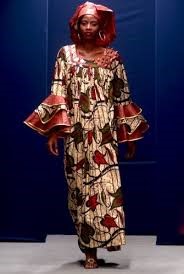
“Kabas are traditional Cameroonian/African dresses that does not show a woman’s body shape. Only Women wear Kabas.”

How is it possible that people consider a woman’s dressing as a possible cause of rape and sexual/street harassment and refuse to see that this whole issue is about power and control given that women in Kabas , Nuns, Children and others who are modestly dressed get raped and  harassed?

Another big problem is that police officers are the ones enforcing the dress code. There is no woman/girl I have seen or spoken to who feels safe in the hands of policemen. Girls who get held by policemen for either forgetting their National Identity cards when traveling or sometimes some possible made up reason like mode of dressing or disrespectful behavior towards the police or another individual often complain about those police men married or not chatting them up instead of doing their jobs. It will be worse for you as a woman if you resist their sexual advances.

People ignore the fact that these policemen’s jobs also involve single and married policemen asking for several women’s numbers or making unwanted sexual advances towards them. It involves policemen harassing women under the pretext of implementing the dress code law.

How does it help when such attitudes are not strongly condemned and the policemen not punished, instead women are told they are the cause of their sexual harassment either by forgetting their National Identity Cards or by their mode of dressing? Policemen are being encouraged and taught to know that they are above the law in Cameroon and can violate people’s rights. Men should be taught to take responsibility for their actions. I find the undefined dress code law very confusing and misleading.
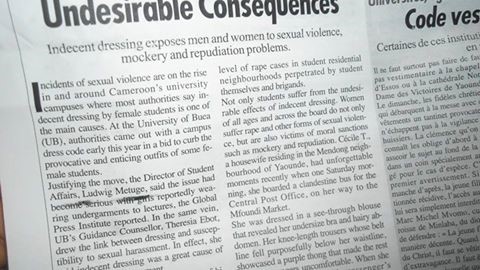
“Read the article not just the heading to see that the whole focus is made on women’s dressing as a cause of violence against them.”

Media coverage of dress code in Cameroon encourages people to shame, humiliate and act violently towards women. Women’s problems and difficulties handling harassment in Cameroon does not arise from their dressing, it comes from people’s twisted views about the world and the woman’s place in society. Instead of being taught to be responsible citizens, young people are being taught to continue with the old tradition of policing women’s lives and bodies. They are taught to violate other people’s rights simply because they are of the wrong sex and will eventually be set free because those group of people whose rights are being violated fall under the underprivileged gender with laws constructed for them to follow with the false notion that it is being done for their own good. Patriarchal norms have made it possible for women to get blamed whether or not they do obey, or do not obey and get attacked.

The media and government of this country should change their language and start talking about ways to punish perpetrators of such crimes, not punish the victims, and teach the perpetrators to live in a society full of different types of people, to understand that everyone has equal rights and the law to protect them.

Berlyne is a Cameroonian-based women’s human rights activist, passionate and determined to put an end to social injustice of any kind. You can find her on twitter @Luvequalityrule and Facebook.

Share

Filed Under: correspondents, street harassment

Australia: The Slippery Slope of Street Harassment

September 6, 2014 By Correspondent

Corina Thorose, Melbourne, Australia, SSH Blog Correspondent

Street harassment is a hot topic at the moment. It seems like everywhere I look, people are discussing it. What it is, who commits it, whether it is an offence, or whether it is actually a compliment. I watched a segment on a panel show the other day, when the subject came up, and to my surprise, every single one of the women on the panel, declared wolf whistles to be a compliment. The women in question ranged from forty to seventy years of age, and each one said that they wish they still got whistles, that at this stage in their lives, they were no longer appreciated as being attractive, or deemed worthy of a cat call.

Well, this was food for thought.

I’m in my late twenties, and it’s never occurred to me what it would be like to be someone who doesn’t turn heads. What it must feel like to be undervalued because of your age. I felt bad for not considering every angle. But then something else happened.

One of the women asked, “Why do we have to pester men to change all their behaviour?”

Why?

Because f*ck you, that’s why.

Because the first time I got whistled at, I was twelve years old. My breasts had just come in, and maybe I looked a little older, but I can’t explain the feeling of shame that came over me as I heard that holler for my body.

Because the second time I experienced street harassment, I was thirteen. A road worker leered at me for so long, I felt frightened, even though he didn’t say anything to me. Did he know how young I was? Did he care?

Because when I was fourteen, a carful of teenager boys pulled over and asked me if I wanted a lift. What on earth possessed them to do that? What part of their brains told them that that was a good idea? And what would have happened to me if I had said yes?

Because when I hear a whistle, or am the subject of a look that lingers way too long, I feel devalued. Great, you think I’m attractive. I’ll file that under things I don’t give a f*ck about and move on. By all means, take a look. I looked at you. We’re programmed to notice members of the opposite sex, or even members of the same sex if we are so inclined. But we are not programmed to behave like horny animals. We don’t grunt and mark our territory. We have evolved.

Let’s say we stop “pestering the men about their behaviour.” Let’s say we okay the wolf whistle. If we okay that, let’s okay the the comment on my skirt. Let’s okay the narrative on how hot my tits look today. Let’s okay the guy who touched my arse because I’m wearing tight pants. Let’s okay the guy who won’t take no for an answer because he bought me the drink and I had a cheeky pash with him.

It’s a slippery slope. Street harassment is not a compliment. It needs to stop being the norm. It is a crime.

Corina is a journalist who is currently in a Masters’ program in Professional Writing. Follow her work on social media: @BrandosBride, www.facebook.com/theirownbells, instagram.com/theirownbells

Share

Filed Under: correspondents, Stories, street harassment

USA: Decreasing harassment and increasing resiliency

September 1, 2014 By Correspondent

Kirstin Kelly, Monterey, California, USA, SSH Blog Correspondent

About a month ago, University of Tennessee researchers Dawn Syzmanski and Chandra Feltman published an article entitled “Helping Women Overcome the Anguish of Unwanted Sexual Advances.” The article professes that women who experience street harassment fall into two major categories: those who are resilient and those who are not. Immediately after publication, Syzmanski and Feltman faced backlash from people who felt the article was supporting victim-blaming mentalities by suggesting that people who are more resilient are better able to cope with the stress of unwanted sexual advances than people who are not.

Normally, I agree with people who caution against products or research that could perpetuate victim blaming because I, like most others, believe that pressuring those engaged in harassing behaviors is far more important than teaching would-be-victims to avoid responsibility. I fully agree that the onus of responsibility should be on the aggressors, not their victims. But this study is fundamentally different to me.

First, the idea of resiliency is widely accepted among psychologists as a way of understanding why certain people respond to stressors by using them as springboards while others experience overwhelming negativity as a result of the same type of occurrence.

Second, victim blaming usually refers to advice or products to help would-be-victims avoid situations that might lead to harassment or even assault. These are obviously problematic because they place the onus of responsibility on the victims to avoid situations in the first place, but ignore the reality that harassment and assault can happen to anyone at any time in any place under any circumstances.

Resiliency could be a useful tool in helping to combat the effects of street harassment because it helps survivors heal from trauma, which could include unwanted sexual advances, but it is victim blaming to suggest that people who lack resiliency will have a harder time. Similarly, since resiliency can be helpful in healing from a number of different traumas, it is not asking potential victims to alter their behavior in order to avoid negative situations.

There is nothing victims can do to keep themselves completely safe, but aggressors have the ability to stop their behavior. Social pressure definitely needs to be placed on the aggressors to stop the behavior, but in the meantime, research that helps us understand how victims can recover from their experiences is valuable. I think it’s helpful to encourage people to increase their resiliency regardless of their perceived susceptibility to aggressive behavior. Likewise, I think aggressors should be discouraged from continuing together.

Perhaps these two approaches work best when combined as a holistic approach to addressing rape culture and street harassment.

Kirstin is a Master’s Student in Nonproliferation and Terrorism Studies at the Monterey Institute of International Studies and a news editor at the Women’s International Perspective (The WIP). You can follower her on Twitter at @KirstinKelley1, where she regularly posts about human rights issues around the world.

Share

Filed Under: correspondents, Resources, street harassment

USA: When my tour guide harassed me

August 24, 2014 By Correspondent

Kasumi Hirokawa, PA, USA, SSH Blog Correspondent

Via Worldin1001view

International travel is great. You get to try new food, practice phrases in a new language, geek out at landmarks and learn about the local history. I honestly don’t know anyone who doesn’t like traveling.

However, the fun of sightseeing abroad can come at a cost if you are a woman or a gender non-conforming person: there’s sexual harassment. Unwanted sexual attention and body policing can come from locals, fellow tourists and people who work closely with tourists. Here, I will share my stories of being harassed by people whose job is to ensure the safety and comfort of travelers.

I visited Bangkok and Pattaya, Thailand in the summer of 2012 with my family. We were part of a 20-some-person tour group with a local guide who spoke Mandarin and Thai.

We were to spend our second day in Pattaya on a beach. It was the day I was looking forward to my entire trip. After running around and riding banana boats on the spotless beach on an island off Pattaya City’s harbor, my sister and I sat down to rest by my mother. My sister dug up a camera out of a backpack and walked away.

I stayed and caught the tour guide, a married middle-aged man, staring at me. He sat next to my mother. “She’s got a fine body, your elder daughter,” he attempted to whisper but he was too loud.

It still wasn’t the worst I’ve encountered yet. Our group was to visit a local Buddhist temple and have dinner at a cruise ship in the city after the beach.

At the temple, bus drivers from other tour groups honked at my sister and me in the parking lot, giving our bums thumbs up. Security guards in uniform ran their eyes up and down our bodies. We heard wolf whistles. We saw them exchange looks and laugh. I didn’t feel the peace of mind the temple promised its visitors.

That same night, when our group climbed on board the cruise for dinner, I heard yet another wolf whistle. A tanned Thai man was standing behind me with a Cheshire cat grin. He whispered “nice ass” before pulling out his flag and led his group of Chinese tourists to their table. I was disgusted that I had to be stuck on the same ship as this man for the next few hours. It wasn’t surprising when he kept whistling at me wherever on the ship I went, following closely behind like a baby duck waddling after its mother – only sleazier and hornier.

Fast forward to last year, in the spring of 2013. My friend and I vacationed in Marrakech, Morocco for a week while we spent our semesters abroad in Paris and London, respectively. It was a dream come true for me. I’ve always been a huge fan of Moorish art and architecture. To this day, Morocco is one of my favorite countries.

Even on this trip, there was something I’d rather forget. It was – you guessed it – sexual harassment. The sheer number of times strangers talking to us was astronomical. Beyond comparison to any other places we’d been. It wasn’t a Japanese holiday and there were few Asians except for us. Most of them seemed to be merchants trying to lure customers into their shops: “Bonjour! Konnichiwa! Miss! The pretty one! Yes, you. With a flower! I have a perfect comb for you! Why don’t you come and have a look?” Some others wanted to know our cell phone numbers and how much we would cost for a night.

I fell instantly in love with our riad – a traditional courtyard house-turned-B&B. We were treated to delicious pastries with jam, freshly squeezed OJ and mint tea every morning. Our room was cozy and the decors in the sitting room and courtyard were crafty and beautiful. The rooftop terrace was a delight. The staff was attentive. It was almost perfect.

We arranged a hike at nearby Ourika Valley with the riad’s own manager assistant-cum-guide, Kamal. Upon seeing the 25-year-old, my friend exclaimed, “Gosh, he’s hot!” He was the only English speaker among the hotel staff. It was a huge relief for me because in the riad everyone else spoke Arabic and French. I don’t know much French, so most of the times I was just pretending to listen with a blank face.

Kamal was very knowledgeable of the valley area, taking us to an argan oil cooperative, showing us a Bedouin house and talking about the flora and fauna of the Atlas Mountains. Kamal the guide made hiking up the rocky surfaces seem easy, but it wasn’t exactly for me.

Despite both of us sporting Converse sneakers, my friend was a far better hiker than me. I had to be pulled up and down by the guide. At one point, he had to summon a fellow guide from another riad to pull me up a steep incline. I was embarrassed to be such a burden to him and my friend.

Back in the riad that evening, my friend sent me to return the money she borrowed from Kamal. She was too exhausted from the hike. I thought nothing of it. I went upstairs to knock on the guide’s office, which is also used as his bedroom. I handed him the money, thanked him and turned around when he called to me, “Hey, would you like to see the pictures of the Atlas Mountains? And the other place you are going to visit tomorrow?” “Well, just a few minutes,” I said.

He opened a browser and frowned. We don’t have a strong internet connection here, he said. Let’s go downstairs, in the sitting room. So we went. It was 10pm but all of the guests were either out or inside their rooms. We had the sitting room to ourselves.

Kamal talked about the place my friend and I were to visit the next day. Then he told me about his dreams of visiting Far East. I tried to hide my yawns. Then I felt his arm wrapped around my shoulder and his other hand rubbing my thigh. I looked at Kamal’s face in shock. He was still talking softly. Kamal the guide brushed a strand of hair from my face and leaned in. I leaned back. “I, I… need to go,” my voice was shaking. He grabbed my arm and said, “Don’t. I know you want to stay. Here, with me.” The guide winked at me. I stood up and left. I ran up the stairs.

My friend was in bed but she was awake. “What took you so long?” She looked at me while I tried to lock the door in vain. No doors have locks in this riad. What if he comes here while we sleep? I was scared. I told my friend what happened. She was surprised. We sat in silence. Finally she told me not to talk to the guide and went to sleep.

Traveling internationally is eye-opening and at the same time, stressful. Not speaking the local language is stressful. Not knowing the local customs is stressful. Having strangers hiss at you in a foreign language in an unfamiliar locale is stressful.

Often, tourists have no choice but to trust their guides and hotel staff with their safety. Therefore, for an individual who is entrusted with the safety and well being of a tourist to sexually harass those whom he or she is sworn to serve, is to betray that trust. It makes a tourist feel unsafe in a place where he or she should be able to feel safe. It makes traveling more stressful for women and gender non-conforming individuals. No one deserves to feel threatened on their vacations that cost hundreds to thousands of dollars when all they want is an escape from everyday routine – including dodging street harassers.

Kasumi is a recent graduate from Penn State with a BA in journalism. Her writing has been published in Valley Magazine, City Weekend Shanghai, Penn State GeoBlog and Shanghai Daily. You can follow her on Twitter, @kasumihrkw

Share

Filed Under: correspondents, Stories, street harassment

USA: Exercising Outdoors While Female

August 20, 2014 By Correspondent

Lorna M. Hartman, Spokane, WA, SSH Blog Correspondent

Image via Shooting Truth Bullets

The discussion has begun on the street harassment women experience when they exercise outdoors. Articles here, here and here (one by our own Holly Kearl here at SSH) describe this type of harassment, and plenty more are a Google search away.

Yet the pushback against this aspect of harassment is considerable. Exhibit A is the comment section of any article on street harassment of women exercising in public spaces.

Kearl’s article cited above gets this gem: “v9988, I don’t make cat calls towards woman and I don’t condone it. On a list of problems that a person could have, cat calls should be near the bottom. If common cat calls bother her then she should grow a thicker skin … She should be happy that she has the ability to run and is pretty enough to get a cat call once in a while. I used to run when I was younger and as a straight man I did not enjoy the occasional cat call that I got from men but it was no big deal.”

A couple of comments down, the attitude continues: “Wait til you lose your looks, become middle aged and the male attention stops. Then you’ll really have something to complain about. Lighten up honey. Not every woman considers a wolf whistle dangerous harassment. Geez. Lemme guess, you majored in ‘Wymyn’s Studies’ in college. Men are the enemy!”

Several more comments down there’s this excerpt: “If you choose to just run along the side of the road in spandex or tight shorts, you will receive catcalls. That is just human nature.”

A 2012 article titled “Running With Breasts: Why Won’t Men Leave Me Alone When I’m Jogging?” by Philadelphia writer Erica Palan describes her experiences jogging in public areas. First comment: “Another woman complaining about her boobs! There doesn’t seem to be one woman on this planet who likes her own boobs (or anyone else’s) … ” and it goes downhill for several paragraphs.

Writer Maghen Nicole says, “As a young, female cyclist, my safety and right to access transportation with dignity has been compromised by traffic and pedestrians,” in her article “Harassing Me While I’m Biking Is Still Street Harassment” published in mid-August this year.

She goes on to say, ““Street harassment is yet another way for men to exert their power over women, far too often without question or consequence. Cyclists have had enough. Women have had enough … cases as extreme as passengers in cars reaching out to touch and grab women biking have been reported … women have reported men making uncomfortable and offensive comments about the way they were seated on their bikes.”

Her article was met with responses such as:

* “Should you be harassed no. Is cat calling really so bad that it makes you feel un-safe? If it does make you feel that way you better just stay home with your mommy while she cooks you din-din”
* “So much women’s studies jargon just to complain about someone saying something to you.”
* “Words are words; learn to be an adult and not some sniveling 12 year old … Now it’s ‘Sticks & stones will break my bones; Words will devastate my inner child, because I’m sniveling cry baby!’”

A blogger named Mountaineer created a Twitter handle called @offsideplays where women can share their experiences of being harassed while bicycling.

She wrote, “Since I created Offside Plays (@offsideplays) as a site to expose the everyday discrimination (e.g. racism, sexism, homophobia etc.) that takes place in sport and exercise nothing has caught my attention more than the harassment that women face while biking … I am consistently surprised by the amount and type of harassment/abuse faced by women on their bikes.”

How do we raise the social and legal costs of harassing outdoor exercisers simply for being female in a public space?

* Push back verbally if it’s safe to do so—both men and women can do this.
* Report physical contact by harassers to police, whether it happens to you or whether you observed it happening to someone else. A harasser moving into someone’s physical space and touching them is breaking the law.
* Advocate for police to have training on what street harassment really is and what it’s really like, and expect police to follow it up when you report a physical assault or stalking situation.
* Press charges when we have opportunity to do so, if we can afford it financially and emotionally.
* Share your stories with friends and family. It gives them the choice: They can either voice their support, or lose the ability to be in denial.

Post your stories to public online places like @offsideplays, the Hollaback website and Hollaback iPhone and Droid apps, following Twitter account @EndStHarassment and tweets tagged #endstreetharassment, following and submitting your stories to StopStreetHarassment and Fuck You Street Harassment on Tumblr, and many more.

There’s a lot of work to do before women exercising outdoors are treated with the respect due to any human being. But we are doing the work, and we can achieve the goal with perseverance.

Lorna is raising three young, kindhearted male allies and has worked on rape and interpersonal violence since the 1990s, including serving on the local rape hotline, answering calls, and driving to emergency rooms to advocate for victims and connect them with resources they needed.

Share

Filed Under: correspondents, Stories, street harassment

« Previous Page
Next Page »

Share Your Story

Share your street harassment story for the blog. Donate Now

From the Blog

  • #MeToo 2024 Study Released Today
  • Join International Anti-Street Harassment Week 2022
  • Giving Tuesday – Fund the Hotline
  • Thank You – International Anti-Street Harassment Week 2021
  • Share Your Story – Safecity and Catcalls Collaboration

Buy the Book

  • Contact
  • Events
  • Join Us
  • Donate
  • Facebook
  • Instagram
  • Pinterest
  • Tumblr
  • Twitter
  • YouTube

Copyright © 2026 Stop Street Harassment · Website Design by Sarah Marie Lacy