• About Us
    • What Is Street Harassment?
    • Why Stopping Street Harassment Matters
    • Meet the Team
      • Board of Directors
      • Past Board Members
    • In The Media
  • Our Work
    • National Street Harassment Hotline
    • International Anti-Street Harassment Week
    • Blog Correspondents
      • Past SSH Correspondents
    • Safe Public Spaces Mentoring Program
    • Publications
    • National Studies
    • Campaigns against Companies
    • Washington, D.C. Activism
  • Our Books
  • Donate
  • Store

Stop Street Harassment

Making Public Spaces Safe and Welcoming

  • Facebook
  • Instagram
  • Pinterest
  • Tumblr
  • Twitter
  • YouTube
  • Home
  • Blog
    • Harassment Stories
    • Blog Correspondents
    • Street Respect Stories
  • Help & Advice
    • National Street Harassment Hotline
    • Dealing With Harassers
      • Assertive Responses
      • Reporting Harassers
      • Bystander Responses
      • Creative Responses
    • What to Do Before or After Harassment
    • Street Harassment and the Law
  • Resources
    • Definitions
    • Statistics
    • Articles & Books
    • Anti-Harassment Groups & Campaigns
    • Male Allies
      • Educating Boys & Men
      • How to Talk to Women
      • Bystander Tips
    • Video Clips
    • Images & Flyers
  • Take Community Action
  • Contact

USA: #NotJustHello: What’s so bad about starting a conversation?

July 3, 2014 By Correspondent

Lorna M. Hartman, Spokane, WA, SSH Blog Correspondent
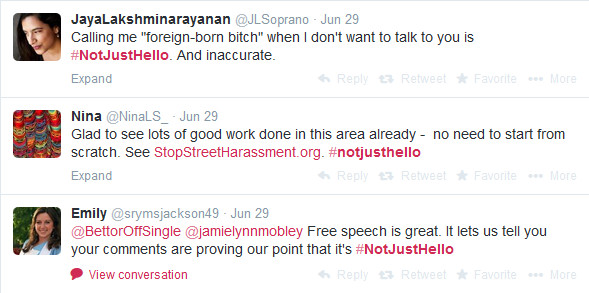
Twitter has provided women worldwide with an avenue for mass sharing of harassment and assault experiences.

It seems easy for some men to hear a story from a woman and simply dismiss it, as many women can testify. When hashtags go viral with dozens or even hundreds of women sharing these experiences, though, it’s much harder for people to simply dismiss them.

It’s harder to say, “You must have overreacted. It doesn’t sound like that big a deal,” when you’re saying it to several hundred or several thousand women from all over the world citing similar experiences.

Writer Aja Romano of The Daily Dot published “#NotJustHello identifies a troubling trend in street harassment” on June 22. She reported, “We’re sure Twitter user UJohnsmeyer probably meant well. But his defense of men who talk to women on the street may have sparked the weekend’s most engaging social commentary hashtag.”

Here’s a piece of the Twitter conversation that led to #NotJustHello:

@UJohnsmeyer  @Feminist_Inti @Karnythia ever think that maybe a guy sees a chick he thinks is hot and just wants to try to start up a convo?

@Karnythia  @UJohnsmeyer @Feminist_Inti Ever think women don’t want to strike up convos with strange men?

More women joined the conversation, telling about their experiences. Finally, @Karnythia said:

@Karnythia We do understand that it’s #NotJustHello right? That street harassment is never that calm or polite?

The new hashtag took off. Here are some samples of both women’s experiences, and of men’s reactions to the hashtag:

@dale_in_denver @KaeAltoBella @AJStream If there is an expectation of a response, then it’s #notjusthello. Ignoring isn’t working or this wouldn’t be a #.

@notallmikaylas Your desire to hit on me does not trump my right to be left alone. #NotJustHello

@hannaheff When I refused to acknowledge a stranger’s compliment, he invaded my personal space and said, “I’m stronger than you.” #NotJustHello

@UJohnsmeyer How do you get women if you can’t say hello to them? #notjusthello

@theamandabatty ‘Hello’ is a smile or a respectful nod, not a catcall, a jeer, a crude gesture or name calling when I don’t respond. #NotJustHello

‏@BettorOffSingle [this individual posted several dozen times, attempting to monopolize the hashtag—his post below is representative]

Hey stupid women: #yesallwomen #notjusthello #feminism all lesbian constructs for seducing gullible str8 women by turning them against men.

@cameralinds_ It’s #notjusthello, it’s fear of retaliation for both responding and not responding.

@RynJ21 It’s #NotJustHello when I have a smile I created specifically to deal with street harassment. I call it, “Please don’t kill me.”

Male allies posted as well:

@HolzmanTweed When I was a teen, a guy tried to “teach” me how to catcall, explaining “the rules:” (1/x) #NotJustHello

@HolzmanTweed He told me look for a ring, an ankle chain, something that flagged her as taken so that I wouldn’t disrespect her man. (2/x) #NotJustHello

@HolzmanTweed There’s no pretense on the guy side that it’s about anything but establishing & confirming power, a compliance check. #NotJustHello

@wisemath Brothers, go read the #NotJustHello tag. If that doesn’t move something in you, I’ll pray for you.

@RobScowen For the male “not allowed to flirt” whiners, please read #NotJustHello *carefully* without feeling like the [f******] victim and educate self

As some women tweeted, if men understood the humiliation and the fear women feel when they are harassed on the street, fewer men would do it. Women’s personal risk in possibly being verbally or physically assaulted by a displeased harasser is real.

Last September, blogger UnWinona told of one terrifying experience while commuting on the Metro in California.

On this occasion a bicyclist brought his bike in with him. Despite an empty car, he sat across from her. When he started talking to her, she calmly told him to leave her alone as she was reading.

He walked to his seat in a huff, muttering about it not being his fault she was pretty. But he didn’t stop there; he continued to mutter and complain, and after a few minutes he got back up and started pacing. Then he started screaming at her, and then punching the train.

She was terrified. She froze in her seat, ready with her feet up in case he attacked her, certain that if she got up and walked away she’d be attacked when she turned her back to leave.

For two stops he kept this up. No one came to her aid; no one even came to see what was happening. The second she reached her station, she ran out the door.

She concluded [emphasis hers], “So when people (men) want to talk about ‘legitimate’ forms of assault, tell girls they should be nice to strangers and give men the benefit of a doubt, tell them to consider it a compliment, tell them to ignore the bad behavior of men, I want them to be forced to feel, for even one minute, what it feels like to have so much verbal hatred and physical intimidation thrown at them for nothing more than being female and not wanting to share.”

Lorna is raising three young, kindhearted male allies and has worked on rape and interpersonal violence since the 1990s, including serving on the local rape hotline, answering calls, and driving to emergency rooms to advocate for victims and connect them with resources they needed.

Share

Filed Under: correspondents, street harassment

USA: Weighing in on harassment against interracial couples

June 25, 2014 By Correspondent

Kasumi Hirokawa, PA, USA, SSH Blog Correspondent

As a car window rolled down, I waited. Perhaps my boyfriend saw it coming, too. “Chinky legs, chinky legs, chinky legs! Ayeeeee!” A male voice chanted at us when we crossed the street, hand in hand.

It was the second time people shouted insensitive remarks at us. Or to me? I do not know. Both incidents I experienced seemed to involve men yelling Asian slurs. Somehow in 2014, the sight of an East Asian woman and a black man linking arms still offends people. The sight of two people in love.

State College, Pa. is a small town of approximately 41,757, according to the United States Census data as of 2013. It’s also very white. The data estimates 83% of the town residents identified as white in 2010. I have also heard that Pennsylvania is one of KKK’s favorite hangouts from multiple sources, including this article by TIME magazine. However, none of these justify hate.

I still remember the first time something like it happened. I think I will never forget if it happens again. It was on our way home from a formal at a mutual friend’s house. We were walking back as we passed by a pair of wobbling white men when my boyfriend abruptly turned around and stopped. “What is it?” I asked. He replied through his clenched teeth, “I thought I heard them say horrible things. Something like ‘sideways pussy.’ Did you hear it?” I was not paying enough attention to even notice it. But my boyfriend is not the kind to make this sort of things up, especially when it is obvious that I am tired.

Unable to find much reliable literature on harassment against interracial couples online, I wondered if similar things happen to other interracial couples. I sought out a few friends of mine, each of whom was in at least one interracial relationship.

Mandy* is an Asian American woman and a student at a local university. She said she was at the receiving end of “judgmental” stares when she was with her boyfriend, who is black, for a gathering in a campus building. She recalled being the only Asian girl in the room: “People [kept asking me], ‘Are you with him?’”

Kyle*, a recent college graduate who lives in Green Lane, Pa., said he and his former partner was never subjected to “direct attack” from strangers but they “caught bad looks and [received] poor service” at restaurants. He said waiting staff would bring food to others who were seated after them – a white man and a black woman. “Waitresses wouldn’t stop by as frequently and you could see them looking [at us],” he recounted.

The days of racism and sexism are seemingly over in the eyes of those who refuse to look at what is happening around them. Who knows what the person behind you in the Starbucks line thinks about another from a different racial, religious or sexual orientation groups? They would shake hands with a fake smile with anyone when sober. How about when their PC façade is washed down by alcohol, mob mentality or raging sense of entitlement? Just like creepy comments hurled at me when I’m alone, these hurtful words and gestures are supposed to remind us that we have stepped out of the line and the harassers have the power to police us.

Kasumi is a recent graduate from Penn State with a BA in journalism. Her writing has been published in Valley Magazine, City Weekend Shanghai, Penn State GeoBlog and Shanghai Daily. You can follow her on Twitter, @kasumihrkw

Share

Filed Under: correspondents, Stories, street harassment

Puerto Rico: El riesgo de ser universitaria, inmigrante o trabajadora en Río Piedras

June 24, 2014 By Correspondent

Cristina del Mar Quiles, Puerto Rico, SSH Blog Correspondent

Río Piedras, un importante sector de San Juan, es una de las pocas áreas de Puerto Rico donde se camina mucho y se depende del transporte público. Es justo donde ubica el principal campus de la Universidad de Puerto Rico, por lo que es habitado en gran medida por estudiantes. Pero Río Piedras también es el segundo centro urbano con mayor población de inmigrantes dominicanos, que en su mayoría son mujeres que llegaron a la isla con la intención de trabajar y poder enviarles dinero a sus familiares en República Dominicana.

Las características demográficas de este centro urbano multiplican en un área pequeña las dinámicas de acoso callejero que son práctica y costumbre en el resto de Puerto Rico. Las estudiantes, las mujeres dominicanas y las trabajadoras de los comercios del área se convierten a diario en el punto de miradas acosadoras, silbidos, chistes machistas, comentarios vulgares e, incluso, masturbaciones públicas.

Para nutrir este escrito con algunos testimonios, me di a la tarea de caminar por el casco urbano de Río Piedras. Sabía que no sería difícil encontrar mujeres que hubieran experimentado el acoso callejero.

Cerca de la librería Mágica, en la avenida Ponce de León, me topé con una estudiante, Katia López. Me contó que es alumna de una de las escuelas públicas cercanas al área. Con 15 años, Katia no me pudo responder cuándo fue la primera vez que un desconocido le lanzó un comentario sobre su apariencia, le pitó o le dijo algo que la incomodara, pero cuando le pregunté que si experimentaba este tipo de situación frecuentemente me respondió con un largo y resignado “sííííííí”.

“En verdad estoy acostumbrada… O sea, yo siempre camino con mis amigas y siempre nos están tocando bocina, tirándonos besos desde los carros… A mí no me gusta, ‘no like’, pero creo que ya, simplemente, los ignoro”, me dijo.

Como estudiante de escuela en Puerto Rico, Katia debe vestir uniforme cada día de clase. O sea, al verla en su uniforme, es evidente que se trata de una menor de edad. Su aspecto físico es el de una niña y su uniforme debe confirmarlo. Pero, en su caso, eso no ha sido disuasivo para el acoso callejero.

Cuando cerca de la estación del tren abordé a Lucía Durán, una dominicana de 34 años que trabaja como empleada doméstica , me respondió con una mirada de resignación y me dijo: “Ay, es que eso pasa todo el tiempo. Tú no te imaginas lo que una tiene que aguantar en la AMA… Lo peor es cuando la guagua va llena, temprano en la mañana o a las 5 de la tarde, los hombres aprovechan y se paran detrás de una… Ahí se aprovechan tocan a una y una ahí aguantando y soportando…” Lucía piensa que muchos hombres se aprovechan de las mujeres dominicanas, pues si no tienen residencia legal en la isla, es muy poco probable que acudan a donde alguna autoridad a denunciarlos.

A Ana Marie Carrasquillo la encontré cerca de la Plaza del Mercado. Es una universitaria que vivió por algún tiempo en Río Piedras, pero que no ha dejado de comprar los frutos frescos que se venden en la Plaza del Mercado. Cuando le pregunté sobre el asunto del acoso callejero, esta muchacha prácticamente se desahogó. Me dijo que le pasó que un día de camino a su hospedaje un hombre le llamó la atención, cuando miró, el tipo se estaba masturbando. “Obviamente me sentí mal, insegura. Quería salir corriendo y llegar rápido a mi apartamento. No sabía qué pensar, pero me puse bien nerviosa. Cuando llegué, no sé por qué, empecé a llorar. Fue una sensación que no te puedo explicar”. Unas semanas después, una mañana en que salía de su apartamento en la calle Humacao hacia el campus universitario, se dio cuenta de que el mismo hombre la esperaba al otro lado de la calle. Ella caminó de prisa, pero lo escuchaba a él siguiéndola. Mientras, él decía en voz muy bajita comentarios sexuales.

Luego de esos incidentes, Ana Marie dejó de hospedarse en Río Piedras. Renunció a la independencia que había adquirido cuando fue aceptada en la Universidad de Puerto Rico y sus padres le permitieron vivir cerca del campus y ya no con ellos en su casa en Naranjito. Pero Ana Marie no quiso exponerse más y decidió volver a vivir a la casa de sus padres, donde sí se sentía segura. Eso significó que todos los días se tenía que levantar dos horas antes, gastar sobre $50 dólares en gasolina cada semana, coger un tapón de una hora en el trayecto de Naranjito a San Juan y perder 20 minutos buscando estacionamiento para poder llegar a su clase de Biología a las 8:30 de la mañana.

El caso de Ana Marie es una evidencia clara de cómo el acoso callejero transforma e impacta negativamente la vida de quienes lo sufren.

“Cuando le cuento esto a la gente, me dicen que soy una exagerada. Pero, yo pienso, y es bien triste y frustrante tener que decirlo así, que al menos mí no me hicieron más daño; al menos a mí no me violaron, porque otras cuantas la han pasado peor que yo”. Entonces Ana Marie me cuenta de la mujer que fue encontrada gimiendo de dolor tras ser atacada y dejada en un edificio abandonado frente a la terminal de guaguas públicas de Río Piedras, y de las estudiantes que fueron violadas en sus hospedajes por un extraño que irrumpió en sus dormitorios en medio de la noche.

La experiencia de Ana Marie es una de las más dramáticas que he escuchado, pero sé, me consta, que el acoso callejero es una cuestión de todos los días. Aún así, he buscado, pero es muy poco lo que se ha dicho o escrito sobre este tema en Puerto Rico.

Permea la idea de que los llamados “piropos” son una forma en que los hombres pueden halagar y hacer sentir bien a las mujeres que caminan por la calle. Muchos piensan que las mujeres que visten escotes, ropa ceñida o pantalones y faldas cortas se exponen a ello y que hay algunas que por su constitución física no podrán evitarlo nunca, pues su voluptuosidad provoca el deseo masculino.

Todas estas concepciones están equivocadas. Entonces, el principal arma de defensa que tenemos es nuestra voz; educar e insistir en que no son “solo piropos”. Hay detrás de cada comentario, de cada bocinazo una cultura que ha convertido a la mujer en accesorio y objeto del que se puede disponer al antojo masculino. Necesitamos visibilizar las experiencias, cuestionar los estándares sociales y contestar, denunciar y luchar.

Cristina es una periodista y productora de noticias de San Juan, Puerto Rico. Posee un bachillerato de la Universidad de Puerto Rico, Recinto de Río Piedras, donde también completa su maestría en Consejería. Puedes seguirla en Twitter en @cristinadelmarq

________________________________________________

Puerto Rico: The risk of being a college student, immigrant or a female worker in Río Piedras.

Río Piedras, an important sector of San Juan, is one of the few areas of Puerto Rico where people walk a lot and rely on public transportation. It is where the main campus of the University of Puerto Rico is located, so it is inhabited mostly by students. But Río Piedras is also the second most populated urban center of Dominican immigrants, who are mostly women who came to this island with the intention to work and send money to their relatives in the Dominican Republic.

The demographic characteristics of this urban center in a small area multiply the dynamics of street harassment that are usual and customary in the rest of Puerto Rico. The students, Dominican women and workers of the businesses in the area often face harassing looks, whistling, sexist jokes, lewd comments and even public masturbation.

To nurture this writing with some testimonials, I gave myself the task of walking through the town of Río Piedras. I knew it would not be difficult to find women who had experienced street harassment.

Near the Librería Mágica, on Ponce de León Avenue, I came across a student, Katia López. She told me she attends a public school near the area. At 15, Katia could not answer me when was the first time that a stranger cat-called on her appearance, or said anything that made her feel uncomfortable, but when I asked her if she had experienced this kind of situation she responded with a long and resigned “siiiiiii”.

“I’m really used to it… I mean, I’m always with my friends and guys honk their horn at us, or throw kisses from their cars … I do not like it, ‘not like’, but now I simply ignore it”, she said.

As a student of a school in Puerto Rico, Katia should wear a uniform every day of class. So, seeing her in her uniform, is a clear evidence that she’s a minor. Her physical appearance is that of a girl and her school uniform should confirm that. It has not been a deterrent to street harassment.

When I neared the train station, I talked to Lucía Durán, a 34 years old Dominican who works as a maid. She replied with a look of resignation and said, “Oh, this happens all the time. You can not imagine what one has to endure in the AMA (public transportation buses) … The worst is when the bus is full, early in the morning or 5 in the afternoon, the men take advantage and stand behind… There is a leverage play and there holding and supporting … “Lucía thinks that many men take advantage of Dominican women because of their illegal residence in the island, is very unlikely to denounce to the authorities.

I found Ana Marie Carrasquillo near the Market Square. She’s a college student who lived for some time in Río Piedras. Although she’s now in another town, she kept buying the fresh fruit sold in the Market Square. When I asked about the issue of street harassment, this girl practically vented. She told me about a day in particular on the way to her student housing, a man called her attention. As she looked, the guy was masturbating. “Obviously, I felt bad, and unsafe. I wanted to run faster and get to my apartment. I did not know what to think, but I got really nervous. When I arrived, I don’t know why, I began to cry out loud. It was a feeling I can’t explain. ” A few weeks later, one morning when she left her apartment on the Humacao street to the college campus, she realized that the same man was waiting across the street. She walked fast, but listened to him following her.

After those incidents, Ana Marie stopped staying in Río Piedras. She renounced the independence she had acquired when she was accepted at the University of Puerto Rico and her parents allowed her to live by herself close to campus and not at home with them in Naranjito. But Ana Marie would not be exposed anymore to situations like these and decided to live in her parental home, where she felt safer. That meant that every day she had to get up two hours before, spend about $ 50 on gas each week, take a traffic jam of an hour in the path from Naranjito to San Juan and lose 20 minutes looking for parking to be on time for her Biology class at 8:30 a.m.

The case of Ana Marie is a clear evidence of how street harassment transforms and negatively impacts the lives of those whom it affects.

“When I tell people about this, they say I’m exaggerating. I think -and it’s very sad and frustrating to have to say so- that at least I wasn’t so damaged; at least I wasn’t raped, because few others had it worst “. Then, Ana Marie tells me of the woman who was found moaning in pain after being attacked and left in an abandoned building in front of the public buses terminal at Río Piedras. Or as happened to the

students who were raped in their lodgings by a stranger who broke into their bedrooms in the middle of the night.

Ana Marie’s experience is one of the most dramatic I’ve heard, but I know, I know, street harassment is an everyday issue. Still, I have searched, but very little has been said or written about this in Puerto Rico.

It tarnishes the idea that the so-called “compliments” are a way in which men can flatter women walking down the street. Many think that women who expose cleavage, sport tight clothing and short skirts or trousers are rightfully exposed to catcalling without remedy.

All these views are wrong. Because of this, the main weapon of defense we have is our voice; educate and insist that they are not “just compliments.” Behind every comment, every honk there’s a culture that has turned women into an accessory and an object that can be subjected to the male will. We need reveal these experiences, question and answer social standards, denounce and fight.

Share

Filed Under: correspondents, street harassment

Belgium: “You get so used to being looked at that you stop looking back”

June 20, 2014 By Correspondent

Dearbhla Quinn, Dublin Ireland/Brussels, Belgium, SSH Blog Correspondent

Game of Thrones star Jack Gleeson has slammed celebrity culture and endorsements in a speech at the Oxford Union | HER

I have never aspired to be famous, the trade off between status and privacy has always marred the fantasy in my eyes. This resolve was strengthened today as I was scrolling through my Facebook newsfeed and I came across a video of Jack Gleeson, best known for the role of King Joffrey in Game of Thrones, discussing the insidious nature of celebrity culture. He described how he preferred the anonymity of blending in rather than ‘teetering on  pedestal on inch above the ground’ and discussed the origins and scholarly analysis of this modern cult.

Much of what he said echoed my own misgivings with celebrity culture, but I was struck by the relevance to street harassment, of one particular sentence; “You get so used to being looked at that you stop looking back”. This statement was used to define a particular celebrity affliction termed “acquired situational narcissism” and perhaps you may accuse me of the final word in that term for this comparison; however it reminded me of my own experience last month.  I had a particularly unyielding week of often quite intimidating street harassment, here in Brussels, and for a while; I responded by walking the streets with my head bowed, avoiding eye-contact with other passersby, for fear of inspiring some unwelcome interaction.

While the experience of a celebrity being intruded upon by fans, bears some similarity to that of people (such as women or LGBTQ people) being harassed in the streets there is, I would argue, one key differentiator. This is that in the case of the celebrity this harassment is inspired by a deferential form of admiration, whereas in the case of sexualised street harassment, the harasser is anything but deferential, in fact their behaviour is often quite menacing.

While the celebrity may feel in that moment at the mercy of the whims of their public, they are in wider context empowered and privileged by the status in which they are held in society, a society of which they are both leaders and victims. I am reminded of Caitlin Moran’s assertion that she was not a royalist, not because she dislikes the British royal family but rather, because she sees them as caged animals that she wants desperately to release. They are endowed with every privilege, but privacy. However neither  harassed woman (or members of the LGBTQ community etc) or the celebrity are being recognised as complex human beings, and this is a significant similarity. A recent series of sex abuse scandals in the Youtube ‘Vlogging’ community has prompted a discussion on sexual consent, but also of the reduction of ‘vloggers’ to their glorified online personas and the power that they glean from this endowment.

As Jack Gleeson spoke, in the familiar Trinity-esque style, and articulated ideas that echoed my own inclinations, I pondered the fact that I had chosen to watch this video of him talk; simply because he was paid ‘to pretend to be mean’ on TV. I was falling prey to the very cultural feature I so vehemently malign. Until recently I had very little exposure to this content through availing of, the filtered nature of, my own twitter feed as a news source. However, I have recently become frustrated by the escalating tendency of so many of the news and commentary outlets, I choose to follow, exposing me to a vitriol of inane celebrity gossip, the nature of  which I had previously managed remain ignorant. This was an insulation I sought, not because of intellectual snobbery; but because of my own moral discomfort with the worrying culture of voyeurism that I believe such gossip fosters.

I find it particularly disturbing when feminist news outlets, which I continue to follow almost out of a habitual loyalty to their founding values, increasingly bow to the doctrine of ‘click counting’ and obediently tabloid-ise their content. It seems ironic that media outlets founded in part to critique the commodification and objectification of the female body, become, complicit in furthering its insidious bedfellow; the commodification of personality. When you reduce an individual to a media persona, constructed solely out of slogan-style values and airbrushed features; you contribute to this culture of dehumanisation. A culture in which women can be reduced to their bodies, and celebrities to the output of their marketing team; and you unwittingly further the notion, that a person can be public property.


Dearbhla graduated from BESS (Business and Sociology), in Trinity College Dublin, last year. She currently lives in Brussels, Belgium, where she has a think-tank internship working in the areas of gender, equality, and employment. Follow her on Twitter @imoshedinheels and her blogs.

Share

Filed Under: correspondents, street harassment

USA: Reframing the Street Harassment Conversation with Men

June 19, 2014 By Correspondent

Kirstin Kelly, Monterey, California, USA, SSH Blog Correspondent

We cannot stop street harassment from happening unless we understand why people do it in the first place.  To this end, I interviewed three mechanics at various stages in life, two of whom my boyfriend has witnessed engaging in street harassment.  All three men were more than happy to talk about what I referred to as catcalling (I didn’t want to shut them down by labeling it harassment), but none of them admitted doing it recently.  The two my boyfriend had seen admitted to catcalling women when they were younger.

All three men said they thought catcalling was stupid, and none of them were really sure why it happened in the first place.  However, they did point out that there were at least two good reasons for it to keep happening: sometimes it is an effective way to pick up women and it makes for a good joke between friends.  These two incentives tell us a lot about what we need to do to stop street harassment.

When I asked what they thought we should do to stop street harassment, the men I spoke to said that it was nature, that it’s impossible to prevent that behavior.  I disagree.  Across all theories of normative psychology, people are only motivated to engage in a given behavior if they believe their behavior will have a favorable impact on the ultimate outcome.  In this case, the men either believe they have a chance of successfully getting their target to come home with them or at least getting a good laugh from their friends.  This is important because for several of these men, fear of rejection means that street harassment is somewhat safe because it can be played off as a joke should the target not respond favorably.  None of the men I interviewed seemed to consider how their behavior made their targets feel unless they got a favorable response.

This is critical- framing street harassment as derogatory, scary, and socially unacceptable is probably the strongest way to change the pervasiveness of the behavior because it would make the perpetrators think about their behavior in a way that may not have before.  For victims, it feels like a loss of power, and perhaps that’s why some perpetrators engage in some types of street harassment, but for those that have never thought about that impact of their actions, reframing the conversation may have a significant impact on how willing people are to accept the behavior.  The bottom line is that it needs to stop being acceptable fodder for jokes.

The men I talked to also suggested that street harassment is something men grow out of when they get into more serious and committed relationships.  There might be something to that, but all three men are in committed relationships, and while they no longer admit to engaging in catcalling, they have been witnessed doing it in the past few months.  Their refusal to admit to catcalling women since entering committed relationships is telling.  It’s demonstrative of a feeling that street harassment is not acceptable behavior, and that to me suggests social change is possible because the type of change we need is already taking root.

Kirstin is a Master’s Student in Nonproliferation and Terrorism Studies at the Monterey Institute of International Studies and a news editor at the Women’s International Perspective (The WIP). You can follower her on Twitter at @KirstinKelley1, where she regularly posts about human rights issues around the world.

Share

Filed Under: Advice, correspondents, street harassment

« Previous Page
Next Page »

Share Your Story

Share your street harassment story for the blog. Donate Now

From the Blog

  • #MeToo 2024 Study Released Today
  • Join International Anti-Street Harassment Week 2022
  • Giving Tuesday – Fund the Hotline
  • Thank You – International Anti-Street Harassment Week 2021
  • Share Your Story – Safecity and Catcalls Collaboration

Buy the Book

  • Contact
  • Events
  • Join Us
  • Donate
  • Facebook
  • Instagram
  • Pinterest
  • Tumblr
  • Twitter
  • YouTube

Copyright © 2026 Stop Street Harassment · Website Design by Sarah Marie Lacy