• About Us
    • What Is Street Harassment?
    • Why Stopping Street Harassment Matters
    • Meet the Team
      • Board of Directors
      • Past Board Members
    • In The Media
  • Our Work
    • National Street Harassment Hotline
    • International Anti-Street Harassment Week
    • Blog Correspondents
      • Past SSH Correspondents
    • Safe Public Spaces Mentoring Program
    • Publications
    • National Studies
    • Campaigns against Companies
    • Washington, D.C. Activism
  • Our Books
  • Donate
  • Store

Stop Street Harassment

Making Public Spaces Safe and Welcoming

  • Facebook
  • Instagram
  • Pinterest
  • Tumblr
  • Twitter
  • YouTube
  • Home
  • Blog
    • Harassment Stories
    • Blog Correspondents
    • Street Respect Stories
  • Help & Advice
    • National Street Harassment Hotline
    • Dealing With Harassers
      • Assertive Responses
      • Reporting Harassers
      • Bystander Responses
      • Creative Responses
    • What to Do Before or After Harassment
    • Street Harassment and the Law
  • Resources
    • Definitions
    • Statistics
    • Articles & Books
    • Anti-Harassment Groups & Campaigns
    • Male Allies
      • Educating Boys & Men
      • How to Talk to Women
      • Bystander Tips
    • Video Clips
    • Images & Flyers
  • Take Community Action
  • Contact

Belgium: Interview with Ingrid of Hollaback! Brussels

July 14, 2014 By Correspondent

Dearbhla Quinn, Dublin Ireland/Brussels, Belgium, SSH Blog Correspondent
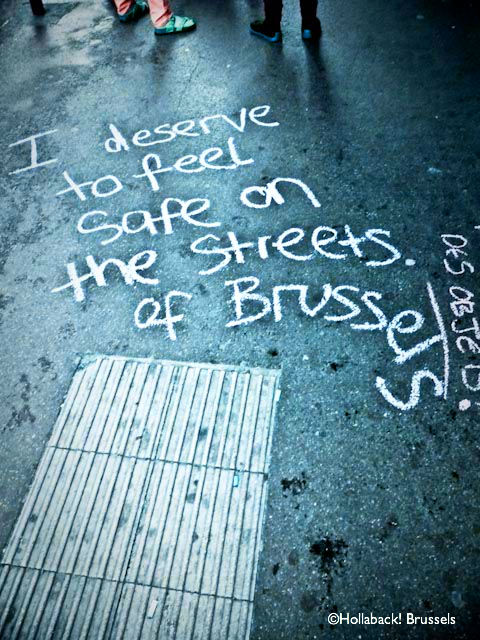
ChalkWalk N°2: @night, June 2012. Credit: Ingrid Vanderhoeven / Hollaback! Brussels

Street harassment is a fact of life for women and LGBQTIA people living in cities all over the world, however, since arriving in Brussels, I have experienced more street harassment than ever before and it was my frustration with this that inspired me to volunteer to contribute to this blog.

Hollaback! an international organisation of activists dedicated to combatting street harassment, works to empower those who are harassed, and Ingrid Vanderhoeven, one of the four founders of the Brussels branch, kindly agreed to discuss their work with me.

Ingrid explains that while Hollaback! is “an international movement with local volunteers and activists”, it is also a method “to respond to street harassment. It’s responding in a way that suits you and it started out as a blog, but now it’s turned into an international movement …Through the internet, but also through on the ground activism, through street actions and yeh, stuff like that.”

Ingrid was born in Brussels, grew up in Flanders and speaks Dutch, and it was only upon arriving back Brussels for university that she first encountered consistent street harassment.

“I had one particularly bad incident in which a group of men followed me and one grabbed my eh… vagina,” she said. After this and other incidents, Ingrid began to change her own behaviour in an attempt to avoid these unpleasant encounters. However, upon returning to Brussels after some time away, her perspective changed.

“(I realised) how much I’d given up my freedom and it was only just coming back into Brussels (that) I decided to do something about it.”

When Ingrid attended the Brussels ‘Slutwalk’ in 2011, she discovered a like-minded community both on and off-line. On the Slutwalk Facebook group “there was a German girl (Angelika Hild) that posted something about Hollaback, and we started a conversation and there with two other girls I didn’t know…one was American (Anna Whaley) and another one was also Belgian (Julie Richel), like me, but from the French speaking part…we just came together in a café and we just discussed if we could start one in Brussels, and that’s how Hollaback Brussels started.”

Inspired by their experience at the ‘Slutwalk’, which Ingrid described as an “empowering… demonstration against rape culture”, these four girls were ambitious in their desire to make Hollaback more than just an online platform.

“When we started we had these ideas of creating empowering experiences for women by sharing our stories of street harassment together, like our experiences, in a sort of sharing circle, and then going back to the spot where it happened. And we started doing and then writing in chalk on the pavement that this was the place where I was street harassed, but also leaving a message for their harasser,” she said.

“Chalk Walks” have become something of a Hollaback! Institution, and hearing these same methods and sentiments from Ingrid as I’d heard from Vanessa of the Dublin branch, I got a strong sense of the unity existing within this network of feminist activists and like Vanessa, Ingrid is confident in her identity as a feminist. “There seems to be a reluctance to identify with the word ‘femme’ in feminist, people want to be called humanists… But I do consider myself a feminist,” she stated.
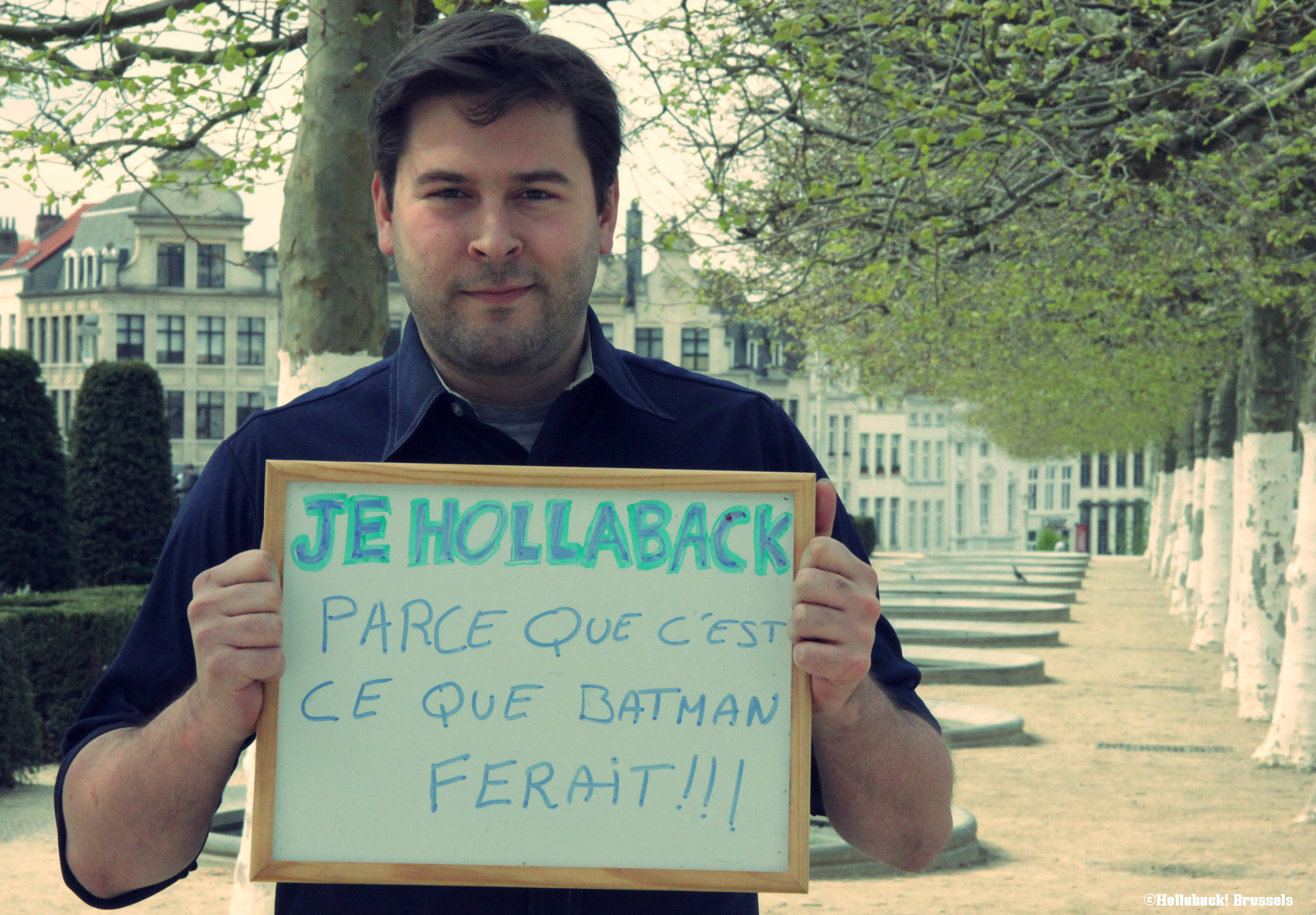
Quentin Daspremont : Hollaback! Brussels’ current Co-Director and French Coordinator. Credit: Ingride Vanderhoeven

Hollaback! Brussels is currently in a stage of renewal as Ingrid is the only remaining original member still living in Brussels. This renewal makes it clear that feminism is not just for femmes. “There’s now a guy that joined, which is nice. So it’s just me and Quentin at the moment and there’s three new people joining, so I think we’ll be going through a change, because when they join they will have new ideas, new plans.”

Ingrid and her team seem to have no shortage of new ideas, from branching out from collecting stories, to using this experience to conduct a research, to visiting schools. “We have a little creative project for school, that when we find the funds, that we would like to do” as well as “developing a box with cards that can be given to harassers…we wanted to provide people with a sort of reacting kit.” It is no exaggeration when Ingrid concludes, “We have a lot of ideas.”

Dearbhla graduated from BESS (Business and Sociology), in Trinity College Dublin, last year. She currently lives in Brussels, Belgium, where she has a think-tank internship working in the areas of gender, equality, and employment. Follow her on Twitter @imoshedinheels and her blogs.

TRANSLATION BY SENNA REES:

Straatintimidatie maak deel uit van het dagelijkse leven van vrouwen en LGBTQIA mensen over de hele wereld. Maar sinds mijn aankomst in Brussel heb ik meer straatintimidatie moeten ondergaan dan ooit, en dit vormde de bron van mijn inspiratie om een bijdrage aan deze blog te leveren.

Hollaback, een internationale organisatie toegewijd aan de bestrijding van straatintimidatie,  streeft ernaar de slachtoffers een stem te geven, en Ingrid Vanderhoeven, een van de vier oprichters van de Brusselse afdeling, was zo vriendelijk om hun werk toe te lichten.

Ingrid leg uit dat hoewel Hollaback! “een internationale beweging met plaatselijke vrijwilligers en activisten” is, het ook een manier is om ‘om te gaan en te reageren op straatintimidatie’. “Het is een reactie geven op je eigen manier die jou het beste past, en het begon allemaal als een blog, maar nu is het een internationale beweging geworden… Dankzij het internet, maar ook door plaatselijke acties en acties op straat, en jah, zulke dingen.” Ingrid groeide op in Brussel en leerde straatintimidatie te aanvaarden als een constante van het leven, totdat ze op een dag een zeer nare ervaring meemaakte. “Het was voornamelijk door een zeer ongewenst voorval, waarin een groep mannen me volgde en een ervan graaide naar mijn…euhm… vagina.” Na deze en andere ervaringen, begon Ingrid haar gedrag te veranderen in de hoop deze onaangename confrontaties te vermijden. Maar bij haar terugkeer in Brussel na een tijdje weg te zijn, begon haar perspectief te veranderen: “ik besefte hoeveel vrijheid ik had opgegeven en het was bij mijn terugkeer naar Brussel dat ik besloot om er iets aan te doen”.

Toen Ingrid de Brusselse versie van de “Slutwalk” in 2011 bijwoonde, ontdekte ze een gelijkgestemde gemeenschap zowel on-line als offline. “En zo deed ik mee in die Slutwalk en was er een Facebook event en een Facebook groep en daarin zat een Duits meisje (Angelike Hild) die iets poste over Hollaback, en we begonnen een discussie en er waren twee andere meisjes die ik niet kende… eentje was een Amerikaans (Anna Whaley) en de andere een Belgische (Julie Richel) zoals ik, maar uit het Franstalige gedeelte. We ontmoetten elkaar in een café en we besproken of we eentje in Brussel zouden kunnen oprichten, en zo begon Hollaback Brussels.”

Geinspireerd door haar ervaring tijden de “Slutwalk”, die Ingrid beschrijft als een krachtige demonstratie tegen de rape culture, waren deze vier dames ambitieus om Hollaback om te vormen tot meer dan een online platform. “Toen we begonnen hadden we enkele ideeën om daadkrachtige ervaringen te creëren voor vrouwen, door het delen van onze eigen verhalen van straatintimidatie, in een soort van kring, en dan terug te gaan naar de plaats van het voorval. En dat deden we en dan schreven we ook in krijt op de stoep ‘dit was de plek waar ik werd lastig gevallen op straat”, en lieten we ook een boodschap na voor de dader.’

‘Chalk Walks’ zijn zowat een Hollaback! gebruik geworden, en toen ik dezelfde methodes en opvattingen hoorde van Ingrid zoals die van Vanessa van de Dublin afdeling, kreeg ik een zeer sterke indruk van eendracht binnen dit netwerk van geëmancipeerde activisten. En net zoals Vanessa is Ingrid overtuigd van haar identiteit als feministe. “Er lijkt wel een afkeer te zijn om geïdentificeerd te worden met het woord ‘femme’ in feminist, mensen worden liever humanisten genoemd… Maar ik beschouw mezelf als feminist.’ Hollaback! Brussel doorgaat in feite een stadium van hernieuwing, want Ingrid is de laatste van de vier stichtende leden die nog in Brussel woont. Die hernieuwing maakt duidelijk dat feminisme niet enkel voor ‘femmes’ is: “er is dus nu een man die erbij is gekomen, wat leuk is. Het is dus nu enkel ik en Quentin op dit moment, en er zijn drie nieuwe leden, dus ik denk dat er verandering op til is, want met hun erbij zullen er ook nieuwe ideeën en nieuwe plannen ontstaan.” Hollaback! Brussel en hun associatie met holebi verenigingen zijn een goed voorbeeld van hoe feministische organisaties partneren met andere verenigingen om steun te bieden aan de slachtoffers van gendergerelateerd geweld.

Ingrid en haar team hebben geen tekort aan nieuwe ideeën, gaande van het inzamelen van verhalen, het gebruiken van die ervaringen om onderzoek te verrichten, tot het bezoeken van scholen. “We hebben een creatief projecteren voor op school dat we zouden willen gebruiken als we de fondsen ervoor verwerven” “We willen ook een doos met kaarten ontwikkelen om die te geven aan de daders… We willen mensen een soort van ‘reactie kit’ geven. Het is niet overdreven wanneer Ingrid besluit dat ze “heel veel ideeën” hebben.

Share

Filed Under: Activist Interviews, correspondents, street harassment

USA: “Lock Up Your Daughters”: Teaching Them Early?

July 11, 2014 By Correspondent

Kasumi Hirokawa, PA, USA, SSH Blog Correspondent

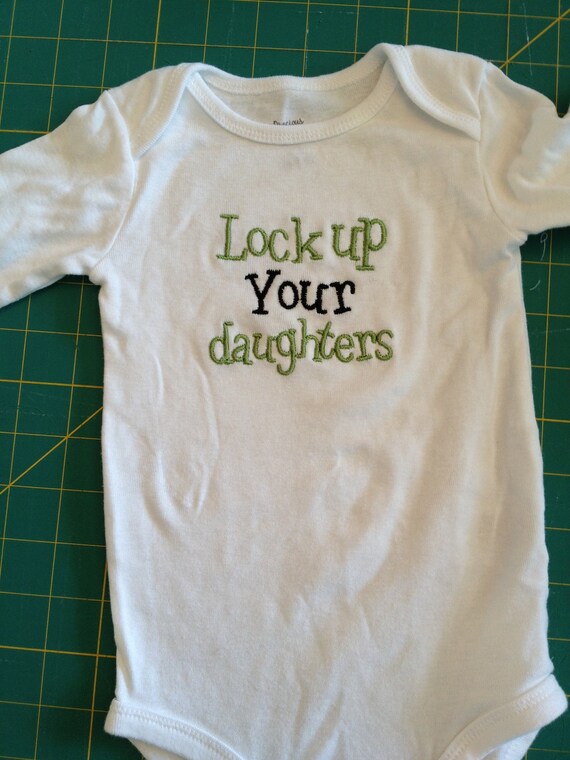
When I was scrolling through my Facebook feed this afternoon, I saw a photograph of a plump baby boy innocently smiling at a sock monkey. But neither the smile nor the plush monkey caught my attention first. Not even the bright green frame that matched that shirt. It was his bright green shirt (or a onesie) that made me linger on the photo. The graphics of the shirt said: Lock Up Your Daughters.

I think it was meant to be cute. It was meant to be funny. It was meant to be a corny innuendo, with a dash of age-appropriate naughtiness only his older relatives are able to chuckle at. Only that, for me, it wasn’t any of those things. I was made uncomfortable. Because I knew the woman who posted the photo has a daughter who is in elementary school.

To me, the slogan screams: this boy will grow up to be a stud; tell your girls to shut their legs while I, as a parent of the irresistibly charming boy, will do nothing to prevent him from taking away the purity of your precious princesses.

That makes me fear what the baby’s shirt may teach the little girl and the little boy about themselves, what is expected of them and how they view others around them. Will the lesson be that it is the responsibility of parents who have daughters to police their sexuality? Are girls responsible for protecting their purity? Is confining girls’ movement the only solution for them not to be bothered? Is sex something men take away from women? Is a woman’s worth dependent on how many sexual advances she refuses before marriage? If she is not properly “lock[ed] up,” does she deserve anything bad happening to her?

Of course, I’m not saying the boy’s parents were to blame for dressing him in such a shirt. Sexism is so insidious yet pervasive, it is hard to catch. The saying goes that a fish doesn’t know that it is swimming in water.

Rearing a child is no easy task, let alone raising a future feminist in the society infected with misogyny. But I hope the sock monkey-loving baby boy will grow up to be a man who stands up for his sister, not because he thinks she should be locked up but he sees her as a human being whose rights are equally important as his own.

Kasumi is a recent graduate from Penn State with a BA in journalism. Her writing has been published in Valley Magazine, City Weekend Shanghai, Penn State GeoBlog and Shanghai Daily. You can follow her on Twitter, @kasumihrkw

Share

Filed Under: correspondents

USA: Phone camera shutters and women-only cars: Japan’s answers to chikan

July 10, 2014 By Correspondent

Kasumi Hirokawa, PA, USA, SSH Blog Correspondent

Recently, I ran into a friend of mine who graduated from Penn State in May. She was on a month-long graduation trip to various locations in the Middle East and Asia, including Japan. She shared her stories of exotic food and unfamiliar customs she came across and I listened eagerly. I always enjoy good travel stories.

She said she enjoyed visiting Asia but was bugged by leering from locals. She attributed it to her being one of very few white girls in the vicinity. People were probably curious, she said. Some would stand too close to her when they hiss “helloooo.” Others would try to take sneaky pictures of her, only to be caught because of their shutter sounds. Street harassment was there to spoil the fun, like always.

Ah, the camera shutters. They were doing something to curb chikan crimes after all. Chikan is a term for a sexual predator and crimes involving one, be it unwanted flashing or groping, in Japan.

I remembered that, in Japan, it is impossible to turn off the shutter sounds on camera phones. Women commuters filed complaints that chikans wouldn’t stop taking upskirt photos in packed train cars. A bill called the Camera Phone Predator Alert Act, which required all mobile devices to have camera shutter sounds that could not be turned off, was proposed in 2009. The camera shutters were sort of a follow-up to women-only train cars that were implemented in 2001.

I haven’t had the experience of owning a camera phone with a mandatory shutter sound or riding a women-only train car since I moved to China, so I am not in a position to say how effective they are in deterring chikans.

While I do not oppose the shutter sounds, I am not fond of women-only train cars. First, they are not always women-only. There are a certain number of designated cars on a train with pink signs on the windows with hours. During those hours (typically rush hours in the morning and the evening), do they become women-only cars.

I know women-only cars were proposed by well-meaning policymakers. However, limiting women’s presence in public spaces is at best reductive and at worst, downright sexist. It’s easy to tell women to ride on designated cars or sign up for self-defense classes. It’s easy to blame a victim that she should have known better than to not get on the women-only car. But women-only cars are not dealing with the problem at its roots: men who harass women on trains. I’d like to see “Beware of chikans!” billboards replaced with ones that say, “Don’t be a chikan! Make public places safe for everyone!”

Kasumi is a recent graduate from Penn State with a BA in journalism. Her writing has been published in Valley Magazine, City Weekend Shanghai, Penn State GeoBlog and Shanghai Daily. You can follow her on Twitter, @kasumihrkw

Share

Filed Under: correspondents, street harassment

USA: #NotJustHello: What’s so bad about starting a conversation?

July 3, 2014 By Correspondent

Lorna M. Hartman, Spokane, WA, SSH Blog Correspondent

Twitter has provided women worldwide with an avenue for mass sharing of harassment and assault experiences.

It seems easy for some men to hear a story from a woman and simply dismiss it, as many women can testify. When hashtags go viral with dozens or even hundreds of women sharing these experiences, though, it’s much harder for people to simply dismiss them.

It’s harder to say, “You must have overreacted. It doesn’t sound like that big a deal,” when you’re saying it to several hundred or several thousand women from all over the world citing similar experiences.

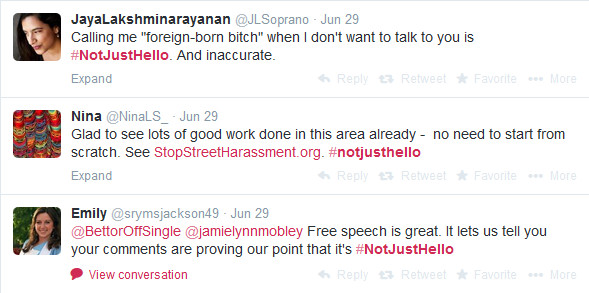
Writer Aja Romano of The Daily Dot published “#NotJustHello identifies a troubling trend in street harassment” on June 22. She reported, “We’re sure Twitter user UJohnsmeyer probably meant well. But his defense of men who talk to women on the street may have sparked the weekend’s most engaging social commentary hashtag.”

Here’s a piece of the Twitter conversation that led to #NotJustHello:

@UJohnsmeyer  @Feminist_Inti @Karnythia ever think that maybe a guy sees a chick he thinks is hot and just wants to try to start up a convo?

@Karnythia  @UJohnsmeyer @Feminist_Inti Ever think women don’t want to strike up convos with strange men?

More women joined the conversation, telling about their experiences. Finally, @Karnythia said:

@Karnythia We do understand that it’s #NotJustHello right? That street harassment is never that calm or polite?

The new hashtag took off. Here are some samples of both women’s experiences, and of men’s reactions to the hashtag:

@dale_in_denver @KaeAltoBella @AJStream If there is an expectation of a response, then it’s #notjusthello. Ignoring isn’t working or this wouldn’t be a #.

@notallmikaylas Your desire to hit on me does not trump my right to be left alone. #NotJustHello

@hannaheff When I refused to acknowledge a stranger’s compliment, he invaded my personal space and said, “I’m stronger than you.” #NotJustHello

@UJohnsmeyer How do you get women if you can’t say hello to them? #notjusthello

@theamandabatty ‘Hello’ is a smile or a respectful nod, not a catcall, a jeer, a crude gesture or name calling when I don’t respond. #NotJustHello

‏@BettorOffSingle [this individual posted several dozen times, attempting to monopolize the hashtag—his post below is representative]

Hey stupid women: #yesallwomen #notjusthello #feminism all lesbian constructs for seducing gullible str8 women by turning them against men.

@cameralinds_ It’s #notjusthello, it’s fear of retaliation for both responding and not responding.

@RynJ21 It’s #NotJustHello when I have a smile I created specifically to deal with street harassment. I call it, “Please don’t kill me.”

Male allies posted as well:

@HolzmanTweed When I was a teen, a guy tried to “teach” me how to catcall, explaining “the rules:” (1/x) #NotJustHello

@HolzmanTweed He told me look for a ring, an ankle chain, something that flagged her as taken so that I wouldn’t disrespect her man. (2/x) #NotJustHello

@HolzmanTweed There’s no pretense on the guy side that it’s about anything but establishing & confirming power, a compliance check. #NotJustHello

@wisemath Brothers, go read the #NotJustHello tag. If that doesn’t move something in you, I’ll pray for you.

@RobScowen For the male “not allowed to flirt” whiners, please read #NotJustHello *carefully* without feeling like the [f******] victim and educate self

As some women tweeted, if men understood the humiliation and the fear women feel when they are harassed on the street, fewer men would do it. Women’s personal risk in possibly being verbally or physically assaulted by a displeased harasser is real.

Last September, blogger UnWinona told of one terrifying experience while commuting on the Metro in California.

On this occasion a bicyclist brought his bike in with him. Despite an empty car, he sat across from her. When he started talking to her, she calmly told him to leave her alone as she was reading.

He walked to his seat in a huff, muttering about it not being his fault she was pretty. But he didn’t stop there; he continued to mutter and complain, and after a few minutes he got back up and started pacing. Then he started screaming at her, and then punching the train.

She was terrified. She froze in her seat, ready with her feet up in case he attacked her, certain that if she got up and walked away she’d be attacked when she turned her back to leave.

For two stops he kept this up. No one came to her aid; no one even came to see what was happening. The second she reached her station, she ran out the door.

She concluded [emphasis hers], “So when people (men) want to talk about ‘legitimate’ forms of assault, tell girls they should be nice to strangers and give men the benefit of a doubt, tell them to consider it a compliment, tell them to ignore the bad behavior of men, I want them to be forced to feel, for even one minute, what it feels like to have so much verbal hatred and physical intimidation thrown at them for nothing more than being female and not wanting to share.”

Lorna is raising three young, kindhearted male allies and has worked on rape and interpersonal violence since the 1990s, including serving on the local rape hotline, answering calls, and driving to emergency rooms to advocate for victims and connect them with resources they needed.

Share

Filed Under: correspondents, street harassment

USA: Weighing in on harassment against interracial couples

June 25, 2014 By Correspondent

Kasumi Hirokawa, PA, USA, SSH Blog Correspondent

As a car window rolled down, I waited. Perhaps my boyfriend saw it coming, too. “Chinky legs, chinky legs, chinky legs! Ayeeeee!” A male voice chanted at us when we crossed the street, hand in hand.

It was the second time people shouted insensitive remarks at us. Or to me? I do not know. Both incidents I experienced seemed to involve men yelling Asian slurs. Somehow in 2014, the sight of an East Asian woman and a black man linking arms still offends people. The sight of two people in love.

State College, Pa. is a small town of approximately 41,757, according to the United States Census data as of 2013. It’s also very white. The data estimates 83% of the town residents identified as white in 2010. I have also heard that Pennsylvania is one of KKK’s favorite hangouts from multiple sources, including this article by TIME magazine. However, none of these justify hate.

I still remember the first time something like it happened. I think I will never forget if it happens again. It was on our way home from a formal at a mutual friend’s house. We were walking back as we passed by a pair of wobbling white men when my boyfriend abruptly turned around and stopped. “What is it?” I asked. He replied through his clenched teeth, “I thought I heard them say horrible things. Something like ‘sideways pussy.’ Did you hear it?” I was not paying enough attention to even notice it. But my boyfriend is not the kind to make this sort of things up, especially when it is obvious that I am tired.

Unable to find much reliable literature on harassment against interracial couples online, I wondered if similar things happen to other interracial couples. I sought out a few friends of mine, each of whom was in at least one interracial relationship.

Mandy* is an Asian American woman and a student at a local university. She said she was at the receiving end of “judgmental” stares when she was with her boyfriend, who is black, for a gathering in a campus building. She recalled being the only Asian girl in the room: “People [kept asking me], ‘Are you with him?’”

Kyle*, a recent college graduate who lives in Green Lane, Pa., said he and his former partner was never subjected to “direct attack” from strangers but they “caught bad looks and [received] poor service” at restaurants. He said waiting staff would bring food to others who were seated after them – a white man and a black woman. “Waitresses wouldn’t stop by as frequently and you could see them looking [at us],” he recounted.

The days of racism and sexism are seemingly over in the eyes of those who refuse to look at what is happening around them. Who knows what the person behind you in the Starbucks line thinks about another from a different racial, religious or sexual orientation groups? They would shake hands with a fake smile with anyone when sober. How about when their PC façade is washed down by alcohol, mob mentality or raging sense of entitlement? Just like creepy comments hurled at me when I’m alone, these hurtful words and gestures are supposed to remind us that we have stepped out of the line and the harassers have the power to police us.

Kasumi is a recent graduate from Penn State with a BA in journalism. Her writing has been published in Valley Magazine, City Weekend Shanghai, Penn State GeoBlog and Shanghai Daily. You can follow her on Twitter, @kasumihrkw

Share

Filed Under: correspondents, Stories, street harassment

« Previous Page
Next Page »

Share Your Story

Share your street harassment story for the blog. Donate Now

From the Blog

  • #MeToo 2024 Study Released Today
  • Join International Anti-Street Harassment Week 2022
  • Giving Tuesday – Fund the Hotline
  • Thank You – International Anti-Street Harassment Week 2021
  • Share Your Story – Safecity and Catcalls Collaboration

Buy the Book

  • Contact
  • Events
  • Join Us
  • Donate
  • Facebook
  • Instagram
  • Pinterest
  • Tumblr
  • Twitter
  • YouTube

Copyright © 2026 Stop Street Harassment · Website Design by Sarah Marie Lacy