• About Us
    • What Is Street Harassment?
    • Why Stopping Street Harassment Matters
    • Meet the Team
      • Board of Directors
      • Past Board Members
    • In The Media
  • Our Work
    • National Street Harassment Hotline
    • International Anti-Street Harassment Week
    • Blog Correspondents
      • Past SSH Correspondents
    • Safe Public Spaces Mentoring Program
    • Publications
    • National Studies
    • Campaigns against Companies
    • Washington, D.C. Activism
  • Our Books
  • Donate
  • Store

Stop Street Harassment

Making Public Spaces Safe and Welcoming

  • Facebook
  • Instagram
  • Pinterest
  • Tumblr
  • Twitter
  • YouTube
  • Home
  • Blog
    • Harassment Stories
    • Blog Correspondents
    • Street Respect Stories
  • Help & Advice
    • National Street Harassment Hotline
    • Dealing With Harassers
      • Assertive Responses
      • Reporting Harassers
      • Bystander Responses
      • Creative Responses
    • What to Do Before or After Harassment
    • Street Harassment and the Law
  • Resources
    • Definitions
    • Statistics
    • Articles & Books
    • Anti-Harassment Groups & Campaigns
    • Male Allies
      • Educating Boys & Men
      • How to Talk to Women
      • Bystander Tips
    • Video Clips
    • Images & Flyers
  • Take Community Action
  • Contact

HABITAT 3: Safer Cities is a Priority

October 18, 2016 By HKearl

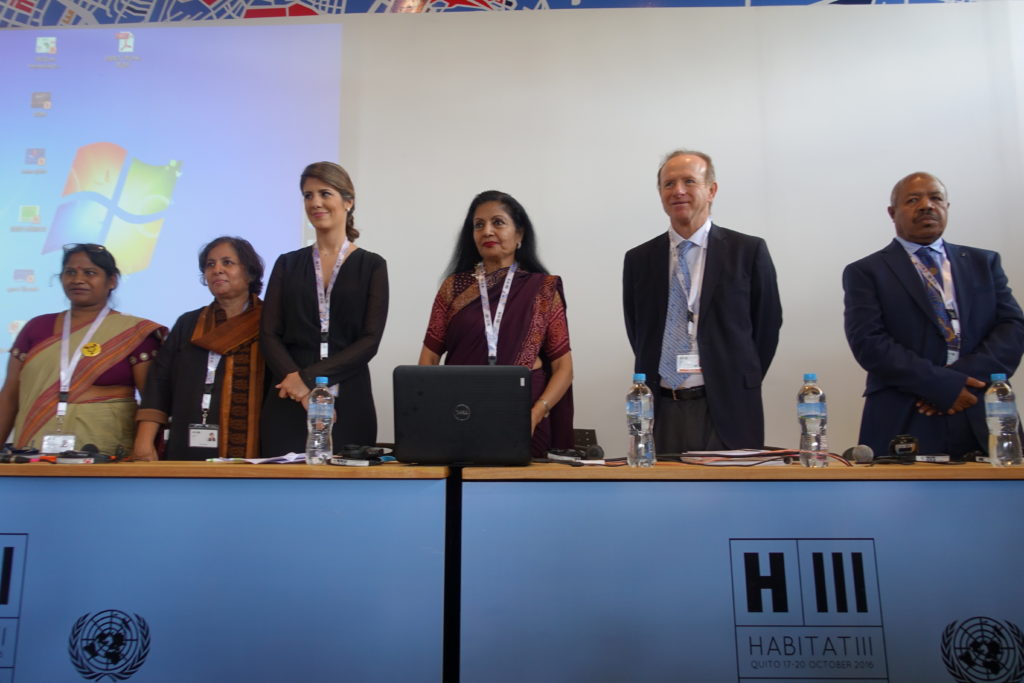
Norti, Suneeta, Maria, Lakshmi, Luis, Powes

Hello from day 4 at HABITAT 3 in Quito, Ecuador. The big event for me today was the UN Women panel on their Safe Cities programme.

UN Women could only host one high-level session at the conference and they chose this issue. My colleagues at UN Women have advocated for several years for this program on sexual harassment in public spaces to be recognized and included in these kinds of high level global events, so this was a big payoff.

The room was packed with about 150 people, including people standing in the back and sitting on the floor. It went really well.

First, here is an overview of what the Safe Cities programme is. This is essentially what was shared by the moderator, Lakshmi Puri, Deputy Executive Director and Assistant Secretary General of UN Women.
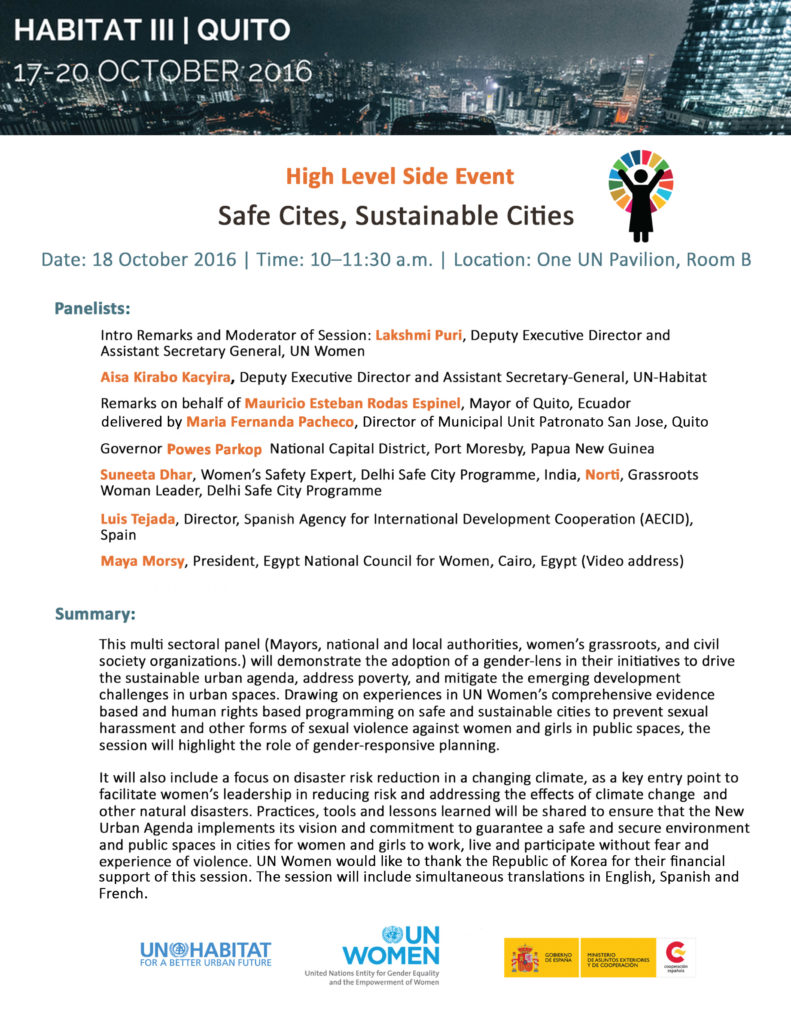
The flyer for the event today... that I designed!
The flyer for the event today… that I designed!

While the program is now in more than 20 cities, there were five flagship cities (Delhi, Cairo, Quito, Port Moresby, and Kigali) that started in 2011. Representatives from all five cities were invited to speak on the panel and representatives from Port Moresby, Delhi and Cairo were able to join (the rep from Cairo gave a pre-recorded video address). They spoke about their efforts and progress over the past five years. They were all incredibly inspiring, but I think that the governor from Port Moresby was my favorite.

In his opening remarks, Governor Parkop Powes did not shy away from sharing the problem of violence in Papua New Guinea. He talked about how tribes have been at war with each other for a long time and that violence is often seen as a means for solving problems. He noted that they are a patriarchal society where men are dominant. “Trying to change the violent culture is not easy. But we see it’s important. Violence is an impediment to women and also to the development of our city.”

The focus of the Port Moresby Safe Cities program has been to make marketplaces safer as they are not only economic hubs but also social hubs. They’ve had some successes so far, but they have a ways to go, he said.

“After being in the program for a while, we see that the interventions deal with the symptoms of violence and they alone won’t solve the problem. We’ve created a safe market to make it safe for women and girls, but we haven’t solved the problem of who is responsible for violence. The women vendors who leave the market and go back home still face threats of violence and fear of violence as they travel or even in their home. So we haven’t solved the problem of violence. Having a safe house for women facing domestic violence is symptom but doesn’t solve the problem. Same thing with the women-only buses – we’d rather have an integrated system where everyone is safe, but for now, we decided to have a women-only bus. Ultimately, it’s the behavior of men that’s the problem. They are violent. It’s the culture. We are working with UN Women to create behavior change.”

They are trying some creative methods. For example, doing yoga with men to help them start to respect themselves and then respect women. As another example, Governor Powes takes a walk every Sunday that anyone can join him in. He said sometimes a thousand people will join him, most of them women. This is really revolutionary because many women feel very unsafe walking in public. Rates of rape are very high, as are rates of murder. On average, every single person knows at least one person who has been murdered. So by walking in public for recreation, the women are claiming public spaces and demanding that they be safe for all.

A representative from the Spanish Agency for International Development Cooperation closed out the panel. This is the “mother donor” of the program. They continued to fund it, even when Spain was in an economic crisis. The representative shared that they will increase their support next year. This is huge as it is really hard to fund programs to end violence against women (as I know firsthand from my limited experience trying to fundraise for Stop Street Harassment). Having this support is really important and makes the program possible.

Later in the day, I also had the opportunity to join my boss in meeting with the Quito Safe Cities team. They talked about their work with transit officials to make public transit safer. They also have created a comic book about respect that they will be taking to five schools and training teachers on how to hold conversations around respect. They were very open about how Ecuadorian culture is full of machismo and how they have to focus on changing mindsets and attitudes before they can really see change. But they said they have support at the highest levels — and indeed, the wife of the mayor, Maria Fernando Pacheco, led the meeting as she is very supportive of the program — and so that is making their implementation process easier. Plus, they have alarming data that helps them more easily galvanize support: more than 90% of women face street harassment. More than 1 in 4 girls have been harassed outside their schools. Most women see public transit as unsafe. And most women try not to be alone in public after 6 p.m. when it gets dark.

These two events were inspiring and uplifting and it made me so so so so happy to hear from and meet people in various parts of the world who are committed to making public spaces safer and who understand that ultimately, we have to see cultures change before that will be a reality.

Share

Filed Under: street harassment, UN events and efforts Tagged With: ecuador, Habitat 3, India, papau new guinea, safe cities, spain, UN women

“While he crossed the street he moved his hand over my stomach and waist”

October 18, 2016 By Contributor

I was riding on the back of a motorcycle once with my friend’s steering the wheels. We were stopping at a traffic light and someone was crossing the street but he walked along the back of the motorcycle I was on. While he crossed the street he moved his hand over my stomach and waist. I was in a shock and I couldn’t process what he just done, my body tensed up and I did not dare to look for the man’s face, let alone scream or act upon it.

Optional: What’s one way you think we can make public places safer for everyone?

Encourage people to act once they see harassment happen because in some cases the victim might be in shock.

– Anonymous

Need support? Call the toll-free National Street Harassment hotline: 855-897-5910

Share your street harassment story for the blog.
See the book 50 Stories about Stopping Street Harassers for idea
s.

Share

Filed Under: Stories, street harassment

HABITAT 3: Men Talking to Men

October 17, 2016 By HKearl

Today was day three of HABITAT 3 in Quito, Ecuador. My boss asked me to attend four sessions that were not pitched as being specifically about women or gender or sexual violence (though there are a few of those across the conference, many of them involving UN Women in some way) with the hopes that I could help insert those topics into the conversation during the Q&A. What I found when I attended the sessions was what she and I suspected, without those items in the title or being pitched as the main topic, gender and women’s experiences and views barely came up at all. It reminded me of college where unless I took a course in the women’s studies division, the courses basically focused on men. As a history major, I’ll always remember my first women’s history class and my relief — “here’s where the women are!”

As an example of the four sessions today, one focused on the active transportation of bicycling and walking and how having fewer vehicles on the roads benefits cities in various ways. In theory, yes, I agree. Here is where I had issues. All of the presenter were men and they seemed to only be focused on men. The data they presented from their various cities did not include a gender break down. Their discussions about barriers to having more people walk or cycle did not include street harassment. Women’s unique experiences were not included AT ALL. What an oversight. You cannot expect to see more women walking and cycling until the issue of street harassment and safety are addressed and ended!

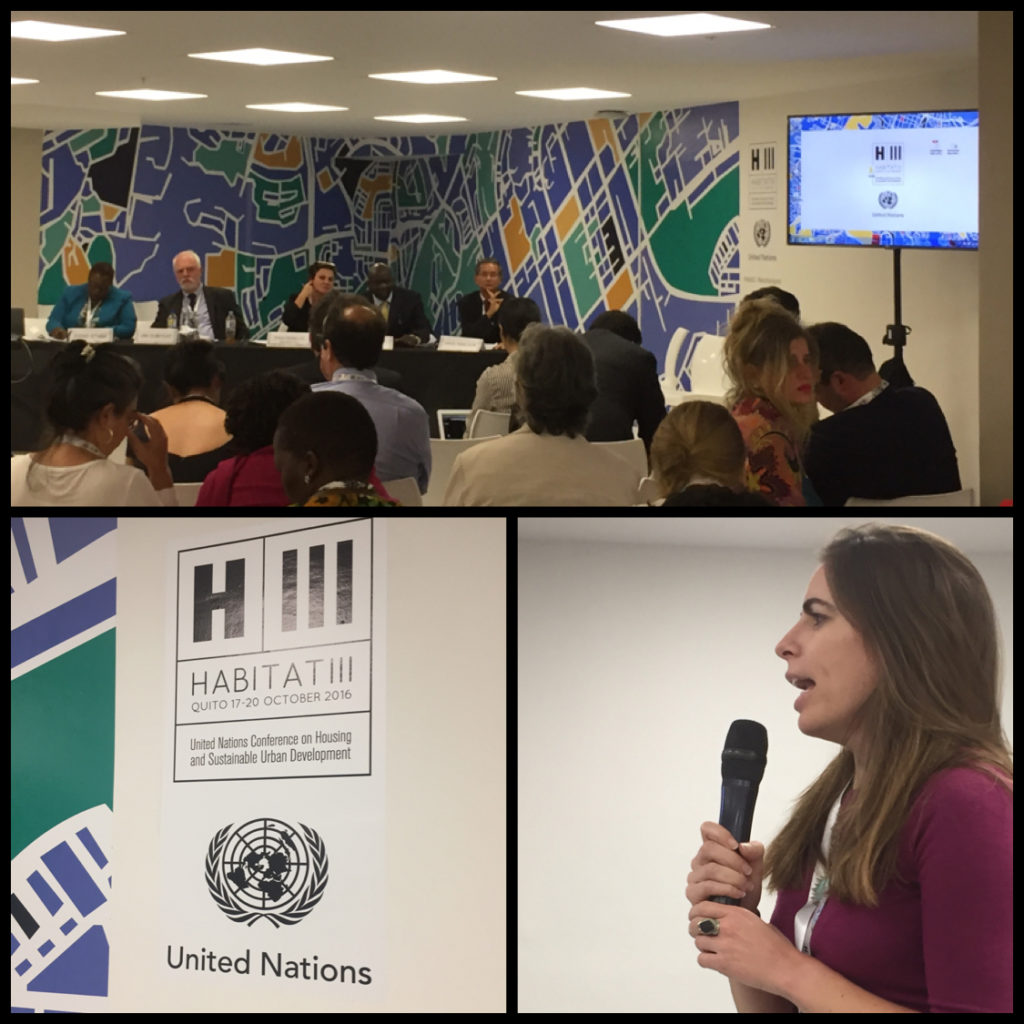
10-17-16-habitat-3The first three sessions I attended went over time or nearly went over time and so there either was no time for questions or only time for 2-3 questions. Thus, I did not get to insert gender during the Q&A … until the final session. This was a session on urban rules and governance. The moderator was a female judge from Malawi and panelists included an EU parliament member, Sierra Leone mayor and minister in Singapore. These three were all men. They talked about how to pass policies and laws, how to work across local, regional and national government, and more.

The process for Q&A was to have a few people ask their questions and then the panelists could answer them in a grouping. I was the fourth person to ask a question in a group and the first woman. The three men went on and on about their own work and observations. I actually asked a question:

In most countries, women are under-represented in government and law, especially at the national level, so what is being done to ensure that women’s unique experiences, such as sexual harassment while in public spaces, is taken into account in the creation of and enforcement of policies and laws?

When the time came for the panel to respond, none of the men addressed my question. They only responded to the topics raised by the men. The moderator kindly tried to incorporate a response to me in her remarks, but even then it was pretty basic: yes, the views of women, children, persons with disabilities, etc should be included as we pass policies and laws.

Needless to say, I was really disappointed in the series of sessions and in the response (or, nonresponse) to my question. I am tired of men talking to men about men’s experiences when women are in the room, are trying to be active participants, and have unique viewpoints to offer!

Share

Filed Under: UN events and efforts Tagged With: gender, Habitat 3, laws, men, transit, UN women

“You ungrateful bitch”

October 17, 2016 By Contributor

Another day as a woman in New York City: a man on the street screams at me, “You are beautiful,” and when I don’t respond he screams, “That’s it, that’s as far as I’m going to go, you ungrateful bitch.”

Where??? Do??? Men??? Learn??? This??? Behavior??? How is this an acceptable thing to do?!?!?

Optional: What’s one way you think we can make public places safer for everyone?

Not electing Donald Trump.

– Maddie

Location: Midtown East, Manhattan, NY

Need support? Call the toll-free National Street Harassment hotline: 855-897-5910

Share your street harassment story for the blog.
See the book 50 Stories about Stopping Street Harassers for idea
s.

Share

Filed Under: Stories, street harassment

HABITAT 3 – Safe Cities Partners Meeting

October 16, 2016 By HKearl

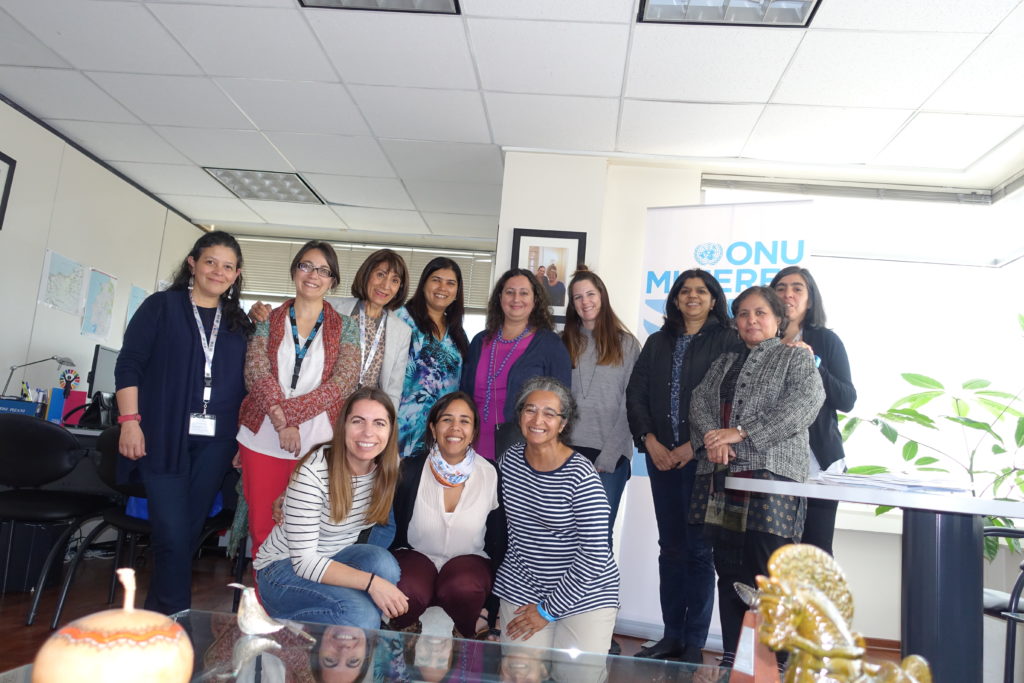
10-16-16-safe-cities-partner-meeting-quito-ecuadorToday was my second day in Quito, Ecuador, for HABITAT 3. I spent the morning with women from eight countries (Argentina, Canada, Colombia, Ecuador, Egypt, Guatemala, India and me in the USA) who each are working to address sexual harassment in public spaces. Many of the people in the room have worked hard for years to see this issue incorporated into the formal UN agenda and they finally succeeded in the Sustainable Development Goals and New Urban Agenda. Given this important change, we discussed the strategic role our organizations need to have when policies are set for nations around the world; we want to ensure that the policies are good.
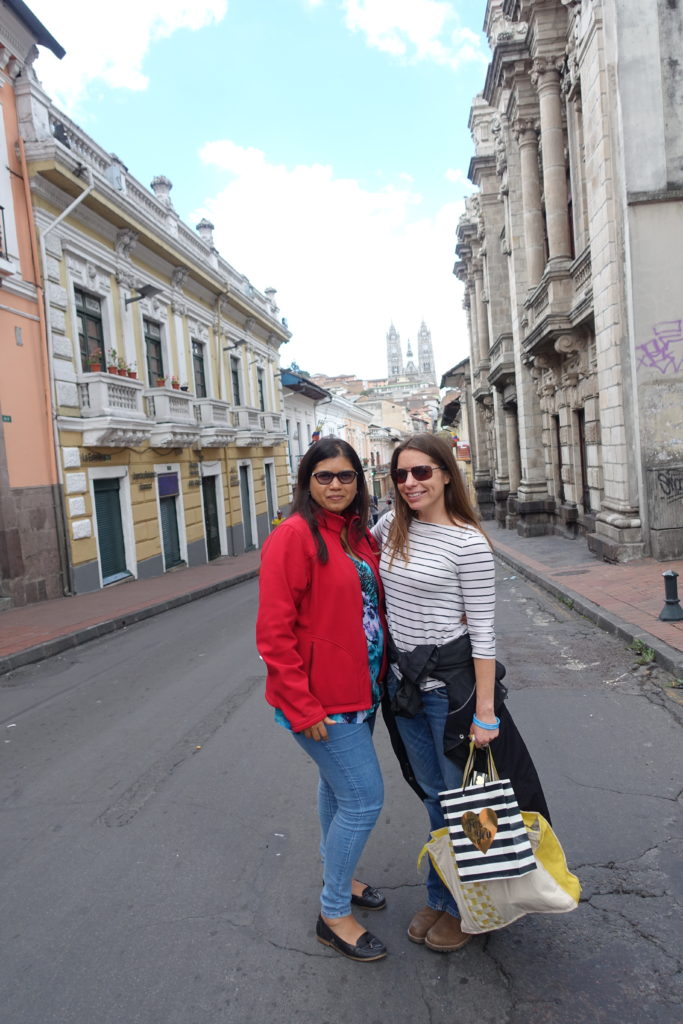
One challenge shared by several women was terminology: what is sexual harassment versus sexual violence and how should each be treated under the law and by society? A woman from India said they had even faced backlash for trying to expand the definition of rape to be more inclusive.

A woman from Guatemala shared the good news that they have had progress with policies by working with congress women. Many women in the room agreed that having women allies in governing bodies is really helpful when it comes to this issue.

A highlight of the morning for me was hearing from a staff member of UN Women in Cairo who has been involved in their safe cities programme for a few years. She shared how they worked with the national government in a number of ways to pass the country’s first ever law against sexual harassment. She herself sat on the committee that drafted the law. What they ended up doing was instead of writing a completely new law, they amended an existing one. This made passing it easier and it also helps make implementation easier since the police and criminal justice system folks are familiar with the original law and simply needed to be updated on the amendment.

dsc04362We also discussed various logistical things and planning future events and conferences.

Overall, it was encouraging to hear that various UN agencies as well as international organizations working with grassroots women have prioritized making public spaces free from sexual harassment and violence.

In the afternoon, I joined Elsa D’Silva, the co-founder of Safecity in India, in sightseeing around Quito. We both had been warned by various people that Quito was unsafe and so we were pleasantly surprised to never be harassed or hassled. Instead, many people assisted us, from police officers to bus drivers to foodstand people. And I have gone running alone both mornings at a lovely park and I have felt completely safe there. For that, I am grateful.

Share

Filed Under: UN events and efforts Tagged With: Habitat 3, quito, safecity

« Previous Page
Next Page »

Share Your Story

Share your street harassment story for the blog. Donate Now

From the Blog

  • #MeToo 2024 Study Released Today
  • Join International Anti-Street Harassment Week 2022
  • Giving Tuesday – Fund the Hotline
  • Thank You – International Anti-Street Harassment Week 2021
  • Share Your Story – Safecity and Catcalls Collaboration

Buy the Book

Search

Archives

  • September 2024
  • March 2022
  • November 2021
  • April 2021
  • March 2021
  • January 2021
  • April 2020
  • March 2020
  • February 2020
  • December 2019
  • November 2019
  • September 2019
  • August 2019
  • July 2019
  • June 2019
  • May 2019
  • April 2019
  • March 2019
  • February 2019
  • January 2019
  • December 2018
  • November 2018
  • October 2018
  • September 2018
  • August 2018
  • July 2018
  • June 2018
  • May 2018
  • April 2018
  • March 2018
  • February 2018
  • January 2018
  • December 2017
  • November 2017
  • October 2017
  • September 2017
  • August 2017
  • July 2017
  • June 2017
  • May 2017
  • April 2017
  • March 2017
  • February 2017
  • January 2017
  • December 2016
  • November 2016
  • October 2016
  • September 2016
  • August 2016
  • July 2016
  • June 2016
  • May 2016
  • April 2016
  • March 2016
  • February 2016
  • January 2016
  • December 2015
  • November 2015
  • October 2015
  • September 2015
  • August 2015
  • July 2015
  • June 2015
  • May 2015
  • April 2015
  • March 2015
  • February 2015
  • January 2015
  • December 2014
  • November 2014
  • October 2014
  • September 2014
  • August 2014
  • July 2014
  • June 2014
  • May 2014
  • April 2014
  • March 2014
  • February 2014
  • January 2014
  • December 2013
  • November 2013
  • October 2013
  • September 2013
  • August 2013
  • July 2013
  • June 2013
  • May 2013
  • April 2013
  • March 2013
  • February 2013
  • January 2013
  • December 2012
  • November 2012
  • October 2012
  • September 2012
  • August 2012
  • July 2012
  • June 2012
  • May 2012
  • April 2012
  • March 2012
  • February 2012
  • January 2012
  • December 2011
  • November 2011
  • October 2011
  • September 2011
  • August 2011
  • July 2011
  • June 2011
  • May 2011
  • April 2011
  • March 2011
  • February 2011
  • January 2011
  • December 2010
  • November 2010
  • October 2010
  • September 2010
  • August 2010
  • July 2010
  • June 2010
  • May 2010
  • April 2010
  • March 2010
  • February 2010
  • January 2010
  • December 2009
  • November 2009
  • October 2009
  • September 2009
  • August 2009
  • July 2009
  • June 2009
  • May 2009
  • April 2009
  • March 2009
  • February 2009
  • January 2009
  • December 2008
  • November 2008
  • October 2008
  • September 2008
  • August 2008
  • July 2008
  • June 2008
  • May 2008

Comment Policy

SSH will not publish any comment that is offensive or hateful and does not add to a thoughtful discussion of street harassment. Racism, homophobia, transphobia, disabalism, classism, and sexism will not be tolerated. Disclaimer: SSH may use any stories submitted to the blog in future scholarly publications on street harassment.
  • Contact
  • Events
  • Join Us
  • Donate
  • Facebook
  • Instagram
  • Pinterest
  • Tumblr
  • Twitter
  • YouTube

Copyright © 2026 Stop Street Harassment · Website Design by Sarah Marie Lacy