• About Us
    • What Is Street Harassment?
    • Why Stopping Street Harassment Matters
    • Meet the Team
      • Board of Directors
      • Past Board Members
    • In The Media
  • Our Work
    • National Street Harassment Hotline
    • International Anti-Street Harassment Week
    • Blog Correspondents
      • Past SSH Correspondents
    • Safe Public Spaces Mentoring Program
    • Publications
    • National Studies
    • Campaigns against Companies
    • Washington, D.C. Activism
  • Our Books
  • Donate
  • Store

Stop Street Harassment

Making Public Spaces Safe and Welcoming

  • Facebook
  • Instagram
  • Pinterest
  • Tumblr
  • Twitter
  • YouTube
  • Home
  • Blog
    • Harassment Stories
    • Blog Correspondents
    • Street Respect Stories
  • Help & Advice
    • National Street Harassment Hotline
    • Dealing With Harassers
      • Assertive Responses
      • Reporting Harassers
      • Bystander Responses
      • Creative Responses
    • What to Do Before or After Harassment
    • Street Harassment and the Law
  • Resources
    • Definitions
    • Statistics
    • Articles & Books
    • Anti-Harassment Groups & Campaigns
    • Male Allies
      • Educating Boys & Men
      • How to Talk to Women
      • Bystander Tips
    • Video Clips
    • Images & Flyers
  • Take Community Action
  • Contact

USA: The Normalization of Street Harassment in Childhood Television

July 15, 2016 By Correspondent

Mariel DiDato, NJ, USA, SSH Blog Correspondent
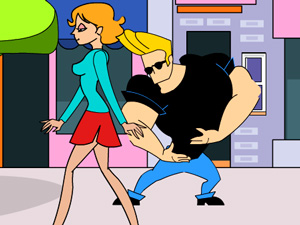
johny-bravo-s-flirts
Johnny Bravo

As a child-turned-adult Pokémon fanatic, I have succumbed to the hype of Pokémon-Go. While basking in my nostalgia, I decided to watch some early episodes of the iconic cartoon. Watching childhood television shows as an adult, I often catch things that I didn’t pick up on as a kid. Certain jokes now make sense, while other things don’t seem as funny. One example of a less-funny aspect of Pokémon is Brock’s persistent advances towards almost every female character besides Misty, and the continued response of female annoyance or rejection. I wouldn’t necessarily claim this show is sexist, as they feature multiple female characters in leadership roles. However, the repeated romantic attempts towards much of these characters, played off with the “boys will be boys” narrative, is something I did not appreciate.

This prompted me to think about the other shows I watched as a child that normalized this kind of behavior. I realized that Pokémon is hardly the worst offender. Johnny Bravo is a show that features catcalling and female rejection as the main source of humor. Even more infamous is Pepe LePew, a male skunk whose storyline involves chasing and grabbing onto a female skunk who, very obviously, does not want to be approached or touched by him.

Although this harassment and female rejection is repeatedly portrayed as comical, the real-life version of this experience is far from laughable. On the Pokémon end of the spectrum, Brock takes rejection with a blushed face, and then moves onto the next woman. Johnny Bravo’s objects of affection sometimes even strike him, leading him to simply move on to his next target, like Brock. However, the reality of female rejection often leads to male escalation, with women receiving a spectrum of responses that can range from insults, threats, and actual violence. Women are aware of this fact; smiling and receiving compliments from harassers is often misconstrued as acceptance and openness, when it is really a method of de-escalation. It is sad to see this portrayed to young children as something to be laughed about. Even while LePew’s victim can be seen struggling to break free from his arms as he kisses her, the whole situation is trivialized to the point of comedy. It is as though harassment is seen as nothing more than a mere annoyance, generally harmless to the women it affects.

More and more data reveal that street harassment is anything but funny or harmless to its victims. Studies show that the continued street harassment most women face before the age of 18 is linked to a multitude of negative effects. One 2008 study found street harassment to be correlated with self-objectification and fear of rape. This, in turn, can lead women to fear travel of any distance, restricting their freedom of movement. In addition, there is evidence that continued and frequent abuse, such as the street harassment women can be subjected to virtually any time they leave their homes, can be more harmful than experiencing one traumatic event.

However, in these cartoons, sexual harassment is shown to be a trivial event that can be laughed off. Young boys are potentially learning that, while ineffective, street harassment is an acceptable way to pick up women. In each of these shows, there is an example of the male “getting the girl.” This might send the message that harassing multiple women is okay. Eventually, one will say “yes” and it will all be worth it. Plus, the women who say no will walk away irritated, but intact. On the other hand, young girls are potentially being taught that objectification and harassment is an appropriate and acceptable part of being female.

Street harassment was a problem prior to the invention of television. Misogynistic cartoon characters did not create the larger problem of sexism in society, but they are instrumental in keeping these messages alive and normalizing them for younger generations. It’s easy to criticize outright sexism on television, but it is also important to pick up on these more discreet messages that people of all ages are receiving. I don’t think I’m going to stop watching shows like Pokémon, but I will definitely be more aware of these indirect messages in the media. I will also be supporting shows that depict healthy relationships, instead of normalizing deeply harmful social interactions. I encourage others to do the same, and hopefully future generations will enjoy cartoons that don’t rely on sexism for their laughs.

Mariel is a recent college graduate, feminist, and women’s rights activist. Currently, she volunteers for a number of different organizations, including the Planned Parenthood Action Fund of New Jersey and the New Jersey Coalition Against Sexual Assault. You can follow her on Twitter at @marieldidato or check out her personal blog, Fully Concentrated Feminism.

Share

Filed Under: correspondents, street harassment Tagged With: cartoons, catcaling, female rejection, kids, messages, objectification, trivialization

“She gets whistled at while walking alone along streets”

July 14, 2016 By Contributor

This did not happen to me, but to my girlfriend. I heard stories from her that she gets whistled at while walking alone along streets. These whistles come from men in cars as well as pedestrian passersby. Sometimes, hawker stalls owners compliments her and ask her for her name. It happens too in cinemas and public places.

Optional: What’s one way you think we can make public places safer for everyone?

I hope that the awareness is raised in Malaysia about the rudeness of catcalling to a complete stranger. I believe that currently there is no act or law in place to curb this. I do want to help in preventing this happening to anyone, be it male or female. Thank you for your kind help. 🙂

– JH

Location: Kuala Lumpur, Malaysia

Share your street harassment story for the blog.
See the book 50 Stories about Stopping Street Harassers for more idea
s.

Share

Filed Under: Stories, street harassment

Street Harassment is a Hate Crime in Nottingham, UK

July 14, 2016 By HKearl

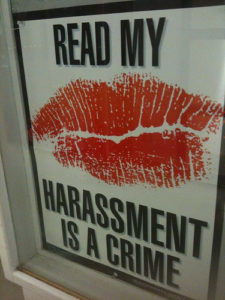
HarassmentisaCrimeThere’s big news out of the UK this week.

Via the Telegraph:

“”A police force has become the first in Britain to recognise misogyny as a hate crime, in an effort to make the county a safer place for women.

Nottinghamshire Police is recording incidents such as wolf whistling, street harassment, verbal abuse and taking photographs without consent within the hate crime definition.

It also includes unwanted sexual advances, uninvited physical or verbal contact and using mobile phone to send unwanted messages….

Sarah Green, acting director of the End Violence Against Women Coalition, said: ‘We welcome this because it comes off the local police force talking to and listening to local women’s groups. What we are talking about is not trivial behaviour – some harassment that women and girls receive in public is upsetting and should have the attention of the authorities.’

She added: ‘Police in Nottingham have not changed the law but they have listened to local women who said the behaviour bothered them. Together, they are recording it so they can monitor it and look back on who is doing it and where it happens.'”

While there are a lot of complications regarding criminalizing street harassment, and there are a lot of nuances for why it’d be hard, possibly unfair, and largely unenforceable to make all verbal street harassment illegal (especially in the USA), I still can’t help but cheer and tear up a little bit to see these horrible, demeaning and needless interactions classified as a HATE CRIME!! They should have no place in our society.

More about this story from Washington Post and Guardian.

“Misogyny hate crime is classed under the new policy as “incidents against women that are motivated by an attitude of a man towards a woman, and includes behaviour targeted towards a woman by men simply because they are a woman”…

Rachel Krys, co-director of the End Violence Against Women Coalition, said: ‘It is great that police in Nottingham will be capturing the way a lot of harassment in public spaces is targeted at women and girls. In a recent poll we found that 85% of women aged 18-24 have experienced unwanted sexual attention in public places and 45% have experienced unwanted sexual touching, which can amount to sexual assault.

‘This level of harassment is having an enormous impact on women’s freedom to move about in the public space as it makes women feel a lot less safe. The women we spoke to do a lot of work to feel safer, including avoiding parts of the city they live in, taking taxis and leaving events in groups.’

Krys said recording such incidents would give police and policymakers a much clearer grasp on the levels of harassment women and girls are subjected to, and better understand measures which could reduce it.

‘It should also challenge the idea that women and girls in public or online spaces are ‘fair game’,’ she added. ‘We know that ignoring harassment and sexist bullying creates the impression that other types of violence against women will be tolerated so we welcome any action which counters this.'”

Share

Filed Under: News stories, street harassment Tagged With: hate crime, laws, UK

This New Survey on Trans Bathroom Discrimination Should Alarm Everyone

July 13, 2016 By Contributor

Patrick Ryne McNeil, SSH Board Member

Toilet sign 4.pptxThis is a fact: LGBTQ people experience public harassment – and according to our spring 2014 report, LGBTQ people in the United States are more likely than straight, cisgender people to report experiencing it (both verbal and physical forms). The sample size in our research forced us to group the entire LGBTQ community into one category. While this lumping is not ideal and cannot account for the ways that intersecting identities lead everyone to experience the world differently, it did show that queer people – as past research has shown – are victims of public harassment.

Preliminary findings from the 2015 U.S. Transgender Survey, out this month from the National Center for Transgender Equality, show that trans people face one particularly dangerous form of public harassment: the kind that takes place in public restrooms.

According to the preliminary results:

  • 59 percent of respondents have avoided bathrooms in the last year because they feared confrontations in public restrooms at work, at school, or in other places.
  • 12 percent said they’ve been harassed, attacked, or sexually assaulted in a bathroom in the last year.
  • 31 percent said they’ve avoided drinking or eating so that they didn’t need to use the restroom in the last year.
  • 9 percent report being denied access to the appropriate restroom in the last year.

These findings should concern and anger everyone. In the same way that street harassment can force women and other marginalized communities into making consequential life changes – like adjusting their commute, moving homes, or switching jobs – harassment of trans people in public bathrooms, as the survey shows, can cause them to avoid using public facilities or can discourage them from drinking or eating in the first place. Those are harmful choices that no one should have to make.

While 12 percent reported experiencing harassment, attacks, or sexual assault, 59 percent have avoided restrooms because they’re afraid it will happen to them. That fear – even in the absence of harassment – is unhealthy. And bills popping up across the country to restrict restroom access aren’t helping.

The full U.S. Transgender Survey will be released later this year.

Patrick works in communications at The Leadership Conference on Civil and Human Rights, where he writes on a range of social justice issues. He is a board member of Stop Street Harassment and he wrote his thesis on the street harassment of gay and bisexual men at the George Washington University. He was awarded SSH’s Safe Public Spaces Trailblazer award in 2013 for his street harassment-related work.

Share

Filed Under: LGBTQ, News stories, Resources Tagged With: bathrooms, transgender

USA: What Can I Say? Taking Submissions for Witty Responses to Harassers

July 10, 2016 By Correspondent

Hope Herten, IL, USA, SSH Blog Correspondent

ViaHollabackDesMoinesIf we had a daily post limit for life, I would have to be quiet for the vast majority of my waking minutes. Talking is one of my favorite hobbies; I’m an expert in forming opinions and I’m a speaking-my-mind frequent flier. As a person who always has something to say, why can’t I stand up for myself when faced with unwanted harassment?

A combination of fear and surprise is probably the top contributing factor; rarely am I approached when I am expecting it or by someone less threatening than me. Though I tell myself that maybe not saying anything at all is the high road, I can’t help feeling that an inability to speak reinforces the power structure being exploited by my harassers.

Often we are taught that it is better to say nothing at all than to speak too quickly and let our emotions run away with our words, and though many intelligent men and women have preached this ideal, I have come to struggle with it, particularly in the last few weeks where harassment has become more frequent in my life.

Is it better to say nothing when patriarchal men try to assert dominance over you in public than to say something that may come out wrong? Does it make a bigger impact to ignore a harasser or give him a piece of your mind? Are harassers impacted at all by what you say or don’t say to them? Am I showing my strength by saying nothing or am I admitting defeat? None of these questions seem to have a clear-cut answer; there is no prescription for patriarchy, no magic words to make someone see what they are doing is harmful.

My conclusion comes back to my favorite aspect of feminism: choice. Silence can be a deliberate act of defiance, refusing to let an oppressive voice cause you to lose your cool and say things you don’t mean. Simultaneously, refusing to stay silent is a choice to empower yourself in a different way, vocalizing your refusal to submit. For some, being forced to speak out of anger or fear can help reinforce the power structure that harassers are acting in. For me, silence isn’t a courageous act. I am scared to speak when harassed in public for fear of saying something wrong, I am afraid of angering the harasser, and I worry that what I say won’t matter. I need to remind myself that I am strong and intelligent and that despite what my words mean to an oppressive body, they mean a lot to me and I will not be made silent by a complete stranger.

I want to remind all of you, that no one should make you do something that makes you feel like a lesser person.  Whether you remain silent or speak up, make it your act of protest. Don’t let a single person or moment push you down, because as a collective, feminists are coming together to give you the freedom to go outside and not have to make the choice at all.

P.S. If you are looking for some great suggestions Stop Street Harassment already has some, here and here.

Hope is a full-time undergraduate student studying public health and Spanish in Chicago, IL.  If you want to keep up with Hope you can follow her on Twitter @hope_lucille or check out her public health blog.

Share

Filed Under: street harassment

« Previous Page
Next Page »

Share Your Story

Share your street harassment story for the blog. Donate Now

From the Blog

  • #MeToo 2024 Study Released Today
  • Join International Anti-Street Harassment Week 2022
  • Giving Tuesday – Fund the Hotline
  • Thank You – International Anti-Street Harassment Week 2021
  • Share Your Story – Safecity and Catcalls Collaboration

Buy the Book

Search

Archives

  • September 2024
  • March 2022
  • November 2021
  • April 2021
  • March 2021
  • January 2021
  • April 2020
  • March 2020
  • February 2020
  • December 2019
  • November 2019
  • September 2019
  • August 2019
  • July 2019
  • June 2019
  • May 2019
  • April 2019
  • March 2019
  • February 2019
  • January 2019
  • December 2018
  • November 2018
  • October 2018
  • September 2018
  • August 2018
  • July 2018
  • June 2018
  • May 2018
  • April 2018
  • March 2018
  • February 2018
  • January 2018
  • December 2017
  • November 2017
  • October 2017
  • September 2017
  • August 2017
  • July 2017
  • June 2017
  • May 2017
  • April 2017
  • March 2017
  • February 2017
  • January 2017
  • December 2016
  • November 2016
  • October 2016
  • September 2016
  • August 2016
  • July 2016
  • June 2016
  • May 2016
  • April 2016
  • March 2016
  • February 2016
  • January 2016
  • December 2015
  • November 2015
  • October 2015
  • September 2015
  • August 2015
  • July 2015
  • June 2015
  • May 2015
  • April 2015
  • March 2015
  • February 2015
  • January 2015
  • December 2014
  • November 2014
  • October 2014
  • September 2014
  • August 2014
  • July 2014
  • June 2014
  • May 2014
  • April 2014
  • March 2014
  • February 2014
  • January 2014
  • December 2013
  • November 2013
  • October 2013
  • September 2013
  • August 2013
  • July 2013
  • June 2013
  • May 2013
  • April 2013
  • March 2013
  • February 2013
  • January 2013
  • December 2012
  • November 2012
  • October 2012
  • September 2012
  • August 2012
  • July 2012
  • June 2012
  • May 2012
  • April 2012
  • March 2012
  • February 2012
  • January 2012
  • December 2011
  • November 2011
  • October 2011
  • September 2011
  • August 2011
  • July 2011
  • June 2011
  • May 2011
  • April 2011
  • March 2011
  • February 2011
  • January 2011
  • December 2010
  • November 2010
  • October 2010
  • September 2010
  • August 2010
  • July 2010
  • June 2010
  • May 2010
  • April 2010
  • March 2010
  • February 2010
  • January 2010
  • December 2009
  • November 2009
  • October 2009
  • September 2009
  • August 2009
  • July 2009
  • June 2009
  • May 2009
  • April 2009
  • March 2009
  • February 2009
  • January 2009
  • December 2008
  • November 2008
  • October 2008
  • September 2008
  • August 2008
  • July 2008
  • June 2008
  • May 2008

Comment Policy

SSH will not publish any comment that is offensive or hateful and does not add to a thoughtful discussion of street harassment. Racism, homophobia, transphobia, disabalism, classism, and sexism will not be tolerated. Disclaimer: SSH may use any stories submitted to the blog in future scholarly publications on street harassment.
  • Contact
  • Events
  • Join Us
  • Donate
  • Facebook
  • Instagram
  • Pinterest
  • Tumblr
  • Twitter
  • YouTube

Copyright © 2026 Stop Street Harassment · Website Design by Sarah Marie Lacy