• About Us
    • What Is Street Harassment?
    • Why Stopping Street Harassment Matters
    • Meet the Team
      • Board of Directors
      • Past Board Members
    • In The Media
  • Our Work
    • National Street Harassment Hotline
    • International Anti-Street Harassment Week
    • Blog Correspondents
      • Past SSH Correspondents
    • Safe Public Spaces Mentoring Program
    • Publications
    • National Studies
    • Campaigns against Companies
    • Washington, D.C. Activism
  • Our Books
  • Donate
  • Store

Stop Street Harassment

Making Public Spaces Safe and Welcoming

  • Facebook
  • Instagram
  • Pinterest
  • Tumblr
  • Twitter
  • YouTube
  • Home
  • Blog
    • Harassment Stories
    • Blog Correspondents
    • Street Respect Stories
  • Help & Advice
    • National Street Harassment Hotline
    • Dealing With Harassers
      • Assertive Responses
      • Reporting Harassers
      • Bystander Responses
      • Creative Responses
    • What to Do Before or After Harassment
    • Street Harassment and the Law
  • Resources
    • Definitions
    • Statistics
    • Articles & Books
    • Anti-Harassment Groups & Campaigns
    • Male Allies
      • Educating Boys & Men
      • How to Talk to Women
      • Bystander Tips
    • Video Clips
    • Images & Flyers
  • Take Community Action
  • Contact

BASH Minneapolis

May 30, 2016 By HKearl

Twyla is a student at South High School in Minneapolis, MN. For her humanities finals she did a “ripple effect” project where she choose something that’s important to her and do something to make a difference about it. She chose sexual harassment in Minneapolis, MN. Her group and she created an informational website about how street harassment effects their community and ways to stop it.
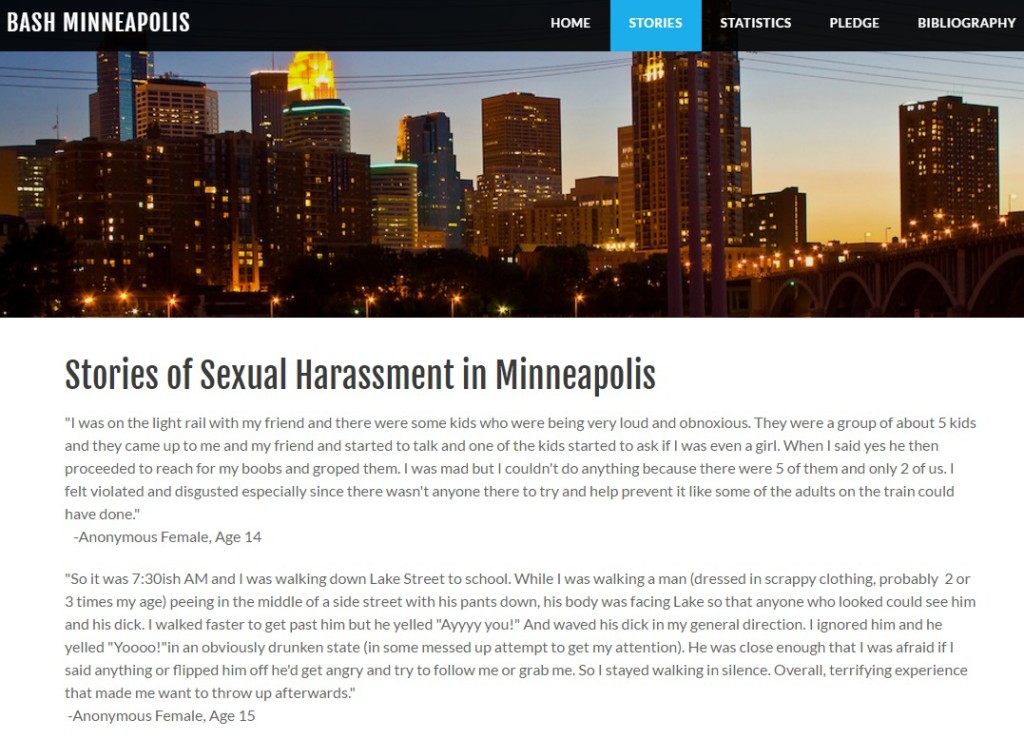

BASH Minneapolis May 2016

Share

Filed Under: Activist Interviews, Resources, street harassment Tagged With: high school, minneapolis, Minnesota

Late May 2016 News Round-Up

May 30, 2016 By HKearl

Yahoo News, “These 3 Women Allegedly Stopped a Date Rape in Progress in California“

“‘Monica, Marla, and I were at FIG at the Fairmont for their delicious happy hour (‘Fig at 5.’ Treat yourself),’ one of the women, who goes by the name Sonia Ulrich on Facebook, posted. ‘I was going on about something and saw Monica staring behind and making a funny face. I stopped. ‘What’s going on?’ After a few second she said ‘That guy just put something in her drink.’

Ulrich wrote she had to ‘Warn her. Tell her to get up and leave this creep. Make him drink it. Something.’ So she lingered in the bathroom to meet the woman in question and said her date had dropped an unknown substance into her beverage, only for the woman to say the man who did it was her ‘best friend.’

The women informed the staff of the restaurant as well, triggering an uneasy wait of nearly 45 minutes for the Santa Monica Police Department to arrive.”

Refinery29, “Meet The Heroic Campaigners Making Cities Safer For Women“

“New research from ActionAid shows that 79% of women living in cities in India, 86% in Thailand, and 89% in Brazil have been subjected to harassment or violence in public. That’s why ActionAid have declared today, Friday the 20th of May, as International Safe Cities for Women Day.

While we might assume that women have it much better in the UK, in the research project interviewing 2,500 women, ActionAid found that 75% of British respondents had experienced some form of violence or harassment in cities. And while 36% of women in UK cities outside the capital feel at risk of harassment on public transport, this rises to 51% on London transport. New mayor Sadiq Khan identified the issue in his campaign, saying: “Women face specific challenges on our transport network that are not currently being addressed.” Citing the reports of sexual offences on London transport almost tripling in five years, he vowed: “As mayor I will take these problems seriously.”

Evening Standard, “Half of women feel at risk of harassment on London public transport“

“This ranges from 39 per cent experiencing name-calling to 54 per cent experiencing wolf-whistling.

Twenty three per cent said they had been victims of groping or unwanted physical contact of a sexual nature.

The findings were published by ActionAid as its ambassadors Imelda Staunton and Jodie Whittaker opened an exhibition at Marble Arch to highlight the plight of victims worldwide.

It found 36 per cent of women felt at risk of harassment on public transport in UK cities, rising to 51 per cent among the 128 London women who took part.”

Metro, “Tackling street harassment at the Clothespin can be the first step to Philly seriously addressing it“

“I normally wear headphones when I get off at the 15th and Market station – also known as the Clothespin – to avoid the hustle and bustle of the city. This week, I forgot them and was reminded of how much I was missing as a result.

Coming up the steps from the SEPTA station underground, I see a crowd of men hover around the entrance. Smoke can be seen surrounding the outskirts as a group of women are walking up. One by one, the men begin to catcall at them and each time the women try to avoid them like the plague.

One of the men proceeded to call them a bitch when none of the women responds. It was in that moment that I simply asked the men to “knock it off.” What followed were a few verbal homophobic jabs at my masculinity and physical intimidation. While this was going on, several other men just walked by.

The biggest disappointment is that this should have been their concern as well.”

Independent, “Iranian women cut their hair off and dress as men to avoid morality police“

“Women in Iran are cutting their hair short and dressing as men in a bid to bypass state ‘morality’ police who rigorously enforce penalties for not wearing a hijab.

A number of women have shared photos of themselves in public with their hair uncovered on Instagram and other social media.”

NYT Live, “ISIS is fining women $10 for showing their eyes“

“Women, a group that’s especially abused by the terror extremists (a fact that hasn’t prevented the group from somehow having a strange allure with some Western women), have been subjected to some of the new taxes and fines. For instance, ISIS will fine women $10 for showing their eyes. Women who wear a cloak that’s too tight will be hit with a $25 fine, and not wearing socks or gloves will cost them $30 in fines.”

News Australia, “Why this man will never catcall another woman after living in Thailand“

“HAVING travelled around Thailand for the past few years, 28-year-old Australian Dylan* has plenty of amusing stories from his travels; many of which include him being followed and propositioned by gay men.

Surprisingly, he says it’s something that has taught him a lot about the experiences of women.

“In Australia, it’s kind of unusual for a guy to have these experiences, but it’s pretty normal in Australian culture for guys to do that [to women],” he said…

“I now understand why, in Australia, if I look at a girl and smile they often just look away. I used to think, ‘that girl is so bitchy, just give me a smile, it’s not that hard,’” he admits.

“But now I realise, she’s probably had 10 guys smile at her before me, and ask for her number or tell her she’s sexy; so when I smile she thinks, ‘Oh here we go again’.

“I’m sort of grateful for the experiences I’ve had, because I can really sympathise with girls now.”

Mini IOL, “Gender activists take on SA taxi drivers“

“Members of the NGO ActionAid South Africa spoke to taxi drivers, staged two street theatre performances and painted a mural on the inside of the taxi rank….
 
Matshidiso Mofokeng, a member of community-based LGBTI group Vosloo Activators, said women and those who identify as LGBTI face similar challenges when using public transport.
 
“As women, we face so many challenges because we live in a patriarchal society,” Mofokeng said. “As a black lesbian who uses public transport, you find that taxi drivers are very homophobic. Today we are here to say enough is enough of gender-based violence.”

TeleSur, “Mexico City Ridiculed for Sexual Harassment Fight With Whistles“

In light of a surge in street harassment and sexual assaults against women, Miguel Mancera, head of the government of Mexico City, announced that his administration will distribute whistles to women to alert bystanders and police of a possible threat.

The proposal quickly became the subject of ridicule on social media. The hashtag #ElPitoDeMancera became a trending topic. In Spanish, “pito” has a double meaning, suggesting a double entendre.”

Quartz, “Just call the rapist ‘brother’ or use this whistle: The ridiculous ways powerful men globally suggest women fight rape“

“Aside from being ludicrous, those kinds of policies ignore the heart of the problem, which is that sexual harassment and assault are learned behaviors, says Holly Kearl, founder of non-profit Stop Street Harassment. Officials should focus on educating school children that such conduct is not OK, and stop the portrayal of women as sexual objects in the media, Kearl says.”

The Star, “Sheffield branch of Woman’s Equality Party launches Safer Streets campaign“

“Sheffield branch founder member Charlie Barker said: “Following on from the #WEcount campaign, which started in London, it was very clear that street harassment was an issue our members and the public wanted us to tackle.

“WE believes that equality is an issue that effects everyone, regardless of gender and this is reflected in the growing number of male and female members and supporters across the country.

“The Sheffield branch of WE currently hosts around 100 members and 300 registered supporters, who’ve been working hard to put together our Safer Streets campaign.”

Georgia State University, “African-American Girls in High-Risk Neighborhoods Experience Threats and Objectification, Study Finds“

“The girls described witnessing marital aggression, experiencing physical and sexual abuse at the hands of adult family members and facing peer aggression, such as bullying, teasing and physical encounters. They reported feeling unsafe inside and outside their home, as well as participating in risk-taking behaviors that elevate the probability of harm. They frequently described early sexual experiences (occurring prior to age 14), being pressured for sex by older boys and watching pornography with boys.”

The Guardian, “#SayHerName: why Kimberlé Crenshaw is fighting for forgotten women“

“When she speaks at public meetings, Professor Kimberlé Crenshaw has a trick. She asks everyone to stand up until they hear an unfamiliar name. She then reads the names of unarmed black men and boys whose deaths ignited the Black Lives Matter movement; names such as Eric Garner, Michael Brown, Tamir Rice, Freddie Gray, Trayvon Martin. Her audience are informed and interested in civil rights so “virtually no one will sit down”, Crenshaw says approvingly. “Then I say the names of Natasha McKenna, Tanisha Anderson, Michelle Cusseaux, Aura Rosser, Maya Hall. By the time I get to the third name, almost everyone has sat down. By the fifth, the only people standing are those working on our campaign.”

The campaign, #SayHerName, was created to raise awareness about the number of women and girls that are killed by law enforcement officers. For Crenshaw – who coined the term “intersectionality” in the 1980s to describe the way different forms of discrimination overlap and compound each other – it is a brutal illustration of how racism and sexism play out on black women’s bodies.”

Huffington Post, “DC Metro Rape Highlights Why Women Are Always Aware of Rape“

“What it does mean is that girls’ socialization is significantly pegged to cultivated rape and rape myths, in ways that boys’ are not and that that socialization has far-reaching inhibitory social effects. For example, in the wake of this DC rape, chances are that the parents of girls are being far more restrictive about their using public transportation than the parents of boys, especially straight boys. Boys, even if they are not taught to restrict themselves, or subject to evergreen risks, are actually made more vulnerable as a result. This is one of the ways that patriarchy backfires on men.

If people abhor rape and would like to make the world a safer place in general, a good simple first step is listening to women when they say that street harassment is a problem.”

Verily, “This Research Reveals the Real Side Effects of Sexting, Harassment, and Self-Objectification“

Orenstein’s book adds more shocking stats to the mix. “I interviewed more than seventy young women between the ages of 15 and 20,” Orenstein explains, and later adds, “Fully half of the girls had experienced something along a spectrum of coercion to rape…. Only two had previously told another adult what had happened.”

Huffington Post, “What I Wish Men Knew About That Creepy Guy At Starbucks“

“None of these incidents are the worst things that have ever happened, by any means. But put together, they’re indicative of a culture that allows men to feel entitled to women’s bodies. One that leads to men attacking, and even killing women for rejecting them.

Here’s the thing: Women know with no uncertainty that a pass from a powerful man is never just that, a direction to “smile” from a stranger is never just that, and that eyes following us down a sidewalk could become more than just that in a moment. Starbucks man was no exception. He was the rule.”

The Daily Northwestern, “Anxiety Abroad: Students call for better resources navigating sexual harassment, mental health issues on study abroad programs“

Revelist, “12 women reveal the good, bad and downright kickass ways they respond to street harassment“

Share

Filed Under: News stories, street harassment

“Don’t look at her, she is ugly as hell”

May 29, 2016 By Contributor

I decided to go to my public library and as I was on my computer minding my own business there were two guys who looked between the ages of 17 and 19. One sat next to me and he kept glancing at me and I felt nervous and uncomfortable. Next to him was his friend who said, “Don’t look at her, she is ugly as hell.”

So hearing that really pissed me off and I ignored it because I knew if I would have responded the way I was thinking about responding, physically, I would have been arrested and charged. I told the librarian as soon as my session ended and she went and talked to them and I feel like they should have been thrown out the library because I don’t know these bastards and they just randomly sat next to me and began harassing me for no reason. I have never spoken a word to either of them, but they felt they had to comment on my appearance. I felt angry, powerless, and disturbed because I honestly felt like fighting both of them. The sad part is that I am put in the position where I can’t safely defend myself.

– Anonymous

Location: Troy, NY

Share your street harassment story for the blog.
See the book 50 Stories about Stopping Street Harassers for more idea.

Share

Filed Under: Stories, street harassment

“He sneered something derogatory at me”

May 28, 2016 By Contributor

I was home from graduate school. One afternoon I went out for a jog around the neighborhood where I grew up. I turned the corner and saw a young guy on a bike. “Whatever,” I thought and kept running. Bike guy saw me and decided to hop his bike onto the narrow sidewalk, coming towards me. I was forced to move out of his way as he sneered something derogatory at me. I think it’s over but I lapped the block (because I know exactly how many laps are a mile), and I saw and heard him again. And again. And again. One time, he even beckoned me to run alongside him. I ignored him, of course. The last time, he rode really close to me and said something extra nasty and disgusting again. Fortunately I didn’t see him again after that.

Did I mention that more than half of the block I run around is the location of an elementary school?!

Optional: What’s one way you think we can make public places safer for everyone?

Educate everyone, especially kids, about how it’s not appropriate to harrass other people – they aren’t there for your pleasure or appreciation, they just want to do what they have to do and move on, enjoying life and being safe!

– Anonymous

Location: Leahy School, Lawrence, MA

Share your street harassment story for the blog.
See the book 50 Stories about Stopping Street Harassers for more idea.

Share

Filed Under: Stories, street harassment

#WEcount: Reclaiming our Streets for Women

May 27, 2016 By HKearl

The Women’s Equality Party is a political party that was founded last year in the UK. One of their agendas is addressing violence against women, including street harassment. Last week I had the honor to Skype with one of their co-founders and their Head of Policy & Partnerships, Halla Gunnarsdóttir. We brainstormed possible policy solutions they could suggest or campaigns they could run.

Fortunately, the new mayor of London Sadiq Khan identified the issue in his campaign, specifically on public transit, saying: “Women face specific challenges on our transport network that are not currently being addressed.” He promised, “As mayor I will take these problems seriously.”

And the Women’s Equality Party has already taken measures to begin to address the issue. The have campaign called #WEcount: Reclaiming Our Streets for Women. Here’s info from their website, including how you can participate:

“WE are now extending #WEcount across the UK so that women right across the country can make their voices heard and say: this must stop,” said Sophie Walker, leader of the Women’s Equality Party.

“WE are asking our supporters to post photos of their hands on social media with the hashtag #WEcount, showing a postcode or place where they have experienced sexual harassment, assault or verbal abuse. Alternatively, they can email their photos to WEcount@womensequality.emailnb.com to be posted anonymously.”

The campaign also includes a film featuring Pavan Amara, who built the “My Body Back” project after being attacked and has helped hundreds of women who have been assaulted to reclaim their lives.

Women can mark their experiences on an interactive map of the UK (wemap.org) by dropping a Google-maps-style pin. In London, this map will be on display for the week on a dedicated billboard at Westfield shopping centre, Shepherd’s Bush.

And in a digital first, the campaign will be brought to life for Londoners with the use of a new visual browsing app, BlippAR.

WE have painted 10 physical markers – which show the Google maps pin transformed into an exclamation mark – at locations around the capital, from the Houses of Parliament to Parliament Hill. People who ‘Blipp’ the mark will receive a host of content and information about the campaign, as well as details of what support is available.

Walker added: “An estimated 400,000 sexual offences against women occur in the UK each year. Despite their frequency, the majority of these incidents are unreported, and women are left feeling unsafe and unable to walk without fear on their own streets. WE want to reclaim our streets.”

“WE are the only party who are making the sexual abuse and harassment of women a political priority. WE will show that women right across the UK are affected by this every day – and that every one of us counts.”

Share

Filed Under: Activist Interviews, Resources, street harassment Tagged With: campaign, england, London, mapping, women's equality party

« Previous Page
Next Page »

Share Your Story

Share your street harassment story for the blog. Donate Now

From the Blog

  • #MeToo 2024 Study Released Today
  • Join International Anti-Street Harassment Week 2022
  • Giving Tuesday – Fund the Hotline
  • Thank You – International Anti-Street Harassment Week 2021
  • Share Your Story – Safecity and Catcalls Collaboration

Buy the Book

Search

Archives

  • September 2024
  • March 2022
  • November 2021
  • April 2021
  • March 2021
  • January 2021
  • April 2020
  • March 2020
  • February 2020
  • December 2019
  • November 2019
  • September 2019
  • August 2019
  • July 2019
  • June 2019
  • May 2019
  • April 2019
  • March 2019
  • February 2019
  • January 2019
  • December 2018
  • November 2018
  • October 2018
  • September 2018
  • August 2018
  • July 2018
  • June 2018
  • May 2018
  • April 2018
  • March 2018
  • February 2018
  • January 2018
  • December 2017
  • November 2017
  • October 2017
  • September 2017
  • August 2017
  • July 2017
  • June 2017
  • May 2017
  • April 2017
  • March 2017
  • February 2017
  • January 2017
  • December 2016
  • November 2016
  • October 2016
  • September 2016
  • August 2016
  • July 2016
  • June 2016
  • May 2016
  • April 2016
  • March 2016
  • February 2016
  • January 2016
  • December 2015
  • November 2015
  • October 2015
  • September 2015
  • August 2015
  • July 2015
  • June 2015
  • May 2015
  • April 2015
  • March 2015
  • February 2015
  • January 2015
  • December 2014
  • November 2014
  • October 2014
  • September 2014
  • August 2014
  • July 2014
  • June 2014
  • May 2014
  • April 2014
  • March 2014
  • February 2014
  • January 2014
  • December 2013
  • November 2013
  • October 2013
  • September 2013
  • August 2013
  • July 2013
  • June 2013
  • May 2013
  • April 2013
  • March 2013
  • February 2013
  • January 2013
  • December 2012
  • November 2012
  • October 2012
  • September 2012
  • August 2012
  • July 2012
  • June 2012
  • May 2012
  • April 2012
  • March 2012
  • February 2012
  • January 2012
  • December 2011
  • November 2011
  • October 2011
  • September 2011
  • August 2011
  • July 2011
  • June 2011
  • May 2011
  • April 2011
  • March 2011
  • February 2011
  • January 2011
  • December 2010
  • November 2010
  • October 2010
  • September 2010
  • August 2010
  • July 2010
  • June 2010
  • May 2010
  • April 2010
  • March 2010
  • February 2010
  • January 2010
  • December 2009
  • November 2009
  • October 2009
  • September 2009
  • August 2009
  • July 2009
  • June 2009
  • May 2009
  • April 2009
  • March 2009
  • February 2009
  • January 2009
  • December 2008
  • November 2008
  • October 2008
  • September 2008
  • August 2008
  • July 2008
  • June 2008
  • May 2008

Comment Policy

SSH will not publish any comment that is offensive or hateful and does not add to a thoughtful discussion of street harassment. Racism, homophobia, transphobia, disabalism, classism, and sexism will not be tolerated. Disclaimer: SSH may use any stories submitted to the blog in future scholarly publications on street harassment.
  • Contact
  • Events
  • Join Us
  • Donate
  • Facebook
  • Instagram
  • Pinterest
  • Tumblr
  • Twitter
  • YouTube

Copyright © 2026 Stop Street Harassment · Website Design by Sarah Marie Lacy