• About Us
    • What Is Street Harassment?
    • Why Stopping Street Harassment Matters
    • Meet the Team
      • Board of Directors
      • Past Board Members
    • In The Media
  • Our Work
    • National Street Harassment Hotline
    • International Anti-Street Harassment Week
    • Blog Correspondents
      • Past SSH Correspondents
    • Safe Public Spaces Mentoring Program
    • Publications
    • National Studies
    • Campaigns against Companies
    • Washington, D.C. Activism
  • Our Books
  • Donate
  • Store

Stop Street Harassment

Making Public Spaces Safe and Welcoming

  • Facebook
  • Instagram
  • Pinterest
  • Tumblr
  • Twitter
  • YouTube
  • Home
  • Blog
    • Harassment Stories
    • Blog Correspondents
    • Street Respect Stories
  • Help & Advice
    • National Street Harassment Hotline
    • Dealing With Harassers
      • Assertive Responses
      • Reporting Harassers
      • Bystander Responses
      • Creative Responses
    • What to Do Before or After Harassment
    • Street Harassment and the Law
  • Resources
    • Definitions
    • Statistics
    • Articles & Books
    • Anti-Harassment Groups & Campaigns
    • Male Allies
      • Educating Boys & Men
      • How to Talk to Women
      • Bystander Tips
    • Video Clips
    • Images & Flyers
  • Take Community Action
  • Contact

“I wish everyone could be treated equally”

May 27, 2016 By Contributor

I am thirteen years old. I was cat-called for the first time today. I had heard about cat-calling happening before, in America and all that, but I didn’t think it would happen in Ireland, or to someone so young like me.

I was walking home from school. There was a girl in front of me who was about a year older than me and a large group of boys in front of me. No, this story is not where you think it is going. It was not the group of boys that cat called me. A man (who looked about 25) was getting into his car with his friend. Next, I see the window rolling down and the man says, “Hey, ladies.”

I was mortified but I ignored him and kept looking down. He was laughing as the car drove off. The girl in front of me seemed to be ignoring the man also. I saw the group of boys looking behind them multiple times, smiling as they did it. Even if I did look older, (which I don’t – I have a flat chest and backside, I’m average height and I don’t wear make-up during school days) I believe it is still completely unacceptable to be cat-called, no matter what you look like or how old you are. I wish everyone could be treated equally. It’s horrible that so many women and young girls like me have to face these situations.

– Anonymous

Location: Ireland

Share your street harassment story for the blog.
See the book 50 Stories about Stopping Street Harassers for more idea.

Share

Filed Under: Stories, street harassment Tagged With: first, ireland, older harasser, young age

Spanish Translation Volunteer Opportunity

May 26, 2016 By HKearl

Can you speak/write in English and Spanish? Do you want to help address street harassment? Here’s a perfect volunteer opportunity for you, if so!

This summer, we’ll be partnering with the Rape, Abuse & Incest National Network (RAINN) and Defend Yourself (DY) to launch the first-ever national street harassment hotline. The hotline will be offered 24/7. As part of the set-up, DY and I am preparing materials that will be used by RAINN’s staff when they take calls. Because the hotline will be offered in both Spanish and English, we need to translate some of our materials into Spanish for the RAINN staff to use with Spanish-speaking callers.

There are about a dozen web pages or articles that would need to be translated into Spanish by June 15. Here are three examples:

https://stopstreetharassment.org/about/what-is-street-harassment/ | https://stopstreetharassment.org/strategies/moment/ | https://medium.com/@hkearl/five-reasons-why-street-harassment-is-serious-15221720f1b7

Let me know if you would have any time in the next 2.5 weeks and be willing to translate one or two (or more) of these items. It would be a huge, huge help. And not only will the translated information be used to help the hotline callers, but it will be posted on the SSH website period, so Spanish speakers coming to the website would be able to gain more information than they can currently because of your help.

In return, I’ll list you in an acknowledgements section on the forthcoming hotline page and also send you some SSH swag in the mail as a thank you!

You can contact me at hkearl @ stopstreetharassment . org. Thanks! – Holly

Share

Filed Under: SSH programs Tagged With: hotline, spanish, volunteer

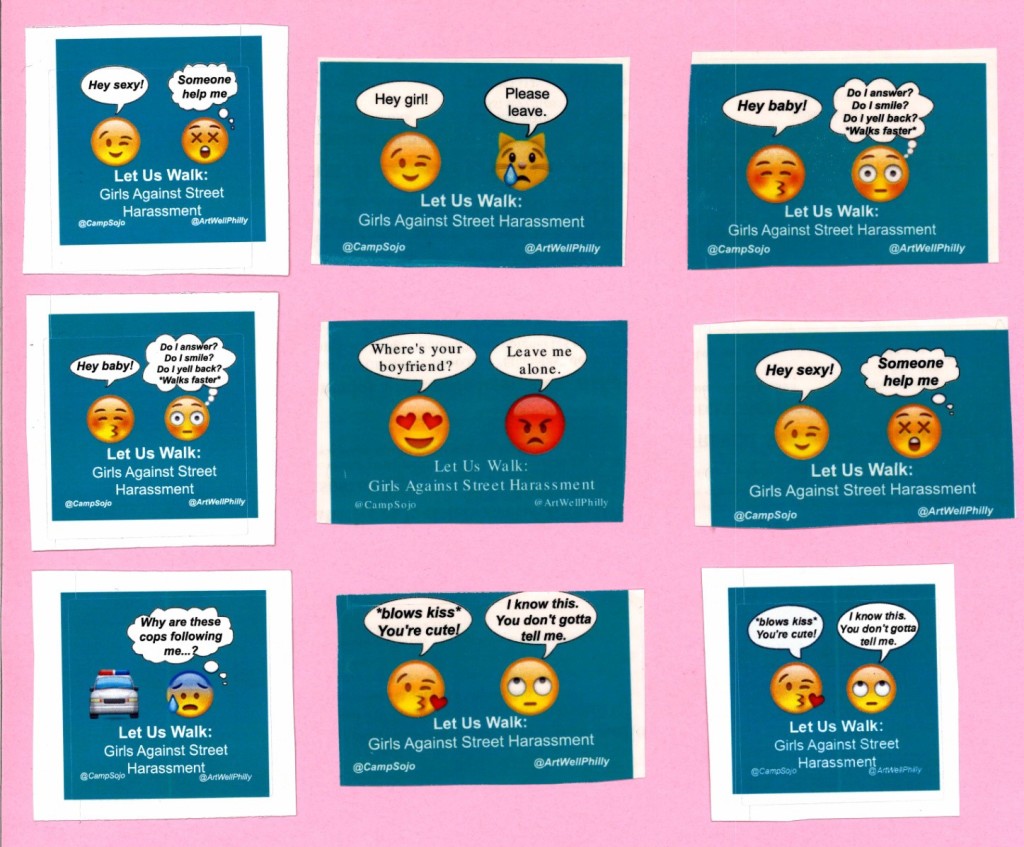
Let Us Walk! Stickers Against Street Harassment

May 25, 2016 By HKearl

 This is an excerpt from the Art of Growing Leaders 2015-16 Highlights, shared with their permission:

“The Art of Growing Leaders [in Philadelphia, PA] introduces young people ages 10-14 to multi-cultural rites of passage traditions, and provides them with creative leadership skills to help them discover their strengths and bring them to their communities. In the culminating project, students embarked on one specific creative social action project to improve their school/community.

Young women from Camp Sojourner, Girls’ Leadership Camp participated in  ArtWell’s The Art of Growing Leaders and created this public guerilla art project to speak out against street harassment. Students designed stickers and gave them out and spoke with hundreds of people on April 30 at the Sojourner Truth Walk in West Philly, sparking important conversations. One parent told us this topic was not appropriate for her child, as she was too young and had not experienced harassment, only to be corrected by her daughter who told her mother that she was no stranger to being harassed. This led to a dialog and new awareness between this mother and her daughter. We are proud of these young women in creating such a powerful,
straightforward, and important project.
“

Camp Sojourner Final Social Action Project - May 2016


Share

Filed Under: Activist Interviews, street harassment Tagged With: art, philadelphia, stickers, youth

USA: Clinic-Specific Street Harassment

May 25, 2016 By Correspondent

Mariel DiDato, NJ, USA, SSH Blog Correspondent

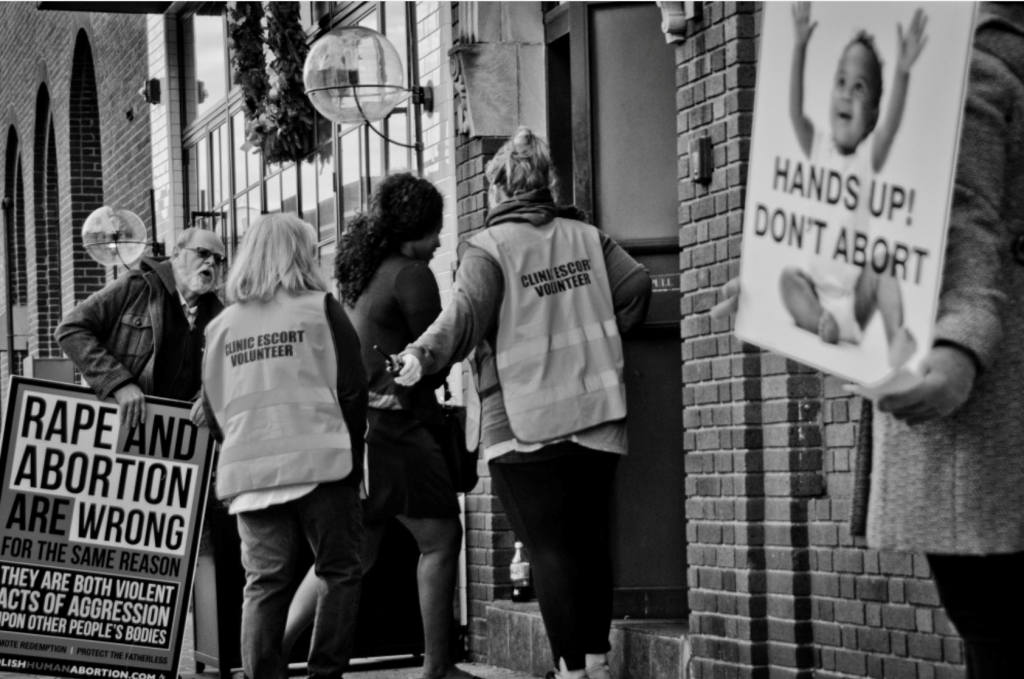
Protestors harass a patient outside of a women’s healthcare clinic. Photo by and courtesy of Wendi Kent.

Whenever a woman is in a public space, there is always a chance she will be shouted at, followed, or recorded without her permission. However, there is one place where that harassment is almost guaranteed.

Women’s health clinics have seen a rise in harassment and violence since the first murder of an abortion provider in 1993. This rate especially has risen within the past few years. The climate is so bad for these clinics that there are volunteer clinic escort teams simply to help patients walk from the sidewalk or parking lot to the front door. As a clinic escort myself, I have seen the extent of this problem first-hand.

Each clinic’s atmosphere is different, as each state has different political leanings, religious influences, and laws surrounding women’s healthcare. In general though, the themes are the same. Patients must walk through numerous, large posters depicting gory, aborted fetuses. They have their personal space violated by anti-choice protestors who follow them and try to convince them not to go inside the clinic. When they finally get to the door, there are protestors preaching loudly, sometimes through megaphones, chastising these women for going inside. It gets so bad that even some of the more peaceful pro-life demonstrators criticize the protestors who scream at and follow patients. To make matters worse, the sound of the megaphones permeates the clinic walls, so that patients inside have to listen to these protests for the entirety of their appointment. Oftentimes, the loudest of the protestors are men, who think they know what women should do with their bodies and health better than the women trying to receive care.

In addition to clinic escort teams, many clinics have been awarded legal buffer zones. Protestors cannot step foot in these areas, so that patients can feel safer in walking to the clinic. Although political buffer zones have been easily enacted in other scenarios, such as political polls, it is difficult to obtain a buffer zone for women’s healthcare clinics. Even when they are obtained, they may not be enforced, depending on the religious or political beliefs of the on-duty police officers. Anti-choice groups often try to repeal these buffer zones by citing of freedom of speech. Although freedom of speech does not protect harassment and intimidation, these cases often swing in the favor of the anti-choice movement. Just recently, anti-choice protestors were even given permission to violate the city noise ordinance in Portland, Maine.

A clinic in Madison, Wisconsin obtained a “floating buffer zone,” in which people within 160 feet of the facility have an eight-foot boundary that protestors cannot cross. Other buffer zones have spanned as wide as 35 feet. These boundaries allow protestors to practice their freedom of speech without causing any physical or emotional harm to patients trying to access the clinic. However, in most other places, the buffer zone can be as little as just eight square feet in front of the clinic entrance. This gives protestors more freedom to the sidewalk than the patients, who may not even be going to the clinic for an abortion. In many places like Richmond, Virginia, or Louisville, Kentucky, there is still no buffer zone at all.

These protests go beyond freedom of speech. The last time I escorted for a clinic, three different women were crying by the time they got inside. This is not an uncommon occurrence. These women and their companions are slut-shamed, insulted, and even threatened. Protestors sometimes violate the buffer zone, but these infractions are hard to prove. Oftentimes, since our focus is on the safety of the patients and not necessarily on the bad behavior of the protestors, we can only pull our cameras out to record after a threat has been made or the buffer zone has been invaded. For the safety and security of the patients, we also never take any photos or videos that could be used to identify them. On the other hand, this is something that anti-choice protestors are not afraid to do.

This issue is not pro-life verses pro-choice. Regardless of one’s stance on abortion, most people should agree that women deserve the right to feel safe on their way to the doctor. The clinic that I volunteer at received their buffer zone through clinic escorting, documenting harassment from protestors, lobbying, emailing weekly reports to the city council (as well as the city and clinic attorneys and the chief of police), and partnering with the local National Organization of Women chapter to draft buffer zone legislation. Buffer zones create harassment-free environments for patients. I urge you to fight for a buffer zone in your area. It can mean the difference between women being scared away from their doctor’s appointments, and women feeling safe enough to receive the care that they need.

Mariel is a recent college graduate, feminist, and women’s rights activist. Currently, she volunteers for a number of different organizations, including the Planned Parenthood Action Fund of New Jersey and the New Jersey Coalition Against Sexual Assault. You can follow her on Twitter at @marieldidato or check out her personal blog, Fully Concentrated Feminism.

Share

Filed Under: correspondents, public harassment Tagged With: clinics, reproductive rights

Part 2: Sexual Harassment of Women in India: A Violation of Personal and Public Space

May 25, 2016 By Correspondent

Manish Madan, Ph.D, USA, SSH Blog Correspondent

[This is continued from Part 1]

The next part of my write-up is on a recent research study that I conducted with my co-author Mahesh K. Nalla, understanding the nature of sexual harassment of women in public places with a focus on the capital city, New Delhi, India. I enumerate a few of the key findings below:

  • Nearly 2 out of 5 women (40 percent) reported to being sexually harassed (from being catcalled, whistled at to being physically groped, poked etc.) in the year prior, and
  • About 3 out of 5 women (about 58 percent) had experienced the harassment at least once in their lifetime.
  • Nearly 56 percent of the women said, they knew someone (friend/family) who has been harassed at least once in their lifetime.
  • About 80 percent of the women reported to have experienced victimization while waiting for a bus at a bus-stop, and about 60-70 percent reported victimization at a roadside; pubic park/public areas such as market place, shopping complex etc.
  • Majority of the women had experienced it in the daytime compared to after dark hours. This in our view was not too surprising given that the most women tend to access public spaces or use the public transportation for their daily business during the daytime.
  • Women find public mode of transportation (busses, metro etc.) and public spaces as less accommodating for them compared to the men.
  • Women were less likely to report feeling of safety in public spaces compared to men.
  • Finally, there is a significant gap in how men and women view sexual harassment.

Most of these finding should find much attention with policy makers in Delhi government or with the Delhi Women Commission given the context of the study post Delhi Gang Rape that questioned the women’s safety in the capital city.

Interestingly, there was not much gap in women’s experience of actual victimization versus their perception of victimization at specific public locations – call it a woman’s instinct, and on a much serious note, admit our inability in ensuring a safer and/or accommodating environment for women.

The significant gap in gender views on sexual harassment opens an important array of discussion points given the dynamics of sexual harassment. For example, nearly one-third to one-fourth of the men did not view whistling, catcalling, brushing up against a women or leaning closely as a constituting sexual harassment while nearly all women found them to be very serious instances of sexual harassment. It is therefore an important take-home for us – the education, awareness needs to be initiated in identifying actions that constitute sexual harassment. We have to be on the same page.

The UN Millennium Project suggested eight goals that quantify as well as qualify toward “basic human rights – the rights of each person on the planet to health, education, shelter, and security.” Promoting gender equality and empower women is one of those eight basic human rights goal that the large gathering of world leaders adopted as part of the UN Millennium Declaration in September 2000. Just like any project deadline, the participating nations committed to the deadline of 2015. Are we there yet, or do we really need a deadline extension in ensuring women safety?

The 2013 Charter of Public Space recently adopted in Rome stated public spaces to be as accessible and enjoyable by all for free … “Public spaces are a key elements of individual and social well-being, the places of a community’s collective life, expression of the diversity of their common natural and cultural richness and a foundation of their identity.” Can we ask the Government to ensure that public spaces are equitable and inclusive to all genders? I see a prominent role of urban city planners, who also understand the concepts of gendered spaces and can advise the government in relevant light.

Finally, as suggested by the study, the inadequate or distressed access of public space to women is not only contrary to the UN Millennium Development Goal on the Status of Women but at a fundamental level challenges the constitutional and basic human rights of women in our society. Eight out of 10 women waiting at a bus stop recognize that they will likely be experiencing or witnessing some form of sexual harassment. Is it supposed to be the new normal? I believe we as a community of responsible citizens can do better, isn’t it?

The Road Ahead

Like any other social menace, sexual harassment of women in public spaces is an issue that needs a collective effort where all stakeholders such as government, legislators, urban planners, criminal justice system, advocacy groups, NGOs, schools, media, researchers and finally, men and women work together. The remedial may not be prompt but with sustained efforts backed by research, we can hope to have lesser instances of sexual harassment.

Citizen-driven initiatives backed by organizations, government will be at the heart of this, in my view. As clichéd as it may sound, I am neither the first one nor will be last to say, the public discourse on sexual harassment must initiate at an early educational level within schools and within homes. Furthermore, attitudinal change is a must toward gender sensitization. Every time there is an instance of sexual harassment, someone’s right to personal and public space is getting violated. Someone’s constitutional right to be a free citizen is getting violated and it is not cool.

I encourage initiating cross-gender dialogue #WhatIsSexualHarassment to understand and raise awareness about what indeed sexual harassment is. Trust me, there will be far too many definitions emerging from this proposed dialogue, however, my hope will be the sensitization and education of many men and women alike about what all constitutes sexual harassment.

Sexual harassment of women is not a women’s issue anymore. As a society we have to work collectively toward addressing the prevalence of sexual harassment and envision a community that refuses any form of violence against women. I do want to put a special emphasis that this article is put in no way to single out one gender over another or to draw a generalization of men versus women. I hope you all join my vision.

Manish is a Professor of Criminal Justice at Stockton University where his research focuses on examining sexual harassment, gender empowerment, spousal abuse and policing issues. You can follow him @Prof_Madan or reach out to him at www.manishmadan.com.

Share

Filed Under: correspondents Tagged With: India, research

« Previous Page
Next Page »

Share Your Story

Share your street harassment story for the blog. Donate Now

From the Blog

  • #MeToo 2024 Study Released Today
  • Join International Anti-Street Harassment Week 2022
  • Giving Tuesday – Fund the Hotline
  • Thank You – International Anti-Street Harassment Week 2021
  • Share Your Story – Safecity and Catcalls Collaboration

Buy the Book

Search

Archives

  • September 2024
  • March 2022
  • November 2021
  • April 2021
  • March 2021
  • January 2021
  • April 2020
  • March 2020
  • February 2020
  • December 2019
  • November 2019
  • September 2019
  • August 2019
  • July 2019
  • June 2019
  • May 2019
  • April 2019
  • March 2019
  • February 2019
  • January 2019
  • December 2018
  • November 2018
  • October 2018
  • September 2018
  • August 2018
  • July 2018
  • June 2018
  • May 2018
  • April 2018
  • March 2018
  • February 2018
  • January 2018
  • December 2017
  • November 2017
  • October 2017
  • September 2017
  • August 2017
  • July 2017
  • June 2017
  • May 2017
  • April 2017
  • March 2017
  • February 2017
  • January 2017
  • December 2016
  • November 2016
  • October 2016
  • September 2016
  • August 2016
  • July 2016
  • June 2016
  • May 2016
  • April 2016
  • March 2016
  • February 2016
  • January 2016
  • December 2015
  • November 2015
  • October 2015
  • September 2015
  • August 2015
  • July 2015
  • June 2015
  • May 2015
  • April 2015
  • March 2015
  • February 2015
  • January 2015
  • December 2014
  • November 2014
  • October 2014
  • September 2014
  • August 2014
  • July 2014
  • June 2014
  • May 2014
  • April 2014
  • March 2014
  • February 2014
  • January 2014
  • December 2013
  • November 2013
  • October 2013
  • September 2013
  • August 2013
  • July 2013
  • June 2013
  • May 2013
  • April 2013
  • March 2013
  • February 2013
  • January 2013
  • December 2012
  • November 2012
  • October 2012
  • September 2012
  • August 2012
  • July 2012
  • June 2012
  • May 2012
  • April 2012
  • March 2012
  • February 2012
  • January 2012
  • December 2011
  • November 2011
  • October 2011
  • September 2011
  • August 2011
  • July 2011
  • June 2011
  • May 2011
  • April 2011
  • March 2011
  • February 2011
  • January 2011
  • December 2010
  • November 2010
  • October 2010
  • September 2010
  • August 2010
  • July 2010
  • June 2010
  • May 2010
  • April 2010
  • March 2010
  • February 2010
  • January 2010
  • December 2009
  • November 2009
  • October 2009
  • September 2009
  • August 2009
  • July 2009
  • June 2009
  • May 2009
  • April 2009
  • March 2009
  • February 2009
  • January 2009
  • December 2008
  • November 2008
  • October 2008
  • September 2008
  • August 2008
  • July 2008
  • June 2008
  • May 2008

Comment Policy

SSH will not publish any comment that is offensive or hateful and does not add to a thoughtful discussion of street harassment. Racism, homophobia, transphobia, disabalism, classism, and sexism will not be tolerated. Disclaimer: SSH may use any stories submitted to the blog in future scholarly publications on street harassment.
  • Contact
  • Events
  • Join Us
  • Donate
  • Facebook
  • Instagram
  • Pinterest
  • Tumblr
  • Twitter
  • YouTube

Copyright © 2026 Stop Street Harassment · Website Design by Sarah Marie Lacy