• About Us
    • What Is Street Harassment?
    • Why Stopping Street Harassment Matters
    • Meet the Team
      • Board of Directors
      • Past Board Members
    • In The Media
  • Our Work
    • National Street Harassment Hotline
    • International Anti-Street Harassment Week
    • Blog Correspondents
      • Past SSH Correspondents
    • Safe Public Spaces Mentoring Program
    • Publications
    • National Studies
    • Campaigns against Companies
    • Washington, D.C. Activism
  • Our Books
  • Donate
  • Store

Stop Street Harassment

Making Public Spaces Safe and Welcoming

  • Facebook
  • Instagram
  • Pinterest
  • Tumblr
  • Twitter
  • YouTube
  • Home
  • Blog
    • Harassment Stories
    • Blog Correspondents
    • Street Respect Stories
  • Help & Advice
    • National Street Harassment Hotline
    • Dealing With Harassers
      • Assertive Responses
      • Reporting Harassers
      • Bystander Responses
      • Creative Responses
    • What to Do Before or After Harassment
    • Street Harassment and the Law
  • Resources
    • Definitions
    • Statistics
    • Articles & Books
    • Anti-Harassment Groups & Campaigns
    • Male Allies
      • Educating Boys & Men
      • How to Talk to Women
      • Bystander Tips
    • Video Clips
    • Images & Flyers
  • Take Community Action
  • Contact

Part 1: Sexual Harassment of Women in India: A Violation of Personal and Public Space

May 24, 2016 By HKearl

Manish Madan, Ph.D, USA, SSH Blog Correspondent

Benjamin Franklin once said, “In this world nothing can be said to be certain, except death and taxes.” If he were a woman in current times, I wonder if this adage would have been stated as, “… nothing is certain except for death, taxes and sexual harassment.” Such is the prevalence of sexual harassment for women not only in the US, but globally.

Various research studies have reported the pervasiveness of sexual harassment within schools, colleges, workplace including in the US military. There are also documented reports of sexual harassment in public spaces worldwide, for example in France, China, Pakistan, Egypt, London, India, and Iran to name a few.

Sexual harassment of women influences job satisfaction, anxiety, depression, physical and mental health, constant stress leading to burnout. Research has also shown evidence of sexual harassment’s association with negative emotions such as fear, shame, anger, and guilt. There is a growing body of literature highlighting sexual harassment’s role in alleviating one’s helplessness to developing post-traumatic stress (PTS) symptoms and posttraumatic stress disorder (PTSD). Needless to say, women are the primary victims and males are mostly the offenders.

In India, the horrific Delhi Gang-Rape of 2012 resulted in the 23-year old woman losing her life. If there is anything positive that resulted from this incident – it is perhaps that this brought the crime against women to the forefront, a much needed impetus.

In my view, it also gave the feminist movement a big push where the young, old, men and women alike were on the streets demanding a basic human right, that is, “safety and security in public spaces.” In the same breath, I am very apologetic for finding a positive in this gruesome event, a human life is far too valuable to be sacrificed for people to start ruffling their feathers toward an important social change.

Notwithstanding my personal position, one thing is apparent that since this incident, the sexual offenses (from rape to assault to insulting the modesty of a women) have alarmingly increased, both at a national level and within the capital city. Do we take pride in a higher reporting and that law enforcement is perhaps taking more complaints, or we feel just about ashamed at these growing numbers and do nothing? Or chart a future course with policy-driven initiatives grounded in empirical evidence?
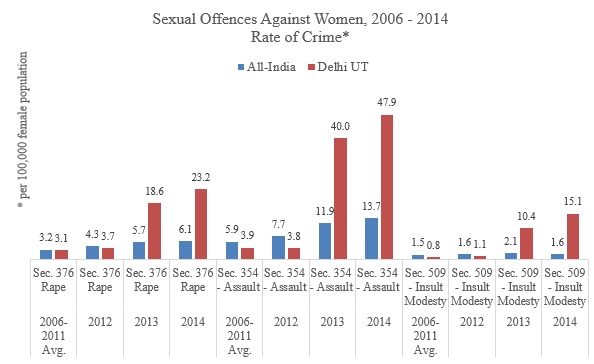
Indiasexoffense

Source: National Crime Record Bureau (India): 2006–2014.

Let me assert that the problem in India is not the laws or its lack thereof. According to the Indian Penal Code (IPC), sexual offences comprise rape (Sec. 375, Sec. 376 IPC); attempt to commit rape, assault on women with intent to outrage her modesty (Sec. 354 IPC) and insult to the modesty of women (Sec. 509 IPC). An offence of rape under sec 376 warrants a fine with rigorous imprisonment of a term not less than seven years, but may also extend to imprisonment for life. The Indian legal system does provide protection and remedial against sexual harassment including many serious sexual offenses. However, the pervasive occurrence of sexual violence in India exists for reasons that are beyond the mere existence of the laws. A Washington Post story attributed it to a few female police officers, a sluggish court system, few convictions, and low status of women in the Indian society among several other factors. For the purpose of this write up, it is my hope that both men and women become aware of the pertinent laws.

Read Part 2.

Manish is a Professor of Criminal Justice at Stockton University where his research focuses on examining sexual harassment, gender empowerment, spousal abuse and policing issues. You can follow him @Prof_Madan or reach out to him at www.manishmadan.com.

Share

Filed Under: correspondents Tagged With: India

“It scared me out of my skin”

May 24, 2016 By Contributor

I was walking on a sidewalk. I was not in the way or anything. A stranger’s car honked at me from behind. I think they wanted me to notice them or something. It scared me out of my skin.

– Anonymous

Location: Kansas City, KS, USA

Share your street harassment story for the blog.
See the book 50 Stories about Stopping Street Harassers for more idea.

Share

Filed Under: Stories, street harassment

“I breached socially constructed expectations because I was angry”

May 23, 2016 By Contributor

My body, my temple!

It is very sad how street harassment is something I’m used to at this point, but this is definitely not something I would like to tolerate!

Whenever I go out for a walk, I either witness a random guy screaming out disgusting sexual comments or their phone number, whistling or gazing with hungry look, guys stopping their cars and offering a ride, or, even worse, grabbing a passing by girl’s buttock.

I saw it all, but I never felt able to do anything and that was angering me. One day, I was walking home from the gym, on the main road I always walked on. As I’m walking, four guys (who looked to be in their early 20s) were walking towards me. I was not worried for my safety as first of all, I was wearing modest sports clothes and I was walking down on of the main roads. However, I was mistaken.

The closer they were getting to me, the more they started to spread out to block the road. Not to provoke them, I moved very close to the roadside. However, it did not help. One of the guys grabbed my hand and pushed me towards him. My self-defense reaction emerged pretty much immediately. I hit the guy’s hand and he ran away from me while three of his friends headed towards me. The only thing I had handy was my to-go bottle filled with protein cocktail. I started to hit them with it. The lid of the bottle fell wide opened and we all were covered from head to toe in a protein cocktail.

Although it was one of the main streets no one stopped to help. Ironically, there were not even patrol cars. I was lucky when the guard of a nearby organization started to whistle. The guys got scared off and ran away.

I am confident the guys did not expect such a wild reaction from me because in our culture men do not expect women to stand up for themselves, to fight, or to shout. They expect us to be fragile, afraid and silent. They do not expect that girls can bring unwanted attention to their misdeeds. I breached socially constructed expectations because I was angry and would not stand to be grabbed as if I were someone’s property.

My body is my temple. No one has the right to touch me without my consent!

Optional: What’s one way you think we can make public places safer for everyone?

More police patrol cars. There should be alarm buttons to press so that police arrives to that spot.

– Dilber

Location: Ashgabat, Turkmenistan

Share your street harassment story for the blog.
See the book 50 Stories about Stopping Street Harassers for more idea.

Share

Filed Under: Stories, street harassment

USA: Vigilant against Street Harassment

May 21, 2016 By Correspondent

Turquoise A. Thomas (Morales), Kansas, USA, SSH Blog Correspondent

Growing up I, like most girls and women, had wholeheartedly internalized the fear of “stranger danger.” So naturally, as I matured and my family allowed me to explore the cities we lived in unattended, I was extremely vigilant. However, like most girls and boys coming into young adulthood, I also felt it was exciting and flattering to occasionally catch the eye of someone who was ‘mutually attractive’. Strolling the mall on a Saturday afternoon with friends, hunting for friendship bracelets at Claire’s, might include a game of seeing how many cute boys we could spot, and in turn, how many would ask for our numbers. We invited these experiences verbally and physically. Some might even argue that we “reverse catcalled” boys of our age.

While my parents, and others always advised my friends I to be wary of strangers, usually older men, there was little to no mention of strangers our own age, whom we often perceived as peers, and thus less threatening.  At the time, most of us girls were still physically larger or around the same stature as the boys our age.

Casual conversations with “cute boys” at the mall, bus stops, or other places in the neighborhood led to my peers building their first “real” relationships.  I met my first “real” boyfriend, walking to a 7-11 in Inglewood, CA, when I was 17. He was 18. While my experience with him is what I’d call atypical, I had other experiences stemming from what I now understand to have been street harassment. I’d also heard haunting tales of street harassment from peers and continue to hear horrific stories now, ten years later.  Today with social media platforms like Snapchat, Instagram, YikYak etc it’s quite easy to share these experiences and the negative experiences easily can spread like wildfire and result in literal organized protests, which I personally welcome.

Street harassment is unavoidable, there is nothing a woman or any other harassment victim can do to ‘avoid’ a perpetrator. In adulthood, my response to inquisitive strangers regardless of their gender or apparent interest in me is much less inviting and quite frankly hostile.  Yet still, I occasionally get harassed. When I’m harassed in adulthood it is almost solely by people I regularly see but still am not acquainted with. Strangers rarely say anything to me.

In a recent survey I conducted of women and gender non-conforming, or non-heterosexual individuals, living in Chicago, IL; Wichita, KS; Miami-Dade, FL; and Sacramento, CA, more than 65% said they had been harassed in areas or on routes that they frequented and their harasser was someone they recognized from their daily routines but did not know.  This seemingly small finding in my survey led me to look into the research of others on the same topic regarding metropolitan populations. I found that in large cities such as Boston, MA, 87% of those harassed were women, 90% were disabled, 90% were LGBTQ+, and 94% were people of color.  Indicative of what I felt I already knew: people harass those that are already systemically disenfranchised. Arguably to remind them of their powerless status in society.

Being in public can result in wonderful and exciting interactions or scary ones. It’s a shame that street harassment has to put so many of us on high alert.

Turquoise is a 26-year-old freelance journalist, a program manager at the Wichita Women’s Initiative Network, and a junior at Wichita State University. She is the founder of SHERO Coalition (SHERO Co) and you can follow her on twitter @anthroisms.

Share

Filed Under: correspondents, street harassment

“I’m amazed at how many men feel my work place is a speed dating site”

May 20, 2016 By Contributor

It’s not “street harassment,” but I’m amazed at how many men feel my work place is a speed dating site. I’m a bank teller and men will tell me I’m really pretty, or ask me if I’m dating or if I want to grab a drink. My supervisor even asked me if I was dating someone because an important customer was interested in company after his wife died. My supervisor is a woman!

– EE

Location: My workplace

Share your street harassment story for the blog.
See the book 50 Stories about Stopping Street Harassers for more idea.

Share

Filed Under: Stories

« Previous Page
Next Page »

Share Your Story

Share your street harassment story for the blog. Donate Now

From the Blog

  • #MeToo 2024 Study Released Today
  • Join International Anti-Street Harassment Week 2022
  • Giving Tuesday – Fund the Hotline
  • Thank You – International Anti-Street Harassment Week 2021
  • Share Your Story – Safecity and Catcalls Collaboration

Buy the Book

Search

Archives

  • September 2024
  • March 2022
  • November 2021
  • April 2021
  • March 2021
  • January 2021
  • April 2020
  • March 2020
  • February 2020
  • December 2019
  • November 2019
  • September 2019
  • August 2019
  • July 2019
  • June 2019
  • May 2019
  • April 2019
  • March 2019
  • February 2019
  • January 2019
  • December 2018
  • November 2018
  • October 2018
  • September 2018
  • August 2018
  • July 2018
  • June 2018
  • May 2018
  • April 2018
  • March 2018
  • February 2018
  • January 2018
  • December 2017
  • November 2017
  • October 2017
  • September 2017
  • August 2017
  • July 2017
  • June 2017
  • May 2017
  • April 2017
  • March 2017
  • February 2017
  • January 2017
  • December 2016
  • November 2016
  • October 2016
  • September 2016
  • August 2016
  • July 2016
  • June 2016
  • May 2016
  • April 2016
  • March 2016
  • February 2016
  • January 2016
  • December 2015
  • November 2015
  • October 2015
  • September 2015
  • August 2015
  • July 2015
  • June 2015
  • May 2015
  • April 2015
  • March 2015
  • February 2015
  • January 2015
  • December 2014
  • November 2014
  • October 2014
  • September 2014
  • August 2014
  • July 2014
  • June 2014
  • May 2014
  • April 2014
  • March 2014
  • February 2014
  • January 2014
  • December 2013
  • November 2013
  • October 2013
  • September 2013
  • August 2013
  • July 2013
  • June 2013
  • May 2013
  • April 2013
  • March 2013
  • February 2013
  • January 2013
  • December 2012
  • November 2012
  • October 2012
  • September 2012
  • August 2012
  • July 2012
  • June 2012
  • May 2012
  • April 2012
  • March 2012
  • February 2012
  • January 2012
  • December 2011
  • November 2011
  • October 2011
  • September 2011
  • August 2011
  • July 2011
  • June 2011
  • May 2011
  • April 2011
  • March 2011
  • February 2011
  • January 2011
  • December 2010
  • November 2010
  • October 2010
  • September 2010
  • August 2010
  • July 2010
  • June 2010
  • May 2010
  • April 2010
  • March 2010
  • February 2010
  • January 2010
  • December 2009
  • November 2009
  • October 2009
  • September 2009
  • August 2009
  • July 2009
  • June 2009
  • May 2009
  • April 2009
  • March 2009
  • February 2009
  • January 2009
  • December 2008
  • November 2008
  • October 2008
  • September 2008
  • August 2008
  • July 2008
  • June 2008
  • May 2008

Comment Policy

SSH will not publish any comment that is offensive or hateful and does not add to a thoughtful discussion of street harassment. Racism, homophobia, transphobia, disabalism, classism, and sexism will not be tolerated. Disclaimer: SSH may use any stories submitted to the blog in future scholarly publications on street harassment.
  • Contact
  • Events
  • Join Us
  • Donate
  • Facebook
  • Instagram
  • Pinterest
  • Tumblr
  • Twitter
  • YouTube

Copyright © 2026 Stop Street Harassment · Website Design by Sarah Marie Lacy