
• About Us
    • What Is Street Harassment?
    • Why Stopping Street Harassment Matters
    • Meet the Team
      • Board of Directors
      • Past Board Members
    • In The Media
  • Our Work
    • National Street Harassment Hotline
    • International Anti-Street Harassment Week
    • Blog Correspondents
      • Past SSH Correspondents
    • Safe Public Spaces Mentoring Program
    • Publications
    • National Studies
    • Campaigns against Companies
    • Washington, D.C. Activism
  • Our Books
  • Donate
  • Store

Stop Street Harassment

Making Public Spaces Safe and Welcoming

  • Facebook
  • Instagram
  • Pinterest
  • Tumblr
  • Twitter
  • YouTube
  • Home
  • Blog
    • Harassment Stories
    • Blog Correspondents
    • Street Respect Stories
  • Help & Advice
    • National Street Harassment Hotline
    • Dealing With Harassers
      • Assertive Responses
      • Reporting Harassers
      • Bystander Responses
      • Creative Responses
    • What to Do Before or After Harassment
    • Street Harassment and the Law
  • Resources
    • Definitions
    • Statistics
    • Articles & Books
    • Anti-Harassment Groups & Campaigns
    • Male Allies
      • Educating Boys & Men
      • How to Talk to Women
      • Bystander Tips
    • Video Clips
    • Images & Flyers
  • Take Community Action
  • Contact

Apply for the 2016 Safe Public Spaces Mentoring Program

May 3, 2016 By HKearl

2015 Safe Public Spaces Mentoring Team in Romania

Do you have an idea for an anti-street harassment project in your community but need some funds and guidance? Then apply for SSH’s Safe Public Spaces Mentoring Program. Groups anywhere in the world can apply.

Examples of past projects include: art projects, workshops in high schools, conducting community surveys, awareness campaigns and more.

Project proposals are due June 15, 2016 and the projects should take place between July 15 and November 30, 2016.

Each selected team will receive $350 for the project as well as advice, connections and publicity. Extra consideration is given to groups and individuals who may not have other funding sources available to them. Past recipients may apply again.

Share

Filed Under: Resources, SSH programs, street harassment

“Interacting with women is not a game to be won”

May 3, 2016 By Contributor

When I lived in the city, in my daily commute I would pass by both homeless men and men just walking around who would leer at me or make comments. It would make me feel angry and cause me to walk incredibly fast. The last leg of my daily commute involved walking past a fancy hotel, and the doorman would recognize me and give a friendly “hello ma’am” greeting. Sometimes I would be so on-edge and aggravated by the earlier men that I would accidentally glare at him or turn my face away and walk faster before realizing he was probably just trying to be friendly.

More common is going out to bars with a female friend or relative and a man coming up and just standing next to me. Not talking to me, not talking to a friend, but just being alone and standing very close to me. I never understand why men do this; I can only assume that they hope I will notice and initiate a conversation, or that my female companion will leave and give them an opening to jump in and say something, I’m not sure. The most recent time this happened my mom was visiting me from out of town and we went to get drinks and some man just stood behind me leering over my shoulder. The bar had a lot of people but there was plenty of room for him to stand elsewhere. It was very distracting and it took a lot of effort to ignore it.

A similar situation happened when I was younger, maybe in my early 20s. My parents and sibling and I had dinner reservations for a holiday meal downtown but my dad took us to a place to get drinks before the meal since we were too early. I was talking to my dad when another, older man just stood near us the whole time. This man finally even asked, “Can I talk to your daughter?” and my dad told him to buzz off. He didn’t appear to be drunk but who knows.

And actually now that I think back, when I was way younger this happened too, when I was around 14-15 years old. My family would often go to this restaurant after church every Sunday and the bus boy would lean against the back of the booth I was seated in, or stand in the hallway near our table or lean on the wall between serving water, just starting at me. He would never say anything but he would make it clear he was interested in me.

Unfortunately my parents were new to men leering at their daughter and thought it was a harmless compliment but it made me feel dirty and alone, like I had dressed some way or did my hair some way to make him stare at me and no one would believe that this wasn’t right (I felt that people would think I was crazy for being upset that some creep found me attractive) or that I could share how uncomfortable I felt so I’d just have to sit and quietly deal with it.

Optional: What’s one way you think we can make public places safer for everyone?

Teach consent in high school! This is the number one way to teach young men and women how to respect one anothers’ boundaries and have consent before interacting with them. I feel many men grow up confused and frustrated by women who have grown up fearful and whose first instinct is to avoid strange men or be skeptical of new men (not that anyone can blame them!). If they understood what consent actually means they would understand how to have productive, respectful conversations with women instead of being fearful and frustrated by them. They would learn how to respect themselves and not hinge their sense of self worth based on if they can “win” a woman or not. They would learn that interacting with women is not a game to be won but just similar human beings that should be friends first.

– Anonymous

Location: Big city, USA

Share your street harassment story for the blog.
See the book 50 Stories about Stopping Street Harassers for more idea
.

Share

Filed Under: Stories, street harassment

USA: Men’s Experiences with Street Harassment

May 2, 2016 By Correspondent

Kathleen Moyer, Philadelphia, Pennsylvania, USA, SSH Blog Correspondent

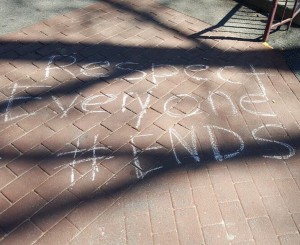
4.13.16 La Salle EASV chalking 2When most people hear the term street harassment, they probably picture of a man whistling at a woman walking down the street, or a man catcalling a woman as he drives by in his car. After all, women make up the majority of street harassment victims and men are most commonly the harassers. According to Stop Street Harassment’s 2014 National Report, 65% of women reported that they had experienced street harassment at some point, and 70% of those respondents said that they had been harassed by one man, while 38% reported being harassed by two or more men. Therefore, I’d be willing to bet that most people don’t picture a man harassing another man or a woman harassing a man when they think about street harassment.

Recently, I posed the following question to my male Facebook friends: Have any of you ever experienced street harassment? I received 9 responses from men stating that they have experienced street harassment before. To put that into perspective, that’s about 13.5% of my male Facebook friends. This is a smaller percentage than the 25% of men who reported that they had experienced street harassment in the 2014 National Report on Street Harassment. However, it is possible that some of my friends who experienced harassment didn’t want to share it, or simply hadn’t seen my question.

Because I hear men’s accounts of street harassment far less frequently than women’s, I wanted to learn more about the experiences of those who responded to my questions. In order to do this, I interviewed most of the men who responded to my question. In conducting these interviews I noticed a few trends.


Every man I interviewed reported being harassed on more than one occasion.

One man I talked to told me that he was harassed twice in the same day – first by teenage girls who yelled, “Hey we wanna suck your dick!” out of their car as he was walking down the street, and later by a man who yelled, “Nice hair, faggot!” at him.

The second experience is also notable because my friend is gay, and the 2014 National Report found that homosexual men are more likely to experience street harassment than heterosexual men, and homophobic slurs were reported to be the most common form of harassment that they experienced.

When I asked another man how often he experiences street harassment, he responded, “A lot. It’s almost commonplace for me so I’ve honestly lost count.”

Therefore, not only do many men experience street harassment, but some experience it on a regular basis.


Many of the men I talked to experienced harassment under circumstances that prevented them from responding sternly, if they had the chance to respond at all.

As I mentioned earlier, one man was harassed twice by people speeding by in cars. Another man, said that he experiences the same thing about once a month when he is outside walking with his girlfriend.

“We’ll be waiting for the light to change and a car will pull up and some teenagers will shout something…a lot of times though, we can’t really tell what they’re saying.”

That same man works in a public place, and described two times that he was harassed while at work. One time, he was bent down sweeping, and a woman walking behind him flirtatiously said, “You can sweep the floor at my house any day.” Because this took place at work, it would be difficult for him to respond assertively.

I believe that people who harass men may choose opportunities like this either because they are more afraid of how a man may respond to harassment, or simply because they enjoy the dominant feeling of being able to harass someone when they are unable to respond.


They experienced both verbal and physical harassment, almost equally.

Although most of the experiences I’ve mentioned so far have been verbal, the men I talked to did share quite a few experiences with physical harassment. One person told me about when he was groped at a restaurant.

“I was at the entrance to a restaurant…and I just felt someone grab my right butt cheek and I thought it was one of my friends messing around, so when I turned around to say stop messing with me right now, I found this girl laughing and asking me if I wanted to dance with her.”

Although he said no, the girl insisted that he dance with her, calling him cute. He walked away from her, but a few minutes later, while he was at an ATM, she approached him again.

“She was like ‘Hey, can I get you a drink?’ and added ‘if you know what I mean…’.”

When he again refused, she called him a “snobby person.”

Another person I talked to shared an experience in which a girl fondled him.

“I was sitting having lunch with a co-worker…one of the girls that works at the ice cream parlor at the local food court stops by to chit chat…Then, I noticed how she began eyeing me up. Next were the comments about me like ‘Damn, boy…,’ followed by her rubbing on my arms and back.”

Fortunately, the girl immediately stopped when he glared at her, but the experience made him very uncomfortable. Which brings me to my final, somewhat obvious, conclusion from the interviews.


Street harassment can make anyone feel violated or annoyed, regardless of their gender or the gender of their harasser.

After each person shared his experiences with me, I asked him how it made him feel. Below are some of the responses.

“Well, confused for sure…it’s just like…why would people say these types of things?”

“It’s more annoying than anything else.”

“Well surprised at the beginning, and she was cute, but she was still a stranger and the whole touching thing was just weird and uncalled for.”

“Awkward and annoyed.”

“Like a piece of eye candy that someone thought they could enjoy. It’s strange being objectified.”

“Highly annoyed.”

“Angry. I wish he got out of his car so he could say that to my face.”

“Grossed out.”

Although women are statistically more often the targets of street harassment, these responses make it clear that the harassment of men is also a serious problem. It is never okay to leer at, verbally objectify, fondle, or otherwise disrespect others, no matter what gender they are. In order to bring more attention to the experiences of both male and female victims, I want to encourage everyone to share their stories on the Stop Street Harassment blog via this Google Form. I believe that discussing these experiences, and listening to all victims, can help the issue of street harassment become more widely acknowledged and hopefully encourage a culture of mutual respect among all.

Kathleen is a full-time graduate student studying professional and business communication. She plans initiatives to increase awareness of sexual assault, domestic violence, and other related issues through her university’s anti-sexual violence group, Explorers Against Sexual Violence.

Share

Filed Under: male perspective, Stories, street harassment

“It happens all the time, day and night”

May 2, 2016 By Contributor

I have been sexually harassed all my life but since I moved from a small village to a city (Stuttgart, Germany), it’s been getting worse. I am the girl-next-door-looking type. I never wear anything revealing.

I can hardly think of a day when I didn’t get any comments about my hair, my eyes, my ass, or whistles from a complete stranger. Some people even try to get really close to me, touch my arm or my hair until I tell them to knock it off and walk away. It only happens when I am alone or with a girl friend. I also had a stalker once who knocked on my window and my door several times and sent me a parcel with sex gadgets.

It makes me feel vulnerable. Like they own me and that they can say whatever they want.

It happens all the time, day and night, and I don’t know how to deal with it.

– CR

Location: Stuttgart, Germany

Share your street harassment story for the blog.
See the book 50 Stories about Stopping Street Harassers for more idea
.

Share

Filed Under: Stories, street harassment Tagged With: germany

End of April 2016 News

April 30, 2016 By HKearl

More recent news:

USA Today, “China introduces female-only bus service“

“A female-only bus service aimed at protecting women from sexual harassment launched this week in China, drawing praise and criticism.

The Zhengzhou 3rd bus company introduced the service on a popular route in the central city of Zhengzhou. It will run during busy commuting hours until early August.

“During the summer, women usually wear thinner clothes, making it easier for them to be harassed in crowded buses. … The all-female service will increase their convenience and safety,” said Kong Chaoping, the firm’s chairman, according to the Beijing Youth Daily newspaper.

The buses are recognizable by their big red signs that read, “Female-only.” They have stuffed animals and other kids’ toys suspended from the ceiling.

Sexual harassment is a common yet largely ignored problem on China’s public transportation system. More than 50% of women have experienced inappropriate touching or body contact while using the country’s trains and buses, a survey by the China Youth Daily newspaper found last year.

In 2014, the Women’s Federation of Guangzhou, a state-affiliated group, found that 85% of all sexual assaults in Guangzhou, a city in southern China, occurred while victims used the city’s public transportation network.”

Quartz, “Thousands of Mexican women are talking about sexual harassment for the first time“

“Rarely publicly acknowledged in Mexico, sexual harassment is being surfaced via Twitter hashtag #MiPrimerAcoso, or #MyFirstHarassment, by women posting their first experiences with male bullying and by others wanting to have an open discussion. Hundreds of thousands of posts have circulated in the last three days.

The drive, started by a Colombian columnist (link in Spanish) on Saturday, is reinforcing the issue after demonstrations Sunday (April 24) in Mexico City and other major cities attracted thousands of women. The Twitter record, a poignant collection of heartfelt confidences, will probably prove more powerful…

#MiPrimerAcoso reveals that many women first experienced harassment as girls, as young as five and six years old. The perpetrators of the abuse span a wide range, from relatives—older cousins and uncles are mentioned frequently—to policemen, to random strangers, and in one case, a therapist.”

Waging Nonviolence, “Mexican feminists declare a ‘violet spring’ on nationwide day of action“

“Tens of thousands of feminists protested across Mexico on Sunday, amid what they say is an epidemic of violence against women.

“We’re sick of suffering all kinds of abuse when we just walk in the street,” said Mari, a protester in the central Mexican city of Puebla, who was joined by hundreds of activists in Puebla’s city center, demanding justice for victims of femicide.

When the march reached the state government offices, activists accused local authorities of failing to bring perpetrators of violence to justice. One masked protester shouted, “The government here in Puebla lets them get away with impunity,” adding, “This isn’t just in Puebla, but all of Mexico.”

Declaring a “violet spring,” protesters called on women across Mexico to take a stand against sexism. One of the largest protests took place in Mexico City, where organizers railed against Mexico’s traditionally machista, or sexist, culture.

“It is evident that we need social re-education — to teach men not to harass, not violate, not hit, not threaten, not enslave, not abuse and not kill women and girls,” organizers said in a statement.”

The Verge, “India mandates panic button on all phones to help keep women safe“

“All mobile phones sold in India will be required to have a panic button as of next year, the country’s telecommunications ministry announced this week, as part of an effort to enhance safety for women. As Bloomberg reports, the order requires handset makers to implement an emergency feature that could be activated by holding down the numbers 5 or 9 on a keypad. The function will be mandatory on all phones by January 1st, 2017, while GPS navigation systems will be mandatory on all devices by 2018.

Women’s safety in India has drawn worldwide attention following reports of gang rapes and other forms of violence. There were more than 330,000 reported cases of violence against women in 2014, according to government statistics, up 9 percent from the previous year. The issue has spurred some companies to develop apps and services that make it easier for women to contact emergency services. India’s minister for women and child development, Maneka Gandhi, pushed for mandated panic buttons last year.”

‘Technology is solely meant to make human life better and what better than using it for the security of women,’ Communications Minister Ravi Shankar Prasad said in a statement.”

attn: “This Man’s Attempt to Take Upskirt Photos Just Backfired in an Extreme Way“

“A shocking piece of footage, in which a man eats his camera’s memory card after being caught allegedly filming upskirt videos, is gaining international attention.

According to the Chinese Publication People’s Daily, the video was filmed by a woman caught the alleged Peeping Tom in the act while riding the subway. The woman who shot the footage goes by the name Xiao Cha Cha A, Daily Mail reports. She posted the video on the Chinese social media service Weibo, with a caption reading, “I had tried to block his view a few times but he kept on taking them. I must expose him!”

In the video, the Xiao Cha Cha A is seen tugging at the man’s bag, and yelling, “delete the pictures, delete them. Look everybody, here is a pervert who takes upskirt pictures of women,” Daily Mail reports.

The man then eats his SD card. It is unclear if the woman forces him to do so, or if he eats the card voluntarily to destroy the evidence. In the final seconds of the 1:01-long video, the man can be seen fleeing the subway car.”

The Source, “[Los Angeles] Metro’s new anti-sexual harassment video“

“Metro launched its “Off Limits” campaign last spring in an effort to reduce sexual harassment on buses and trains. The campaign was a direct response to riders identifying this as an issue in Metro’s customer surveys.”

Share

Filed Under: News stories Tagged With: china, India, los angeles, mexico, phone app, public transit

« Previous Page
Next Page »

Share Your Story

Share your street harassment story for the blog. Donate Now

From the Blog

  • #MeToo 2024 Study Released Today
  • Join International Anti-Street Harassment Week 2022
  • Giving Tuesday – Fund the Hotline
  • Thank You – International Anti-Street Harassment Week 2021
  • Share Your Story – Safecity and Catcalls Collaboration

Buy the Book

Search

Archives

  • September 2024
  • March 2022
  • November 2021
  • April 2021
  • March 2021
  • January 2021
  • April 2020
  • March 2020
  • February 2020
  • December 2019
  • November 2019
  • September 2019
  • August 2019
  • July 2019
  • June 2019
  • May 2019
  • April 2019
  • March 2019
  • February 2019
  • January 2019
  • December 2018
  • November 2018
  • October 2018
  • September 2018
  • August 2018
  • July 2018
  • June 2018
  • May 2018
  • April 2018
  • March 2018
  • February 2018
  • January 2018
  • December 2017
  • November 2017
  • October 2017
  • September 2017
  • August 2017
  • July 2017
  • June 2017
  • May 2017
  • April 2017
  • March 2017
  • February 2017
  • January 2017
  • December 2016
  • November 2016
  • October 2016
  • September 2016
  • August 2016
  • July 2016
  • June 2016
  • May 2016
  • April 2016
  • March 2016
  • February 2016
  • January 2016
  • December 2015
  • November 2015
  • October 2015
  • September 2015
  • August 2015
  • July 2015
  • June 2015
  • May 2015
  • April 2015
  • March 2015
  • February 2015
  • January 2015
  • December 2014
  • November 2014
  • October 2014
  • September 2014
  • August 2014
  • July 2014
  • June 2014
  • May 2014
  • April 2014
  • March 2014
  • February 2014
  • January 2014
  • December 2013
  • November 2013
  • October 2013
  • September 2013
  • August 2013
  • July 2013
  • June 2013
  • May 2013
  • April 2013
  • March 2013
  • February 2013
  • January 2013
  • December 2012
  • November 2012
  • October 2012
  • September 2012
  • August 2012
  • July 2012
  • June 2012
  • May 2012
  • April 2012
  • March 2012
  • February 2012
  • January 2012
  • December 2011
  • November 2011
  • October 2011
  • September 2011
  • August 2011
  • July 2011
  • June 2011
  • May 2011
  • April 2011
  • March 2011
  • February 2011
  • January 2011
  • December 2010
  • November 2010
  • October 2010
  • September 2010
  • August 2010
  • July 2010
  • June 2010
  • May 2010
  • April 2010
  • March 2010
  • February 2010
  • January 2010
  • December 2009
  • November 2009
  • October 2009
  • September 2009
  • August 2009
  • July 2009
  • June 2009
  • May 2009
  • April 2009
  • March 2009
  • February 2009
  • January 2009
  • December 2008
  • November 2008
  • October 2008
  • September 2008
  • August 2008
  • July 2008
  • June 2008
  • May 2008

Comment Policy

SSH will not publish any comment that is offensive or hateful and does not add to a thoughtful discussion of street harassment. Racism, homophobia, transphobia, disabalism, classism, and sexism will not be tolerated. Disclaimer: SSH may use any stories submitted to the blog in future scholarly publications on street harassment.
  • Contact
  • Events
  • Join Us
  • Donate
  • Facebook
  • Instagram
  • Pinterest
  • Tumblr
  • Twitter
  • YouTube

Copyright © 2026 Stop Street Harassment · Website Design by Sarah Marie Lacy