• About Us
    • What Is Street Harassment?
    • Why Stopping Street Harassment Matters
    • Meet the Team
      • Board of Directors
      • Past Board Members
    • In The Media
  • Our Work
    • National Street Harassment Hotline
    • International Anti-Street Harassment Week
    • Blog Correspondents
      • Past SSH Correspondents
    • Safe Public Spaces Mentoring Program
    • Publications
    • National Studies
    • Campaigns against Companies
    • Washington, D.C. Activism
  • Our Books
  • Donate
  • Store

Stop Street Harassment

Making Public Spaces Safe and Welcoming

  • Facebook
  • Instagram
  • Pinterest
  • Tumblr
  • Twitter
  • YouTube
  • Home
  • Blog
    • Harassment Stories
    • Blog Correspondents
    • Street Respect Stories
  • Help & Advice
    • National Street Harassment Hotline
    • Dealing With Harassers
      • Assertive Responses
      • Reporting Harassers
      • Bystander Responses
      • Creative Responses
    • What to Do Before or After Harassment
    • Street Harassment and the Law
  • Resources
    • Definitions
    • Statistics
    • Articles & Books
    • Anti-Harassment Groups & Campaigns
    • Male Allies
      • Educating Boys & Men
      • How to Talk to Women
      • Bystander Tips
    • Video Clips
    • Images & Flyers
  • Take Community Action
  • Contact

USA: Harmful Oklahoma Court Ruling

April 29, 2016 By Correspondent

Rupande Mehta, New Jersey, USA SSH Blog Correspondent

It was a good and bad week for victims of sexual assault and rape. While former House Speaker Hastert was being sentenced to 15 months (yup, only 15 months after the judge declared him a “serial child molester”) for molesting young boys when he coached as a wrestler, the Oklahoma court shocked everyone with the declaration that state law does not criminalize oral sex with a victim who is completely unconscious.

Right, why didn’t we think of that? An unconscious person is completely capable of giving consent so why prosecute someone who took advantage of the VERY fact that the victim was unconscious and orally sodomized her?

I have to be brutally honest here: some days the fight to make folks understand what constitutes violation of a person’s body seems so hopeless. On days like these, I feel I am transported to the hell holes of Pakistan, India and other countries where rape and other forms of violence against women is a daily fact of life. My mind cannot accept the fact that a verdict of that magnitude was issued by a court in the United States. It seems like the work of moron village elders and other local leaders, who need five witnesses to prove a rape, not that of a judicial body in the United States.

I can’t even comprehend the idiocy of this court. And I don’t even know where to begin.

This is not the court’s fault…not ONLY their fault. This is a system-wide issue that takes pride in victim-blaming. Every day we hear about assault, rape and other forms of violence like street harassment, but the question that takes center stage is “what was she doing” instead of “why did he abuse”?

We as a society have culturally evolved to the point where violence is acceptable if we can shift the onus on the victim. We look for loopholes in her story – why was she there? Who did she go with? What was she wearing? Or as John Kasich famously said, don’t drink at parties so you don’t get raped. I can’t wait for his 16 –year-old twin girls to get to college and avoid parties because their father warned them they could get raped.

We live in a society that victim blames and no one is a better example of this than our judicial system. We let lawyers question victims about abuse in a manner that befits no living being in this world. We sit back and enjoy every tiny detail re-lived by the victim over and over again and then turn around and tell her that her story has holes in it because she cannot remember every single ghastliness that happened to her. We sit back and let lawyers badger victims, not considering their emotional abuse and high levels of trauma that prevent them from being consistent in their narration. We live in a society where it is acceptable to yell and scream at people who have been abused but not okay for someone to falter in their responses. We have made our society into a mockery of human values devoid of empathy, understanding and respect of one’s experiences; instead delving into painful details where even accurate chronicles result into justice failing them at the end of the day.

Our focus is on the victim and what they did or didn’t do right. Did you say no? Did you scream? Why not? If not, how can we believe you were being raped? Or in this Oklahoma case, you were passed out so you could not have said no. But what about her not saying yes either?

This level of victim blaming is nauseating. Besides a severe gap between ideas of rape and consent and appropriate laws, there is a lack of basic understanding of what consent is. And asinine rulings such as the Oklahoma case further propagate a society where such behavior becomes the norm.

We are all responsible for this hideous culture – a social order where women are constantly assessed on how well they defended themselves against harm, how deftly they handled a street harassment situation or whether they made a big deal of the assault at the time it was happening. As far as the abuser is concerned, we are waiting to give them a free pass or sympathize and excuse him the moment a woman cannot fill all holes in her story.

Consent is simple: Yes means yes and No means no. If a person is too drunk, they CANNOT give consent. Consequently, if they are passed out; the question of consent does not even arise. This is a very simple concept but many of us, including the learned individuals on the Oklahoma court, cannot grasp it. Whichever way we look at it, it is time to change the way the rules are written; ones which do not look to place the blame on the victim but on the one who committed the crime. It is time the law takes into account emotional abuse, trauma and, of course, the unequivocal definition of consent.

Rupande grew up in Mumbai, India, and now resides in the U.S. She has an MBA and is currently working towards her MPA, looking to specialize in Non Profit Management. You can find her writing on her blog at Rupande-mehta.tumblr.com or follow her on Twitter @rupandemehta.

Share

Filed Under: correspondents Tagged With: oklahoma victim blaming, rape, unconscious

“What could have been demoralizing turned out to be invigorating”

April 28, 2016 By Contributor

One morning I was late to work and had to park far away as all the other employees had taken the nearest spaces. As I exited my vehicle, I noticed two white boys across the street, reminiscent of Beavis and Butthead. I knew they were going to say something.

The first time he said something, I didn’t understand it, so I asked him to repeat it.

“I wanna lick your poop chute” and then he did that thing with his tongue that the truck driver in “Thelma & Louise” did.

His cartoonish companion chuckled and maneuvered in a slightly menacing way to demonstrate that he had his bro’s back.

I’m not sure what overcame me, but I feel like my subconscious picked up on several clues that prompted me to take bold action. I noticed the landscaping of 10lb stones covering the ground around their feet. I noticed the sudden lack of traffic on the one way street between us. And I noticed their likely cowardice in the face of unexpected retribution.

Without saying anything, I marched across the street. His demeanor changed to recoil as he meekly inquired, “What are you doing?” I picked a choice stone from the ground, turned and heaved it in his direction, shot put-style. In my mind I thought if I hit him with this large rock, he’s especially dull, so I almost did care if I had, but he dodged it at the last second and took off running up the street yelling, “YOU’RE CRAZY!!”

I responded with, “Come back you coward! Come back and say something else to me!” But he was off to the races. It was funny how quickly he ran.

As I turned around, quite satisfied, to head back to work, I passed his male companion and hawked a loogie in his direction. Contorting his back, he dodged it. By the time I made it to my street a block away, Beavis was STILL running, nearly half a mile away.

This was risky in a lot of ways, I know. But my intuition led me in the right direction. It all happened so quickly and I left feeling quite powerful. Had I not responded in that way, I would have been bothered by it for the rest of the day. To my surprise, my coworkers were quite insightful about how I was bullied and how Beavis and Butthead were trying to intimidate me. Normally people don’t approve of women taking the offensive. What could have been demoralizing turned out to be invigorating.

– Sara F.

Location: Denver, CO

Share your street harassment story for the blog.
See the book 50 Stories about Stopping Street Harassers for more idea
.

Share

Filed Under: Stories, street harassment Tagged With: empowering response, fighting back

“I think that man is recording me with his cellphone”

April 27, 2016 By Contributor

So… I went to the clinic with my mom. We entered a tunnel and we saw a man running behind us. He passed us and turned his head to look at us… He got to the clinic first and just stood there until we got there and he saw us enter and so he did as well.

He sat in front of us. The man had a cellphone and its camera was pointing at my face. I noticed and didn’t say anything because i thought i was being paranoid. so i started to read, not paying attention to him, but time passed and the camera was still pointing at me. i told my mom i will switch seats without giving any reason, so I did and then  I was next to him so he couldn’t record me.

Suddenly he starts “receiving” calls and he places his cellphone in the left ear and his camera (surprisingly) is pointing at me again. So, my mom sits with me and I tell her, “I think that man is recording me with his cellphone.”

She changes her face totally, then looks at the man (in his 40s or 50s) and pulls out her cellphone. She starts recording and tries to point the camera at him. She tries to record him but i notice she’s nervous and we got called by the doctor exactly at the moment her camera was pointed at him. So he noticed.

We had our consult and when we got out the man wasn’t there anymore. I was shaking. We kept searching in the street for any suspicious man, but we didn’t see any. We got on the bus and i just stared at every man but we didn’t see anything weird.

I was shocked, when I got home and I started crying. I couldn’t stop crying and my mom talked to me. My dad said, “It was just a creep, don’t worry honey” and my brother hugged me.

I just can’t stop thinking about it, about what the hell was that man thinking. The whole situation is just so frightening, it was disturbing.

– C

Location: Mexico

Share your street harassment story for the blog.
See the book 50 Stories about Stopping Street Harassers for more idea
.

Share

Filed Under: Stories, street harassment

USA: Gender Essentialism, Engaging Men in Sexual Assault Awareness, & Walk a Mile in Her Shoes©

April 27, 2016 By Correspondent

By LB Klein, Jen Przewoznik, & Jeff Segal

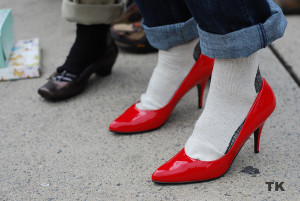
3973726431_718ce14cc5_bEvery April, for Sexual Assault Awareness Month (SAAM), men all over the country stumble through public parks in high heels to raise awareness for the gender-based violence movement. Walk a Mile in Her Shoes© has been a staple of SAAM programming since 2001, and has been touted as “a world-wide movement” engaging “tens of thousands of men” in conversations on difficult topics like gender, power, and sexual assault in an accessible and fun way.
Men have embraced Walk a Mile in Her Shoes© – it’s very often the most well-attended SAAM event by men, and its popularity has helped raise tremendously needed funds for rape crisis centers and other anti-violence organizations nationally and internationally. However, many activists and organizers have begun to voice serious concerns over the popular event.

It is vital that we consider not only the intent but the impact of our sexual assault awareness events. In Walk a Mile in Her Shoes©, men step into high heels to show their solidarity with women. High heels are therefore held as emblematic of “women.” But while some women wear high heels, many women do not, and furthermore, women are often targeted specifically because they express themselves outside of the normative societal expectations of their gender. By equating high heels with “women,” we remove gender non-conforming women from our conversations about sexual violence entirely, and reinforce the common myth that people who present in ways that are considered masculine are not vulnerable to violence. Walk a Mile in Her Shoes© positions women as victims and men as perpetrators, but we need to also acknowledge that there are survivors of all gender identities, including men.

Walk a Mile in Her Shoes© also creates spaces that further marginalize transgender people. Forge, a national transgender rights organization, says activists should consider “whether they are re-victimizing more than a third of all victims by ignoring their very existence.” According to the National Transgender Discrimination Survey, 64% of transgender people have been sexually assaulted in their lifetime. Transgender women are often incorrectly and offensively described as “men wearing women’s clothing,” which is often used to justify violence against them. Transgender women, especially those of color, face not only an incredibly disproportionate risk of experiencing sexual and intimate partner violence but also street harassment, police brutality, homelessness, joblessness, incarceration, and murder. It is vital for people working to end gender-based violence to closely ally with transgender and non-binary people instead of holding events that exclude and further marginalize them.

It is evident that Walk a Mile in Her Shoes© has raised attention, awareness, and funds, but at what expense? We cannot afford to raise awareness by perpetuating an essentialist view of what people should wear, how they should look, act, and be. The Walk a Mile in Her Shoes© narrative is accessible because it is reductive, and oversimplification in our work is, quite literally, dangerous. Of course, communities should still hold awareness raising events, but we must be intentional about changing the exact norms that perpetuate violence instead of reinforcing them. Events that re-victimize, erase, or marginalize survivors in their very concept do not have a place in our field.

So, what else can we do instead to engage men during SAAM?

We can hold events that encourage folks of all genders working together. We can bring smaller groups of men together for meaningful conversation or larger groups for fundraisers that are not built around reinforcing harmful gender norms. Perhaps, as Forge suggests, we should hold events that encourage everyone to break stereotypes about gender and discuss how harmful gender norms perpetuate violence. Then, we will be raising awareness of the true message of the movement to end sexual assault: that to end sexual assault, we must change culture.

LB Klein, MSW has dedicated her professional and academic life to ending gender-based violence, supporting survivors, and advancing social justice. She is a Consultant and Lead Trainer for Prevention Innovations Research Center at the University of New Hampshire. She is based in Atlanta, GA and will begin pursuing a doctorate in the School of Social Work at the University of North Carolina at Chapel Hill this August.

Jen Przewoznik, MSW has over 15 years of experience working with/in women’s and LGBTQ communities as an educator, trainer, technical assistance provider, practitioner, and programevaluator. She is founder of the Queer Research Consulting Collaborative, a project designed to consult with researchers studying LGBTQ issues. Jen is currently the Director of Prevention & Evaluation at the North Carolina Coalition Against Sexual Assault and co-chairs the NC Sexual Violence Prevention Team and the NC Campus Consortium.

Jeff Segal, BS resides in NYC, where he works in the tech sector and moonlights as a professional dancer. He has been a part of the movement to end sexual violence for ten years. Jeff has four years of experience as a sexual violence crisis counselor, and currently is leading initiatives to make social dancing in New York a safer space.

Share

Filed Under: correspondents Tagged With: engaging men, male allies, Sexual Assault Awareness Month, walk a mile in her shoes

#DoYouKazoo Anti-Street Harassment Action by #BreakthroughCatalysts

April 26, 2016 By Contributor

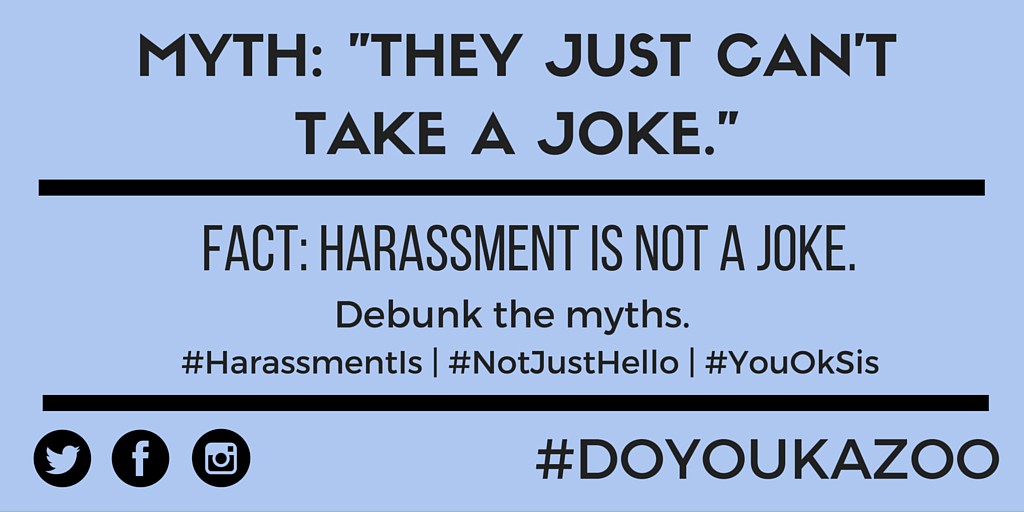
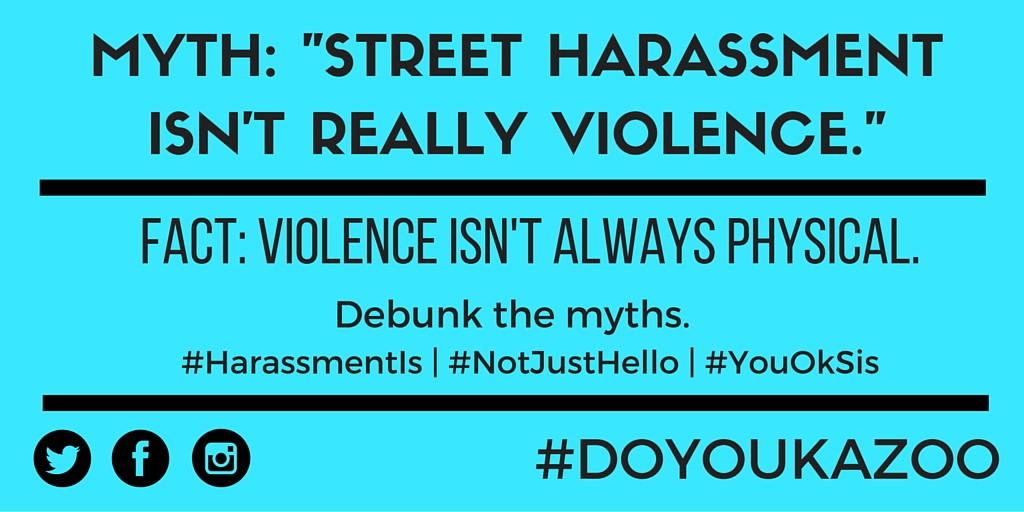
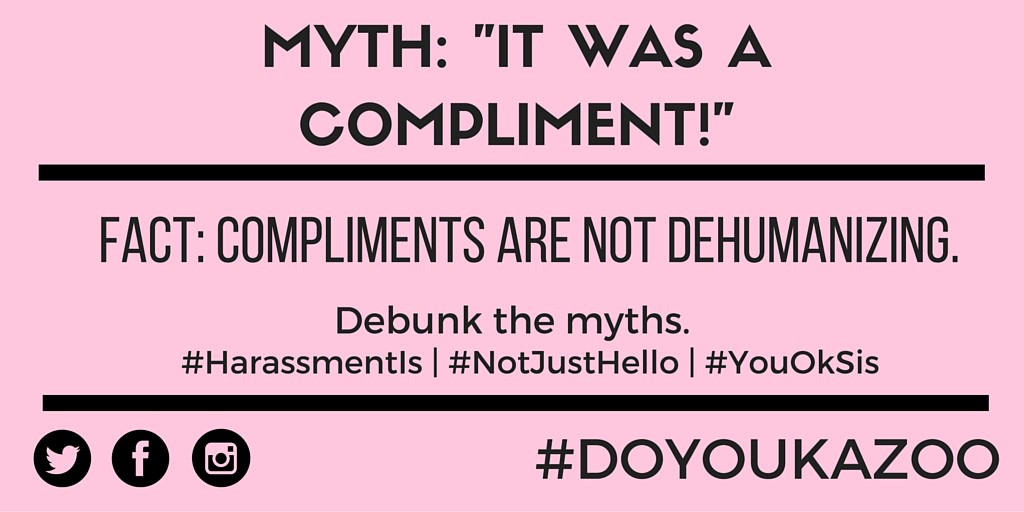
Prepare Inc. - Debunk Myths 5A committed group of people, brought together by Breakthrough Catalyst trainings, strive to use collective knowledge, energy, connections and commitment to end/reduce street harassment through cultural change. Breakthrough Catalysts and friends want to help raise awareness and promote a culture shift that discredits common street harassment myths and provide easy and effective responses to invalidate them with our posters and social media. We stand in solidarity with other organizations and individuals during Sexual Assault Awareness Month and Anti-Street Harassment Week, from April 10th to 16th, 2016.
Prepare Inc. - Debunk Myths 3We chose the symbol and sound of a Kazoo to promote the idea that tools work best to call out rape culture and myths about gender violence, not to prevent it. The use of the Kazoo is inspired by a joke by comic Cameron Esposito, who wishes for a rape Kazoo instead of a rape whistle, in the hopes that its sound is more appealing and will garner help if she is attacked.
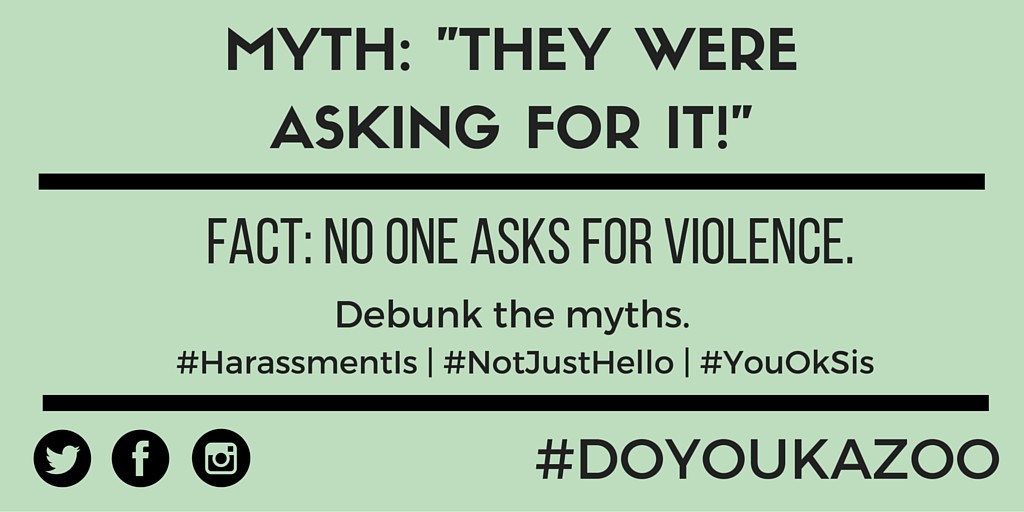
Prepare Inc. - Debunk Myths 4Key concepts:

  • Reinventing the “rape whistle” as a Kazoo
  • “Sounding the alarm” about the issue of street harassment
  • Changing culture through positive humor (vs. put-down humor) as Kazoos are often thought of as whimsical, fun, non-serious musical instruments anyone can play. Kazoos have a history of use as tools of social protest.

Feel free to use and share these images with the hashtag #DoYouKazoo!

Prepare Inc. - Debunk Myths

Karen Chasen is the Vice President of Prepare Inc.

Share

Filed Under: anti-street harassment week, Resources, street harassment Tagged With: breakthrough, campaigns, doyoukazoo, street harassment

« Previous Page
Next Page »

Share Your Story

Share your street harassment story for the blog. Donate Now

From the Blog

  • #MeToo 2024 Study Released Today
  • Join International Anti-Street Harassment Week 2022
  • Giving Tuesday – Fund the Hotline
  • Thank You – International Anti-Street Harassment Week 2021
  • Share Your Story – Safecity and Catcalls Collaboration

Buy the Book

Search

Archives

  • September 2024
  • March 2022
  • November 2021
  • April 2021
  • March 2021
  • January 2021
  • April 2020
  • March 2020
  • February 2020
  • December 2019
  • November 2019
  • September 2019
  • August 2019
  • July 2019
  • June 2019
  • May 2019
  • April 2019
  • March 2019
  • February 2019
  • January 2019
  • December 2018
  • November 2018
  • October 2018
  • September 2018
  • August 2018
  • July 2018
  • June 2018
  • May 2018
  • April 2018
  • March 2018
  • February 2018
  • January 2018
  • December 2017
  • November 2017
  • October 2017
  • September 2017
  • August 2017
  • July 2017
  • June 2017
  • May 2017
  • April 2017
  • March 2017
  • February 2017
  • January 2017
  • December 2016
  • November 2016
  • October 2016
  • September 2016
  • August 2016
  • July 2016
  • June 2016
  • May 2016
  • April 2016
  • March 2016
  • February 2016
  • January 2016
  • December 2015
  • November 2015
  • October 2015
  • September 2015
  • August 2015
  • July 2015
  • June 2015
  • May 2015
  • April 2015
  • March 2015
  • February 2015
  • January 2015
  • December 2014
  • November 2014
  • October 2014
  • September 2014
  • August 2014
  • July 2014
  • June 2014
  • May 2014
  • April 2014
  • March 2014
  • February 2014
  • January 2014
  • December 2013
  • November 2013
  • October 2013
  • September 2013
  • August 2013
  • July 2013
  • June 2013
  • May 2013
  • April 2013
  • March 2013
  • February 2013
  • January 2013
  • December 2012
  • November 2012
  • October 2012
  • September 2012
  • August 2012
  • July 2012
  • June 2012
  • May 2012
  • April 2012
  • March 2012
  • February 2012
  • January 2012
  • December 2011
  • November 2011
  • October 2011
  • September 2011
  • August 2011
  • July 2011
  • June 2011
  • May 2011
  • April 2011
  • March 2011
  • February 2011
  • January 2011
  • December 2010
  • November 2010
  • October 2010
  • September 2010
  • August 2010
  • July 2010
  • June 2010
  • May 2010
  • April 2010
  • March 2010
  • February 2010
  • January 2010
  • December 2009
  • November 2009
  • October 2009
  • September 2009
  • August 2009
  • July 2009
  • June 2009
  • May 2009
  • April 2009
  • March 2009
  • February 2009
  • January 2009
  • December 2008
  • November 2008
  • October 2008
  • September 2008
  • August 2008
  • July 2008
  • June 2008
  • May 2008

Comment Policy

SSH will not publish any comment that is offensive or hateful and does not add to a thoughtful discussion of street harassment. Racism, homophobia, transphobia, disabalism, classism, and sexism will not be tolerated. Disclaimer: SSH may use any stories submitted to the blog in future scholarly publications on street harassment.
  • Contact
  • Events
  • Join Us
  • Donate
  • Facebook
  • Instagram
  • Pinterest
  • Tumblr
  • Twitter
  • YouTube

Copyright © 2026 Stop Street Harassment · Website Design by Sarah Marie Lacy