• About Us
    • What Is Street Harassment?
    • Why Stopping Street Harassment Matters
    • Meet the Team
      • Board of Directors
      • Past Board Members
    • In The Media
  • Our Work
    • National Street Harassment Hotline
    • International Anti-Street Harassment Week
    • Blog Correspondents
      • Past SSH Correspondents
    • Safe Public Spaces Mentoring Program
    • Publications
    • National Studies
    • Campaigns against Companies
    • Washington, D.C. Activism
  • Our Books
  • Donate
  • Store

Stop Street Harassment

Making Public Spaces Safe and Welcoming

  • Facebook
  • Instagram
  • Pinterest
  • Tumblr
  • Twitter
  • YouTube
  • Home
  • Blog
    • Harassment Stories
    • Blog Correspondents
    • Street Respect Stories
  • Help & Advice
    • National Street Harassment Hotline
    • Dealing With Harassers
      • Assertive Responses
      • Reporting Harassers
      • Bystander Responses
      • Creative Responses
    • What to Do Before or After Harassment
    • Street Harassment and the Law
  • Resources
    • Definitions
    • Statistics
    • Articles & Books
    • Anti-Harassment Groups & Campaigns
    • Male Allies
      • Educating Boys & Men
      • How to Talk to Women
      • Bystander Tips
    • Video Clips
    • Images & Flyers
  • Take Community Action
  • Contact

“The frustration just builds up inside”

April 23, 2016 By Contributor

Street harassment happens a lot where I live (Newcastle, UK). This story isn’t about a time I was harassed, it’s about when I realised how bad the problem actually is.

Over the 4 or 5 years that I’ve lived here, I’ve been told to smile more times than I can remember.

A man once drove onto the pavement and tried to get me into his car.

Men in vehicles have slowed right down to have a better look at me (including a uniformed UPS driver and a Gateshead Council van).

A pedestrian stuck his head in my car.

Other drivers have slowed down, making sexual gestures at me.

Men have told me they’d like to “slip their cocktail in my vagina” that I’ve got “a weird arse” and “a nice body but it’s a shame about the face.”

Men have randomly shouted “pussy” at me.

Men have blocked my path.

Men have followed me down the street.

I am beeped at by men in passing cars pretty much every time I leave the house.

The other day a man catcalled as I was unlocking my front door. The last one scared me a lot as this creep now knows where I live, what I drive, and what time I come home.

I try to let it go, but I feel so powerless. I want to hit them, to throw rocks at their cars, but I know I’d be the one who ends up in trouble with the police if I did. The frustration just builds up inside.

A week or so ago I’d had a busy few days and was feeling hungry and tired. I didn’t have much to eat, so I thought I’d take a walk to the shops. Then I didn’t, because I just didn’t have the strength to let another attack go, and I knew there was a really high chance of something happening if I went out.

That hit HARD. I called for takeout instead. And cried.

Optional: What’s one way you think we can make public places safer for everyone?

Specifically criminalise non-physical harassment like shouting, beeping and name calling.

– SA

Location: Newcastle, UK

Share your street harassment story for the blog.
See the book 50 Stories about Stopping Street Harassers for more idea
.

Share

Filed Under: Stories, street harassment

#NoEsMiCultura: Latin America join forces to launch the first continental campaign against Street harassment

April 22, 2016 By HKearl

Mapa-OCAC-LATAMThe following was provided by OCAC Chile.

En el marco de la Semana Internacional Contra el Acoso Callejero, Latinoamérica se une por primera vez para lanzar una campaña de alcance regional contra el acoso sexual en espacios públicos. La campaña #NoEsMiCultura es organizada por la red de Observatorios Contra el Acoso Callejero (OCAC) de Bolivia, Chile, Colombia, Costa Rica, Guatemala, Nicaragua y Uruguay. Su objetivo es concientizar y visibilizar el acoso callejero como un problema que se sufre en todo el continente.

Durante la Semana Internacional Contra el Acoso Callejero, las sedes de OCAC Latinoamérica realizarán actividades para educar, sensibilizar y erradicar la idea que el acoso sexual en espacios públicos es parte de un folclore y típico de los países. La idea es transmitir que, más bien, es un problema transversal. Esta premisa se difunde en un video y en contenido en las redes sociales de la red de Observatorios.

“Queremos que en cada país se deje de justificar el acoso callejero como parte de la cultura local, queremos que se sepa que el acoso sexual callejero es un problema global y que nos afecta como región. Sabemos que nuestras voces unidas tienen más fuerza, por eso trabajamos articuladas para aprender unas de las experiencas de las otras. Hacemos entre los OCAC y también buscamos hacer redes con otras ONGs a nivel internacional”, señaló Alice Junqueira, Directora de Articulación Internacional de OCAC Chile.

Además de esta primera acción conjunta, en los últimos meses, cada Observatorio ha realizado acciones a nivel local. Junqueira destaca el proyecto de Ley contra el acoso callejero aprobado por la cámara de diputados en Chile, la campaña entre Action Aid y OCAC Nicaragua, la caja de herramientas que prepara OCAC Colombia, los talleres municipales de OCAC Uruguay, la articulación por una ley contra el acoso callejero de OCAC Costa Rica y los videos de sensibilización de OCAC Bolivia y OCAC Guatemala.

In English

In the context of the International Anti-Harassment Week, Latin America joined forced to launch the first regional campaign against sexual harassment in public places. #NoEsMiCultura [#NotMyCulture] is a campaign organized by the Observatories Against Street Harassment (OCAC, in Spanish) of Bolivia, Chile, Colombia, Costa Rica, Guatemala, Nicaragua and Uruguay. Its aim is to raise awareness and make street harassment visible as a problem in the whole continent.

During the International Anti-Harassment Week, the six OCAC branches developed activities to educate, create awareness and eradicate the idea of sexual harassment in public places as part of folklore or as a typical expression of each country. The idea is to communicate that street harassment is a transversal problem.

“We want each country to stop justifying street harassment as part of their local culture. We want the people to know that street harassment is a global problem that affect us as a region. We know that our voices together are stronger, so we work organized to learn from each other’s experiences. We do that as OCAC Latin America and with other NGOs all around the world.” said Alice Junqueira, International Coordinator from OCAC Chile.

Additionally to this first joint action, in the last months, each Observatory has done initiatives in a local level. Junqueira highlights the bill “Respeto Callejero” [Street Respect] against street harassment in Chile, the local campaign between Action Aid and OCAC Nicaragua, the tool box that OCAC Colombia is preparing, the municipal workshops held by OCAC Uruguay, OCAC Costa Rica’s activism for a bill against street harassment in the country, and the videos to raise awareness by OCAC Bolivia and OCAC Guatemala.

Share

Filed Under: anti-street harassment week, Resources Tagged With: Bolivia, chile, colombia, Costa Rica, Guatemala, LatAm, uruguay

“I was extremely confused and a little scared”

April 22, 2016 By Contributor

I was about 18 when this happened and still in high school. I lived close to the school so I walked to and from it.

Well, one day I was walking along, just minding my own business There were a few boys ahead of me who were being really slow, so I went around them as I was walking. Well, one of them threw a glass bottle at me and it shattered on the road maybe an inch away from my feet.

I was extremely confused and a little scared because I had no idea that merely walking in front of someone could justify a reaction like that.

Luckily, a classmate had seen what happened and she stopped her car next to me to give me a ride home.

Optional: What’s one way you think we can make public places safer for everyone?

We need better awareness People need to be told about this and need to learn that behavior like that is not acceptable.

– MB

Location: Illinois

Share your street harassment story for the blog.
See the book 50 Stories about Stopping Street Harassers for more idea
.

Share

Filed Under: Stories, street harassment

That Time We Spoke About Street Harassment on the Nicaraguan Radio

April 21, 2016 By HKearl

Cross-posted from The Vulnerable Traveler with permission from the author Char J. Stoever.

Last week, I walked to the Women’s Collective of Matagalpa, which I’ve been to multiple times for their spontaneous theater shows. The collective has a theater program, health and education outreach, and a radio station.

April is Sexual Assault Awareness month. April 10-16 is International Anti-Street Harassment Week, so I thought I’d see if the collective was having an event to raise awareness. I’d just written about kick-ass organizations in Egypt, Mexico, the U.S., and India fighting against street harassment, so I thought I’d ask.

I asked Machú, a woman who works there and documents all of the spontaneous theater shows. “No, we haven’t planned anything, but maybe you could talk to Argentina. She’s running the radio program right now since Leo is in Europe on the theater tour.”

Fanny, one of my the most expressive, lively actresses, happened to be there and listened in. She said hello to me with the typical kiss on the cheek and jokingly said, “Hi, Charlotte-I mean, Charleen!” because it took her a while to get my name right. We giggled, then she walked me over to the radio station, where I spoke with Argentina about my spontaneous question-turned-project.

“We don’t have anything planned to raise awareness, but street harassment happens every day, not just one week of the year. I can reserve a slot for you to come chat at 8 AM on Monday if you’d like. It would be good if you brought a friend who is from here.” I agreed that it would be important for a Nicaraguan woman to talk about it, so I called my friend Rosa right away. She agreed to send her daughter, Amy, whose quinceañera (15th birthday party) my mom and I attended last Christmas Eve.

Fanny’s son, Marlon, was also there, and I asked if he could come. He agreed because street harassment affects everyone, not just women. In November 2015, Gerardo Cruz was stabbed and killed in San José, Costa Rica after he caught a perverted man following a woman from behind and filming up her skirt. The video went viral, but he lost his life for speaking against street harassment.

https://www.youtube.com/watch?v=MbYxRwqNIoA

Street harassment affects everyone. It’s so important to talk to boys as well as girls about actions that dismantle gender equity. These kinds of workshops will be done at Peace Corps Camp CHACA for boys in Nicaragua this July.

Street harassment also hurts economies. I often wonder how much more tourism dollars a country’s people could earn if women weren’t afraid of traveling because of feeling uncomfortable in public. I’ve decided against traveling down the street or to different countries because I don’t want to be hissed at or groped in public.

On Monday, I walked with Amy to The Collective. “Are you nervous to be on the radio?” I asked her. “No,” she said. “Well, I am! I’m glad you’re not nervous. What you’re doing is so important because many people don’t have a chance to share their opinions and to be heard. I’m nervous, but excited” I replied. I’d been on the radio before in Ecuador when I went with La Poderosa Media Project in 2011, but that time, I just spoke about who I was and where I was from. This time, it would be a more meaningful topic that I’d hoped would begin more much-needed conversations about unintentional (and intentional) gender oppression.

Amy and I got to the station and arrived before Argentina did. I don’t know about Amy, but I was squirming in my seat! In order to kill time, we chatted about her experiences with harassment.

https://www.instagram.com/p/BEW5jelMZfF/

Then, it was time to start once Argentina and Meyling arrived. We introduced ourselves and Argentina began the interview. She talked about how street harassment is becoming a more violent issue. The older men she’s talked to say that back in the day, they used to “seduce” women in the street by saying “sweet” things to them (las enamoraban), but never being disrespectful to them. Now, men are being more and more vulgar, forward, and disrespectful. With that background knowledge about the history of cat calling, we began.

Argentina (our host): How does street harassment make you feel?

Meyling: If you walk down into the city, and on the way down, you hear ten cat calls, then on the way back up, you’ll hear them ten times again. It’s exhausting for women to feel like they are constantly being objectified, or worse, groped. If men yell vulgarities at me, like “hey mamacita, you look delicious today,” then I tell them that what they’re doing is punishable by the Ley 779, and that I have the right to report them to the police. Once, a man in the street threatened to beat me up because I didn’t like him! He tried hugging me to feel my chest, but I had to use a self-defense move I learned in a jiu jitsu class on him.”

Meyling ended up thrusting her palm against his chin, causing him to fall back as she ran away.

Me: When men cat call me a “delicious white woman” in the street, I feel uncomfortable and objectified. I’m not a coconut popsicle! (The women in the room covered their mouths and laughed at this one) I’m not a food. I’m not an object. I’m a person. It’s interesting to point out that back in the day, men talking to women in the street was seen as a civilized, polite affair. Enamoraban a las mujeres (They seduced women).

“Enamorar” has the most positive connotation. Then, it was and is called “cat-calling”, or tirar piropos. We cannot see it as this innocent act any more. It’s violent, it’s unsolicited, and so we need to call it what it is: street harassment.

Amy explained that she’s experienced street harassment for as long as she could remember, and she brought up the important issue of child raising. By sharing her experience about her father trying to get her brother to talk to women as a boy, she made it clear that we need to think about how we raise our children. We need to teach our children how to be respectful to others.

https://www.instagram.com/p/BEW95gQsZVq/?taken-by=vulnerabletraveler

Break time rolled along. My Nicaraguan counterpart teacher, Claudia, tapped on the door and came in a bit late because she’d gotten lost. Claudia and I are runners, so we both know what it’s like to have our workout routines disrupted by harassment. I was assaulted on a run last year because I wore headphones to avoid harassment, and my attacker thought I had a shiny iphone in my pocket, but I didn’t. I simply wore headphones to trick men into thinking I couldn’t hear them, but I still experienced physical violence. I’ve mostly recovered from it, as I ran a 10k later, but it’s undeniable that street harassment has shaped my experience here.

https://www.instagram.com/p/BEXERJ9sZQX/

Claudia goes running at 5 AM to avoid the crowds. Once, on a run, a man began to take of his clothes and masturbated in front of her. She threatened to report him if he ever did that again, but the next day, she was too shaken up to go running.

https://www.instagram.com/p/BEW8gGDMZTq/

After Claudia shared, Argentina asked our listeners whether they thought cat-calls were innocent compliments or harassment. No one called in to participate, but oh well- the five of us had more than enough to say! We moved on to talking about how women dress. No matter how you dress, you’ll get attention. Harassers seem to think that women dress in order to please the men, not themselves.

“I’m a lesbian, so I’m not attracted to men,” I shared. “If I wear shorts it’s because it’s hot outside and I want to avoid sweating profusely (It’s always in the 80s and humid around here). I don’t wear shorts to please men.”

I almost didn’t come to Nicaragua because I was afraid of having to be in the closet, but here I was, coming out on the radio!

Before we knew it, it was 9 AM. We wrapped it up, and I gave a shout out to Amy’s mom, Rosa, for sending her brave daughter along to chat about street harassment. We’d all been pretty nervous to be on the air, but as the show progressed, we ended up laughing, giggling, and nodding our heads at one another.

We didn’t feel alone that morning, and I’m sure our listeners didn’t either. By having conversations like these about the misconceptions and effects of street harassment, maybe someday we’ll put an end to it.

Amy was such a boss that Argentina asked for her contact info to come back for another show!

Have you experienced street harassment? If not, do you know someone who has? How has it affected you or them?

Share

Filed Under: anti-street harassment week, street harassment Tagged With: Nicaragua

Thank You for Joining Anti-Street Harassment Week 2016!

April 21, 2016 By HKearl

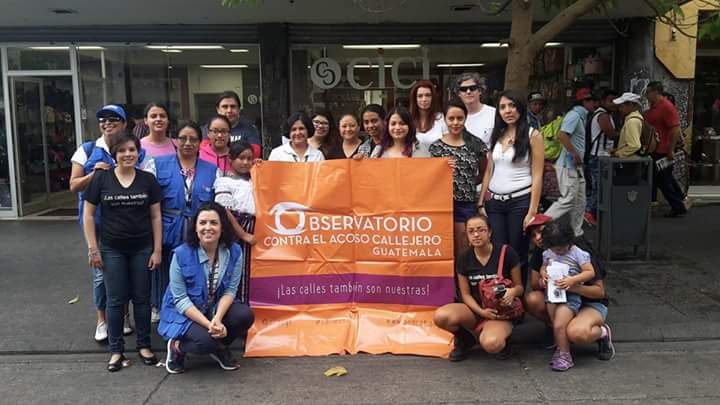
4.16.16 PDH Guatemala street actionThank You for Meeting Us on the Street!

Hundreds of groups and tens of thousands of people all over the world participated in International Anti-Street Harassment Week. Through these actions, our online campaigns and media coverage, our message of safe public spaces for all reached millions.

THANK YOU for being part of it and making it all possible!

  • View photos from the actions that took place in more than 30 countries.
  • Read the daily recaps of each day and guest blog posts from across the week.
  • Check out the 65 media hits the week received.

A few highlights of the actions include:

  • Argentina: The release of the first-ever street harassment study in Buenos Aires showing that 100% of women had faced street harassment.
  • Afghanistan: 300 people wrote messages against street harassment.
  • Australia: Member of Parliament Fiona Patten MLC gave a statement in Victoria, focused on LGBTI street harassment.
  • Chile: A law amendment to criminalize street harassment was passed unanimously today in the Chilean Chamber of Deputies.
  • France: Stop Harcelement de Rue groups in seven cities across the country held sidewalk chalking, discussions, and other actions.
  • Latin America: Seven countries across Latin America launched the #NoEsMiCultura (#NotMyCulture)
  • Nepal: Many events took place in Kathmandu, including a presentation of street harassment study findings at the National Women Commission including to the deputy Prime Minister, Shrijana Sharma, and held a massive march.
  • Philippines: UN Women Safe Cities and the Quezon City local government worked with the Tricycle Drivers Association to train 100 tricycle drivers (tuktuk drivers) on gender sensitivity and to come up with joint solutions for addressing street harassment.
  • UK: Everyday Sexism founder Laura Bates spoke at an Abortion Rights event in Parliament on protecting women from harassment and abuse outside UK clinics.
  • USA: Iowa City actions received among the most media coverage of any place in the world, raising significant public awareness about the issue in that community.

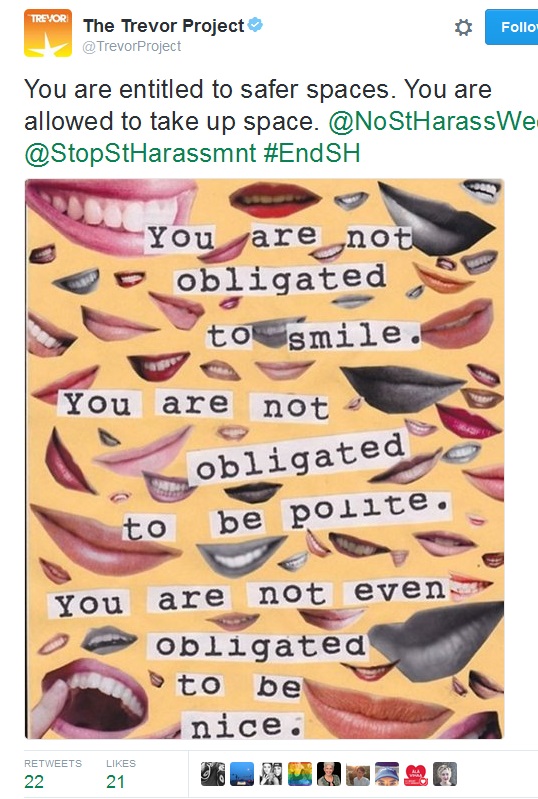
TrevorProjectA few new countries joined the week for the first time, including the Democratic Republic of Congo, Papua New Guinea, and the Maldives.

There were five tweet chats, a global tweetathon, a Google+ Hangout, and a Vlog series by our board member Erin McKelle.

Meet Us on the Street Social Media Manager Lauren McEwen wanted to share this with you: “Thank you so much for all of your help and flexibility, for being there to answer my questions and for hosting such great, thought-provoking Twitter chats.”

5 Things to Do Next:

  1. If you haven’t already, please send us a few sentences about how your event went, how many people participated or were impacted, and any compelling quotes. Also please send us photos! (If you already wrote about your event, you can send us a link.) The information will be used in our wrap-up report celebrating all of the actions that took place!
  2. Plan to participate in Meet us on the Street 2017. The dates will be April 2-8, 2017 (moved earlier in the month so as to avoid the Easter holiday)
  1. Apply for the SSH Blog Correspondents Program, for the May to August cohort. Applications are due by April 30.
  1. Donate $11 or more to fund the first national USA street harassment hotline (in partnership with RAINN). $11 will cover 15 minutes of caller time!
  1. Be an early applicant for SSH’s Safe Public Spaces Mentoring Program. Project proposals are due June 15, 2016 for projects that will take place between July 15 and November 30, 2016. Each selected team will receive $350 for the project as well as advice, connections and publicity. Extra consideration is given to groups and individuals who may not have other funding sources available to them. Past recipients may apply again.


Share

Filed Under: anti-street harassment week

« Previous Page
Next Page »

Share Your Story

Share your street harassment story for the blog. Donate Now

From the Blog

  • #MeToo 2024 Study Released Today
  • Join International Anti-Street Harassment Week 2022
  • Giving Tuesday – Fund the Hotline
  • Thank You – International Anti-Street Harassment Week 2021
  • Share Your Story – Safecity and Catcalls Collaboration

Buy the Book

Search

Archives

  • September 2024
  • March 2022
  • November 2021
  • April 2021
  • March 2021
  • January 2021
  • April 2020
  • March 2020
  • February 2020
  • December 2019
  • November 2019
  • September 2019
  • August 2019
  • July 2019
  • June 2019
  • May 2019
  • April 2019
  • March 2019
  • February 2019
  • January 2019
  • December 2018
  • November 2018
  • October 2018
  • September 2018
  • August 2018
  • July 2018
  • June 2018
  • May 2018
  • April 2018
  • March 2018
  • February 2018
  • January 2018
  • December 2017
  • November 2017
  • October 2017
  • September 2017
  • August 2017
  • July 2017
  • June 2017
  • May 2017
  • April 2017
  • March 2017
  • February 2017
  • January 2017
  • December 2016
  • November 2016
  • October 2016
  • September 2016
  • August 2016
  • July 2016
  • June 2016
  • May 2016
  • April 2016
  • March 2016
  • February 2016
  • January 2016
  • December 2015
  • November 2015
  • October 2015
  • September 2015
  • August 2015
  • July 2015
  • June 2015
  • May 2015
  • April 2015
  • March 2015
  • February 2015
  • January 2015
  • December 2014
  • November 2014
  • October 2014
  • September 2014
  • August 2014
  • July 2014
  • June 2014
  • May 2014
  • April 2014
  • March 2014
  • February 2014
  • January 2014
  • December 2013
  • November 2013
  • October 2013
  • September 2013
  • August 2013
  • July 2013
  • June 2013
  • May 2013
  • April 2013
  • March 2013
  • February 2013
  • January 2013
  • December 2012
  • November 2012
  • October 2012
  • September 2012
  • August 2012
  • July 2012
  • June 2012
  • May 2012
  • April 2012
  • March 2012
  • February 2012
  • January 2012
  • December 2011
  • November 2011
  • October 2011
  • September 2011
  • August 2011
  • July 2011
  • June 2011
  • May 2011
  • April 2011
  • March 2011
  • February 2011
  • January 2011
  • December 2010
  • November 2010
  • October 2010
  • September 2010
  • August 2010
  • July 2010
  • June 2010
  • May 2010
  • April 2010
  • March 2010
  • February 2010
  • January 2010
  • December 2009
  • November 2009
  • October 2009
  • September 2009
  • August 2009
  • July 2009
  • June 2009
  • May 2009
  • April 2009
  • March 2009
  • February 2009
  • January 2009
  • December 2008
  • November 2008
  • October 2008
  • September 2008
  • August 2008
  • July 2008
  • June 2008
  • May 2008

Comment Policy

SSH will not publish any comment that is offensive or hateful and does not add to a thoughtful discussion of street harassment. Racism, homophobia, transphobia, disabalism, classism, and sexism will not be tolerated. Disclaimer: SSH may use any stories submitted to the blog in future scholarly publications on street harassment.
  • Contact
  • Events
  • Join Us
  • Donate
  • Facebook
  • Instagram
  • Pinterest
  • Tumblr
  • Twitter
  • YouTube

Copyright © 2026 Stop Street Harassment · Website Design by Sarah Marie Lacy