• About Us
    • What Is Street Harassment?
    • Why Stopping Street Harassment Matters
    • Meet the Team
      • Board of Directors
      • Past Board Members
    • In The Media
  • Our Work
    • National Street Harassment Hotline
    • International Anti-Street Harassment Week
    • Blog Correspondents
      • Past SSH Correspondents
    • Safe Public Spaces Mentoring Program
    • Publications
    • National Studies
    • Campaigns against Companies
    • Washington, D.C. Activism
  • Our Books
  • Donate
  • Store

Stop Street Harassment

Making Public Spaces Safe and Welcoming

  • Facebook
  • Instagram
  • Pinterest
  • Tumblr
  • Twitter
  • YouTube
  • Home
  • Blog
    • Harassment Stories
    • Blog Correspondents
    • Street Respect Stories
  • Help & Advice
    • National Street Harassment Hotline
    • Dealing With Harassers
      • Assertive Responses
      • Reporting Harassers
      • Bystander Responses
      • Creative Responses
    • What to Do Before or After Harassment
    • Street Harassment and the Law
  • Resources
    • Definitions
    • Statistics
    • Articles & Books
    • Anti-Harassment Groups & Campaigns
    • Male Allies
      • Educating Boys & Men
      • How to Talk to Women
      • Bystander Tips
    • Video Clips
    • Images & Flyers
  • Take Community Action
  • Contact

16 Days: Human Rights Day (Day 16)

December 10, 2015 By HKearl

Today is Human Rights Day and also the final day of the 16 Days of Activism Against Gender-Based Violence. That’s because violence against women IS a human rights violation. Everyone should live lives from from violence.

Ministers and Deputy Ministers from 17 countries talk talk about violence against women in their country and what they will do about it.

For the last two days, I’ve had the honor to attend — and today present at — a global conference on ending violence against women (VAW) in Istanbul, Turkey, organized by UN agencies and the government of Turkey and timed to fall within the end of the 16 Days (there’s been lots of orange everywhere!).

Via UN Women’s website:

“The two-day meeting will be held 20 years after the landmark Beijing Declaration and Platform for Action – Violence against Women, was adopted by 189 countries in 1995. Turkey, being the host of the international meeting, echoes the leading role the country has played as the first government to ratify the Istanbul Convention, which sets legally binding standards to prevent violence against women and girls, protect victims and punish perpetrators.

Meeting objectives include reviewing progress and challenges since the Beijing Declaration; sharing the latest data and good practices to prevent and respond to violence against women and girls; and, importantly in light of the Sustainable Development Goals (SDGs) adopted by world leaders in September 2015, to get fresh political commitments from Governments to end violence against women.”

UN estimates 300 people from around 70 countries attended. Ministers and deputy ministers of 17 countries attended and made statements of commitment to ending VAW.  We heard from the Prime Minister of Turkey yesterday and tonight at the closing reception, we heard from the mayor of Istanbul.

I took a lot of notes and will write about the highlights during my long flight home tomorrow. In the meantime, here is a UN write-up about the first day, yesterday, which includes this message:

Phumzile Mlambo-Ngcuka, UN Under-Secretary-General and Executive Director of UN Women

“Violence against women and girls remains one of the most widespread and tolerated violations of human rights – but it is not inevitable, and we can prevent it. We are here today to say that this is enough. Now is the moment for coherently executed, decisive action to eliminate violence against women and girls for good,” said Phumzile Mlambo-Ngcuka, UN Under-Secretary-General and Executive Director of UN Women, at the opening session.

This evening at the closing reception, she said, “In the 19th century, the world abolished slavery. In the 20th century, we ended colonialism. Now, in the 21st century, we will end violence against women. It is an idea whose time has come.”

Yes, it has!

Share

Filed Under: 16 days, Events Tagged With: human rights day, Istanbul, turkey, United Nations, violence against women

“Harassment is a serious crime that can emotionally damage a person”

December 10, 2015 By Contributor

An ex-boyfriend of mine posted flyers with my personal phone number, address, and work location. On the flyer it stated I was a drug addict/ dealer. Which I am not, I’m a pharmacy technician, and what he said on the flyer could of really hurt my career. I felt scared for my life, because people were actually believing the flyers harassing my phone, my residence, and even at my job. I went to the police, and they basically said they can’t help me until I was physically assaulted. So I put a restraining order against him. Now I’m just trying to recover, it’s very hard I’m still very fearful and a lot of anxiety. I go through therapy now, because I know that guy is still out there, apparently really close to where live I spoke up, because no one should ever have to go through or feel how I felt. Harassment is a serious crime that can emotionally damage a person.

– Tiana Sayas

Location: Oahu, Hawai’i

Share your street harassment story for the blog.
See the book 50 Stories about Stopping Street Harassers for more idea
.

Share

Filed Under: Stories, street harassment

Grown Men Harass DC Elementary School Students

December 9, 2015 By HKearl

Anti-abortion protesters outside of the Two Rivers Public Charter School, which is next to a new Planned Parenthood facility that is under construction in Washington, D.C., shown here in November 2015. (Courtesy of Two Rivers Public Charter School)

“School leaders at a public charter school in Northeast Washington filed a lawsuit [today] against anti-abortion protesters who they say are harassing students in their efforts to stop construction of a Planned Parenthood facility next door.

Two Rivers Public Charter School alleges in a complaint filed in D.C. Superior Court that the protesters have engaged in “extreme and outrageous conduct” during the past several months, targeting school children as young as 3 years old with gruesome images of aborted fetuses and messages about the “murder facility” going in next to their school. The school is asking the court to order protesters not to talk to the schoolchildren or approach them outside the school.” Read more in the Washington Post.

The DC Mayor’s office reached out yesterday to SSH and other relevant groups to see if we would write a letter in support of this lawsuit. Our board of directors unanimously agreed!

Here it is:

“Stop Street Harassment (SSH) is a nonprofit organization dedicated to documenting and ending gender-based street harassment worldwide. We are based in Reston, Virginia, and do work locally, nationally and internationally.

Locally, one of our initiatives is partnering with WMATA and Collective Action for Safe Spaces on an anti-harassment transit campaign in the Washington Metropolitan Region. We are proud to be part of that effort because we want everyone in the region to feel safe on the Metro trains and buses.

We also want people, including children, to feel safe in other public spaces. For that reason, we are dismayed that people protesting the construction of a Planned Parenthood health center on 4th Street are targeting elementary school children at Two Rivers Public Charter School next door, including with signs reading, “They kill babies nearby! Tell your parents to stop them.”

We believe that street harassment is a human rights violation because it denies harassed persons equal access to public spaces by making them feel unsafe and unwelcome there. This is exactly what the anti-Planned Parenthood protesters are doing. Elementary school children should have the right to go to and from school without feeling unsafe and unwelcome — and without feeling threatened and intimidated — but the Planned Parenthood protesters are denying them that right each time they protest and target them.

We support both the Two Rivers’ complaint and request for preliminary and permanent injunctive relief and the Mayor’s efforts to protect the students at the school and Planned Parenthood’s work in Washington, D.C. from this systematic harassment and intimidation.

Sincerely,

The Stop Street Harassment Board of Directors”

Share

Filed Under: News stories, public harassment, SSH programs Tagged With: children, elementary school, lawsuit, planned parenthood, reprodutive rights

#16Days of Activism: 16 Empowering Responses (Day 15)

December 9, 2015 By HKearl

This is cross-posted from Pixel Project’s website.

The Pixel Project is pleased to share the fifth annual blog list of 16 memorable stories of women dealing with street harassment which has been kindly compiled by Holly Kearl, Founder of our partner, Stop Street Harassment, and one of our 16 Female Role Models of 2010.

Empowering Response #1: #WhatMySHSaid – Instagram

Chloe Parker has been harassed since she was 12 years old. Now 17, she started an Instagram hashtag #WhatMySHSaid where people write their age and location and what their street harasser said to them. Many posts are liked thousands of times. Chloe wrote, “The average age is twelve [for the story submissions] and the average reaction is disbelief, but with the topic comes horrible responses as well. I have heard people defending these pedophiles who creep on these girls, or say that street harassment is because of what the girl was wearing. We live in a culture of blaming the victims, and by saying a twelve-year-old is asking to be followed as she walks home from school is a testament to this. We as a society can and should change this culture that we promote and live in. It should not be up to the victims to change their lives and patterns to make harassers comfortable. This is not a problem that should be ignored.”

Empowering Response #2: Parking Attendant Woes – Charlotte, North Carolina, USA

Every day for two weeks as a woman left a parking garage in Charlotte, North Carolina, the parking attendant would stare at her and say he wanted to see her smile and other similar remarks. She felt uneasy, and, as he continued day after day, she felt anxious and stressed. One day she pa0nicked and drove away while he was still talking. She resolved to talk to him and the next day. She asked him to stop telling her to smile as it made her feel uncomfortable. He said okay. She wrote, “I hope he’ll think before he makes these unwanted comments to anyone else. I didn’t complain to the company since he made an indication of respecting my wishes. I don’t plan to park there any more since I don’t want to see him again, but being able to say something took such a weight off my shoulders. I didn’t even realise how much this was affecting me until after I said something.”

Empowering Response #3: Standing Up Against Harassers – Kabul, Afghanistan

After witnessing a friend drop out of school because of harassment, Shafi in Kabul, Afghanistan, began standing up to harassers. She wrote, “Whenever I see people harassing girls or women in streets and university, I go to them and talk reasonably with them to stop them and explain to them that their act is wrong. I ask what if it happens to their sister or mother, what then? Now it is the time for everyone to start vanishing this bad and shameful culture. Yes, if we want to change then we can. We can start it right now!”

Empowering Response #4: Ladders Are Useful Items

ladder

Empowering Response #5: Caught on CCTV

After a drunk man grabbed a woman on a subway and kissed her, she reported him to the transit police. They found him on the train’s CCTV and circulated his image to local police stations. She wrote, “If you experience street harassment, report it to the police. It will make you feel proactive and powerful – and they might even catch the perpetrator.”

Empowering Response #6: No Free Pass for the Police – San Jose, CA, USA

A woman in San Jose, California, noticed a police sergeant (not in uniform) exposing himself and masturbating in a car. She turned away but he drove his car and parked so she had to see him again. She took photos of him and his license plate and he fled. She filed a police report and the investigators discovered he was a 13-year veteran of the police department. He was arrested and placed on administrative leave.

Empowering Response #7: Taking Harassment Seriously – Liverpool, United Kingdom

Two men in a car in Liverpool, UK, harassed a Russian woman. She felt too scared to say anything, but she ran back, called the police, reported what happened and gave their license plate number. She wrote, “The inspector rang me back to make sure I know they take it seriously. Then after an hour a female officer came to see me. It turned out it was a crime as section 5 public order offence, besides it was gender-based. The officer visited his house, etc. He now has a criminal record. Ladies, you don’t have to take this shit!”

Empowering Response #8: Facing Down Harassers… and Winning! – Tennesee, USA

When Bryanna was in college in Tennessee, a group of men would hang out by the door and harass her daily with sexual slurs. She felt humiliated and would try to run past them before they could say anything. But one day she decided to confront them. She wrote, “They whistled and said, ‘Damn!’ really loudly. So I turned around, marched right up to them (at least eight of them) and shouted, ‘What do you expect to happen from this? Do you really think a girl will turn around and say ‘Oh wow that’s such a compliment, being told my ass is fine by these complete strangers. Do you want to hook up?’ Has it worked for you yet?’ By the look on their stunned faces, I answered for them, ‘No, I didn’t think so. Get a life!’ and stormed off. The rush I felt was incomparable to anything else. I felt strong – like I could take care of myself.”

Empowering Response #9: Singing Against Harassment

Singer Empress Of wrote a song about street harassment called “Kitty Kat.” She said in an interview, “I remember a stranger saying something nasty to me on the street while walking home. I was so mad, but I couldn’t say anything back at that moment. What would be the point? When I got back I started to work on this aggressive sound on a track. As soon as I turned the mic on to record, I started to sing what I wanted to say to that guy on the street, but now I get to sing it every night in front of a crowd.”

Empowering Response #10: “That’s NOT a compliment!” – San Diego, CA, USA

A woman was walking her dog through downtown San Diego, California, when a man told her, “You have no idea how badly I want to play with your boobs.” She told him that his comment was inappropriate and he apologised. But then he told her she should “take it as a compliment.” She had already passed him, but turned around to yell back, “That’s NOT a compliment!” She wrote, “Let the harasser know what he is doing is wrong and unwelcome and that it’s not a compliment in order to help convert him to viewing it as a bad thing.”

Poppy SmartEmpowering Response #11: Sparking a National Debate – United Kingdom

After weeks of trying various tactics for dealing with street harassers along her route to work in the UK (the harassment included men purposely blocking her path), Poppy Smart took the matter to the police. She said in an interview, “It made me feel really uncomfortable and the fact it went on for so long was the main reason I reported it. If it had just been an isolated incident – one, two, three, four times – maybe I could probably brush it off because these things happen and you have to kind of accept these people’s ignorance.” Poppy says she spoke to the owner of the building site. “He just sort of apologised. He obviously can’t control all of his staff all of the time and I appreciated that. I just wanted them to realise it is offensive and I wanted it to stop.” Her story sparked a national debate about the issue.

Empowering Response #12: Sanctuary from Harassment – New York City, USA

A man on the train in New York City rubbed his penis against a woman’s butt. She elbowed him but he kept doing it. Because of the crowd, she couldn’t easily get away. A woman nearby noticed what was happening and gave up her seat for her saying, “Come sit down, that man is trying to rub himself on you!”

Empowering Response #13: Not Remaining Silent – London, United Kingdom

Y.E. in London, UK, was the target of public masturbation on the Tube. No one else was on and when she moved away, he followed her, only zipping up his pants after a man entered the carriage. When YE got off the train, he followed and she ran to report him to a transit worker. The police took her report. She also decided to write about what happened. “I hesitated several times whilst starting to write this and contemplated just keeping it to myself, considering the crude nature of this incident. However, it has come to my attention that this is no longer becoming a ‘once in a blue moon issue’ and it could have easily been burdened on a child, family member, or another member of the public. Looking back at the past struggles in history, since when has any change occurred from remaining silent?”

smallstepsEmpowering Response #14: Anti-Street Harassment Workshops – Romania

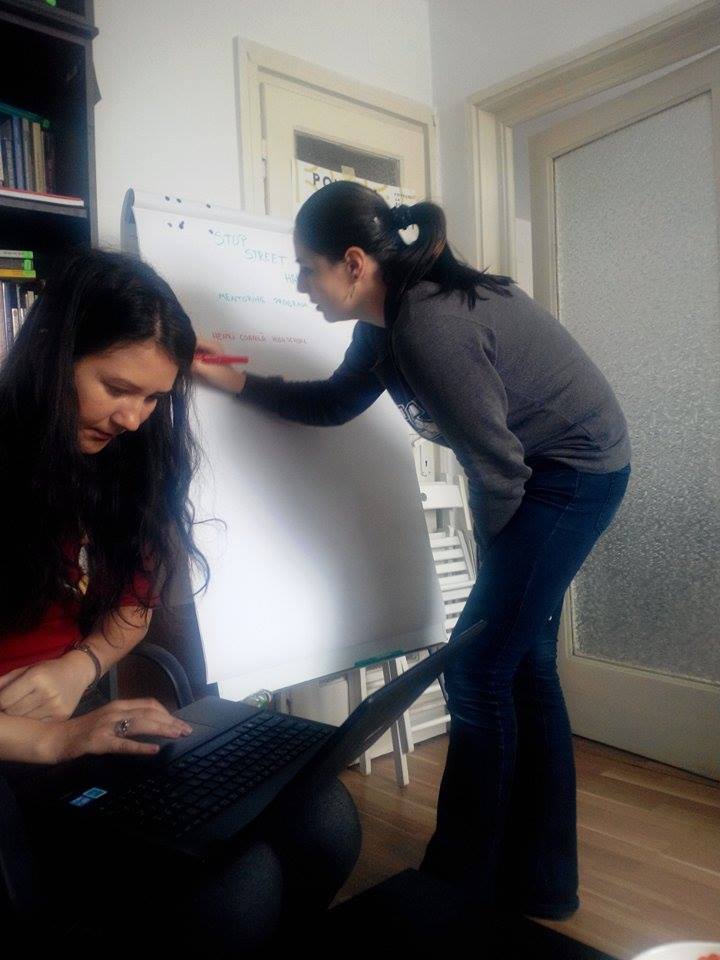
Aila in Romania used to face harassment from high school students as she walked from her hostel to the university. Now she and a group of other women at the NGO FILIA are in the process of working with that high school to bring street harassment awareness workshops to the students. She wrote, “Change can be done. I am not a victim anymore, I am a person who can bring change and can help the other girls who are still living in that hostel.”

Empowering Response #15: Open Letter Tactic – Washington D.C., USA

 Sara in Washington, DC wrote an open letter to the man who harassed her. In it, she thanked a woman who spoke up. “To the woman on the sidewalk who said, ‘That’s so rude’ and shook her head when he drove off, thank you. Your three simple words in solidarity were my saving grace and snap back to reality, that no one, not even myself, has the right to disrespect my body. So, dear man in the blue minivan, I will use my body in the best way I know how — to share this story and inspire others to feel a little braver when they step into a crosswalk. To be what the woman on the sidewalk was to me: solidarity.”

Empowering Response #16: Reporting an Unwanted Grope – San Francisco, CA, USA

After a man groped AB at a shopping mall in San Francisco, California, she dropped her bag and ran after him. She lost him, but filed a police report. She wrote, “I’ve been harassed many times, but I’d never run after someone. Something snapped in me. And something broke when no one would help. I was proud that enough was finally enough, and I did something, even though he got away with it. At the very least, it’s caused me to talk about it and snap back when I get hollered at on the street.”

Share

Filed Under: 16 days, Advice, Resources, Stories, street harassment Tagged With: responding to harassment

#16Days of Activism: Creative Youth Projects (Day 14)

December 8, 2015 By HKearl

Nov. 25 – Dec. 10 are the 16 Days of Activism Against Gender-Based Violence. To commemorate the week, we are featuring 1 activism idea per day. This information is excerpted from my new book Stop Global Street Harassment: Growing Activism Around the World (Praeger 2015).

Whether it’s by making art or a video or organizing a march, youth from Azerbaijan to the United States are undertaking creative ways to address street harassment.

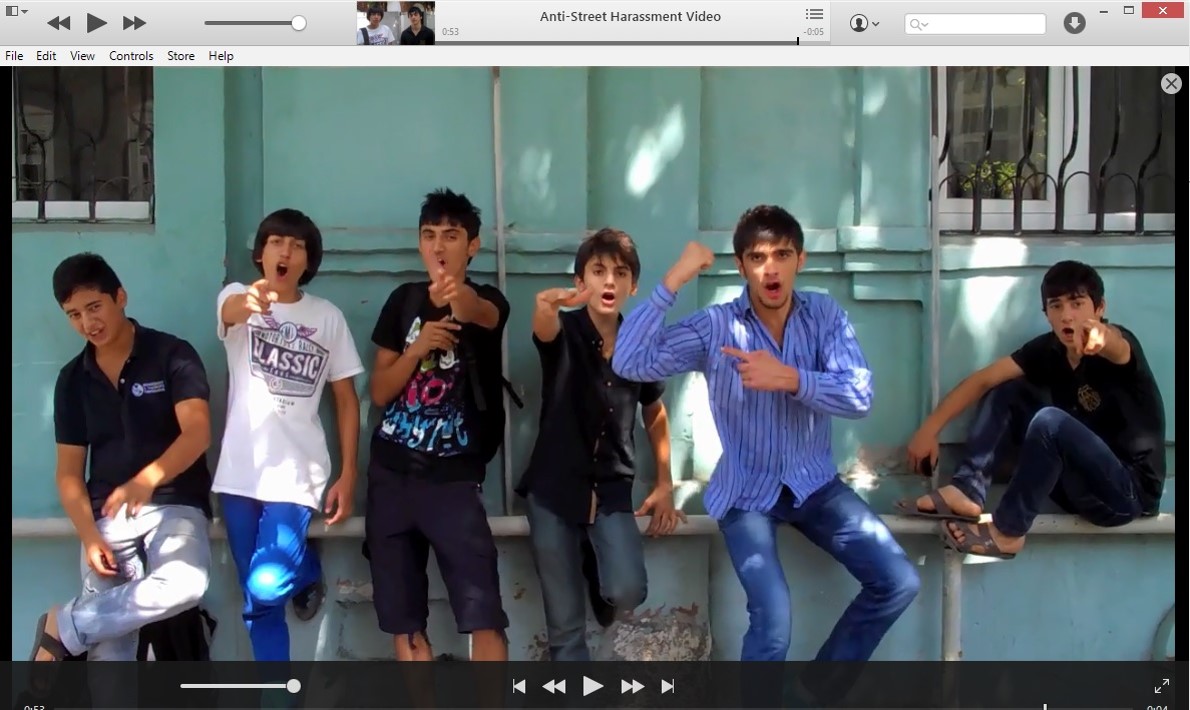
beagentleman“What do you get when you annoy girls? They just think you are a bad person,” “You shouldn’t do it, bro,” and “Be a good man,” six teenage boys tell their peers in a mixture of Azerbaijani and English in a 2012 YouTube video. Jake Winn, an American youth development Peace Corps volunteer was in Azerbaijan, from 2010 to 2012 and had daily interaction with many young boys and men. He told me he noticed that “street harassment was a learned behavior and most were sincerely ignorant to the dangers and problems with street harassment.”

When he brought it up with them, there was little resistance to the idea that it needed to stop. It was just something they had never thought about. And for the boys and men who did think there was something wrong, he said, “they didn’t know how to bring it up, how to resist, how to convey a message to their peers that it wasn’t OK.”

After Winn showed the youth an American video of men telling other men to stop harassing women, the boys decided to make their own. “They wrote it, filmed it, edited it. … They loved making the video and were proud to show it,” Winn said. “Few had ever taken the time to think and reflect. It was great to see how inspired girls were to realize how many allies they had among the young men.”

To date, it has been viewed more than 6,000 times, and it received a standing ovation when it was shown at a youth film festival in Azerbaijan’s capital, Baku. Winn also developed a lesson plan and discussion questions for other Peace Corps volunteers to use with their own students, and more than a dozen volunteers did so. The materials are available on the SSH website in both Azerbaijani and English.

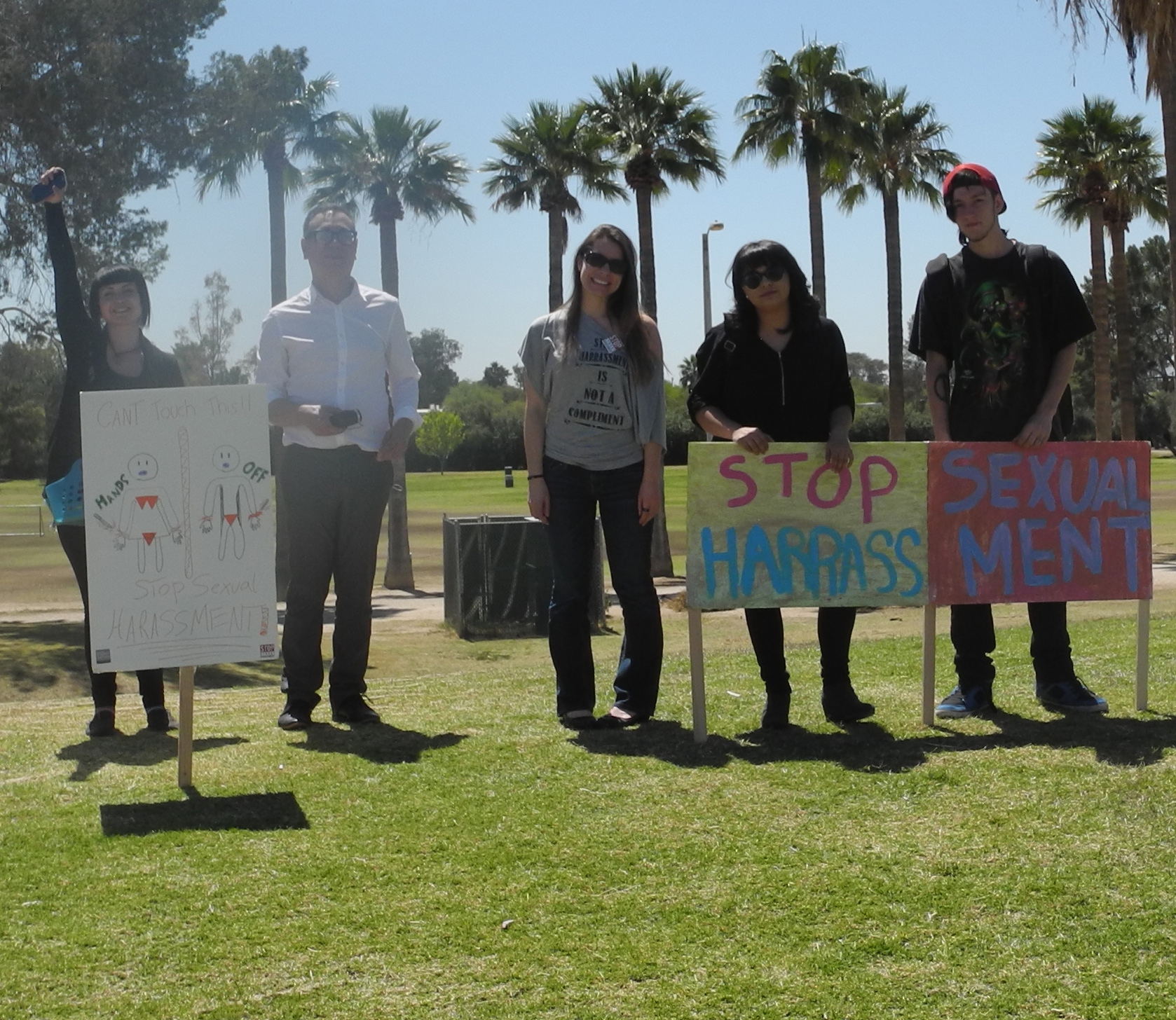
2014 Hey Baby art in Tucson
2014 Hey Baby art in Tucson (Abril is two in from the left)

Hey Baby | Art Against Sexual Violence launched in Tucson, Arizona, through the Southern Arizona Center Against Sexual Assault in 2009. Inspired by an art-centric Hey Baby project in North Carolina, up to 50 students and 30 adults participate in the Tucson initiative each spring. Their artwork addresses themes of prevention and support for survivors of homophobia, street harassment, relationship abuse, rape, and child sexual abuse.

While the program is currently evolving, in the past, the art has been displayed in public libraries across Tucson during Sexual Assault Awareness Month and online. “I think it is important for youth to engage with troubling social issues in a context where they have control over the processes used to solve that problem,” the program’s manager (and SSH board member) Manuel Abril told me. “This means that instead of making youth [feel they] have to identify with social issues (social systems dispense blame for social problems affecting them onto marginalized communities) they are able to investigate it, to unravel it aesthetically, and to give it back to society.”

Share

Filed Under: 16 days, male perspective, public harassment, Resources, street harassment Tagged With: arizona, Azerbaijan, boys, hey baby art, youth

« Previous Page
Next Page »

Share Your Story

Share your street harassment story for the blog. Donate Now

From the Blog

  • #MeToo 2024 Study Released Today
  • Join International Anti-Street Harassment Week 2022
  • Giving Tuesday – Fund the Hotline
  • Thank You – International Anti-Street Harassment Week 2021
  • Share Your Story – Safecity and Catcalls Collaboration

Buy the Book

Search

Archives

  • September 2024
  • March 2022
  • November 2021
  • April 2021
  • March 2021
  • January 2021
  • April 2020
  • March 2020
  • February 2020
  • December 2019
  • November 2019
  • September 2019
  • August 2019
  • July 2019
  • June 2019
  • May 2019
  • April 2019
  • March 2019
  • February 2019
  • January 2019
  • December 2018
  • November 2018
  • October 2018
  • September 2018
  • August 2018
  • July 2018
  • June 2018
  • May 2018
  • April 2018
  • March 2018
  • February 2018
  • January 2018
  • December 2017
  • November 2017
  • October 2017
  • September 2017
  • August 2017
  • July 2017
  • June 2017
  • May 2017
  • April 2017
  • March 2017
  • February 2017
  • January 2017
  • December 2016
  • November 2016
  • October 2016
  • September 2016
  • August 2016
  • July 2016
  • June 2016
  • May 2016
  • April 2016
  • March 2016
  • February 2016
  • January 2016
  • December 2015
  • November 2015
  • October 2015
  • September 2015
  • August 2015
  • July 2015
  • June 2015
  • May 2015
  • April 2015
  • March 2015
  • February 2015
  • January 2015
  • December 2014
  • November 2014
  • October 2014
  • September 2014
  • August 2014
  • July 2014
  • June 2014
  • May 2014
  • April 2014
  • March 2014
  • February 2014
  • January 2014
  • December 2013
  • November 2013
  • October 2013
  • September 2013
  • August 2013
  • July 2013
  • June 2013
  • May 2013
  • April 2013
  • March 2013
  • February 2013
  • January 2013
  • December 2012
  • November 2012
  • October 2012
  • September 2012
  • August 2012
  • July 2012
  • June 2012
  • May 2012
  • April 2012
  • March 2012
  • February 2012
  • January 2012
  • December 2011
  • November 2011
  • October 2011
  • September 2011
  • August 2011
  • July 2011
  • June 2011
  • May 2011
  • April 2011
  • March 2011
  • February 2011
  • January 2011
  • December 2010
  • November 2010
  • October 2010
  • September 2010
  • August 2010
  • July 2010
  • June 2010
  • May 2010
  • April 2010
  • March 2010
  • February 2010
  • January 2010
  • December 2009
  • November 2009
  • October 2009
  • September 2009
  • August 2009
  • July 2009
  • June 2009
  • May 2009
  • April 2009
  • March 2009
  • February 2009
  • January 2009
  • December 2008
  • November 2008
  • October 2008
  • September 2008
  • August 2008
  • July 2008
  • June 2008
  • May 2008

Comment Policy

SSH will not publish any comment that is offensive or hateful and does not add to a thoughtful discussion of street harassment. Racism, homophobia, transphobia, disabalism, classism, and sexism will not be tolerated. Disclaimer: SSH may use any stories submitted to the blog in future scholarly publications on street harassment.
  • Contact
  • Events
  • Join Us
  • Donate
  • Facebook
  • Instagram
  • Pinterest
  • Tumblr
  • Twitter
  • YouTube

Copyright © 2026 Stop Street Harassment · Website Design by Sarah Marie Lacy