• About Us
    • What Is Street Harassment?
    • Why Stopping Street Harassment Matters
    • Meet the Team
      • Board of Directors
      • Past Board Members
    • In The Media
  • Our Work
    • National Street Harassment Hotline
    • International Anti-Street Harassment Week
    • Blog Correspondents
      • Past SSH Correspondents
    • Safe Public Spaces Mentoring Program
    • Publications
    • National Studies
    • Campaigns against Companies
    • Washington, D.C. Activism
  • Our Books
  • Donate
  • Store

Stop Street Harassment

Making Public Spaces Safe and Welcoming

  • Facebook
  • Instagram
  • Pinterest
  • Tumblr
  • Twitter
  • YouTube
  • Home
  • Blog
    • Harassment Stories
    • Blog Correspondents
    • Street Respect Stories
  • Help & Advice
    • National Street Harassment Hotline
    • Dealing With Harassers
      • Assertive Responses
      • Reporting Harassers
      • Bystander Responses
      • Creative Responses
    • What to Do Before or After Harassment
    • Street Harassment and the Law
  • Resources
    • Definitions
    • Statistics
    • Articles & Books
    • Anti-Harassment Groups & Campaigns
    • Male Allies
      • Educating Boys & Men
      • How to Talk to Women
      • Bystander Tips
    • Video Clips
    • Images & Flyers
  • Take Community Action
  • Contact

#16Days of Activism: Hosting Youth Workshops (Day 13)

December 7, 2015 By HKearl

Nov. 25 – Dec. 10 are the 16 Days of Activism Against Gender-Based Violence. To commemorate the week, we are featuring 1 activism idea per day. This information is excerpted from my new book Stop Global Street Harassment: Growing Activism Around the World (Praeger 2015).

Street harassment begins at a young age for many people. More adults are recognizing this and the importance of creating spaces, like workshops, for youth to talk about their experiences and brainstorm strategies of resistance. Youth workshops have taken place in countries like the United States, Cameroon, and Germany.

In March 2012 in the United States, female youth organizers at the Brooklyn, New York-based nonprofit Girls for Gender Equity (GGE) hosted “Bring Your Brother Day” to talk about street harassment. The young women of GGE “felt strongly about the importance of bringing the young men in their lives into their work to counteract sexual harassment and gender-based violence,” wrote community organizer Neferiti Martin and intern Katie Bowers for the SSH blog. “The workshop grew out of youth organizers’ concerns that the conversation around street harassment and gender-based violence is taking place primarily among women. By reaching out to the young men in their lives, youth organizers are working to build allies.”

The three-hour workshop explored gender stereotypes and how they impacted the lives of young people and included street harassment story sharing and a discussion about how young men can be allies to young women. “The young men were thoughtful, open, and engaged throughout the workshop,” wrote Martin and Bowers. “Their comments and opinions added new depth to the conversation and reflected the positive influence of the awesome young women in their lives.”

11.30.13-SSH-CameroonSPSMentoringsiteEvent3Wearing orange shirts that said “Stop Street Harassment,” 25 youth aged 15–19 attended a street harassment seminar in Buea, Cameroon, in December 2013 that was organized by Zoneziwoh M. Wondieh, the leader of Young Women for a Change, Cameroon (WFAC). In small groups, the youth shared their stories of harassment, ranging from whistling to grabbing and touching. “African baby,” “Fine ass,” “My size,” and “Pretty butts” were examples of verbal harassment the girls said they had faced. One boy shared how he had been sexually harassed by a man and how it made him understand better what his female peers experienced on a regular basis.

For six hours the youth listened to guest speakers, learned steps for dealing with harassers, and engaged in role-play and debates with the goal of being ready to mentor others and speak out against harassment in their community. As an outcome of the youth seminar, WFAC launched an SMS text campaign to send educational text messages about street harassment to anyone who wants to receive them on a weekly or bi-weekly basis. Wondieh posts tips and information over social media, too. She estimates that she has reached 1,000 youth through her various efforts, and she’s having an impact. For example, a young man recently told her that thanks to the information she shares, he has “reconsidered what he thinks is proper behavior toward women.”

In Germany, the women in the group ProChange recognize that the best place to start educating people about street harassment, sexual violence, and sexism is in schools, so in 2014, they created violence prevention and assertiveness workshop trainings for students ages 9–12 years old. So far, they have held one workshop and are working to secure more funding to be able to lead more. “We want to achieve a shift in their mindset so that the youth can be self-confident and free from role models and stereotypes,” they told me. “In our view it is important to start at an early age because they are already surrounded by stereotypes and influenced by sexist advertisements and media … [We want them] to be empowered to choose their own ways.”

Help fund our work in 2016, donate to our end-of-year giving campaign!

Share

Filed Under: 16 days, male perspective, Resources Tagged With: cameroon, germany, usa, workshops, youth

Mural Against Harassment in Mumbai

December 7, 2015 By HKearl

Safecity and students in Mumbai painted the ‪#‎TalkingWall along Peddar Road, outside Sophia College.

SafeCityMumbaiMural-Dec2015-2

SafeCityMumbaiMural-Dec2015-3

SafeCityMumbaiMural-Dec2015-4

Share

Filed Under: Resources, street harassment Tagged With: college students, India, mumbai, Mural, safecity

#16Days of Activism: Raising Awareness on Campuses (Day 12)

December 6, 2015 By HKearl

Nov. 25 – Dec. 10 are the 16 Days of Activism Against Gender-Based Violence. To commemorate the week, we are featuring 1 activism idea per day. This information is excerpted from my new book Stop Global Street Harassment: Growing Activism Around the World (Praeger 2015).

A growing number of colleges and universities from Egypt to the United States have been addressing street harassment, often during Sexual Assault Awareness Month or in conjunction with International Women’s Day or International Anti-Street Harassment Week. They host workshops and street demonstrations, write sidewalk chalk messages, distribute materials, screen documentaries like the 1998 film War Zone, and create their own videos.
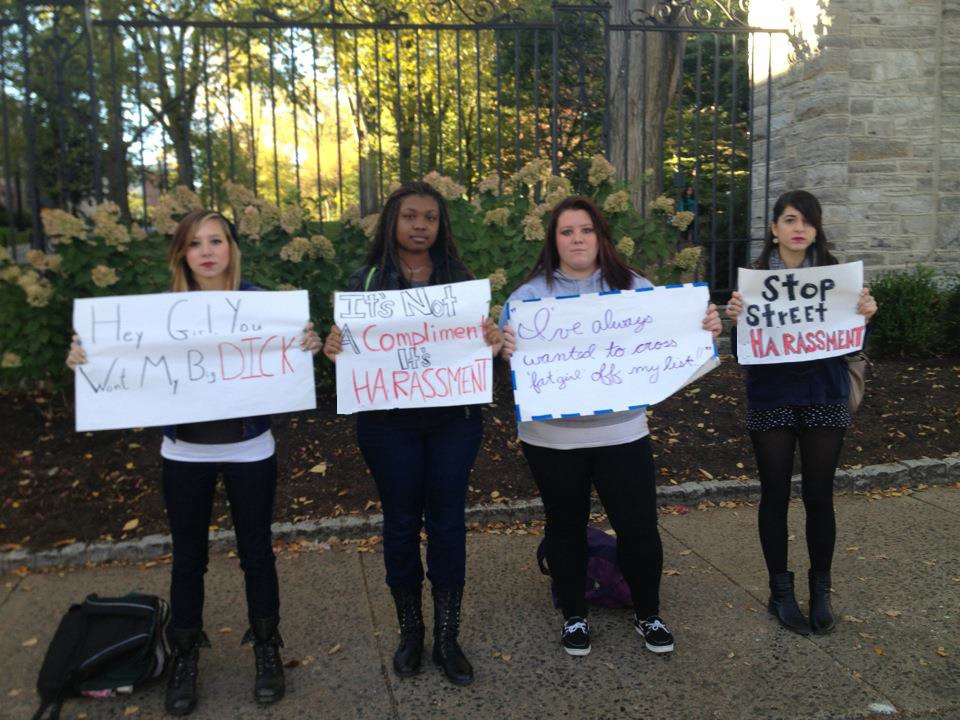
Penn State TRIOTAIn 2012, members of Pennsylvania State University’s Triota, the women’s studies honor society, held an anti-street harassment demonstration on a busy Friday afternoon in October in downtown State College, Pennsylvania. They held signs proclaiming their anti-harassment message and even included specific remarks that had been yelled at them during their time at Penn State like “Hey girl, you want my big dick?” and “I’ve always wanted to cross a fat girl off my list.” They also held up anti-street harassment messages like “It’s not a compliment; it’s harassment.” Julie Mastrine, one of the organizers, wrote about it for the SSH blog:

Don’t be mistaken: these types of incidents aren’t rare in this town. Street harassment is a widespread problem in State College, where nearly every woman I know has experienced some form of it: catcalls, taunting, lewd remarks, leering, sexually objectifying remarks, you name it. And this type of harassment functions as part of a larger issue in this town: rape culture. We saw a lot of stares and furrowed brows from passersby. Only a few people approached us to express their support, but it doesn’t matter—getting this issue in the eyes and ears of the State College community is important if we want to combat harmful behavior and attitudes toward women.
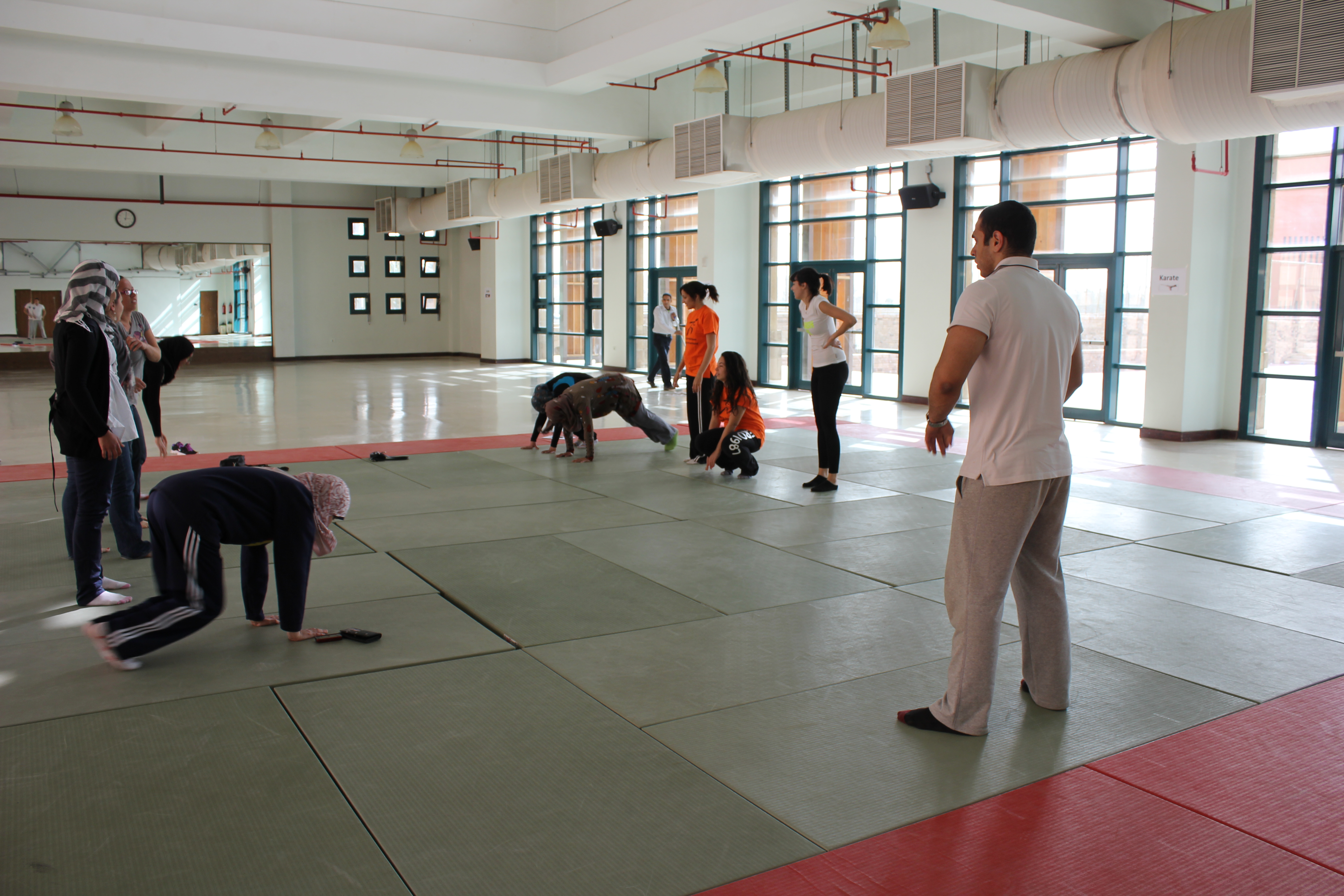
Harassment 101 Class EgyptIn Egypt, college student Holly Dagres created the Fight Harassment 101 (FH101) workshop in 2012 to educate female students about harassment and the use of self-defense. For 10 weeks at the American University of Cairo, 15 students took part in FH101 for two hours a week. Dagres wrote for the SSH blog about how the workshop entailed sharing information and stories about street harassment and then practicing self-defense for 90 minutes. She wrote: “It gave them a sense of empowerment to defend themselves in the worst-case scenarios. At first they were shy about sharing their experiences, but once they found it was a common occurrence and learned that it was not their fault, they felt the need to fight against it

Help fund our work in 2016, donate to our end-of-year giving campaign!

Share

Filed Under: 16 days, public harassment, Resources Tagged With: campuses, Egypt, penn state, university students

Italy: Street Harassment and Gender Stereotypes

December 6, 2015 By Correspondent

Sara Rigon, Italy, SSH Blog Correspondent

You are walking down the street and a man screams at you “hey, you are beautiful, babe”. You ignore him and keep walking. A million thoughts cross your mind: “Oh no, not again”, “Should I thank him so he doesn’t get mad”, “Does he look hostile?”, “Should I cross or walk faster?” etc.

The bottom line is you just want it to be over and with no consequences, so you rarely ask yourself why. It has happened so many times and it will happen again: it feels so pointless to wonder why.

Nonetheless, if we want to put an end to this we should learn from the best and follow Sun Tzu’s art of war rule: know your enemy. So, where does street harassment and violence against women come from? Where does it all start?

Vintage Sexist Ad
Vintage Sexist Ad

Social norms often view violence against women as a private matter and street harassment as women’s responsibility. Basically it is your fault: the way you walk, the clothes you wear, the way you look or don’t look, you are causing the problem: it is you. But it is not, it is a matter of gender and power. As the United Nation Declaration on the Elimination of Violence against Women, adopted by the General Assembly on 20 December 1993, states “[violence against women] is a manifestation of historically unequal power relations between men and women, which have led to domination over and discrimination against women by men and to the prevention of the full advancement of women, and that violence against women is one of the crucial social mechanisms by which women are forced into a subordinate position compared with men”.

In other words gender violence is a matter of gender equality and street harassment is the daily proof that despite of what some people think in 2015 men and women are not equal, not even in the civil and democratic western world. This is when I get the feeling life is like monopoly: we got the “go back 3 spaces” card. Back to gender equality and the question remains: how do you fight historically unequal power? I say we start from stereotypes and prehistoric clichés.

They say stereotypes are not a bad thing, on the contrary they can save your life as they help you categorize the world and quickly make sense of the mass of data that compose your day which will take forever to interpret if taken individually. However I’m not so sure this is always the case as nothing is entirely good (or bad, of course). Clichés and stereotypes about women, for example, are not necessary true and they definitely don’t simplify your life, especially if you belong to that group of people who is believed to be superficial but caring and maternal, good listener and compassionate but also gossipy and bitchy, ornamental and absolutely not good at STEM.

You may have heard of the term STEM, it seems like everyone is talking about it, creating hashtag and launching campaign to increase the number of students in such an innovating field. For those who are not familiar with it, STEM (previously SMET) is an acronym that refers to the academic disciplines of science, technology, engineering and mathematics.

Women in STEM
Women in STEM

I have never really thought about it, but with all this talking about STEM and the lack of women in STEM education I started reflecting on my relationship with math and science. Did an old and narrow-minded stereotype put me off STEM? That’s not possible, I love science, I am a doctor, after all, and I have plenty of women colleagues. As a recent bmj career article reports that back in 2009 the Royal College of Physicians predicted that by 2017 most doctors would be women. I thought we were doing well, however I was forgetting that medicine is not strictly considered science, but more of an art and doctors artist armed with basic scientific knowledge in medicine.

STEM is more about hard science and so my studying to become a physician doesn’t really count. To be totally honest, I’ve always thought I wasn’t good at math and I’ve never contemplated the idea of pursuing a career in engineering. Now that I think about it, even with good grades in math I’m not so sure I would have enrolled in a STEM program at Uni knowing what the boys in my class thought and said about girls who majored in engineering and mathematics.

Reading the recent L’Oréal Foundation international report on the perception of women in science I can say it is not just me, conscious and unconscious bias and cliché on women in STEM are real and they discourage girls from undertaking a scientific education and ultimately a STEM job and career, the same and old cliché that undermine women and sustain gender inequality. Now more than ever, we know the limiting factor is not women’s brain but culture. Science needs diversity, we need a cultural shift.

Unfortunately, cultural changes are known to be slow and painful, especially when they are lead by grown-ups, in such cases it gets a lot easier if you start from posterity. It is not simple to separate nature from nurture and all different aspect of creating gender role in kids, however studies shows that drawing clear distinction in gender roles plays a role in pushing kids toward a specific career and gender stereotype.

So it’s up to us, to you, to be the change you want to see in the world: enroll your daughters to math camp and football teams, ask Santa to bring your son cooking and baking toys and dancing shoes: this could be the first step to stop street harassment for good.

Sara is a registered General Practitioner in Italy and New Zealand. She is the founder and current lead of the newly established Equally Different group within the European Junior General Practitioners Organization, the Vasco da Gama Movement, branch of the World Organization of Family Doctors. Follow her on Twitter @rgn_sr.

Share

Filed Under: correspondents, street harassment Tagged With: gender stereotypes, STEM

Street Harassment Testimony Before DC Council – Moughari

December 5, 2015 By HKearl

On Thursday, the DC council held an historic hearing on street harassment. This was the testimony of our board member Layla Moughari.

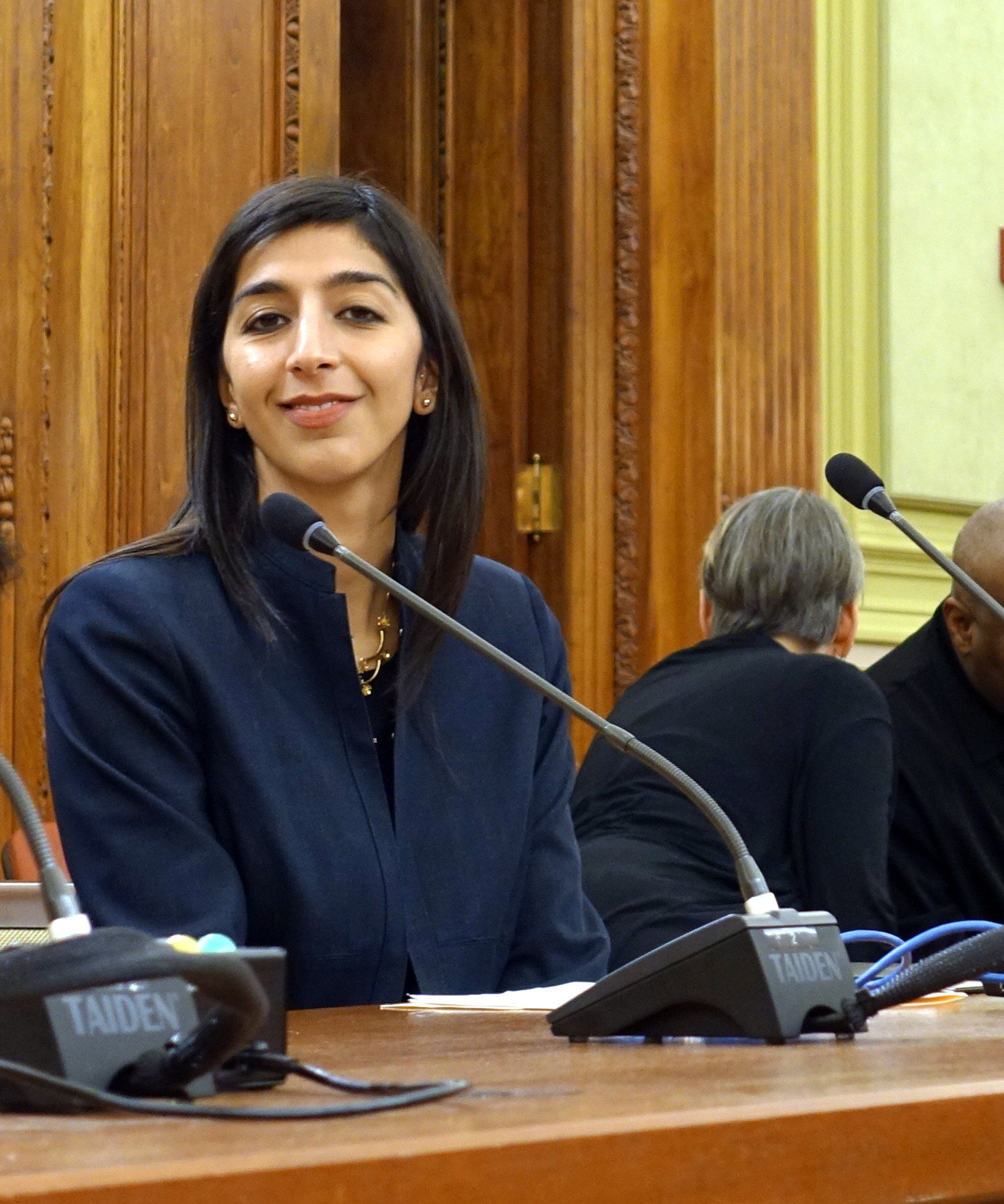
Our board member Layla before she gave her testimony
Layla right before she gave her testimony.

Good morning, Committee members. My name is Layla Moughari. I am a resident of Ward One and a member .of the Stop Street Harassment Board of Directors. Thank you for the opportunity to speak at this roundtable.

I’m here to request that you take action against street harassment.

Many people see street harassment as harmless, and a fact of life. But street harassment can be terrifying and inhibit mobility, and there’s always a possibility that street harassment can escalate into violence or sexual assault.

In the 10 years I’ve lived in DC, street harassment has been a regular feature in my life.  There have been times I’ve experienced it daily.

In Columbia Heights, I’ve experienced several aggressive and upsetting interactions. On one occasion, two men shouted obscenities at me because I didn’t respond to their advances. Another time, someone grabbed me as he rode past me on his bike.

And in another situation I was alone, walking to the gym at 6 o’clock in the morning. It was pitch black out and no one was around. I heard someone hissing at me. I looked around and couldn’t see anyone. The hissing continued but closer this time. I realized that someone was following me, getting closer to me, but hiding from me.  I was alone in the dark.  When the hissing continued, I felt that I was in imminent danger and completely helpless. I started to run and scream down the street. A concerned neighbor asked if I was OK. I was still scared, but I felt better instantly.

I skipped the gym that morning, and never felt safe walking home again. In fact, the harassment I experienced in Columbia Heights contributed to my decision to move from the neighborhood in 2012 after living there five years.

Unfortunately, this experience is not unique to me as is evident by the others here today and the many people who submit their stories to the CASS and Stop Street Harassment blogs. A national study commissioned by SSH found that two-thirds of women and one-quarter of men had experienced gender-based harassment in public spaces.

While some research exists on street harassment, we lack concrete data for DC and are limited in what we know about the rates, causes and consequence of street harassment here in the District, as well as the best practices for combating it.

I request that the city council assist in collecting data so we can better understand the scope of the problem and where specifically it happens. Then, once we understand the issue more, I hope the city council can work with local organizations on non-criminalizing, community-based solutions such as public awareness campaigns.

I hope that one day street harassment will be viewed the same way workplace sexual harassment is largely seen now, recognized by our culture as disrespectful,  inappropriate, and harmful.  Workplace sexual harassment was also accepted as normal not long ago.  But with research, policies, laws, enforcement of the rule of law, and culture change, workplace harassment is much less pervasive today.

Share

Filed Under: SSH programs, street harassment Tagged With: city council hearing, Washington DC

« Previous Page
Next Page »

Share Your Story

Share your street harassment story for the blog. Donate Now

From the Blog

  • #MeToo 2024 Study Released Today
  • Join International Anti-Street Harassment Week 2022
  • Giving Tuesday – Fund the Hotline
  • Thank You – International Anti-Street Harassment Week 2021
  • Share Your Story – Safecity and Catcalls Collaboration

Buy the Book

Search

Archives

  • September 2024
  • March 2022
  • November 2021
  • April 2021
  • March 2021
  • January 2021
  • April 2020
  • March 2020
  • February 2020
  • December 2019
  • November 2019
  • September 2019
  • August 2019
  • July 2019
  • June 2019
  • May 2019
  • April 2019
  • March 2019
  • February 2019
  • January 2019
  • December 2018
  • November 2018
  • October 2018
  • September 2018
  • August 2018
  • July 2018
  • June 2018
  • May 2018
  • April 2018
  • March 2018
  • February 2018
  • January 2018
  • December 2017
  • November 2017
  • October 2017
  • September 2017
  • August 2017
  • July 2017
  • June 2017
  • May 2017
  • April 2017
  • March 2017
  • February 2017
  • January 2017
  • December 2016
  • November 2016
  • October 2016
  • September 2016
  • August 2016
  • July 2016
  • June 2016
  • May 2016
  • April 2016
  • March 2016
  • February 2016
  • January 2016
  • December 2015
  • November 2015
  • October 2015
  • September 2015
  • August 2015
  • July 2015
  • June 2015
  • May 2015
  • April 2015
  • March 2015
  • February 2015
  • January 2015
  • December 2014
  • November 2014
  • October 2014
  • September 2014
  • August 2014
  • July 2014
  • June 2014
  • May 2014
  • April 2014
  • March 2014
  • February 2014
  • January 2014
  • December 2013
  • November 2013
  • October 2013
  • September 2013
  • August 2013
  • July 2013
  • June 2013
  • May 2013
  • April 2013
  • March 2013
  • February 2013
  • January 2013
  • December 2012
  • November 2012
  • October 2012
  • September 2012
  • August 2012
  • July 2012
  • June 2012
  • May 2012
  • April 2012
  • March 2012
  • February 2012
  • January 2012
  • December 2011
  • November 2011
  • October 2011
  • September 2011
  • August 2011
  • July 2011
  • June 2011
  • May 2011
  • April 2011
  • March 2011
  • February 2011
  • January 2011
  • December 2010
  • November 2010
  • October 2010
  • September 2010
  • August 2010
  • July 2010
  • June 2010
  • May 2010
  • April 2010
  • March 2010
  • February 2010
  • January 2010
  • December 2009
  • November 2009
  • October 2009
  • September 2009
  • August 2009
  • July 2009
  • June 2009
  • May 2009
  • April 2009
  • March 2009
  • February 2009
  • January 2009
  • December 2008
  • November 2008
  • October 2008
  • September 2008
  • August 2008
  • July 2008
  • June 2008
  • May 2008

Comment Policy

SSH will not publish any comment that is offensive or hateful and does not add to a thoughtful discussion of street harassment. Racism, homophobia, transphobia, disabalism, classism, and sexism will not be tolerated. Disclaimer: SSH may use any stories submitted to the blog in future scholarly publications on street harassment.
  • Contact
  • Events
  • Join Us
  • Donate
  • Facebook
  • Instagram
  • Pinterest
  • Tumblr
  • Twitter
  • YouTube

Copyright © 2026 Stop Street Harassment · Website Design by Sarah Marie Lacy