• About Us
    • What Is Street Harassment?
    • Why Stopping Street Harassment Matters
    • Meet the Team
      • Board of Directors
      • Past Board Members
    • In The Media
  • Our Work
    • National Street Harassment Hotline
    • International Anti-Street Harassment Week
    • Blog Correspondents
      • Past SSH Correspondents
    • Safe Public Spaces Mentoring Program
    • Publications
    • National Studies
    • Campaigns against Companies
    • Washington, D.C. Activism
  • Our Books
  • Donate
  • Store

Stop Street Harassment

Making Public Spaces Safe and Welcoming

  • Facebook
  • Instagram
  • Pinterest
  • Tumblr
  • Twitter
  • YouTube
  • Home
  • Blog
    • Harassment Stories
    • Blog Correspondents
    • Street Respect Stories
  • Help & Advice
    • National Street Harassment Hotline
    • Dealing With Harassers
      • Assertive Responses
      • Reporting Harassers
      • Bystander Responses
      • Creative Responses
    • What to Do Before or After Harassment
    • Street Harassment and the Law
  • Resources
    • Definitions
    • Statistics
    • Articles & Books
    • Anti-Harassment Groups & Campaigns
    • Male Allies
      • Educating Boys & Men
      • How to Talk to Women
      • Bystander Tips
    • Video Clips
    • Images & Flyers
  • Take Community Action
  • Contact

#16Days of Activism: Sidewalk Chalking (Day 2)

November 26, 2015 By HKearl

Nov. 25 – Dec. 10 are the 16 Days of Activism Against Gender-Based Violence. To commemorate the week, we are featuring 1 activism idea per day. This information is excerpted from my new book Stop Global Street Harassment: Growing Activism Around the World (Praeger 2015).

Colombia, 2014
Colombia, 2014

Using sidewalk chalk to write messages like “My body is not public space” has become a popular way to quickly raise awareness about street harassment. It is inexpensive, easy, and something an individual or a small group can do, and the impact can be huge. In addition to raising the awareness of people passing by while the chalking happens, dozens, hundreds, or even thousands of people can see it as they pass by—barring rain or other conditions that might wipe out the message. Anti-street harassment chalking parties have taken place all over the world, including in Melbourne, Australia; Ottawa, Canada; Bogota, Colombia; Berlin, Germany; and Dublin, Ireland, as well as in American states like California, Florida, Georgia, Hawai’i, Illinois, Massachusetts, New York, Oregon, Pennsylvania, and South Dakota.

A unique approach to chalking is the Chalk Walk the group Rebellieus, formerly Hollaback! Brussels, held in 2012. Four young women met at Ribaucourt, Molenbeek in Brussels, Belgium, on a spring morning. Their meeting place was significant because it was where one of the women, Angelika, had been harassed. With a bright-colored piece of chalk, Angelika stooped down and wrote on the sidewalk, “I was harassed here. I Hollaback. I reclaim the street.”

Brussels, 2012
Belgium, 2012

She proudly stood by her message as her friends hugged her and congratulated her on reclaiming the space. Together, they made a pilgrimage to other spots where they had been harassed: a busy four-lane boulevard for Anna, the sidewalk of a busy bridge for Julie, and the staircase at the Metro stop De Brouckere for Ingrid. At each place, they shared their stories, reclaimed the space with chalk, and hugged. Several people stopped to talk to them, to hear their stories, and to support their message.

Bahamas Chalk Walk 2014
The Bahamas, 2014

“AWESOME is not even a strong enough word to describe it! EMPOWERING comes close!” the women wrote on their Facebook wall. “What we discovered was that writing with chalk on the sidewalk, on the street, on the bridge, telling Brussels: “I was harassed here’ ‘I reclaim the street’ is a powerful, liberating ritual and an amazing [experience].” In 2013, they launched a We Chalk Walk Tumblr where anyone can submit anti-street harassment chalk messages.

Chalking can be an effective way to start conversations and change minds. In Nassau, the Bahamas, two young women wrote messages such as “Whistle at dogs, not girls” and “Respect girls” on a sidewalk along the beach. They said that among the people who stopped to talk to them was a man “who thought we were writing the message specifically to him. We explained what we were doing to him and told him what he did WAS in fact street harassment. He, of course, did not believe us, and we had to break it down for him. He ended up understanding what we were saying, so we hope we have a converted man in Nassau!”

This is exactly the kind of impact they hoped to have. Alicia Wallace, one of the women, told the local newspaper: “Chalk messages are not common here, and we knew it would attract the attention of pedestrians. … It is unacceptable, and educating the general public on the definition and everyday examples of street harassment is the first step to combating this problem.”

Help fund our work in 2016, donate to our end-of-year giving campaign!

Share

Filed Under: 16 days, Resources, street harassment Tagged With: 16 days of activism, gender-based violence, sidewalk chalking

#16Days of Activism: More Global Action (Day 1)

November 25, 2015 By HKearl

Nov. 25 – Dec. 10 are the 16 Days of Activism Against Gender-Based Violence. To commemorate the week, we will feature 1 activism idea per day, starting tomorrow.

Today, I wanted to express gratitude and acknowledgement that gender-based street harassment, or sexual violence in public spaces, is gaining much more widespread recognition as a problem. Here are two examples from this year that clearly illustrate this.

1. In April groups in 41 countries took action in support of safe public spaces through our International Anti-Street Harassment Week, from Australia to Zimbabwe and dozens of countries in between. You can view photos and read a recap (and plan to join us April 10-16, 2016!). It’s heartening to see so many people dedicate time and energy to this cause.

EndSHWeekpostcard2016

2. UN Women hosted a Safe Cities Global Leaders’ Forum in June, and 140 people from 24 countries gathered in Delhi, India, to share ideas about the best strategies to address sexual violence in public spaces. Attendees included government officials, grassroots women, researchers, and staff from UN agencies that are implementing programs that form part of the agency’s Safe Cities Global Initiative (SCGI).

The SCGI works with local organizations and governments to tackle sexual harassment and other forms of sexual violence in public spaces. Launched in New Delhi in November 2010 with five cities, it now includes 22 cities. Representatives from these cities, as well as from other groups working on safe cities work, were present at the forum.

Read the wrap-up report.

SafeCitiesForumIndia-cropped

For too long, street harassment has been seen as normal, no big deal, or the fault of harassed persons. Those attitudes are quickly falling away and in their place are thousands of people worldwide who are dedicating time, energy, and expertise to making public places safer for everyone. For that, I am grateful.

Help fund our work in 2016, donate to our end-of-year giving campaign!

Share

Filed Under: 16 days, anti-street harassment week, SSH programs, street harassment Tagged With: 16 days of activism, gender-based violence, global efforts, UN women

Update on Washington, DC-Area Anti-Harassment Transit Campaign

November 23, 2015 By HKearl

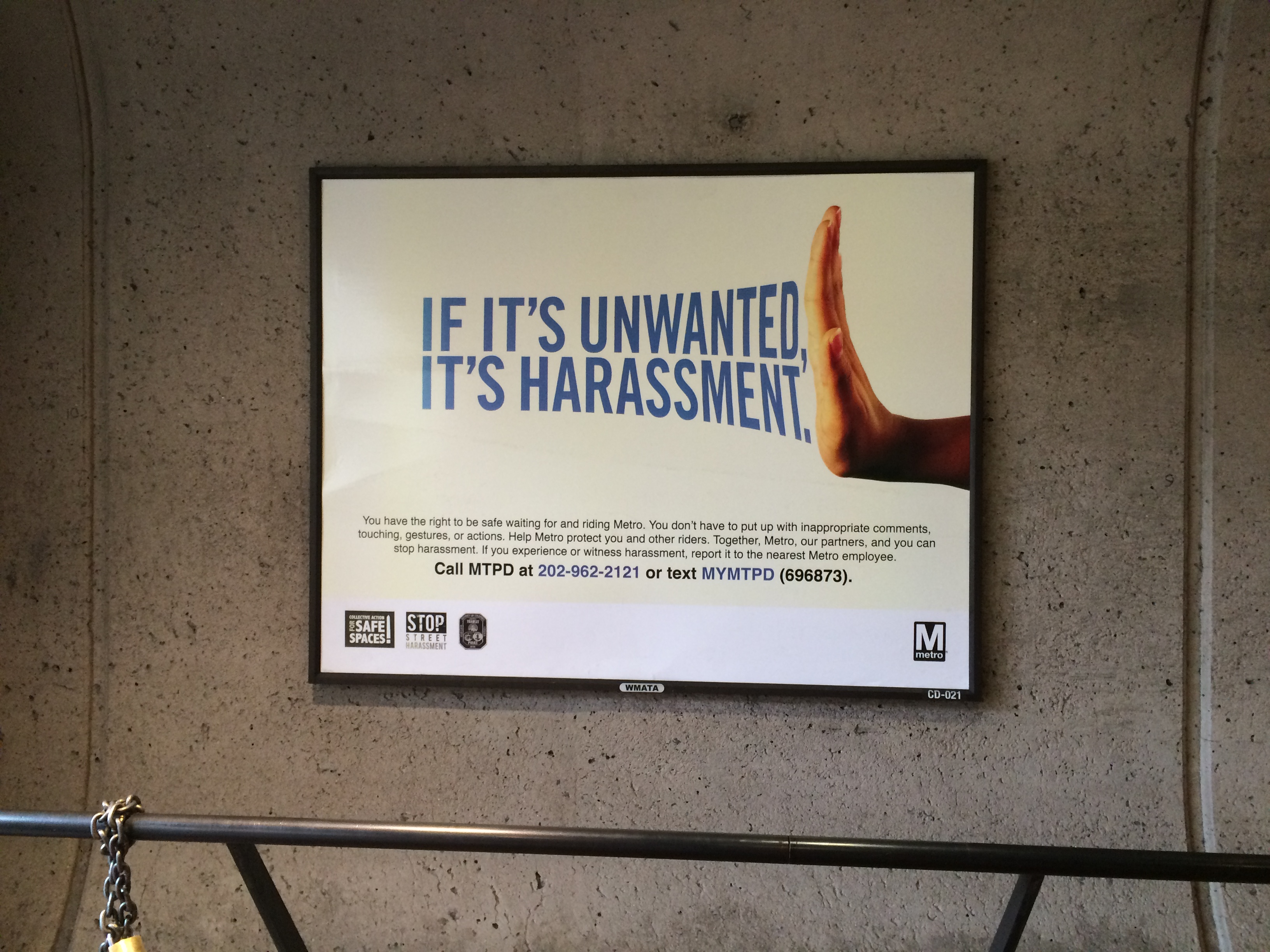
Anti-Harassment Transit Ad, Washington DCIt’s been more than 3.5 years since we began working with Collective Action for Safe Spaces (CASS) and the Washington Metropolitan Area Transit Authority (WMATA) on an anti-harassment campaign.

Periodically, we meet with the sexual harassment taskforce at WMATA to discuss the campaign and next steps, etc. Today was one of those meetings, with myself, four WMATA staff members, and CASS’s interim executive director Jessica Raven.

For a status update on what the campaign currently entails:

* A second wave of anti-harassment ads are up across the system.

* More trainings are underway to ensure that all 4000 front line employees know what to do if they witness or experience street harassment or if someone reports an incident to them.

* There is an online reporting form that makes it easier to report incidents.

* We jointly hold annual outreach days, distributing materials at metro stations during International Anti-Street Harassment Week. This year, we were at five metro stations across VA, DC and MD.
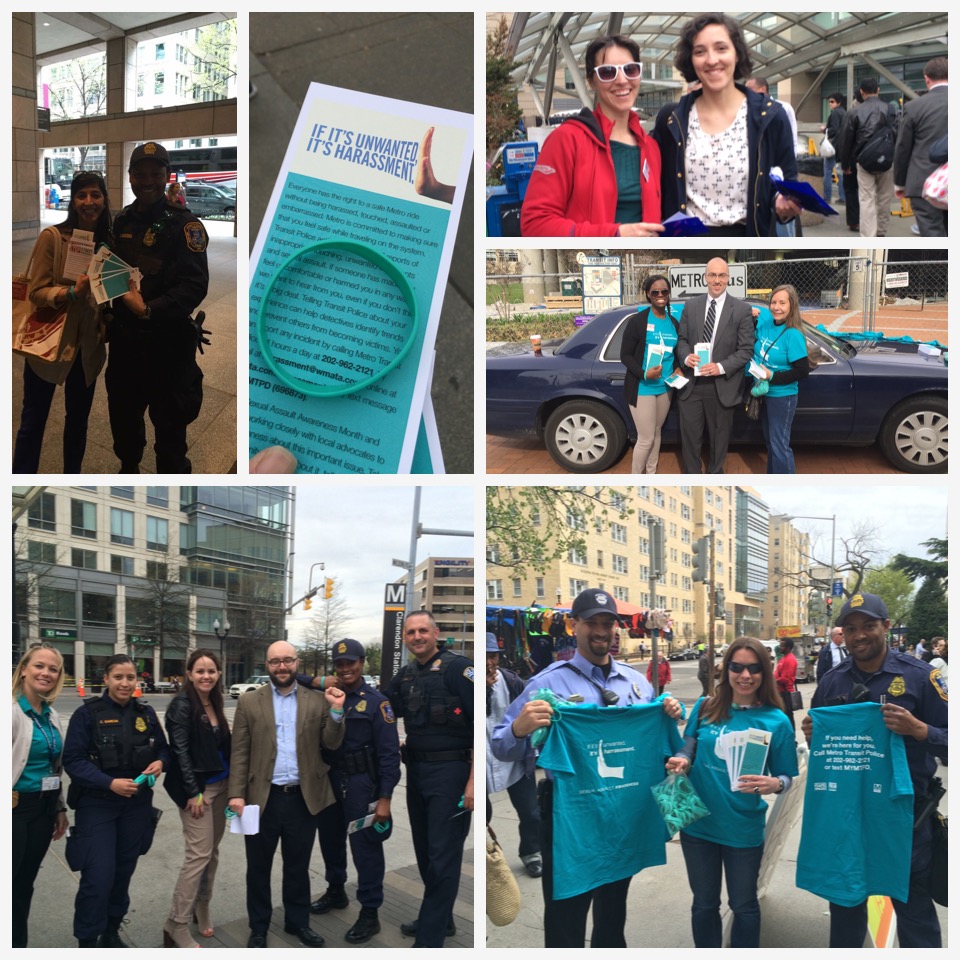
Metro outreach day, April 2015

I am excited that today at our meeting, WMATA committed to a third wave of ads next year. They will survey riders before the end of this year to better understand their experiences with harassment and their feelings about the first and second waves of ads, and ask for their thoughts for the next wave. We discussed having a message focused on bystanders and/or the community-of riders generally, but we will see what riders have to say.
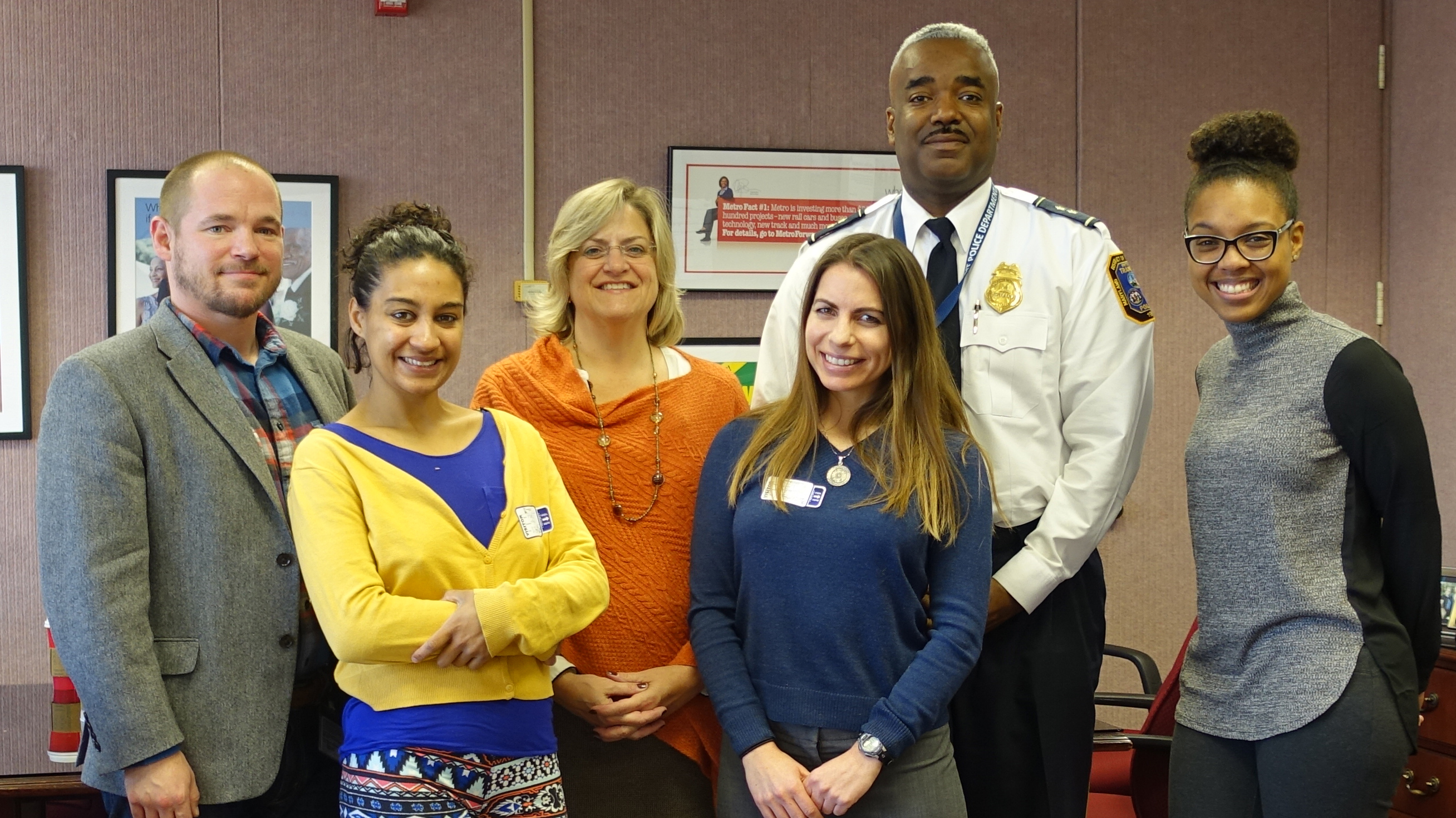
11.23.15 WMATA - SSH - CASS meeting. (L to R): Jason Minser, Jessica Raven, Lynn Bowser, Holly Kearl, Deputy Chief Leslie Campbell, and Morgan Dye
11.23.15 WMATA – SSH – CASS meeting. (L to R): Jason Minser, Jessica Raven, Lynn Bowser, Holly Kearl, Deputy Chief Leslie Campbell, and Morgan Dye

WMATA wants to collaborate on four flyering/outreach events at Metro stations in 2016: 1) during Anti-Street Harassment Week in April, 2) mid-summer, 3) around the back-to-school time, and 4) on December 10 for Human Rights Day.

We discussed a few other ways that we may collaborate to help spread the word about the campaign among WMATA staff and the larger Metro-area community. More on those ideas when they are solidified.

All in all, it was a productive meeting.

I am so proud and happy every time I see one of the Metro ads (and on my metro ride to/from the meeting I saw two different ones), not only because I am part of the campaign, but also because I feel great pride in knowing that my city takes this issue seriously and is expending significant time, resources, and staff power to help people feel safer on public transit. Thank you, WMATA!

Also of note –

* The history of how our collaboration came about is featured in my new book Stop Global Street Harassment: Growing Activism Around the World.

* If you’re in the DC-area, join WMATA, CASS, Defend Yourself, the DC Rape Crisis Center, and SSH staff and many community members in testifying about street harassment before the DC City Council next week, Dec. 3.

 

Share

Filed Under: SSH programs, street harassment Tagged With: DC-area, transit campaign, WMATA

Harassed Three Times By the Same Man

November 23, 2015 By Contributor

For about three weeks I have been walking to the train station itself to wait for my bus. It has gotten so windy and cold out now to stand at the bus stop now that it’s November. As the bus pulls up, a line forms for people to insert their bus fare into the machine. While I am checking my messages on my phone I notice that through my peripheral vision that his middle age man in a blue jacket and grey hat has turned towards me and started saying “My, my. my.”

His tone alone made the words “leave me alone” echo in my head. I was mainly focused on my phone, which he noticed so he repeated, “My, my, my” at me again. Since we were in a line I stepped off the the side and said, ‘Excuse me’ in an effort to come off as if I wasn’t really paying attention to him. He looked at me and said something along the lines of ‘I look beautiful’. (Again, I was more focused on responding a message on my phone so I just brushed him off thinking that’s he’s just showing off his ignorance).

He said, “I’ve seen you some times get on the 24 bus”. The 24 is not my usual bus so I don’t know what confused nonsense he was talking about. It came off as ‘stalker-like’. The thought alone made me feel vile.

That was the first time. I never thought I’d have to see that person again. I was wrong.

I was waiting for the bus again at the same station gateway when the same man made the acknowledgement that he saw me yesterday. Once again, my mind was juggling between schoolwork and how I would I spend next time with my boyfriend so I didn’t hear word for word what he said. I got a slightly better look at this guy and my only inner comment was that he looked old enough to be my father’s uncle and my dad is 52! I was definitely bothered now.

It’s not just what he’s saying that struck a nerve with me. It’s because of the sheer fact that if someone is not acknowledging you, it’s only common sense to leave that person alone, but this guy wasn’t getting the hint. He’s either oblivious or a jackass!

If that wasn’t bad enough there was a third time. Like I said, I. had. enough.

If that guy ever tries fishing for my attention again then I’m telling him off! I was boarding the bus as usual and standing in line to insert bus fare when you-know-who showed up saying ‘hello again’. I ignored him the first time and then he repeated it again.

That’s it! “Leave me alone you disgusting vole!” I shouted at him. There was one person in front of me and another in back of me so they certainly saw and heard me say it too. He just smirked and tried to play it off for the other people who saw. I then turned to board the bus thinking he probably wasn’t expecting me to speak up. As soon as I sat down with my book in hand this same jackass sat in the seat across from me and tried to tap the two-seater I was in to get my attention again! He stopped after more people began to board the bus. What was this guy’s problem?!

Before I even said anything my body language said ‘not interested.’ and ‘sure as hell not interested’. It should’ve stopped the first time but I hope that there won’t be a fourth time.

– Nia H.

Location: Newark Penn Station, NJ

Share your street harassment story for the blog.
See the book 50 Stories about Stopping Street Harassers for more idea
.

Share

Filed Under: Stories, street harassment

“I live in fear”

November 21, 2015 By Contributor

This morning I stepped out of my apartment and started walking to the subway station – four blocks from my apartment. After two blocks, a man walking from around the corner ends up on the same sidewalk as me, about five yards behind.

Immediately, I hear, “Daaaamn, when you walk like that it jiggles. Looks good from here though. Bless you AND ya mama. Bless you.”

I have two options here. I can ignore him and keep walking, picking up my pace a bit to distance myself. But then he’ll take notice of this passive (almost submissive) behavior, and he might want to take advantage of that. He might keep following me. He might make more comments. He might even take action. He might grab me.

My other option is to turn around and look him dead in the eye and stand up for myself, telling him it’s not okay for him to speak to someone that way. But then he might get offended. He might not appreciate that I spoke at all – I’m supposed to just be an object, right? He might want to shut me up and put me in my place. He might try to attack me. He might try to rape me. He might try to hit me.

While I’m mulling over my two absolutely stellar options on this empty street in Brooklyn at 11 o’clock in the morning, I wonder to myself, “Should I not have worn these leggings? Should I not have worn these booty heels? Is it somehow my fault?” FU** THAT. These leggings are comfortable as shit, and it’s fu**ing cold outside. And I like these shoes – I think they’re cute. That’s why I fu**ing picked them out at the store and bought them. That’s why they were manufactured – for women to wear outside. Not for men to attack women for wearing them.

I should mention I’m also wearing a baggy t-shirt and a huge soccer backpack. I could have been wearing a sack and this man would have found a way to comment on my ankles or my hair or the fact that I have a skeleton covered in skin.

I ended up choosing the first option – saying nothing, picking up my pace (which of course I’m realizing makes “it jiggle” even more – great!). I ducked into the first coffee shop I came upon and waited a few minutes for the coast to be clear. After this all happened, I found myself wishing I had stood up for myself and said something. After all, that’s the only way he’s going to learn that he did something wrong.

However, in this situation, standing up for yourself also means risking your safety and your life. I’ve never been raped. I’ve never been physically assaulted. I live in a nice enough neighborhood. And yet, I live in fear of the day someone will find me in a vulnerable situation and take advantage of me.

No woman should have to live in fear. No woman should have to be alert for rape – no woman should be responsible for preventing it from happening. The next time you try to tell me that men are just “paying me a compliment,” think twice. Say nothing.

Optional: What’s one way you think we can make public places safer for everyone?

Educate young men.

– Kerry

Location: Brooklyn, NY

Share your street harassment story for the blog.
See the book 50 Stories about Stopping Street Harassers for more idea
.

Share

Filed Under: Stories, street harassment

« Previous Page
Next Page »

Share Your Story

Share your street harassment story for the blog. Donate Now

From the Blog

  • #MeToo 2024 Study Released Today
  • Join International Anti-Street Harassment Week 2022
  • Giving Tuesday – Fund the Hotline
  • Thank You – International Anti-Street Harassment Week 2021
  • Share Your Story – Safecity and Catcalls Collaboration

Buy the Book

Search

Archives

  • September 2024
  • March 2022
  • November 2021
  • April 2021
  • March 2021
  • January 2021
  • April 2020
  • March 2020
  • February 2020
  • December 2019
  • November 2019
  • September 2019
  • August 2019
  • July 2019
  • June 2019
  • May 2019
  • April 2019
  • March 2019
  • February 2019
  • January 2019
  • December 2018
  • November 2018
  • October 2018
  • September 2018
  • August 2018
  • July 2018
  • June 2018
  • May 2018
  • April 2018
  • March 2018
  • February 2018
  • January 2018
  • December 2017
  • November 2017
  • October 2017
  • September 2017
  • August 2017
  • July 2017
  • June 2017
  • May 2017
  • April 2017
  • March 2017
  • February 2017
  • January 2017
  • December 2016
  • November 2016
  • October 2016
  • September 2016
  • August 2016
  • July 2016
  • June 2016
  • May 2016
  • April 2016
  • March 2016
  • February 2016
  • January 2016
  • December 2015
  • November 2015
  • October 2015
  • September 2015
  • August 2015
  • July 2015
  • June 2015
  • May 2015
  • April 2015
  • March 2015
  • February 2015
  • January 2015
  • December 2014
  • November 2014
  • October 2014
  • September 2014
  • August 2014
  • July 2014
  • June 2014
  • May 2014
  • April 2014
  • March 2014
  • February 2014
  • January 2014
  • December 2013
  • November 2013
  • October 2013
  • September 2013
  • August 2013
  • July 2013
  • June 2013
  • May 2013
  • April 2013
  • March 2013
  • February 2013
  • January 2013
  • December 2012
  • November 2012
  • October 2012
  • September 2012
  • August 2012
  • July 2012
  • June 2012
  • May 2012
  • April 2012
  • March 2012
  • February 2012
  • January 2012
  • December 2011
  • November 2011
  • October 2011
  • September 2011
  • August 2011
  • July 2011
  • June 2011
  • May 2011
  • April 2011
  • March 2011
  • February 2011
  • January 2011
  • December 2010
  • November 2010
  • October 2010
  • September 2010
  • August 2010
  • July 2010
  • June 2010
  • May 2010
  • April 2010
  • March 2010
  • February 2010
  • January 2010
  • December 2009
  • November 2009
  • October 2009
  • September 2009
  • August 2009
  • July 2009
  • June 2009
  • May 2009
  • April 2009
  • March 2009
  • February 2009
  • January 2009
  • December 2008
  • November 2008
  • October 2008
  • September 2008
  • August 2008
  • July 2008
  • June 2008
  • May 2008

Comment Policy

SSH will not publish any comment that is offensive or hateful and does not add to a thoughtful discussion of street harassment. Racism, homophobia, transphobia, disabalism, classism, and sexism will not be tolerated. Disclaimer: SSH may use any stories submitted to the blog in future scholarly publications on street harassment.
  • Contact
  • Events
  • Join Us
  • Donate
  • Facebook
  • Instagram
  • Pinterest
  • Tumblr
  • Twitter
  • YouTube

Copyright © 2026 Stop Street Harassment · Website Design by Sarah Marie Lacy