• About Us
    • What Is Street Harassment?
    • Why Stopping Street Harassment Matters
    • Meet the Team
      • Board of Directors
      • Past Board Members
    • In The Media
  • Our Work
    • National Street Harassment Hotline
    • International Anti-Street Harassment Week
    • Blog Correspondents
      • Past SSH Correspondents
    • Safe Public Spaces Mentoring Program
    • Publications
    • National Studies
    • Campaigns against Companies
    • Washington, D.C. Activism
  • Our Books
  • Donate
  • Store

Stop Street Harassment

Making Public Spaces Safe and Welcoming

  • Facebook
  • Instagram
  • Pinterest
  • Tumblr
  • Twitter
  • YouTube
  • Home
  • Blog
    • Harassment Stories
    • Blog Correspondents
    • Street Respect Stories
  • Help & Advice
    • National Street Harassment Hotline
    • Dealing With Harassers
      • Assertive Responses
      • Reporting Harassers
      • Bystander Responses
      • Creative Responses
    • What to Do Before or After Harassment
    • Street Harassment and the Law
  • Resources
    • Definitions
    • Statistics
    • Articles & Books
    • Anti-Harassment Groups & Campaigns
    • Male Allies
      • Educating Boys & Men
      • How to Talk to Women
      • Bystander Tips
    • Video Clips
    • Images & Flyers
  • Take Community Action
  • Contact

Young Boy is a Bystander Hero!

November 19, 2015 By Contributor

Note: This is cross-posted from author Julia Price’s Facebook page.

Julia Price, from her Facebook post

I was on my usual running path when I heard an older man yelling loudly enough for me to hear through my headphones. “Sexy lady, hey hey hey sexy lady!” He kept screaming it and I decided to just ignore him and keep running.

This ignoring seemed to piss him off so he lashed out and said “eff you, dumb B****!” Now let’s keep in mind he was well-dressed and appeared to be on his lunch break from an office job.

That was my trigger point. The B word. I ripped off my headphones prepared to stand up for myself when this little boy who was walking alongside his mother and little sister in a stroller looked at the guy and said, “Hey. That is not nice to say to her and she didn’t like you yelling at her. You shouldn’t do that because she is a nice girl and I don’t let anyone say mean things to people. She’s a girl like my sister and I will protect her.”

The man was immediately embarrassed and started gathering his lunch to leave. I asked the mother if I could hug the little boy (his name is James) and I told him how grateful I was for him. He just shrugged and said “Well I just wanted to make sure your heart was okay.”

According to his mother, this is a typical day in the life of James. Thank you so much to the mothers and fathers who are raising the next generation to be brave and courageous, and to be little earth angels for all. I am so touched.

Share

Filed Under: Stories, street harassment Tagged With: bystander, running, success story

Croatia: It’s Never Too Soon to Talk to Children

November 19, 2015 By Correspondent

Marinella Matejcic, Croatia, SSH Blog Correspondent

As I was finishing my chores for the day, my daughter began sharing a story from her class with me. She goes to elementary school, is very calm, mature, and has a strong sense of justice. “So, do can you even imagine what did this boy did..”

“Which one?” I asked gently, trying to hide my ignorance. “This X kid or the Y kid?”

“Neither of them, it was the XY, he pushed a girl to the ground and tried to kiss her. We didn’t tell anyone, and he decided to let her go. But can you imagine?”

The unexpected sorrow got to me because the sad part is – I could imagine. That boy is the theoretical boy who later on continues to hassle other people. That boy represents the one who never hears no from his peers because they’re afraid of him. Boys like that get to be local mini-bully that grow up to a typical bully and possibly later on develop a file with the police. That kind of behaviour is the starter pack for harassment that includes catcalling and other forms of street harassment.

What bugs me is this – when and why and where did that boy decide it would be okay to harass someone? I don’t feel that kind of behaviour is congenital. Are the patriarchal patterns so deeply incorporated into our culture that we are successfully implementing them from that early age? I’m not thinking about general gender-roles expectations, but – is the violence that comes from hatred and the urge to dominate so easily being ignored, just for the sake of letting “boys be boys?”

I firmly believe that it’s never too soon to talk to our children about these serious topics — consent, personal boundaries, acceptance, freedom, and discrimination – even though they keep our throats dry and heart rates high. Those are the topics we should discuss at home since children carry their respect to others from home.

What is the exact moment when the let “boys be boys” changes into a hate crime, sex crime, whatever? In situations like that, when we’re talking about children and parenting, it’s important not to blame it on the kid – it’s never the kid’s fault. At the same time, we have to keep in mind that at some point, the child will start making informed or less informed choices and we are here to help them carry out the good ones by promoting healthy life choices and providing positive models to look up to.

Society changes step by step, and we are the society, so wouldn’t it be logical to teach our children the same values we desire? We can talk about how to combat street harassment with activities, rallies, and websites, but we will not make as big of a positive impact until we start teaching the next generation how to avoid becoming those harassers.

Marinella is a freelance journalist/writer, feminist activist, and soon-to-be administrative law student. She writes for Croatian portal on gender, sex and democracy called Libela.org and covers CEE stories for globalvoicesonline.org. Follow her on Twitter @mmatejci.

Share

Filed Under: correspondents, street harassment Tagged With: children, parents

“That’s not a compliment. That’s my personal hell.”

November 17, 2015 By Contributor

I’ve been street harassed more times than I could possibly count or recall. Having said that, I need to be very clear about two thing: First, in society, it’s assumed that being “beautiful, sexy, pretty, hot, etc.” is a blessing and should be received with open arms. And two, it’s no hidden secret that individuals with certain “desired characteristics” tend to have more opportunities in social and economic settings. Consequently, it’s widely thought that the first sentiment and the second automatically mean an individual is comfortable with this privilege.

Yes, I’m calling it a privilege because it’s true- aesthetically pleasing people have more given to them. But it’s also true that what is given is NOT always wanted. I have been told on numerous occasions I am so beautiful, that to be shy or awkward when given attention is ludicrous. Honestly, people truly believe that my looks should instill in me a sense of pride and accomplishment. When in reality, I am self-conscious on so many levels because I know no matter what I wear, which type of style I pick for that day, I will be given unwanted attention. Very unwanted attention.

I can honestly say I will be street harassed at least once every week. Generally it happens on the way to and from work, when going to the gym, out buying groceries, going to a sporting event, and getting into my car after dinner. In case you missed it… IT HAPPENS EVERYWHERE!

For example: just last week I was at Walmart and waiting in the self-checkout line. I only had one item to buy and the man ahead of me had around twenty or so items. When he glanced back at me, saw that I had the one, he told me to go ahead because he would be a while. I said, “thank you” and smiled at his generosity. Little did I know that I was actually being asked to go ahead of him because, in his words, “I had a nice ass and was a fine piece of meat.” I stood there for 30 second while he moaned and whistled under his breathe and said that over and over again. For 30 second I was sexually harassed as I rushed through to get out of the store. I sprinted for my car and got in just in time to breathe.

Can you imagine feeling that way on a regular basis? That’s not a compliment. That’s my personal hell.

– DT

Location: Oklahoma City, OK

Share your street harassment story for the blog.
See the book 50 Stories about Stopping Street Harassers for more idea
.

Share

Filed Under: Stories, street harassment

The Netherlands: From Paris to Amsterdam: Connecting the Dots

November 16, 2015 By Correspondent

Eve Aronson, Amsterdam, the Netherlands, SSH Blog Correspondent

The events in Paris last week, just a few hours drive from Amsterdam, were tragic and appalling. They also represent an extreme form of a familiar foe.

The Paris shooters targeted people in public venues—sports stadiums, restaurants and concerts—dictating their movement and using violence to carry out their agenda.

What such a choice in venues and tactics makes clear is that the perpetrators targeted spaces designed for public use and leisure and used violence towards people they did not know within these spaces.

We can therefore look at the events in Paris as examples—albeit extreme ones—of the broader power structures that define how safe people feel in public spaces.

Not unlike a man groping or catcalling a woman on the street, the incidents in Paris show how important it is to understand seemingly mundane ‘everyday’ street harassment incidents as part of broader notions of freedom and safety in public spaces.

You might be thinking: Wait a second. That’s a bit of a stretch. Street harassment is, for one, typically gendered (e.g. a man catcalls/whistles at/gropes a woman), whereas the Paris events were not.

That is a valid point to raise and indeed, the Paris events were not explicitly gendered (although they do have implicit echoes of links between terrorism and masculinity that have been raised in relation to previous violent attacks in public spaces).

However, there are a few important connections to highlight that bring these issues closer together than you might expect.

But before I do, I want to note why I am taking the time to do so. By showing how different and seemingly unrelated forms of violence within public spaces connect, my hope is that better, more lasting and enduring solutions can be found to a larger number of problems that affect people in public spaces. In addition to finding better solutions, underlining the similarities among these issues can also lead to more resources and brains available to prevent them in the future. But I digress.

One main connection between the incidents in Paris and everyday street harassment are that the feelings of powerless, confusion and fear that were evoked last Friday were the same feelings that people in Amsterdam, for example, reported feeling while and after they were harassed.

And, at least for the short-term, the feelings of apprehension that many people in Paris are feeling when they step out into the public sphere is not so dissimilar to the feelings expressed by people as a result of their experiences with street harassment in Amsterdam.

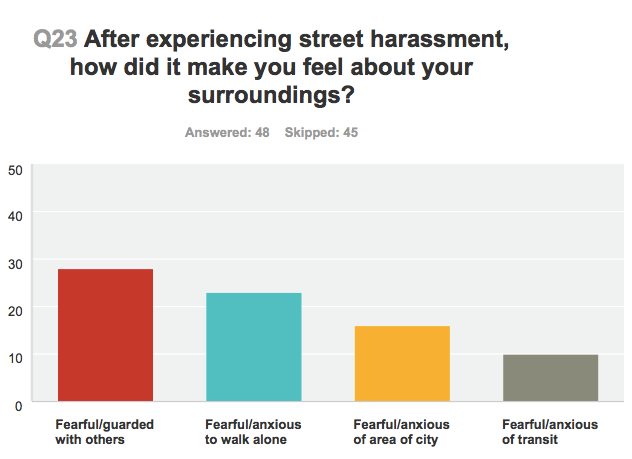
Below is a chart of some of the primary feelings about their surroundings that people in Amsterdam reported after experiencing various forms of street harassment:

amsterdam-fearful

A look on the conversations happening on Twitter about the Paris events reveals a similar spectrum of emotions. What this shows, is that in order to more fully understand and fight against issues like street harassment and violent attacks in public spaces, we have to start making connections between different manifestations of impeding or restricting movement within public spaces.

By doing this, we can start to see broader power structures emerge that reveal why these incidents occur and the factors that drive people to be physically or verbally violent towards others they do not know within different public spaces around the world.

The majority of reasons that people in Amsterdam, for example, think that their harasser(s) did what they did is that they believe their harasser(s) want to fit in with others in some way and to be accepted and applauded for their actions. The second most common reason people cited that was that they believed that their harasser(s) thought it was the ‘normal’ or ‘natural’ thing to do.

The fact that many perpetrators (street harassers or others) are motivated by group acceptance and by what they think is normal are just more of the many commonalities between issues like street harassment and other forms of violence in public spaces.

In a time where people are increasingly fearful, anxious or weary of moving through public spaces—whether because they do not want to be catcalled or groped, or whether because they do not want to be harmed or attacked in another way—it is absolutely essential that we make it our priority to examine the links between different forms of violence in public spaces more closely.

Looking at these links and using them to our advantage in the fight against street harassment and against violence in public spaces will lead to more informed policies, more helpful solutions and to more individuals feeling safer in public spaces. So what are we waiting for?

You can find the full analysis of the Amsterdam survey results here or by contacting Eve at evearonson@gmail.com. Follow Eve and Hollaback! Amsterdam on Twitter at @evearonson and @iHollaback_AMS and show your support by liking Hollaback! Amsterdam’s Facebook page here.

Share

Filed Under: correspondents, News stories Tagged With: paris, terrorism

USA: What Would the World Be Like If All Women Were Safe?

November 15, 2015 By Correspondent

Sara Conklin, Washington, DC, USA, SSH Blog Correspondent

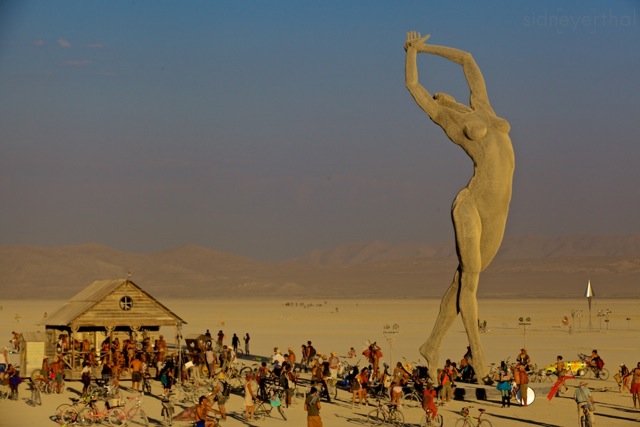
1234695_627388203960774_255348182_n
Truth is Beauty | Marco Cochrane

What would that be like? I’ve spent the past several days in quiet contemplation on the matter. After “planning” (read: pinterest’ing) my probably-not-happening-anytime-soon trip to Burning Man, I came across this striking art installation by The Bliss Project, of a 40-foot woman that poses the question, what would the world be like if all women were safe?

Well, for starters, my world would be drastically different. I have built a life around women survivors; women who have braved incomparable odds and battled life’s challenges. I work in a community center and housing complex for women experiencing homelessness. I drum alongside an all-women’s cohort of marching percussionists. I keep a tight-knit group of women warrior friends. And I champion daily, my mother and grandmother who came before me and all they’ve taught me about strength and veracity. (Heck, I even write for this blog.)

What I love the most about this sculpture of the female form is that you can’t hide from it. She is vivaciously and fiercely alive. Her presence is notably dominant on the landscape. But, as the artist Ian Mackenzie mentions, “that very energy is dangerous for women to do in the real world.”

If I closed my eyes and imagined a world in which all women were safe, I see a huge void. Would my all-women’s drumline have the same necessary element of female empowerment? Would my girlfriends have the same compassion and vitality each time we meet? And more interestingly, would the organization I work for simply exist?

Perhaps this speaks more to the lifestyle I’ve chosen, then the dramatic question the artist poses. Nonetheless, it got me thinking about my daily environment and mainly that the threat of being unsafe is what permeates my everyday life.

And what an interesting thought that is – Do you pity the person who lives with that in mind each passing day, or in solidarity, do you choose to champion her?

These are a lot of questions that I do not have the answer to. But, what I can begin to conclude is that if we are faced with a world where women will not, have not, and cannot always be safe, then I am proud there are so many sisters with me. If the impossibility is permanent, together we can lessen it. If we do indeed share the burden, I’m happy at least to know I am sharing it. For being alone in a fight is a scary thing.

Sara works in fundraising events at an organization that empowers women who face homelessness through recovery, wellness training, and housing. She runs her own photography company (saraconklinphotography.com) and a popular website that seeks to connect the world through pictures, sarapose.com.

Share

Filed Under: correspondents Tagged With: safety, solidarity, violence

« Previous Page
Next Page »

Share Your Story

Share your street harassment story for the blog. Donate Now

From the Blog

  • #MeToo 2024 Study Released Today
  • Join International Anti-Street Harassment Week 2022
  • Giving Tuesday – Fund the Hotline
  • Thank You – International Anti-Street Harassment Week 2021
  • Share Your Story – Safecity and Catcalls Collaboration

Buy the Book

Search

Archives

  • September 2024
  • March 2022
  • November 2021
  • April 2021
  • March 2021
  • January 2021
  • April 2020
  • March 2020
  • February 2020
  • December 2019
  • November 2019
  • September 2019
  • August 2019
  • July 2019
  • June 2019
  • May 2019
  • April 2019
  • March 2019
  • February 2019
  • January 2019
  • December 2018
  • November 2018
  • October 2018
  • September 2018
  • August 2018
  • July 2018
  • June 2018
  • May 2018
  • April 2018
  • March 2018
  • February 2018
  • January 2018
  • December 2017
  • November 2017
  • October 2017
  • September 2017
  • August 2017
  • July 2017
  • June 2017
  • May 2017
  • April 2017
  • March 2017
  • February 2017
  • January 2017
  • December 2016
  • November 2016
  • October 2016
  • September 2016
  • August 2016
  • July 2016
  • June 2016
  • May 2016
  • April 2016
  • March 2016
  • February 2016
  • January 2016
  • December 2015
  • November 2015
  • October 2015
  • September 2015
  • August 2015
  • July 2015
  • June 2015
  • May 2015
  • April 2015
  • March 2015
  • February 2015
  • January 2015
  • December 2014
  • November 2014
  • October 2014
  • September 2014
  • August 2014
  • July 2014
  • June 2014
  • May 2014
  • April 2014
  • March 2014
  • February 2014
  • January 2014
  • December 2013
  • November 2013
  • October 2013
  • September 2013
  • August 2013
  • July 2013
  • June 2013
  • May 2013
  • April 2013
  • March 2013
  • February 2013
  • January 2013
  • December 2012
  • November 2012
  • October 2012
  • September 2012
  • August 2012
  • July 2012
  • June 2012
  • May 2012
  • April 2012
  • March 2012
  • February 2012
  • January 2012
  • December 2011
  • November 2011
  • October 2011
  • September 2011
  • August 2011
  • July 2011
  • June 2011
  • May 2011
  • April 2011
  • March 2011
  • February 2011
  • January 2011
  • December 2010
  • November 2010
  • October 2010
  • September 2010
  • August 2010
  • July 2010
  • June 2010
  • May 2010
  • April 2010
  • March 2010
  • February 2010
  • January 2010
  • December 2009
  • November 2009
  • October 2009
  • September 2009
  • August 2009
  • July 2009
  • June 2009
  • May 2009
  • April 2009
  • March 2009
  • February 2009
  • January 2009
  • December 2008
  • November 2008
  • October 2008
  • September 2008
  • August 2008
  • July 2008
  • June 2008
  • May 2008

Comment Policy

SSH will not publish any comment that is offensive or hateful and does not add to a thoughtful discussion of street harassment. Racism, homophobia, transphobia, disabalism, classism, and sexism will not be tolerated. Disclaimer: SSH may use any stories submitted to the blog in future scholarly publications on street harassment.
  • Contact
  • Events
  • Join Us
  • Donate
  • Facebook
  • Instagram
  • Pinterest
  • Tumblr
  • Twitter
  • YouTube

Copyright © 2026 Stop Street Harassment · Website Design by Sarah Marie Lacy