• About Us
    • What Is Street Harassment?
    • Why Stopping Street Harassment Matters
    • Meet the Team
      • Board of Directors
      • Past Board Members
    • In The Media
  • Our Work
    • National Street Harassment Hotline
    • International Anti-Street Harassment Week
    • Blog Correspondents
      • Past SSH Correspondents
    • Safe Public Spaces Mentoring Program
    • Publications
    • National Studies
    • Campaigns against Companies
    • Washington, D.C. Activism
  • Our Books
  • Donate
  • Store

Stop Street Harassment

Making Public Spaces Safe and Welcoming

  • Facebook
  • Instagram
  • Pinterest
  • Tumblr
  • Twitter
  • YouTube
  • Home
  • Blog
    • Harassment Stories
    • Blog Correspondents
    • Street Respect Stories
  • Help & Advice
    • National Street Harassment Hotline
    • Dealing With Harassers
      • Assertive Responses
      • Reporting Harassers
      • Bystander Responses
      • Creative Responses
    • What to Do Before or After Harassment
    • Street Harassment and the Law
  • Resources
    • Definitions
    • Statistics
    • Articles & Books
    • Anti-Harassment Groups & Campaigns
    • Male Allies
      • Educating Boys & Men
      • How to Talk to Women
      • Bystander Tips
    • Video Clips
    • Images & Flyers
  • Take Community Action
  • Contact

“Any response I could have given would only have gratified him”

October 28, 2015 By Contributor

I was leaving a skate park with a kid I was babysitting. A high-school aged skater yelled at me as I left, “Are you a MILF? Are you a MILF? Are you a MILF?” My back was turned when he started, so I just kept walking without turning back. I felt embarrassed and powerless in the situation. Any response I could have given would only have gratified him.

– Anonymous

Location: Denver, CO

Share your street harassment story for the blog.
See the book 50 Stories about Stopping Street Harassers for more idea
.

Share

Filed Under: Stories, street harassment

USA: City Council Member Tackles Street Harassment

October 28, 2015 By HKearl

NYC Hearing on Street Harassment, Oct. 2010

Five years ago this week, NY City Council Member Julissa Ferreras called the first-ever hearing on street harassment. My first book was used in the briefing papers and I was the first to testify. More than a dozen of us, ranging in age from 14 to 52 and representing many races and genders, gave testimonies about street harassment and how it impacts our lives. The hearing was covered by scores of outlets and CM Ferreras has remained committed to the issue in various ways ever since.

One of our former volunteers Raquel Reichard works for Latina.com and did a great interview with CM Ferreras this week. Here is an excerpt, but the whole interview is worth a read!

CM Ferreras and Holly Kearl in Feb. 2011

“In 2010, when you were chair of the committee on women’s issues, you organized the first-ever city council hearing on street harassment. Why was it important for you to do this?

As young girls, we are taught to ignore this behavior, but then we are told to not put up with domestic violence when we are grown up. How does that make sense? So, for me, it was a great opportunity to share with women that their situation mattered.

I had just gotten elected in November of 2009, so I felt I had the opportunity to use my authority as a council member to have a hearing on this topic. Seventy-five women came up to testify. Women took time off from their day, sat through testimonies and talked about street harassment, because it’s an important conversation.

How can governments make streets safer for women?

For starters, it’s important to create a space where we can hear women speak about the problem. When I held the hearing, I heard stories about girls and women being harassed when walking up the stairs to elevated trains. If you stand underneath the stairs, you can look up the girls’ skirts. Maybe we need to rethink the way we build train stations and the stairs, and that becomes a governmental issue. Also, here in New York, we deal with Daylight Savings Time, meaning it gets dark when we still have whole days ahead of us. And we know, from studies, that women feel unsafe in dark settings. So we need to work on improving lighting in neighborhoods, and we need to work with small businesses that might leave their lights on throughout the night. I’ve done this in the past, and bodegas are willing to leave their lights lit if it’s for the safety of their community

But also, we need to get police departments to take this issue seriously, to listen to women and take their reports.”

Read more.

The city council hearing is featured in my book Stop Global Street Harassment: Growing Activism Around the World (Praeger 2015) and I will be talking about it, among other issues, at my NYC book event at Bluestockings on Nov. 5.

Also, if you’re in Washington, DC, you can participate in a city council roundtable on Dec. 3, organized by Collective Action for Safe Spaces. Info. 

Share

Filed Under: street harassment Tagged With: city council hearing, Julissa Ferreras

USA: Flipping the Script on Homeless Harassment

October 28, 2015 By Correspondent

Sara Conklin, Washington, DC, USA, SSH Blog Correspondent
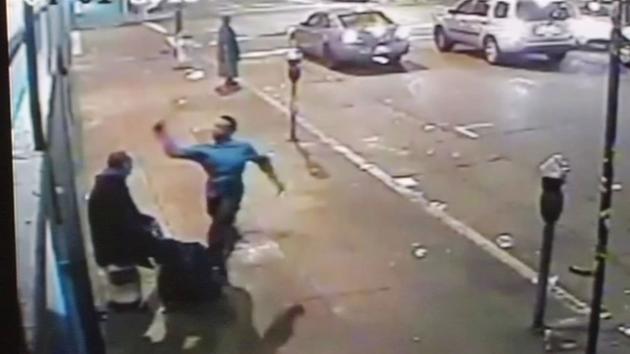
Credit: ABC7news.com

If I asked you to imagine in your head a scenario involving street harassment and a homeless person, what would you picture? If the hour I just spent scrolling through Google is any indication, you’re imagining an unassuming individual being harassed by a surly person who looks to be sleeping on a street corner. This happens, A LOT. I’ve been harassed by a seemingly unhoused individual on many occasions and as someone who works in the field of homelessness in Washington, DC, I am intimately familiar with the myriad of reasons a homeless person can “act out of order,” related to a series or traumas or serious mental illnesses/addiction stemming from chronic homelessness.

But that’s not what I want to talk about —

Far fewer people are flipping the script on the conversation of harassment and homeless people, choosing also to discuss how people experiencing homelessness are often cruelly harassed themselves.

Try to imagine instead, a homeless person who has struggled with serious depression and mental illness and asks for money on the street in an unthreatening and polite manner. Instead of a humble, “no” the solicited person replies with a vulgar and dehumanizing response. This happens more often that you’d think. I’d recommend watching this heartbreaking video, to give you a good picture of such cruelty (and these were just online tweets; the harassment in person can be much worse). One person even asks, “If home is where the heart is, do homeless people even have hearts?”

I come from an organization that supports 60% of the homeless women in our metropolitan area. Our working mantra is that, “But for a few circumstances of fortune and timing, ‘she’ could be me.” The women I have met here are survivors. They have faced unparalleled odds against them and come out on the other side. If we are discussing “street harassment” as unwanted comments, gestures, and actions forced on a stranger, particularly with an actual or perceived gender-bias, homeless women might take the cake.

I have no intention of ignoring the legitimate case that homeless men are antagonized and harassed every day, but I’ve learned firsthand from clients that identify as female, that unaccompanied homeless women disproportionately face, “multiple forms of interpersonal victimization, including sexual and physical assault at the hands of strangers, acquaintances, pimps, sex traffickers, and intimate partners on the street, in shelters, or in precarious housing situations (vawnet.org).”

In the United States we have already made public spaces unsafe for people experiencing homelessness. Reference for example, how it has been outlawed to sit down in San Francisco, or the effort to make it illegal to give people food in Philadelphia, how Manteca purposely changed the water sprinkler schedule to keep the homeless from sleeping in a park, or how Sarasota just got rid of their park benches altogether.

These degrading and brutalizing efforts coupled with verbal attacks from housed city residents can make the day-to-day life of a homeless person unbearable.

But the bigger conversation centers on how we’ve come to tolerate the harassment of a homeless person more than that of a seemingly housed person. It very well could be that the vast majority of readers are appalled by this and reject entirely the thought. But that doesn’t mean it isn’t happening.

The sad truth is, the majority of Americans treat homeless people like occupied public spaces. In other words, without context, making assumptions about why that person is there and why they can or cannot leave. Those are not our assumptions to make. But once we do, it makes it easier for us to dehumanize a person enough to permit their mistreatment.

Since many of us treat our parks and streets with a certain abandon for retribution, we tend to treat the people who occupy those spaces recklessly as well – it’s as if we feel that since the park is public, the person who sleeps there is publicly owned as well, which leaves me entitled to judge them. That sort of entitlement can lead to vocalizing slurs or prejudicial comments without fear of consequence. When a person is on their knees, it’s easier to knock them down.

As we discuss the innumerable ways in which street harassment exists in our everyday lives, and the inconceivable reality that people can be objectified and reduced to targets of harassment merely by existing in a public space, we should acknowledge the ways we treat all individuals who occupy public spaces, including those facing homelessness.

What compels someone to harass a homeless person is a concept I may never understand. But, I can begin to infer that it has something to do with entitlement in communal areas – how we choose when or when not to vocalize observations or opinions about another person sharing a collective space, can speak volumes about our compassion and empathy.

As I continue to demand respect for myself when I occupy a street or sidewalk, I will also petition others to demand the same respect for others regardless of circumstance. After all, “But for a few circumstances of fortune and timing, ‘she’ could be me.”

Sara works in fundraising events at an organization that empowers women who face homelessness through recovery, wellness training, and housing. She runs her own photography company (saraconklinphotography.com) and a popular website that seeks to connect the world through pictures, sarapose.com.

Share

Filed Under: correspondents, street harassment Tagged With: homeless

“Wow, you can’t even say hi back?”

October 27, 2015 By Contributor

I was walking home from my high school softball game when I stopped at a busy intersection a block away from my house. I was waiting to cross the street when I made eye contact with a man in the parked car to my right. His head was out the window and he looked at me and said, “Hello there.”

I ignored him and kept looking forward. Then he said, “Wow, you can’t even say hi back?” As I started to cross the street I tried to laugh it off uncomfortably and said, “No sorry.”

The words that he said next will never leave my head. He responded by saying, “Yeah? Well why don’t you wipe that dirty ass smirk off your face.” Are you kidding me? Who does this man think he is, hitting on a girl who is at least 15 years younger than him and expecting a postive response? It gets me so angry.

My mother always told me never to say anything back because I never know what kind of person he is and whether or not he will hurt me. It’s so frustrating listening to these rude and disgusting things that these men say when they don’t hear what they want and not being able to say anything.

Optional: What’s one way you think we can make public places safer for everyone?

I would like to see posters all around NYC with slogans such as: I will not smile for you.

– A.D.

Location: Queens, NY

Share your street harassment story for the blog.
See the book 50 Stories about Stopping Street Harassers for more idea
.

Share

Filed Under: Stories, street harassment

The Netherlands: Demystifying Dutch Tolerance

October 26, 2015 By Correspondent

Eve Aronson, Amsterdam, the Netherlands, SSH Blog Correspondent

Have you heard of the Dutch Myth of Tolerance? It’s not a myth in the mythical sense, and it’s not a fairytale, though it does sound admittedly magical.

Since the 17th century, the Netherlands has been a smorgasbord of races, ethnicities and religions and has continuously championed itself on what are known as “pillars” of tolerance.

The Dutch Myth of Tolerance is reflective of the disintegration of these pillars towards what has become an increasingly harsh critique of the narrative of ‘acceptance and multiculturalism’ in the Netherlands (or the lack thereof).

At first, the presence of this myth throughout my research was subtle. People told me about their experiences of street harassment and may have thrown in some (racially) identifying characteristics of their harassers. But after several months, it became evident that a more solid smokescreen lurked, and that the notion of Dutch pluralism and tolerance was not always as strong as it presented itself to be.

When people talk about street harassment in Amsterdam, it is not uncommon to highlight the race or ethnicity of one’s harassers, particularly if they are of Moroccan or Turkish decent, two of the largest minority populations in the Netherlands. Often times, the harasser is also tied to a particular neighborhood. For example, one person I talked to said: “In my experience, harassment was worse in neighborhoods with a lot of immigrants from cultures…Moroccans for example.” Another echoed: “A lot of catcalling, primarily from members of black communities”.

A report released in March of this year by the city of Amsterdam also highlighted particular minority-populated neighborhoods and communities as being more affected by street harassment, which arguably worked to further emphasize the link between street harassment and race or ethnicity.

Many of you might also recall the October 2014 video of a woman walking through the streets of New York in the US. The video heavily criticized for selectively showing a disproportionate number of men of color harassing the (white) woman in the video. Emphasizing connections between street harassment, race and location is not only completely inaccurate; it also strips accountability from a significant proportion of harassers who fall outside of these stereotypes and who are harassing women in Amsterdam just as often.

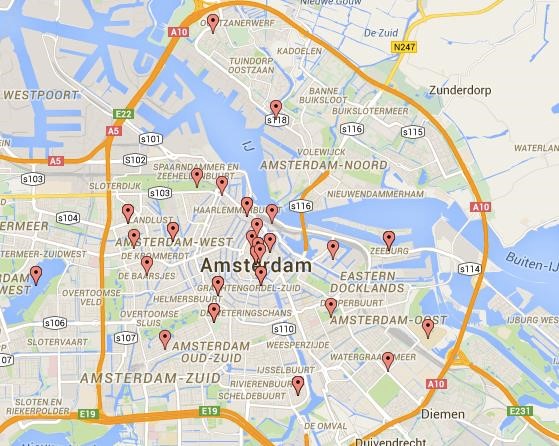
Below is a map of locations tagged by 48 respondents of a recent street harassment survey that I conducted in Amsterdam. Take a good look at where the majority of incidents are reported:

Amsterdam-BatchGeo2015(Source: BatchGeo 2015)

The majority of the geotagged incidents were reported in the center of the city, mostly around touristy areas and not in areas of the city known to have large minority populations (Biljmer, Zuid-Oost and Oost, for example). What this data does then, is encourage a revisiting of stereotypes of street harassment in Amsterdam, albeit from a purely geographic perspective. And this is just a start. The more stereotypes are checked—particularly using visual tools and visualizations—the more people are realizing that street harassment extends beyond race, ethnicity and geographical area.

What kind of impact does this have on the ground? Understanding street harassment as part of broader power structures does not mean that everyone gets this memo, and in this vein, individuals’ lived experiences are critical to take into account. But without denying individual experiences with street harassment, it is important to underline the implications of making generalized statements about races or communities.

Starting up a Hollaback! in Amsterdam is one way to work towards exposing exactly what happens on the ground and where. Geotagging experiences of street harassment not only confronts the Dutch Myth of Tolerance but it also provides an important starting point for conversations about street harassment and race in the Netherlands. Coupled with other awareness-raising initiatives and campaigns, addressing racial stereotyping in conversations about street harassment through such visual tools also encourages a look at street harassment through a much broader lens—one that unfortunately does not make the fight against street harassment easier but who said this was going to be easy? Ultimately, what taking a more comprehensive approach to street harassment does, is it makes the work more strategic and more effective in the long run.

You can find the full analysis of the Amsterdam survey results here or by contacting Eve at evearonson@gmail.com. Follow Eve and Hollaback! Amsterdam on Twitter at @evearonson and @iHollaback_AMS and show your support by liking Hollaback! Amsterdam’s Facebook page here.

Share

Filed Under: correspondents, hollaback, race, Resources, street harassment Tagged With: Amsterdam, hollaback, maps, statistics

« Previous Page
Next Page »

Share Your Story

Share your street harassment story for the blog. Donate Now

From the Blog

  • #MeToo 2024 Study Released Today
  • Join International Anti-Street Harassment Week 2022
  • Giving Tuesday – Fund the Hotline
  • Thank You – International Anti-Street Harassment Week 2021
  • Share Your Story – Safecity and Catcalls Collaboration

Buy the Book

Search

Archives

  • September 2024
  • March 2022
  • November 2021
  • April 2021
  • March 2021
  • January 2021
  • April 2020
  • March 2020
  • February 2020
  • December 2019
  • November 2019
  • September 2019
  • August 2019
  • July 2019
  • June 2019
  • May 2019
  • April 2019
  • March 2019
  • February 2019
  • January 2019
  • December 2018
  • November 2018
  • October 2018
  • September 2018
  • August 2018
  • July 2018
  • June 2018
  • May 2018
  • April 2018
  • March 2018
  • February 2018
  • January 2018
  • December 2017
  • November 2017
  • October 2017
  • September 2017
  • August 2017
  • July 2017
  • June 2017
  • May 2017
  • April 2017
  • March 2017
  • February 2017
  • January 2017
  • December 2016
  • November 2016
  • October 2016
  • September 2016
  • August 2016
  • July 2016
  • June 2016
  • May 2016
  • April 2016
  • March 2016
  • February 2016
  • January 2016
  • December 2015
  • November 2015
  • October 2015
  • September 2015
  • August 2015
  • July 2015
  • June 2015
  • May 2015
  • April 2015
  • March 2015
  • February 2015
  • January 2015
  • December 2014
  • November 2014
  • October 2014
  • September 2014
  • August 2014
  • July 2014
  • June 2014
  • May 2014
  • April 2014
  • March 2014
  • February 2014
  • January 2014
  • December 2013
  • November 2013
  • October 2013
  • September 2013
  • August 2013
  • July 2013
  • June 2013
  • May 2013
  • April 2013
  • March 2013
  • February 2013
  • January 2013
  • December 2012
  • November 2012
  • October 2012
  • September 2012
  • August 2012
  • July 2012
  • June 2012
  • May 2012
  • April 2012
  • March 2012
  • February 2012
  • January 2012
  • December 2011
  • November 2011
  • October 2011
  • September 2011
  • August 2011
  • July 2011
  • June 2011
  • May 2011
  • April 2011
  • March 2011
  • February 2011
  • January 2011
  • December 2010
  • November 2010
  • October 2010
  • September 2010
  • August 2010
  • July 2010
  • June 2010
  • May 2010
  • April 2010
  • March 2010
  • February 2010
  • January 2010
  • December 2009
  • November 2009
  • October 2009
  • September 2009
  • August 2009
  • July 2009
  • June 2009
  • May 2009
  • April 2009
  • March 2009
  • February 2009
  • January 2009
  • December 2008
  • November 2008
  • October 2008
  • September 2008
  • August 2008
  • July 2008
  • June 2008
  • May 2008

Comment Policy

SSH will not publish any comment that is offensive or hateful and does not add to a thoughtful discussion of street harassment. Racism, homophobia, transphobia, disabalism, classism, and sexism will not be tolerated. Disclaimer: SSH may use any stories submitted to the blog in future scholarly publications on street harassment.
  • Contact
  • Events
  • Join Us
  • Donate
  • Facebook
  • Instagram
  • Pinterest
  • Tumblr
  • Twitter
  • YouTube

Copyright © 2026 Stop Street Harassment · Website Design by Sarah Marie Lacy