• About Us
    • What Is Street Harassment?
    • Why Stopping Street Harassment Matters
    • Meet the Team
      • Board of Directors
      • Past Board Members
    • In The Media
  • Our Work
    • National Street Harassment Hotline
    • International Anti-Street Harassment Week
    • Blog Correspondents
      • Past SSH Correspondents
    • Safe Public Spaces Mentoring Program
    • Publications
    • National Studies
    • Campaigns against Companies
    • Washington, D.C. Activism
  • Our Books
  • Donate
  • Store

Stop Street Harassment

Making Public Spaces Safe and Welcoming

  • Facebook
  • Instagram
  • Pinterest
  • Tumblr
  • Twitter
  • YouTube
  • Home
  • Blog
    • Harassment Stories
    • Blog Correspondents
    • Street Respect Stories
  • Help & Advice
    • National Street Harassment Hotline
    • Dealing With Harassers
      • Assertive Responses
      • Reporting Harassers
      • Bystander Responses
      • Creative Responses
    • What to Do Before or After Harassment
    • Street Harassment and the Law
  • Resources
    • Definitions
    • Statistics
    • Articles & Books
    • Anti-Harassment Groups & Campaigns
    • Male Allies
      • Educating Boys & Men
      • How to Talk to Women
      • Bystander Tips
    • Video Clips
    • Images & Flyers
  • Take Community Action
  • Contact

France: Comic Strips are Changing the Conversation

October 25, 2015 By Contributor

Our four Safe Public Spaces Mentees are half-way through their projects. This week we are featuring their blog posts about how the projects are going so far. This post is from our team in France. Their projects are supported by SSH donors. If you would like to donate to support the 2016 mentees, we would greatly appreciate it!
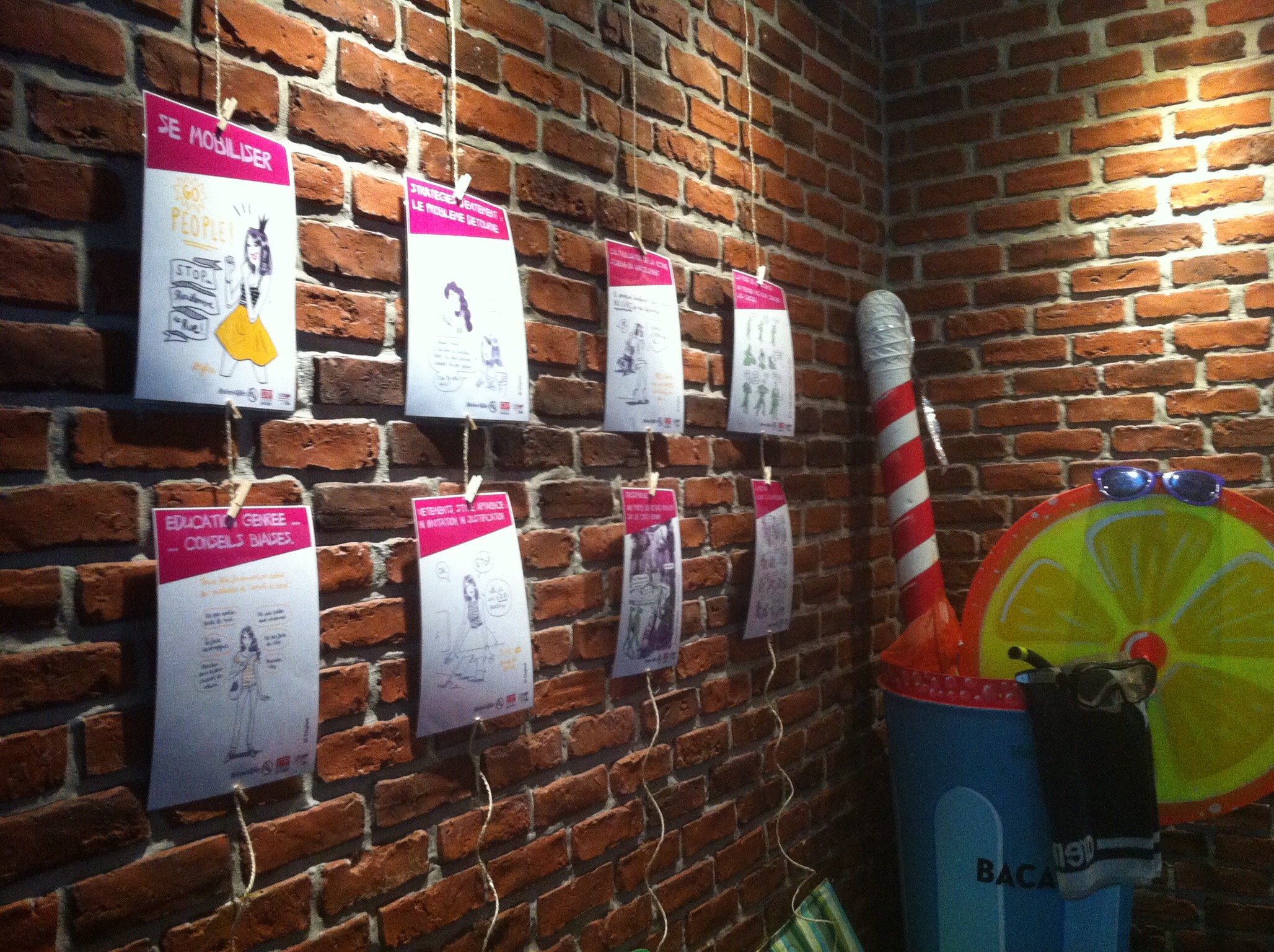
At the "Livestation DIY" bar in Lyon
At the “Livestation DIY” bar in Lyon

Street harassment wasn’t a word we used to hear in France a few years ago. To draw a really rough sketch, women often talked about “oafishes” between themselves, mostly making it funny stories. Men never got to sense the extent of the issue.

Then Sofie Peeters shot a shocking film in the streets of Brussels, “Femmes de la Rue” (“Women of the Street”, 2012), showing how she was constantly, repeatedly and heavily harassed in the street, whether it was stares, whistles, names or insults. The media started to talk about it, and it’s like women realized they weren’t alone and had the right to speak up.

It had to be extreme to make us realize that it was truly something happening to a lot of – if not every – women, in a vast variety of situations, context and ways. We also connected the dots and got to fully see that it was happening to many people presenting a difference to society’s “normality”, such as LGBQ-identified people, trans*, fat people, persons with mental disabilities, and the list could go on and on and on.

“Stop Harcèlement de Rue” (“Stop Street Harassment”) started in Paris in March 2014, and then spread across France. The local section of Lyon emerged 6 months later, and we started with no means to raise awareness among people. One of the best tools to use against street harassment has been the Internet and the mainstream culture it carries. For example, Thomas Mathieu has his Tumblr “Projet Crocodiles” (“Crocodile Project”), where he uses real situations that women send to him, often about street harassment, and transforms them into comic strips with men represented as crocodiles of the urban jungle. It became very popular. Other cartoonists started to talk about the subject, like Diglee in her blog. It was like we – the civil society, artists, people – had taken the “red pill” (cf. Matrix) and it was just impossible not to see it and impossible to go back.

We decided that we had to take these drawings to the streets and to the schools, to make people think about the issue through them, especially young people, and to hopefully deeply change the way many people are treated in our common public spaces. So we asked Thomas Mathieu and Diglee for their permission. They were very happy to give us the use of their work. We turned to our Facebook and Twitter followers, our friends and family, and ultimately many people have supported us as we’ve collected the money needed to print the drawings in high quality, large and rigid format, and create a proper exhibition to be shown everywhere.

Stop Street Harassment’s Safe Public Spaces Mentoring Program came at the right time for us, and we got selected, to our great joy. The funding has helped us with the printing costs, too. We’re now midway through our project, and so much already happened, including media coverage of our campaign:

* We tested a first version of the exhibition in a bar on the 3rd of September, and we got a lot of positive feedback, plus some institutions got in contact with us to have it shown at their locations.
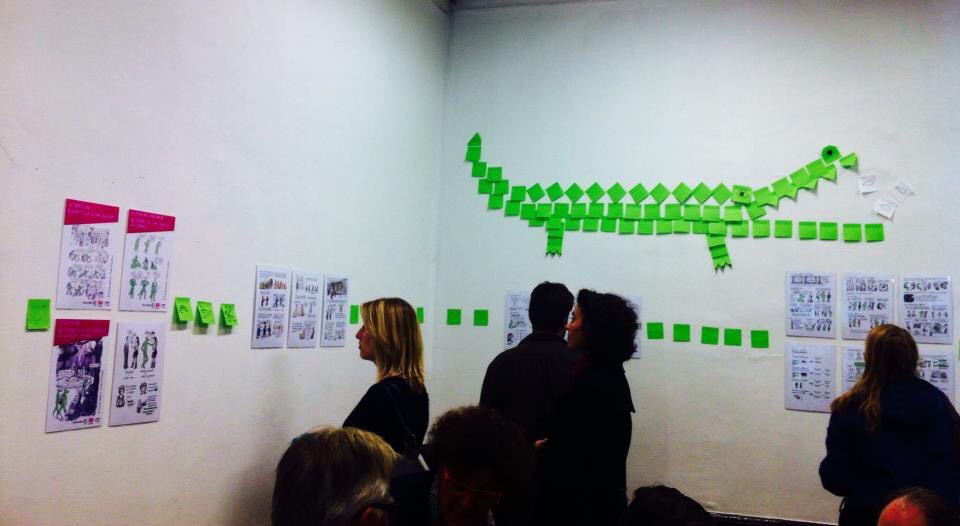
At the "Clochards Célestes" theater At the “Clochards Célestes” theater

* We presented the exhibition on an “equality boat” lent by the region Rhône-Alpes during two evenings, the 1st and 2nd of October, in the presence of the cartoonists and as an introduction to debates. People participated a lot and the exchanges were great.
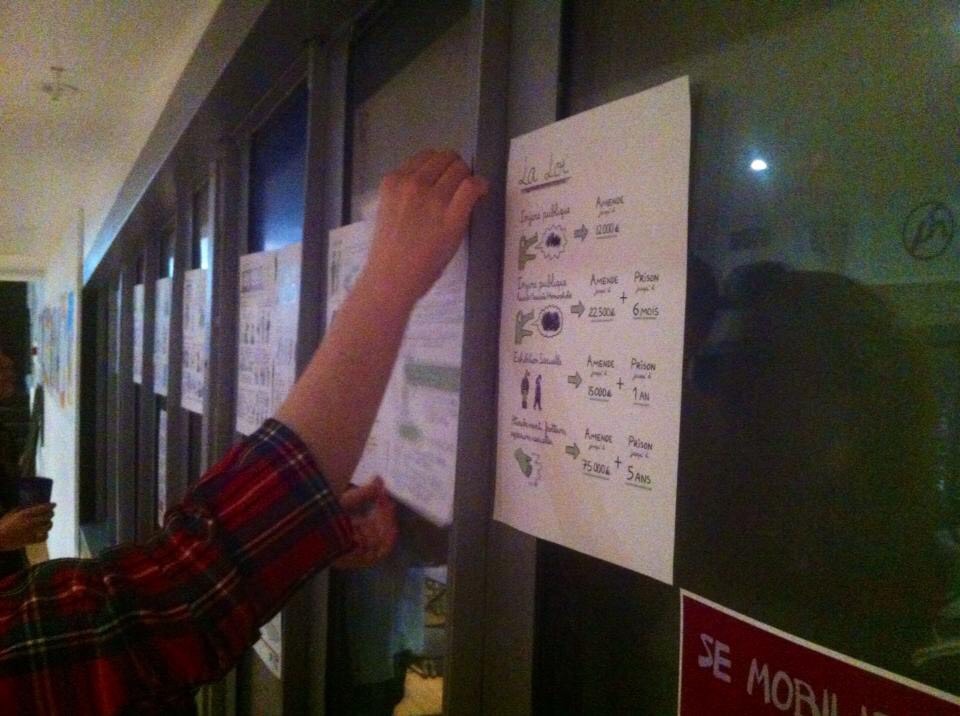
On the Région Rhône-Alpes' "equality boat" navigating on the Rhône. Oct. 2015
On the Région Rhône-Alpes’ “equality boat” navigating on the Rhône

* We worked with the town of Grenoble to present the exhibition during a week in the streets, in a really huge size, from the 7th to 13th of October. A lot of people saw it and stopped by, and we got a lot of good comments, both from the town officers and the public.
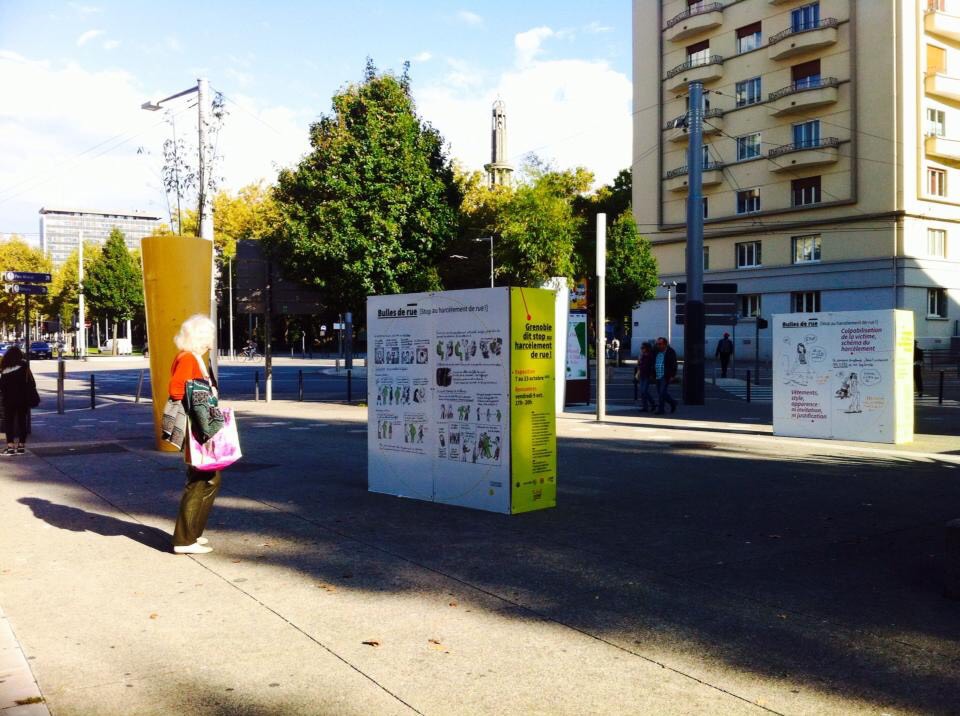
On Valentin Huïy's place in Grenoble. Oct. 2015On Valentin Huïy’s place in Grenoble. Oct. 2015

* We took our exhibition to a high school for our very first school intervention. It was there for a week, from the 12th to 16th or October. The students were very interested and so was the teaching team. It was a success.
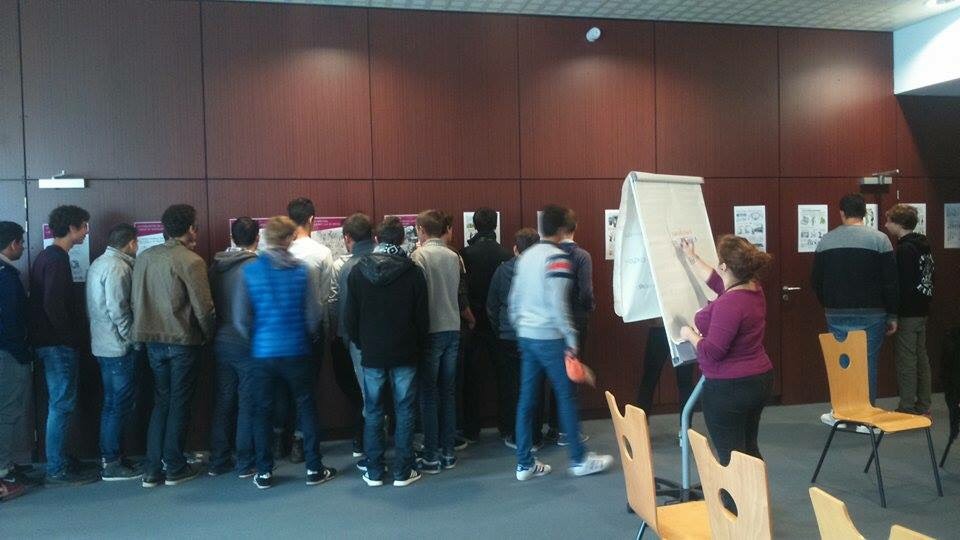
Neuville-sur-Saône high-school, exhibition and workshop. Oct. 2015Neuville-sur-Saône high-school, exhibition and workshop

We’re now looking forward to adding drawings and texts to our first version, to send the final one to the printer! It’s a long job, but we’ve already been rewarded for it, so it is just a matter of time. 2016 will see a beautiful new tool to fight street harassment, first in Lyon and Rhône-Alpes, and then through France entirely.

Anne Favier is the co-founder of Stop Harcèlement de Rue in Lyon, France.

Share

Filed Under: SSH programs, street harassment Tagged With: france, Lyon, safe public spaces mentoring program

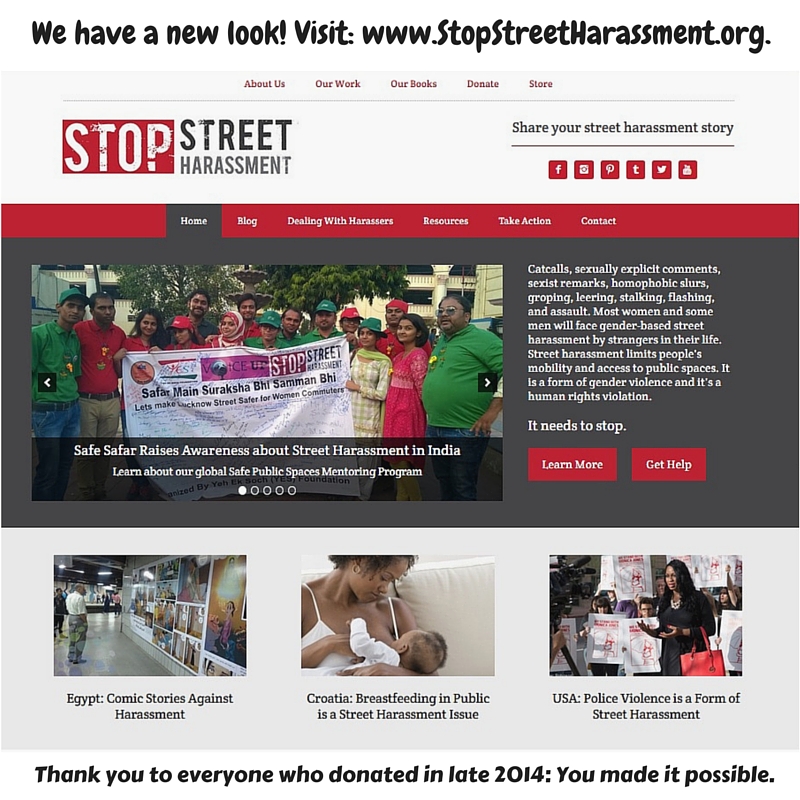
Check Out Our New Look!

October 25, 2015 By HKearl

We have a new look! Visit www.StopStreetHarassment.org.Thank you to everyone who donated in late 2014 to make it possible.

Thank you also to our website designer Sarah of Sarah Marie Lacy Studios. I highly recommend her for a website upgrade or launch!

Share

Filed Under: SSH programs, street harassment Tagged With: website redesign

Ireland: A Letter Challenging Verbal Abuse

October 25, 2015 By HKearl

Jenny Stanley. Image via The Independent

Last week, Jenny Stanley wrote a powerful open letter about street harassment for The Irish Times. In it she describes the many times she faced street harassment as she simply commuted home from work at night. Her closing is heartbreaking:

“I walked home. I opened the door and sat in my kitchen. I cried. I was so very, very tired. I knew then that just because I was home it did not mean it was all over. I too am exhausted, not only for myself but for those who have had and will have similar experiences, and the innumerable amount of men who do value and respect women and anyone who believes that gender should not influence a person’s right to be viewed as an equal in the eyes of another.”

Her letter has been covered by several outlets, including Cosmo, MTV, Elite Daily, Bustle, and the Huffington Post.

I joined Jenny and Tom Meagher of the White Ribbon Project on an episode of The Women’s Podcast for The Irish Times. I was asked to talk about the “right way” to respond to street harassers and shared how there is no right way. We have to do whatever we can to feel safe and get out of a frustrating, annoying, upsetting and sometimes really scary situation. And then we can do what we can to speak out and be part of the cultural shift so that street harassment is no longer acceptable or commonplace.

Tom spoke about men’s role and how to reach boys on the issue, which is so, so important.

I applaud Jenny for taking a stand — even if she didn’t feel able at the time the harassment happened, she is clearly having an impact now.


Share

Filed Under: Advice, News stories, Stories, street harassment Tagged With: Jenny stanley, speaking out

USA: Police Violence is a Form of Street Harassment

October 24, 2015 By Correspondent

Hannah Rose Johnson, Arizona, USA, SSH Blog Correspondent

This month I talked with Pat Farr, a member of Hey Baby! Collective, in Tucson, AZ, about the intersections of sexual violence that are embedded in societal institutions; the sort of intersections that are more complex to organize around—specifically how profiling by police and police brutality constitute street harassment.

Farr presented an analysis of the nuances, scopes and the limits of perfect-victim narratives. When we think of street harassment solely as a cat-calling, where is power moving, what identity is created and who is being left out?

Farr says, “…rape culture is really a complex system that creates a framework for identifying who is a victim and who is a perpetrator. And if someone doesn’t fit into these tropes of victim/perp then it they fall outside of the discourse and are not victims and not perpetrators. So I like the term perfect and imperfect victim…[…] With street harassment it’s even more difficult. There’s very few protections against street harassment to begin with. So this notion of a perfect victim becomes subjectively very difficult to define.”

The first is the Office on Violence Against Women’s definition of sexual assault, which is defined as: any type of sexual contact or behavior that occurs by force or without consent of the recipient of the unwanted sexual activity. Farr says that “The definition of sexual assault by the OVW includes street harassment.”

The second is the Center for Disease and Control’s uniform surveillance on sexual violence, which extends to noncontact unwanted sexual experiences. “This,” says Farr, “is very similar to non-consensual behavior of a sexual nature as described by the OVW.”

The third is the Equal Employment Opportunity Commission’s definition of sexual harassment which includes offensive remarks about a person’s sex. The EEOC goes on to define sex-based discrimination as: discrimination against an individual because of gender identity, including transgender status, or because of sexual orientation. “As such,” Farr argues that “because sexual harassment is a form of sexual discrimination, according to the EEOC, harassment based on a person’s gender identity or sexual orientation is a form of sex discrimination.”

“This gives us the opportunity to extend the definition of street harassment,” Farr says, “according to these definitions, it is street harassment when a transgender woman walking down the street is attacked because of her gender identity, and hence this would count as sexual violence.”

Farr brought up the case of Monica Jones—a black transwoman, sex worker rights activist and MSW student in Phoenix, AZ. She was arrested after a demonstration for sex workers when she took a ride from an undercover, and refused the driver’s proposition. Farr told me that “even though she refused the driver’s propositions, she was still arrested on the prostitution related crime against morality, manifestation of prostitution.” This kind of law, within the city municipal code crimes against morality, is known as “manifestation of prostitution.” It’s a kind of profiling law when a police officer thinks someone looks like a sex worker and is doing something in an area where sex workers would be.

“…it’s essential to recognize that people of color, lower class people, LGBQ people, transgender people, and HIV positive people all are at greater risk of police violence that’s based largely on culturally defined stereotypes of sexuality,” Farr states, “Compulsive heterosexuality, heteronormativity, white supremacy, neoliberal economics, and the prison industrial complex are all bound up with street harassment as a form of institutional violence against particular identities.”

Identities in the margins present different relationships to power which are reinforced through all of our state-sanctioned systems. These identities—these people and their lives—are vulnerable in the face of systems that reproduce heterosexuality, white supremacy, patriarchy and transphobia. These systems rely on exclusion and violence to function, and create our cultural understanding of who is a victim and what terms make a victim.

What Farr is saying here gives us a wider framework to think about who is a victim of street harassment. It is no longer only the person walking down the street being cat-called, it’s also person being profiled by police and arrested because of their gender identity and race.

This allows us to see police violence as a form of street harassment that is inevitably tied to the state.

Share

Filed Under: correspondents, LGBTQ, police harassment, race, street harassment Tagged With: ACLU, monica jones, police harassment, sexual violence, transgender

USA: Friends Don’t Ask Their Friends for “Rush Boobs”

October 23, 2015 By Correspondent

LB Klein, USA, Former SSH Blog Correspondent

Sigma Alpha Epsilon (SAE) at University of California San Diego is blowing up my RSS feed right now for requiring pledges to solicit photos of women’s breasts with “Rush SAE” written on them. These SAE brothers didn’t invent this. Google “rush boobs” (or don’t, seriously don’t) and there are myriad search results. Total Frat Move refers to using women’s breasts as promotional objects as a “timeless tradition.” This story broke when UCSD student Rachel Friedman posted a chat conversation in which her SAE new member friend senior Spenser Cornett asked her to share topless photos of Ms. Friedman and her friends.


Rachel Friedman and the message she received. Image via Cosmo

More and more fraternity chapters are receiving sexual violence prevention education. A common strategy for engaging men in preventing sexual violence is to appeal to their relationships with women. We call upon men to think of their “mothers, sisters, and girlfriends” and to consider they wouldn’t want the important women in their lives to be harmed. However Mr. Cornett’s request, and I imagine others like it, is a friendly one. It is flanked by “lol funny story” and a laughing emoji. Sexism is often embedded within men’s relationships with women. Ms. Friedman and Mr. Cornett’s friendship illustrates a need to ask more of men in these relationships.

I genuinely believe that virtually all fraternity men don’t want their mothers, girlfriends, sisters, and women friends to be raped. That just isn’t enough anymore. Many of these young men would proudly pin on a white ribbon pledging they are against rape or host a 5K to benefit a local rape crisis center. That just isn’t enough anymore. We have raised enough awareness, and we need real action. In our educational efforts, we are indeed calling men to action. We ask young men to “stand up” and “fight back” with the same hypermasculine ideals that perpetuate violence. Because men are considered leaders, we ask them to lead, to make public displays about how intolerant of violence they are. That just isn’t enough anymore. Moving toward culture change will require these young men to question tradition and advocate for structural change. It will require them to listen to women. It will require them to do something revolutionary for men to do: follow. This change will mandate that they feel a little more uncomfortable to make women a little more comfortable.

I imagine that the SAE brothers who collected topless photos of their women friends were insulted when some folks tied their behavior to sexual violence. “This is harmless,” they might say. “Boys will be boys,” others might say. “She overreacted,” several have posted in the comments (Friendly reminder: don’t read the comments). Young men are faced with choices between working toward a gender equitable futures and holding tight to tradition that has favored them. Making the day-to-day choices to resist patriarchal tradition is hard, and we need to intentionally work with men to do it. We need to help them take these risks.

Otherwise, we are asking too little of men. If we are going to say that men should care about ending sexual violence because of their relationships, we need to demand they do better in these relationships. It isn’t enough to congratulate men for not committing sexual violence or to applaud them for saying they’re against rape. That is too easy. It does not foster the critical thinking and empathy needed to shut down “rush boobs” from the inside, as opposed to relying on women to call this behavior out when they are made to feel unsafe (though brava, Rachel Friedman). We need to balance ensuring our educational programs meet men where they are, while also nudging them forward.

Sexual violence is about power and control. To truly achieve culture change, we need to ask men to give up some power: not just rapists, all men. We can’t end violence while propping up the exact oppressive traditions and systems that perpetuate it. We can’t decry rape and laugh off objectification. I am willing to believe that institutions founded as boys’ clubs (like fraternities or indeed institutions of higher education) can evolve their traditions as we approach a more gender equitable futures. However, I do think that we need to call on these traditionally patriarchal institutions to prove it. We need to raise our standards for men as they become engaged in ending sexual violence. As fraternity men become more visible in the movement to end sexual violence, we need to hold them accountable. Men shouldn’t be able to have their feminist cookies, and eat their misogyny cake too.

I am indeed somebody’s daughter and wife. I am proud of the many men in my life I count as friends, and I take those relationships seriously. Because I love these men, I hold them to a higher standard than just not raping women. My bodily autonomy, my right to be subject and not object needs to be more important than my male friends’ egos. They need to treat me like a whole person of equal worth to them. They need to not only not participate in my objectification but to prevent others from doing so, to make that behavior so abhorrent that there is a social cost to those who engage in it. They need to give up some of their social power, as they are gaining it at my expense.

The hypothetical young man or men in SAE who could have spoken out against asking their friends for “rush boobs” would have taken a risk. While sexual violence is certainly far too common, sexism is far more ubiquitous. We need young men to make small changes in the spaces in which they are currently the most comfortable. Indeed, we will incrementally achieve culture change as men give up some of their space in the boardroom, the subway, and the university campus. We need to create a culture in which young men consider challenging their bros as less problematic than reducing their women friends to topless photos (“no face necessary, lol”).

Engaging men in their roles as “fathers, sons, husbands, and friends” can be a powerful way to initially activate men to create change, but we can’t stop there. That is just not enough anymore. To achieve culture change, we need men to be inconvenienced in the exact spaces they once felt the most secure, the ones in which they benefit the most from tradition.

LB is an Atlanta-based advocate and educator dedicated to ending gender-based violence, supporting survivors, and advancing social justice.  You can follow her on twitter @LB_Klein.

Share

Filed Under: correspondents, News stories Tagged With: activism, college, fraternities, masculinity

« Previous Page
Next Page »

Share Your Story

Share your street harassment story for the blog. Donate Now

From the Blog

  • #MeToo 2024 Study Released Today
  • Join International Anti-Street Harassment Week 2022
  • Giving Tuesday – Fund the Hotline
  • Thank You – International Anti-Street Harassment Week 2021
  • Share Your Story – Safecity and Catcalls Collaboration

Buy the Book

Search

Archives

  • September 2024
  • March 2022
  • November 2021
  • April 2021
  • March 2021
  • January 2021
  • April 2020
  • March 2020
  • February 2020
  • December 2019
  • November 2019
  • September 2019
  • August 2019
  • July 2019
  • June 2019
  • May 2019
  • April 2019
  • March 2019
  • February 2019
  • January 2019
  • December 2018
  • November 2018
  • October 2018
  • September 2018
  • August 2018
  • July 2018
  • June 2018
  • May 2018
  • April 2018
  • March 2018
  • February 2018
  • January 2018
  • December 2017
  • November 2017
  • October 2017
  • September 2017
  • August 2017
  • July 2017
  • June 2017
  • May 2017
  • April 2017
  • March 2017
  • February 2017
  • January 2017
  • December 2016
  • November 2016
  • October 2016
  • September 2016
  • August 2016
  • July 2016
  • June 2016
  • May 2016
  • April 2016
  • March 2016
  • February 2016
  • January 2016
  • December 2015
  • November 2015
  • October 2015
  • September 2015
  • August 2015
  • July 2015
  • June 2015
  • May 2015
  • April 2015
  • March 2015
  • February 2015
  • January 2015
  • December 2014
  • November 2014
  • October 2014
  • September 2014
  • August 2014
  • July 2014
  • June 2014
  • May 2014
  • April 2014
  • March 2014
  • February 2014
  • January 2014
  • December 2013
  • November 2013
  • October 2013
  • September 2013
  • August 2013
  • July 2013
  • June 2013
  • May 2013
  • April 2013
  • March 2013
  • February 2013
  • January 2013
  • December 2012
  • November 2012
  • October 2012
  • September 2012
  • August 2012
  • July 2012
  • June 2012
  • May 2012
  • April 2012
  • March 2012
  • February 2012
  • January 2012
  • December 2011
  • November 2011
  • October 2011
  • September 2011
  • August 2011
  • July 2011
  • June 2011
  • May 2011
  • April 2011
  • March 2011
  • February 2011
  • January 2011
  • December 2010
  • November 2010
  • October 2010
  • September 2010
  • August 2010
  • July 2010
  • June 2010
  • May 2010
  • April 2010
  • March 2010
  • February 2010
  • January 2010
  • December 2009
  • November 2009
  • October 2009
  • September 2009
  • August 2009
  • July 2009
  • June 2009
  • May 2009
  • April 2009
  • March 2009
  • February 2009
  • January 2009
  • December 2008
  • November 2008
  • October 2008
  • September 2008
  • August 2008
  • July 2008
  • June 2008
  • May 2008

Comment Policy

SSH will not publish any comment that is offensive or hateful and does not add to a thoughtful discussion of street harassment. Racism, homophobia, transphobia, disabalism, classism, and sexism will not be tolerated. Disclaimer: SSH may use any stories submitted to the blog in future scholarly publications on street harassment.
  • Contact
  • Events
  • Join Us
  • Donate
  • Facebook
  • Instagram
  • Pinterest
  • Tumblr
  • Twitter
  • YouTube

Copyright © 2026 Stop Street Harassment · Website Design by Sarah Marie Lacy