• About Us
    • What Is Street Harassment?
    • Why Stopping Street Harassment Matters
    • Meet the Team
      • Board of Directors
      • Past Board Members
    • In The Media
  • Our Work
    • National Street Harassment Hotline
    • International Anti-Street Harassment Week
    • Blog Correspondents
      • Past SSH Correspondents
    • Safe Public Spaces Mentoring Program
    • Publications
    • National Studies
    • Campaigns against Companies
    • Washington, D.C. Activism
  • Our Books
  • Donate
  • Store

Stop Street Harassment

Making Public Spaces Safe and Welcoming

  • Facebook
  • Instagram
  • Pinterest
  • Tumblr
  • Twitter
  • YouTube
  • Home
  • Blog
    • Harassment Stories
    • Blog Correspondents
    • Street Respect Stories
  • Help & Advice
    • National Street Harassment Hotline
    • Dealing With Harassers
      • Assertive Responses
      • Reporting Harassers
      • Bystander Responses
      • Creative Responses
    • What to Do Before or After Harassment
    • Street Harassment and the Law
  • Resources
    • Definitions
    • Statistics
    • Articles & Books
    • Anti-Harassment Groups & Campaigns
    • Male Allies
      • Educating Boys & Men
      • How to Talk to Women
      • Bystander Tips
    • Video Clips
    • Images & Flyers
  • Take Community Action
  • Contact

Chicago Teens Tackle Street Harassment

July 21, 2015 By HKearl

This is awesome!! (Via Alternatives in Action🙂
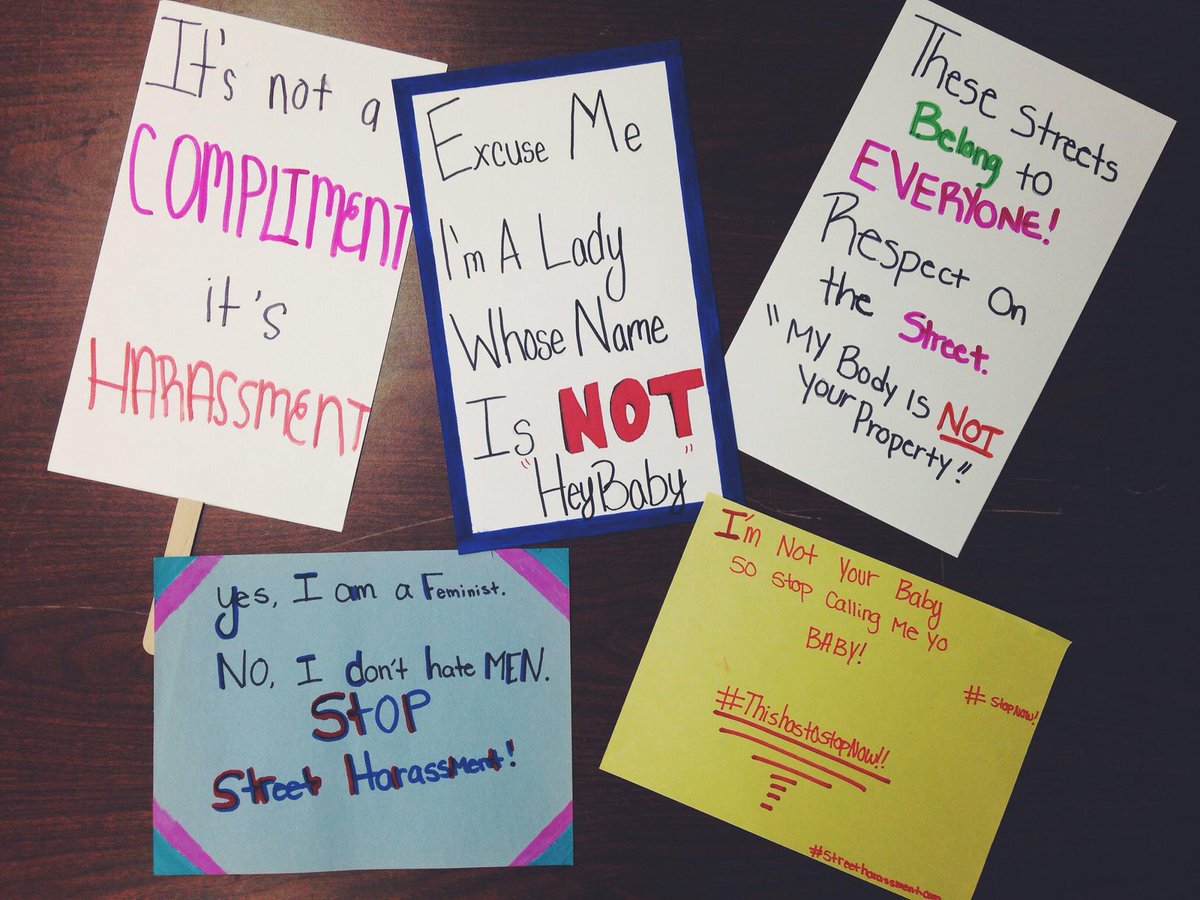
Girl World Team members make signs ahead of the CTA meeting in July 2015

“This summer, Girl World [in Chicago] will employ 15 young women ages 14-18 in a six week long project addressing street harassment and gender-specific violence. Girl World will act as a hub of resources and action for the current “Courage Campaign”, a campaign that works to address and eliminate the occurrences of sexual harassment on public transportation.

Participants will gather research around the issue of harassment through the use of interviews, surveys, and analyzing current campaigns/policies. Participants will be responsible for the presentation of research and findings to campaign members and community members throughout the six week session; as well as produce materials such as posters, videos, and online content to engage community members and peers in a broader conversation regarding harassment.

Furthermore, participants will engage 20 local businesses, organizations, and elected officials to ask for their support in displaying materials.”

Follow them on Twitter and Facebook.

Share

Filed Under: Activist Interviews, Resources, street harassment

The Netherlands: An Interview with Gaya Branderhorst of Straatintimidatie

July 21, 2015 By Correspondent

Julka Szymańska, the Netherlands, SSH Blog Correspondent

Gaya Branderhorst, from her website www.gaya.nl/

Street harassment is a global issue and the Netherlands is no exception, but to this date many people treated it as a fact of life, a minor inconvenience for women, who “should just take the compliment”. But street harassment is not a compliment and it can be a very large, scary inconvenience; the Dutch public is, fortunately, starting to wake up to this notion.

To speed up this awareness and fight the problem, the website Straatintimidatie (the Dutch word for street harassment) was created, alongside a citizen’s initiative that calls for penalizing street harassment with fines.

If you’re a Dutch national, you can still sign the initiative here and if you master the Dutch language, please give them a like on Facebook or tweet with #straatintimidatie on Twitter.

I had a conversation with founder Gaya Branderhorst to find out more about this important project:

J: Could you please introduce yourself and tell us a little bit about the team behind the website Straatintimidatie.nl and the accompanied citizens’ initiative against street harassment?

G: My name is Gaya Branderhorst and I’m from the Netherlands, but recently moved to New York for a new job. Before I left — approximately a year ago — I started a project against street harassment, which in this case is a citizens’ initiative requiring 40,000 signatures. This initiative primarily consists of a proposed bill that would punish the sexual harassment of women in public with a fine. At the start of this project I surrounded myself with a small group of supporters, for example: an attorney who wrote the bill itself, a person who manages the social media etc. As well as a well-known Dutch comedian (Soundos el Ahmadi) and an emeritus professor of Human Rights (Cees Flinterman).

J: How did this initiative came about exactly?

G: The team behind the citizen’s initiative against street harassment consists of both women and men, the gender ratio is about 50/50. This was a conscious decision on my part, because street harassment overwhelmingly happens to women, but the harassing is dominantly done by men, so to solve this problem we need men as well. Men should speak up against other men who harass women and tell them to stop this behavior. We also see that almost half of the people who sign the initiative are male. You have to understand that the majority of Dutch men do not condone street harassment, it’s the minority of men who harass the majority of women.

J: I’ve seen a video on YouTube you made in which a group of women turn the tables on random men on the street by catcalling them and asking them how this made them feel afterwards. What a funny, witty action! How did you come up with it?

G: The idea of ‘reverse catcalling’ isn’t entirely new, the Dolle Mina’s (a prominent feminist group during the Second Wave of feminism in the Netherlands) did this too. As I understand it, they did so for different reasons, mainly for laughs, is what a former Dolle Mina told me. But we did it after hearing the commentary of people questioning “if catcalling is really that bad? Isn’t it complimenting women’s beauty in a way?”

So we figured we could turn this around in order to showcase that men don’t find it complimentary to be catcalled either. It turns out we were absolutely right about that: you can see in the video that virtually none of the men are pleased about it, they don’t experience it as a compliment either. And for good reason, because catcalling truly isn’t a compliment at all, it’s a vicious phenomenon that people often don’t see for what it is: harassment. Street harassment is worlds apart from getting a respectful compliment and it honestly surprised me to notice how many people are confused about this. But by reversing the dynamic it suddenly becomes a lot clearer that street harassment is unpleasant. So that’s why we created the video.

J: The Dutch often pride themselves in their liberalism and emancipation of women and minorities, but an initiative again street harassment is clearly still necessary. So, what’s the deal with this country?

G: On one hand the Netherlands are doing relatively well in terms of equality in comparison to some other countries. So in a way that’s true, for example: same sex marriage is finally gaining more ground in the United States (at time of publication we’re happy to report that the supreme court of the USA has decided to lift the ban on same sex marriage last month) and we already had that for quite a while of course. The same goes for women’s right to choose for an abortion, that’s not that big of a deal anymore in the Netherlands either. In a lot of things we are ahead of other countries, even other Western countries, but as a consequence, the danger looms that we as a nation start slacking off. That this so called “tolerant attitude” digresses to a sort of indifference, which is something entirely different than tolerance.

Especially when it comes to the rights of women, this tolerance often turns into a “whatever, been there done that” mindset. And that’s increasingly visible in the realm of women’s rights: there are quite a few things in the Netherlands that are contradictory to the notion that men and women are equals. These things include the wage gap, the amount of women on top of the corporate ladder and the prevalence of domestic- and sexual violence against women and girls to name a few. And of course street harassment, something so many women have experience with. If you take a look at the women in our team, they all have had to deal with street harassment, which is part of the reasons why they’re in our team in the first place. This goes for the women who sign our initiative as well: some of the stories they tell in the comments they leave us are outright shocking.

I don’t understand why –with all out tolerance and progressiveness– street harassment isn’t more of a priority in Holland.

J: What’s in store for the future of this citizen’s initiative against street harassment and the situation surrounding street harassment in the Netherlands in general?

G: Last year I was a guest in the television talkshow Knevel & van den Brink and one of the other guests at the table just happened to be Minister of Social Affairs Lodewijk Asscher, that was a happy coincidence. I was asked if street harassment really is such a significant problem in the Netherlands and my reply was that I think it most definitely is. I told them that every woman I talk to struggles with this sometimes, but that we can’t be 100% certain, because there are no statistics on the matter. Looking at the minister for this paid off, because by now a nation-wide study has been carried out. So even though the proposed bill isn’t far enough in the process yet, we can see that the public debate on street harassment is catching on, something I’m glad about.

On top of that we’re also talking with Member of Parliament Achmed Marcouch about the issue, hopefully this leads to results as well. In our neighboring countries street harassment is a hot topic too, we’re not the only ones in Holland. Belgium for example has already implemented a law against street harassment and France and Egypt are on the same track. Both internationally and nationally things are happening to combat the problem, I think there’s a growing consciousness about street harassment. But if it will be enough? I’m not sure, from my personal, subjective perspective: I don’t see the instances decreasing. There is still plenty of work ahead of us

J: Thank you so much for this interview.

G: You’re very welcome.

 Julka is a 25-year-old feminist activist and soon-to-be Cultural Science student with a generous amount of life experiences -including street harassment – and even more passion for social justice.

Share

Filed Under: Activist Interviews, correspondents, street harassment

Queer Review Launch!

July 20, 2015 By HKearl

Today is the launch of the Queer Review website, http://www.myqueerreview.com/. It’s “the first and only online resource to help you discover Safe Spaces around the globe. Starting July 20th, you can rate and review businesses on a per-location basis regarding their treatment of the LGBTQ+ community.”

Queer Review website screenshot

So go ahead and start writing your reviews!

Washington, DC-area friends – I’ll be speaking at the release party on July 29, 5:30 p.m. at DC9 Nightclub, as will our board member Patrick McNeil (pending his work schedule). The event is free, goes until 8:30 p.m., and proceeds from drinks will support the Casa Ruby LGBT Community Center. Hope you can come by!

Share

Filed Under: Events, LGBTQ, Resources, street harassment

UK: Art and Objectification

July 20, 2015 By Correspondent

Ruth Mair, UK, SSH Blog Correspondent

Yoko Fukase, image via The Guardian

I have caught people photographing me without my permission and I usually try to mess up their photo in some silly small way, like pulling a face or rolling my eyes. I have also caught people drawing me on the bus, and I have heard of others having similar experience. Sometimes those creating their art based on strangers are repeat offenders (“Oh that dude on that bus with the sketchbook, yeah I’ve seen him before”), and somehow, they are almost always men. I do not know whether this is because men are the ones confident enough to pull such tricks, or defend themselves if caught at it. Perhaps it’s because there is a surplus of male artists out there without willing and consenting subjects for their art. Or maybe the women doing the equivalent thing are better at not getting caught.

In this context, I have been thinking a lot about women in art. Both as subjects of art, and also as artists. But the problem about women who have art made about them, is that they are subjects of it, subjected to it. Guerilla Girls have made some great pieces concerning this issue; it was via Guerilla Girls that I learned about the difference in number of women portrayed in art in major American art galleries, versus the number of pieces of art by women that were displayed in those galleries. And that was before even getting into question of the vast chasm between the money earned by female artists and that earned by male artists.

These are things we’ve come to expect one we acknowledge the existence of the patriarchy, and once you start digging, there is a lot of discussion concerning this. However what I am writing about here is the position of the woman as a subject, and fact that this can be done secretly, without consent, in passing, in the street, raised a lot of questions for me. It was a Guardian article that led me to this topic, and it’s been stewing in my head for several days, with a lot of related feelings and thoughts about consent and the feeling of being watched, or being a performer.

Subject of art, or complicit in its creation. Masahisa Fukase created a collection of photographs in 1974 that focused entirely on his wife Yoko. She is in every photo, complicit, consenting, even performing for him, the creator of the photo of which she is a subject. This project was 13 years in the making, and throughout that time, Fukase focused intensely on his wife and the creation of images of her. It might seem an obvious outcome to say that they got divorced. Yoko was quoted in the article as having said that her life with Fukase was “suffocating dullness interspersed by violent and near suicidal flashes of excitement”. This surprised me, but then I’m not married to an artist so it’s likely that I was interpreting her position as muse and subject in a different way to someone who has actually experienced that kind of life would have done.

All I could think was how suffocating it would be, how intrusive and exhausting, to have been observed in all that detail, through the eye of a lens for 13 years. And although Yoko was clearly an active participant in this project, I found that the photos begged the question of where the personal ended and the performance began.

Further, the question of consent, and the potential for violation through the medium (and even using the excuse) of art, is something I find deeply troubling. Like the story of Yoko Fukase which still troubles me. There are so many questions I would love to ask her about those 13 years; whether she knew which photos were to be used in the collection, whether she had any say in this, and what happened when she did not feel like having her photograph taken.

Aside from my small moments of messing up photos strangers have tried to take of me, I’ve never confronted anyone doing things like that. Like many other forms of street harassment, confronting those perpetrating it is full of difficulties and second guessing; were they really photographing me? Will they think I’m arrogant for assuming it’s me? Am I arrogant for assuming that? Shouldn’t I be complimented that someone wants to use my face or silhouette or passing blurred figure for their work?

But the in the same way that street harassment is a violation, so is this.

Ruth is a human rights MA student finishing her MA dissertation on the legal and normative rights of terror suspects in the UK (spoiler alert: rights are being violated). She also plays bass in a band called Kinshot, sews as often as she can, and spends time getting annoyed at the cat sleeping on top of her computer.

Share

Filed Under: correspondents, News stories, street harassment

July 20, 2015: News Round-Up

July 20, 2015 By HKearl

“Video Showing Sexual Harassment of Two Girls in Saudi Arabia“

“A video that shows a group of young boys harassing two women in Jeddah’s Corniche sparked an outrage in social media last week. The video, which was uploaded to YouTube, went viral on social media, with statements denouncing the “barbaric” behaviour of these teenagers toward two veiled women on the Corniche.”

“Egyptian police arrest 29 men for sexual harassment during Eid: MOI“

“Police in Cairo have arrested 29 men for sexual harassment since the beginning of the Eid Al-Fitr holiday on Friday, Al-Ahram Arabic reported.

Police said one man was arrested for physically harassing a woman in downtown Cairo’s Qasr El-Nil area, while others were caught verbally harassing girls outside cinemas in the Roxy area in the district of Heliopolis.

During the three-day Eid Al-Fitr holiday, which marks the end of Ramadan, families and young people often celebrate with outings to parks, cinemas, fairs and other public spaces.

Reports of sexual harassment and assault in crowded areas increase during the holiday.”

“141 sexual harassment incidents reported in 3 days during Eid al-Fitr“

“A total of 141 police reports were issued on sexual harassment incidents during Eid al-Fitr 2015, according to the National Council for Woman (NCW.)

“A total of 136 verbal and five physical harassment incidents were reported,” said NCW, noting that most of the girls dropped the reports.

NCW said it received 50 verbal harassment reports in Cairo and one physical harassment report on Sunday.

Moreover, Egyptian grassroots initiative “I Saw Harassment” published its final report on the sexual harassment during Eid al-Fitr; it stated that the rates of the harassment were higher than the feats of the last few years.”

“Ottawa [Canada] pick-up artist controversy fuels conversation about street harassment”

“What started out as a few tweets on Friday about an Ottawa pick-up artist who secretly films women has now evolved into a broader discussion about street harassment and personal privacy.

The Carleton University Sexual Assault Support Services Twitter account appears to be the first to sound the alarm about Luke Howard, a local hypnotist and YouTuber who engages in conversations with women on the street and uploads the encounter on the video sharing website.

In an interview with Metro last Friday, Howard said his videos are meant to show guys with social anxiety how to talk to women they’re attracted to in the daytime.

While Ottawa police have previously said secretly filming people over 18 in a public space is legal, women say what he is doing is unethical and constitutes harassment.

Soon after the public outcry, local women condemned his behaviour, which prompted him to hide his series of YouTube videos from public view.

At the time, Howard said he temporarily blocked his videos after receiving threats of violence online.

As his YouTube channel remained quiet on Sunday, there was a loud rumbling on social media that spawned the #corneredinottawa hashtag and a Twitter account of the same name.

Maya Shoucair, a woman who says she has been confronted by Howard on the street, said she hosted an informal meeting with about a dozen concerned women at her house on Sunday to discuss how to proceed.

“This is what it looks like when Ottawa women have had enough,” said Shoucair, referring to the social media uproar.

“We just want to feel safe in our streets.”

“After Anand Parbat stabbing case, alleged eve-teasers seriously injure Rohtak schoolgirl”

“A day after a minor girl died after being allegedly stabbed by two men in Delhi`s Anand Parbat locality for resisting a molestation attempt, a schoolgirl from Lonal village in Haryana`s Rohtak district on Saturday has sustained grievous injuries following an attack by three alleged [harassers] while she was on her way to school.

The victim has been admitted to a hospital in Rohtak where she is undergoing treatment for multiple wounds on her face and head. The girl`s relative said that a complaint has been lodged with the police, but lamented that no arrests have been made so far.”

“Montreal Police Tell Women To Not Take Taxis In The City Alone Anymore”

After a several women in Montreal came forward saying cab drivers sexually assaulted them, the police “said women should try to not take taxis alone, and to ‘limit their alcohol consumption and stay in control,’ as quoted by the Gazette. If you see a problem with this, then congratulations, you are a sensible person.”

One of SSH’s facebook followers said in a comment it to this story that “In response the STM (transit system) made an announcement reminding women that they don’t have to take the taxi because bus drivers will drop women (or men too) off as close to their house as they can at night if you just ask more than one stop ahead.”

“Men who harass women online are quite literally losers, new study finds”

“Michael Kasumovic and Jeffrey Kuznekoff, researchers at the University of New South Wales and Miami University, respectively…watched how men treated women during 163 plays of the video game Halo 3.

As they watched the games play out and tracked the comments that players made to each other, the researchers observed that — no matter their skill level, or how the game went — men tended to be pretty cordial to each other. Male players who were good at the game also tended to pay compliments to other male and female players.

Some male players, however — the ones who were less-skilled at the game, and performing worse relative their peers — made frequent, nasty comments to the female gamers. In other words, sexist dudes are literally losers.”

“One Perk of Older Age? Fewer Catcalls”

“I wouldn’t trade my quiet morning walks for the hellishness of my teen years for anything. But when you’re brought up to feel that the most important thing you can be is attractive to men, the absence of their attention – even negative attention – can feel distressing.”

“Activists Call On CTA To Post Anti-Sexual Harassment Campaign”

“Despite a high profile PSA campaign about Chicago [USA] Transit Authority courtesy, there are still no ads regarding sexual harassment. One woman is trying to change that and is being rebuffed along the way… Last year Kara Crutcher launched the “Courage Campaign,” which she hoped would bring attention to the issue of sexual harassment on public transportation. As DNAinfo reported at the time, her campaign was attempting to work with the CTA to produce advertisements to fight sexual harassment on city buses and trains and to bring more awareness to the issue….

Fast forward an entire year, and unfortunately those advertisements haven’t materialized. The transit agency’s ad company, Titan Worldwide, has a rule that states PSAs must be posted by a government agency or a registered nonprofit, leaving the Courage Campaign out in the cold. Crutcher and 15 girls from the female youth empowerment group “Girl World” recently met with CTA board members to talk about bringing such advertisements to the public transportation system.

At the meeting, Crutcher was frustrated by the fact that the conversation seemed to center around how to report incidents of sexual harassment, instead of how to create the ads, she said. Jaime Schmitz, a youth development specialist who works with Girl World, agreed, telling DNAinfo, “I don’t think people realize how hard it is for people to share a story like that. They’re under the impression that when you’re harassed it should be so easy to report. But a lot of the time it’s re-traumatizing.”

The point of the ads is to prevent the incident before it even starts, so simply reporting incidents doesn’t necessarily modify behavior, the women argued. While frustrated by the setback, Crutcher is not giving up. “I have no doubt that they care about the safety of their riders. I just think more can be done, and this is great vehicle to do so, and right now I can’t move forward,” she said.”

 “Photographer charged with stalking Grand Rapids woman”

“A man whose picture went viral on social media is now being charged with stalking a woman in Grand Rapids. Thomas Chubinski, 69, is accused of recently harassing a woman who was walking with her daughter near Michigan and Diamond.

“I was just so terrified, I’m shaking. It was 2 o’clock in the afternoon,” said Emily Gray. She says Chubinski was driving slowly beside her. “He’s asking me all kinds of horrible things about my body, every body part you could imagine. I told him, ‘I’m just trying to walk my daughter.'”

Emily did not go to police, but a few days later she saw a post on Facebook about the same man. The woman who posted those pictures said he had taken pictures of her as she walked her dog in East Grand Rapids…

WZZM 13 News talked to Chubinski on the phone earlier this week. He said he didn’t remember an encounter with Gray, but he does remember the woman in East Grand Rapids. He admitted to taking pictures of her in public, but said he did nothing wrong. According to East Grand Rapids police, the woman in that incident never filed a police report. Chubinski says he’s a professional photographer who admittedly likes to take pictures of “beautiful women.” He has no criminal history.”

 “The Brian Lehrer Show: The Unwelcome Harassment Women Face on the Street”

Holly Kearl, founder and executive director of Stop Street Harassment and the author of Stop Street Harassment: Making Public Places Safe and Welcoming for Women (Praeger, 2010), talks about what women are subjected to on the street to make them feel unsafe, from catcalls to groping, and how to end it.

Plus: Anthonine Pierre, Lead Community Organizer at the Brooklyn Movement Center, talks about the Center’s “Anti-Street Harassment Bike Patrol,” which is part of their “No Disrespect” campaign.

Share

Filed Under: News stories, street harassment

« Previous Page
Next Page »

Share Your Story

Share your street harassment story for the blog. Donate Now

From the Blog

  • #MeToo 2024 Study Released Today
  • Join International Anti-Street Harassment Week 2022
  • Giving Tuesday – Fund the Hotline
  • Thank You – International Anti-Street Harassment Week 2021
  • Share Your Story – Safecity and Catcalls Collaboration

Buy the Book

Search

Archives

  • September 2024
  • March 2022
  • November 2021
  • April 2021
  • March 2021
  • January 2021
  • April 2020
  • March 2020
  • February 2020
  • December 2019
  • November 2019
  • September 2019
  • August 2019
  • July 2019
  • June 2019
  • May 2019
  • April 2019
  • March 2019
  • February 2019
  • January 2019
  • December 2018
  • November 2018
  • October 2018
  • September 2018
  • August 2018
  • July 2018
  • June 2018
  • May 2018
  • April 2018
  • March 2018
  • February 2018
  • January 2018
  • December 2017
  • November 2017
  • October 2017
  • September 2017
  • August 2017
  • July 2017
  • June 2017
  • May 2017
  • April 2017
  • March 2017
  • February 2017
  • January 2017
  • December 2016
  • November 2016
  • October 2016
  • September 2016
  • August 2016
  • July 2016
  • June 2016
  • May 2016
  • April 2016
  • March 2016
  • February 2016
  • January 2016
  • December 2015
  • November 2015
  • October 2015
  • September 2015
  • August 2015
  • July 2015
  • June 2015
  • May 2015
  • April 2015
  • March 2015
  • February 2015
  • January 2015
  • December 2014
  • November 2014
  • October 2014
  • September 2014
  • August 2014
  • July 2014
  • June 2014
  • May 2014
  • April 2014
  • March 2014
  • February 2014
  • January 2014
  • December 2013
  • November 2013
  • October 2013
  • September 2013
  • August 2013
  • July 2013
  • June 2013
  • May 2013
  • April 2013
  • March 2013
  • February 2013
  • January 2013
  • December 2012
  • November 2012
  • October 2012
  • September 2012
  • August 2012
  • July 2012
  • June 2012
  • May 2012
  • April 2012
  • March 2012
  • February 2012
  • January 2012
  • December 2011
  • November 2011
  • October 2011
  • September 2011
  • August 2011
  • July 2011
  • June 2011
  • May 2011
  • April 2011
  • March 2011
  • February 2011
  • January 2011
  • December 2010
  • November 2010
  • October 2010
  • September 2010
  • August 2010
  • July 2010
  • June 2010
  • May 2010
  • April 2010
  • March 2010
  • February 2010
  • January 2010
  • December 2009
  • November 2009
  • October 2009
  • September 2009
  • August 2009
  • July 2009
  • June 2009
  • May 2009
  • April 2009
  • March 2009
  • February 2009
  • January 2009
  • December 2008
  • November 2008
  • October 2008
  • September 2008
  • August 2008
  • July 2008
  • June 2008
  • May 2008

Comment Policy

SSH will not publish any comment that is offensive or hateful and does not add to a thoughtful discussion of street harassment. Racism, homophobia, transphobia, disabalism, classism, and sexism will not be tolerated. Disclaimer: SSH may use any stories submitted to the blog in future scholarly publications on street harassment.
  • Contact
  • Events
  • Join Us
  • Donate
  • Facebook
  • Instagram
  • Pinterest
  • Tumblr
  • Twitter
  • YouTube

Copyright © 2026 Stop Street Harassment · Website Design by Sarah Marie Lacy