• About Us
    • What Is Street Harassment?
    • Why Stopping Street Harassment Matters
    • Meet the Team
      • Board of Directors
      • Past Board Members
    • In The Media
  • Our Work
    • National Street Harassment Hotline
    • International Anti-Street Harassment Week
    • Blog Correspondents
      • Past SSH Correspondents
    • Safe Public Spaces Mentoring Program
    • Publications
    • National Studies
    • Campaigns against Companies
    • Washington, D.C. Activism
  • Our Books
  • Donate
  • Store

Stop Street Harassment

Making Public Spaces Safe and Welcoming

  • Facebook
  • Instagram
  • Pinterest
  • Tumblr
  • Twitter
  • YouTube
  • Home
  • Blog
    • Harassment Stories
    • Blog Correspondents
    • Street Respect Stories
  • Help & Advice
    • National Street Harassment Hotline
    • Dealing With Harassers
      • Assertive Responses
      • Reporting Harassers
      • Bystander Responses
      • Creative Responses
    • What to Do Before or After Harassment
    • Street Harassment and the Law
  • Resources
    • Definitions
    • Statistics
    • Articles & Books
    • Anti-Harassment Groups & Campaigns
    • Male Allies
      • Educating Boys & Men
      • How to Talk to Women
      • Bystander Tips
    • Video Clips
    • Images & Flyers
  • Take Community Action
  • Contact

USA: Andrea Gibson’s Powerful Poem That’s Meant to Be Used

June 4, 2015 By Correspondent

enhanced-28939-1430922447-6.png
Via www.tayloryo.com

Michelle Marie Ryder, USA, SSH Blog Correspondent

In the United States, 65% of women have been harassed in public. Each wolf-whistle, obscene gesture and violating touch has the power to transform our world. For many of us it’s hard to forget the first time we were harassed, as evidenced by a recent popular hashtag #FirstHarassed.

No matter how confident we might start the day, we struggle to keep an ocean of fear at bay the moment we step outdoors. Everyday we navigate a sea of uncertainty that limits our mobility and sense of safety. Short of a cure, we find ways to cope.

Personally, I never leave the house without putting on my best Wednesday Addams resting bitchface. I evade eye contact with strangers to avoid being perceived as flirty; my gaze is restricted, my interaction with the social world strained and limited, some of its richness lost.

When I feel safe enough I speak up, tempted by the peace of mind assured by an effective counterattack. The first time I did I shouted a simple, liberating FUCK YOU! – drawing in a deep breath of air between the two words for extra effect. That was really all it took to shut up a clot of men (who hang out in groups of five because they each have one fifth of a personality, jokes comedian Eddie Izzard, who is frequently harassed in public for cross-dressing). At the time I had been walking alone, but thankfully had the anonymity of a crowd to slip into for protection.

But there are times when our friends, family members or lovers are with us, putting them in the awkward position of wanting to defend us but also being well aware of the threat of violence, of how easily catcalls can escalate into something more serious. So they, too, often feel compelled to suppress their anger and frustration.

Renowned slam poet Andrea Gibson speaks to these feelings of powerlessness with high-octane eloquence in her poem “To The Men Catcalling My Girlfriend as I’m Walking Beside Her.” Co-performed with Katie Wirsing, Gibson addresses the subject of the poem, the street harasser, directly, making this quite possibly the finest the-reason-you-suck-speech to ever grace the earth.

Gibson says this is the first poem she’s ever written that’s meant to be “used in the real world.” Carried like a weapon in our consciousness is what I imagine she meant by that. Carried like “Wolverine keys” girded for battle between clenched fists, “because what men fear most about going to prison is what women fear most about walking down the sidewalk,” proclaims a popular #YesAllWomen tweet.

Whether we’re carrying mace, a rape whistle, switchblade or scythe (I’ve considered them all), these weapons, like Gibson’s dagger-sharp wordplay, are symbols of the violence women face daily. They evoke with forceful lucidity our second-class citizenship. There is significant risk in defying this system, in defying the will of the harasser, even for those who might try to intervene on our behalf.

A 31 year old San Franciscan man, Ben Schwartz, was savagely attacked in 2014 when he asked a catcaller to stop making lewd comments to his girlfriend. He was stabbed nine times, the knife narrowly missing his major arteries and spinal cord. Michael Tingling, a Chicago father, wasn’t so lucky. He was killed shielding his 15 year old daughter from sexually degrading treatment on the street after picking her up from school.

Street harassment is not flattering, it is frightening. It is a barrier to true equality and a denial of liberties, writes Holly Kearl, founder of Stop Street Harassment. But the good news is there’s a lot we can do to fight back, to stop from sinking in the ocean of fear that greets us daily. From speaking up to taking to the streets to pressing for policy change, the fight is only just beginning.

Michelle is a freelance writer and community activist. She has written for Infita7.com, Bluestockings Magazine, and The New Verse News on a range of social justice issues, and shares her poetry regularly at poetrywho.blogspot.com.

Share

Filed Under: correspondents, street harassment

“I was so humiliated”

June 3, 2015 By Contributor

Hi!
I just want to share my street harassment story. It was the end of my shift, exactly 5:30 when I arrived at the terminal. It was a Friday so I was already expecting that lots of people would be dying to ride a bus, since we have limited buses only. There is one baby bus but if it’s already full, it is your choice if you wanna ride- but standing, or you’ll fall in line and wait for the next one.

Since I was very eager and excited to go home, I just chose to stand up and ride that bus. I was in the middle of the aisle when the driver and the bus ticket collector advised me to go near the driver’s seat because many people would be standing and I might be uncomfortable if many men would surround me. Thinking that it was an act of concern, I went near the driver’s seat and stood up there. Suddenly, I heard the ticket collector talking to a man, looking at me. And then he said, ʺAsawa ho ng dirver yang nakatayo/ The woman standing is the driver’s wife,ʺ I was so humiliated because everybody looked at me. The driver is almost 50 years old, and I’m just 20. I looked at the ticket collector with a dim face, trying to compose myself. He looked at me, shaking his head and smiling. I took my phone, I acted like I was calling my boyfriend, just to somehow let them know that I’d be calling someone. He backed off. And then I talked to them ʺKuya, mahiya po kayo sa balat nyo.ʺ And then bumaba na ako. I felt so humiliated.

– Anonymous

Location: Coastal Mall/ Bus Terminal, Philippines

Share your street harassment story for the blog.
See the book 50 Stories about Stopping Street Harassers for more idea

Share

Filed Under: Stories, street harassment

“I felt pretty anxious for the rest of the day”

June 2, 2015 By Contributor

The other day I went to go get something to eat with my friends after class and after we finished we started walking back to my friend’s house. They both bike to and from school so they were together about 50 yards ahead of me. We took a shortcut through the park and my friends decided to go ahead of me a little bit (about 200 yards). I saw them bike past a group of about 7 or 8 guys from my school who were sitting on both sides of the path. I didn’t want to make it obvious that I wanted to avoid walking past them alone (not a great decision) so I just walked right between them. This one guy had a mouthful of water and ʺpukedʺ all over the path and my leg and his friend was laughing and patting him on the back. I continued to walk and one guy called ʺthat booty tho’!ʺ to me and they all just started cracking up.

Personally, this was my first catcalling experience and I’m honestly very surprised about how calmly I reacted. I just kept a straight face and walked away and did not react. I didn’t want to give them any ammunition to use against me. I’m still slightly shaken up from it even though I know this is much less worse than what some other people experience regularly, but I know I’m not the one to blame and I keep telling myself that. I just really hope this never happens again because I get very easily scared and I felt pretty anxious for the rest of the day. I considered momentarily to change the way I dress to protect myself but I immediately realized I shouldn’t have to change my personality or the way I express myself to feel safe in a situation like this.

Optional: What’s one way you think we can make public places safer for everyone?

Always stick with a friend that can help you in an uncomfortable position or go to someone trustworthy who can help you and discourage young people from catcalling.

– Anonymous

Location: Berkeley, CA

Share your street harassment story for the blog.
See the book 50 Stories about Stopping Street Harassers for more idea

Share

Filed Under: Stories, street harassment

What I’ve Been Reading: Early June 2015 Edition

June 2, 2015 By HKearl

Here are some of the articles I’ve been reading the past two weeks.

Korea Times:

“Concerned residents in the Haebangchon neighborhood, located next to Itaewon in Seoul, have formed a community awareness group in response to an increased amount of sexual harassment in the area. People Unite against Street Harassment (PUSH) was established in March this year.” Read street harassment stories in the Korea Observer.

Global Times (China):

“One of my friends from Chengdu, Sichuan Province, told me that she was groped by a man who covered her mouth to keep her from screaming out.

Apart from empty streets, crowded subway trains in China are also common places for sexual assaults to take place. There are numerous photos and videos on the Internet taken by bystanders of women being harassed in various ways, including men trying to take photos up women’s skirts.

Some reports state that up to seven in every 10 women have experienced some form of sexual harassment. Public transportation authorities in some cities have launched campaigns to crack down on sexual harassment on the subway, but they are not always effective.”

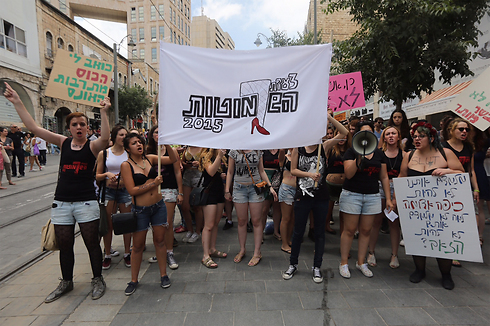
SlutWalk in Jerusalem (Photo: Gil Yohanan)

Y Net News:

“400 people embarked on a SlutWalk on Friday afternoon in Jerusalem, protesting sexual violence, sexual harassment and the objectification of women…

Tamar, a Jerusalem resident in her 20s, said she was taking part in the walk to protest against sexual violence. “It doesn’t matter what I’m wearing, my body is not public property. I’m not a sex object, I can dress however I feel like and it doesn’t give anyone the right to touch me, make offensive comments about me or talk to me disrespectfully,” she said.

Tamar said she experienced verbal sexual harassment in the past. “There is a lot of harassment on the street, a lot of terror. I have been harassed by men on the street since the age of 14. It happened in other cities in the country and actually anywhere in the world,” she said.”

Guardian:

“It’s never been my style, but dudes have been hollering, cat calling or cracking on women years before I was even born. I grew up in east Baltimore’s dope-boy culture, where the coolest guys attracted women by dressing nice, being popular and having conversations. Screaming at women and acting thirsty always looked stupid to me and always will. Seeing the look on that young woman’s face while she was walking with her child made me realize how scary it can be for a woman to walk down the street.

If we men are the problem, we can also be part of the solution…Us men are responsible for not only stopping guys from harassing women, but also telling others to do the same. For this is the only way to shift the culture.”

Herald-Review:

“Oregon lawmakers on Tuesday advanced a proposal aimed at closing a loophole in state privacy laws that recently let a man go unpunished after he took photographs up a teenager’s skirt.

The state Senate unanimously passed the bill, which would make it a misdemeanor to surreptitiously take photos up women’s dresses without their consent. A teachers union proposed the measure after a student took so-called upskirt cellphone photos of an educator and shared them online.

The Senate vote came three months after an Oregon judge ruled a 61-year-old man did nothing illegal when he snapped photos up a teen’s skirt in a Target store.”

Fortune:

“A driver contracted with U.S.-based online taxi company Uber Technologies was arrested near New Delhi on Tuesday, police said, after a woman passenger accused him of sexual harassment when she hailed his cab over the weekend.

Uber was banned in New Delhi in December after another woman passenger accused one of its drivers of rape. The company resumed its services in January after applying for a radio taxi licence, which it still awaits.”

Vice News:

“Holly Kearl, an adjunct professor of women’s studies at George Mason University in Virginia and author of two books about sexual harassment, said that many state laws haven’t caught up with technology, and that it often takes someone being acquitted for a crime before politicians are even aware laws aren’t adequate.

“One of the biggest weakness with many voyeurism laws is that they don’t include public spaces as places that people have the right to privacy,” she said. “Places like locker rooms or bathrooms are protected, but places like subways and parks often aren’t.”…Kearl said that while laws concerning voyeuristic photography become stronger, most would benefit from additional punishments for those who upload those images to the internet, something few laws currently address. And, as depressing as it might sound, we might not see any improvements to the law until more high-profile cases make upskirt photography impossible to ignore.

“This isn’t so common that it’s happening to someone every day,” Kearl said. “Until it is more prevalent, it might not gain traction or become a priority.”

Ravishly:

“It’s incredible how a short interaction can have such a huge effect on your day. Just one catcall can make me go from feeling fabulous to wishing I could curl up into a ball and disappear. It’s bad enough when I’m street harassed out by myself — I feel vulnerable and deciding how to respond can be hard. But it gets really complicated when I’m harassed and with my child.”

Share

Filed Under: News stories, street harassment

“I was harassed here. No one helped me. Don’t stand by. Stand up.”

June 2, 2015 By Correspondent

Alicia Wallace, the Bahamas, Former SSH Blog Correspondent

Riverside – via Seizing Our Destiny

It can be tough to explain to people that street harassment, though normalized, is not normal, and the practice is not linked to the culture of any country. It happens everywhere, and affects a broad spectrum of people.

Street harassment looks, sounds, and feels different depending on identity, location, time of day, and any number of other factors. The harassment I experience on a daily basis in Nassau is unlike harassment in any other place I’ve visited. I’m accustomed to the go-to names, phrases, and gestures of people in my city, but placed in an unfamiliar city, I don’t know what to expect, or how to respond. Language barriers prevent me from making assessments with the same accuracy as when I completely understand what is being said. Having limited knowledge of a place can be disempowering, changing the way I respond to harassment.

A few months ago, I went to Los Angeles for a conference. I was on a tight budget, so I stayed about 90 minutes away from the conference location and spent a lot of time walking and using public transportation. My experiences of harassment were less frequent than in Nassau, but put me on edge. I constantly thought about how desolate the bus stop near my hostel looked and felt at six o’clock every morning, and the fact that I couldn’t change my routine. Harassers could easily determine my routine the next day – or night – and find me there, alone and vulnerable. I thought about the long wait I had, every night, on the bus stop near the conference location. It didn’t get much pedestrian traffic, so even in the dark of night, I felt safer there than I did at the one near the hostel.

After the conference, I decided to visit a friend in Riverside. Everything I’d heard about Riverside suggested that it was pretty quiet, conservative, and, quite possibly, boring. I was fully prepared to wander around, aimlessly walking up and down streets, peeking into small stores, and hanging around the university area. I found that most people kept to themselves, not really bothering to pay much attention to anyone else. I was quite confident that I was in a relatively harassment-free zone. That changed on my birthday, when I decided to venture out a little further. I had to go through the main public transit hub.

As I made my way from a bus stop to the hub, I approached a group of middle-aged women who were hanging around a food truck. One was laughing and talking with the person in the truck, and the other women sat on the ground with their backs against a building on the other side of the sidewalk. As I got closer, the woman by the truck turned to face me, and looked me up and down repeatedly. She spoke rapidly in another language to the other women, making broad gestures toward me. As I walked between her and the other women, she turned the sidewalk into a catwalk. She kept saying things like, “That is nice!” and “You are so sexy!” For the first time, I felt conflicted about my response. This was a woman, clearly my senior, telling me she loved my ensemble, but what about all the other things she said? Should I smile? Say “thank you”? Pick up my pace? I didn’t know what to do, so I did all three. Even when I was well past her, she kept calling after me. It felt odd and uncomfortable.

Just when I started to feel a bit less weird, I approached a group of men in their early thirties, offloading a truck. They stopped to hoot and holler at me. Never before have I had to walk through the people who make me feel uncomfortable and at-risk of sexual assault. Generally, I can safely cross the street at any point in Nassau, but bigger cities don’t give that option. The only way was through, and I made it.

It was another twenty steps before I got to the main hub where a man in his twenties kept asking me for my number, where I’m from-from, and if he could go with me. It didn’t take long to shake him. I quick-walked to the furthest end of the station and sat on an empty bench. I put my earphones in and played an audio book.

Within a few minutes, another man – approximately 40 years old – came to the bench where I sat alone. He talked at me for about five minutes before he got angry. He aggressively questioned me about my reasons for not responding to him. He asked me if he was too ugly, or if I thought I was too good for him. Eventually, he came to the conclusion that I thought he had no money. He took out his wallet, crumpled up bills and threw them at me. He pelted me with money as no less than a dozen people looked on, silently.

In Nassau, I would have read him the riot act. I would have addressed that crowd, and told them they had just witnessed assault. I would have explained to them that they perpetuated that act of violence against me by remaining silent. I would have told them what it means to be a good bystander. I would have told that man that he should have been ashamed of himself, and that I am not object for sale. I am not a problem he could literally throw money at to solve or dissolve. Because I was in Riverside – a city I really didn’t know – and an area I had not explored before, I did none of these things. I didn’t know the culture of the place or its people. I didn’t know where the nearest police station was. I didn’t know how to call for help with internationally roaming. I was a sitting duck – the perfect target for street harassment. It was later that day that I returned to the spot with chalk. “I was harassed here. No one helped me. Don’t stand by. Stand up.”

Street harassment is a reality in every part of world, and there’s no way to identify potential harassers. They can be of any gender, race, or age, and could speak any language. They could feel deprived or entitled. They can talk at you and let you walk on, or may want to escalate the situation, causing you physical harm or public shame. These things can’t be predicted, especially if you’re in an unfamiliar space. While it’s empowering to respond, it’s important for people experiencing harassment to be mindful of cultural differences, deficiencies in knowledge of a place or people, and overall safety. Sometimes the safest thing we can do is walk away. We can always hollaback later.

Alicia is a freelance writer and public educator in Nassau, Bahamas. You can connect with her on Twitter (@_AliciaAudrey and on her blog.

Share

Filed Under: correspondents, Stories, street harassment

« Previous Page
Next Page »

Share Your Story

Share your street harassment story for the blog. Donate Now

From the Blog

  • #MeToo 2024 Study Released Today
  • Join International Anti-Street Harassment Week 2022
  • Giving Tuesday – Fund the Hotline
  • Thank You – International Anti-Street Harassment Week 2021
  • Share Your Story – Safecity and Catcalls Collaboration

Buy the Book

Search

Archives

  • September 2024
  • March 2022
  • November 2021
  • April 2021
  • March 2021
  • January 2021
  • April 2020
  • March 2020
  • February 2020
  • December 2019
  • November 2019
  • September 2019
  • August 2019
  • July 2019
  • June 2019
  • May 2019
  • April 2019
  • March 2019
  • February 2019
  • January 2019
  • December 2018
  • November 2018
  • October 2018
  • September 2018
  • August 2018
  • July 2018
  • June 2018
  • May 2018
  • April 2018
  • March 2018
  • February 2018
  • January 2018
  • December 2017
  • November 2017
  • October 2017
  • September 2017
  • August 2017
  • July 2017
  • June 2017
  • May 2017
  • April 2017
  • March 2017
  • February 2017
  • January 2017
  • December 2016
  • November 2016
  • October 2016
  • September 2016
  • August 2016
  • July 2016
  • June 2016
  • May 2016
  • April 2016
  • March 2016
  • February 2016
  • January 2016
  • December 2015
  • November 2015
  • October 2015
  • September 2015
  • August 2015
  • July 2015
  • June 2015
  • May 2015
  • April 2015
  • March 2015
  • February 2015
  • January 2015
  • December 2014
  • November 2014
  • October 2014
  • September 2014
  • August 2014
  • July 2014
  • June 2014
  • May 2014
  • April 2014
  • March 2014
  • February 2014
  • January 2014
  • December 2013
  • November 2013
  • October 2013
  • September 2013
  • August 2013
  • July 2013
  • June 2013
  • May 2013
  • April 2013
  • March 2013
  • February 2013
  • January 2013
  • December 2012
  • November 2012
  • October 2012
  • September 2012
  • August 2012
  • July 2012
  • June 2012
  • May 2012
  • April 2012
  • March 2012
  • February 2012
  • January 2012
  • December 2011
  • November 2011
  • October 2011
  • September 2011
  • August 2011
  • July 2011
  • June 2011
  • May 2011
  • April 2011
  • March 2011
  • February 2011
  • January 2011
  • December 2010
  • November 2010
  • October 2010
  • September 2010
  • August 2010
  • July 2010
  • June 2010
  • May 2010
  • April 2010
  • March 2010
  • February 2010
  • January 2010
  • December 2009
  • November 2009
  • October 2009
  • September 2009
  • August 2009
  • July 2009
  • June 2009
  • May 2009
  • April 2009
  • March 2009
  • February 2009
  • January 2009
  • December 2008
  • November 2008
  • October 2008
  • September 2008
  • August 2008
  • July 2008
  • June 2008
  • May 2008

Comment Policy

SSH will not publish any comment that is offensive or hateful and does not add to a thoughtful discussion of street harassment. Racism, homophobia, transphobia, disabalism, classism, and sexism will not be tolerated. Disclaimer: SSH may use any stories submitted to the blog in future scholarly publications on street harassment.
  • Contact
  • Events
  • Join Us
  • Donate
  • Facebook
  • Instagram
  • Pinterest
  • Tumblr
  • Twitter
  • YouTube

Copyright © 2026 Stop Street Harassment · Website Design by Sarah Marie Lacy