• About Us
    • What Is Street Harassment?
    • Why Stopping Street Harassment Matters
    • Meet the Team
      • Board of Directors
      • Past Board Members
    • In The Media
  • Our Work
    • National Street Harassment Hotline
    • International Anti-Street Harassment Week
    • Blog Correspondents
      • Past SSH Correspondents
    • Safe Public Spaces Mentoring Program
    • Publications
    • National Studies
    • Campaigns against Companies
    • Washington, D.C. Activism
  • Our Books
  • Donate
  • Store

Stop Street Harassment

Making Public Spaces Safe and Welcoming

  • Facebook
  • Instagram
  • Pinterest
  • Tumblr
  • Twitter
  • YouTube
  • Home
  • Blog
    • Harassment Stories
    • Blog Correspondents
    • Street Respect Stories
  • Help & Advice
    • National Street Harassment Hotline
    • Dealing With Harassers
      • Assertive Responses
      • Reporting Harassers
      • Bystander Responses
      • Creative Responses
    • What to Do Before or After Harassment
    • Street Harassment and the Law
  • Resources
    • Definitions
    • Statistics
    • Articles & Books
    • Anti-Harassment Groups & Campaigns
    • Male Allies
      • Educating Boys & Men
      • How to Talk to Women
      • Bystander Tips
    • Video Clips
    • Images & Flyers
  • Take Community Action
  • Contact

Acid throwing in Iran

April 26, 2015 By HKearl

Rezvan Moghaddam, an influential leader for women’s rights in Iran, asked me to share this information on the blog (and here is a full article she wrote about acid throwing in Iran):

Sohila is a 26-year-old Iranian law student who loves to read. She is a victim of an acid attack. She was attacked and sprayed with acid on 9 October 20014, at 6 pm, in the streets of Bozorgmehr,  by a man on a motorcycle wearing a helmet who was accompanied by cars in the front and rear (a white Pikan and a black Pejot).

In November 2014 , she had an unsuccessful eye surgery. Sohila’s  mother asks, “What was the crime of my daughter? Why she is a  victim of this outrageous act?”

Sohila and her mother asked women’s rights defenders to support her for surgery.

Sohila is just one of the victim targeted by Islamic fundamentalism because she was not wearing Hejab. Her father said: the world should not forget these victims, women’rights defenders should be their voice.

Join this Facbook page against acid throwing and follow this blog to keep up to date with this issue and how you can help stop it.

Share

Filed Under: News stories, street harassment Tagged With: acid throwing, iran

“I just needed help. Those men were following me”

April 24, 2015 By Contributor

I was 20 and in Philadelphia for summer break. I was walking down the city street on my way to have lunch with my dad at his office around 11:30 in the morning. It was a summer day and I had a skirt and shirt on. I had gotten a couple looks so I put my cardigan on and tried to make myself look smaller. Then I noticed this group of guys kept following me down the street. It was a residential street not super busy but plenty of apartments with stoops. The men started talking to me in Spanish saying really horrible things (they didn’t know a blonde girl could speak Spanish). I felt them getting close and close and the their words started getting louder.

I suddenly saw a group of women, maybe in their 30s, talking on a stoop saying goodbye to each other. I walked up to these strangers and said loudly, “Hi, it’s SO good to see you guys sorry I’m late,ʺ and joined them on the steps away from the street and the men. They looked at me like I was crazy and said ʺhello?ʺ Once the men past us I turned to them and said, ʺI’m so sorry I just needed help. Those men were following me.ʺ

They could tell that I was scared and offered for me to sit with them for a few minutes to calm down. I later went to lunch with my dad.

I wish I didn’t have to ʺcover upʺ to avoid being bothered. I wish our society told men to just KNOCK IT OFF and have some self control instead of telling women to take responsibility.I wish I lived in a world where I didn’t need to come up with creative solutions to avoid being harassed. I wish it just didn’t happen in the first place.

– MAC

Location: Philadelphia, PA

Share your street harassment story for the blog.
See the book 50 Stories about Stopping Street Harassers for more idea

Share

Filed Under: Stories, street harassment

USA: No, Anti-Harassment Laws and Policies Don’t Violate Your Constitutional Rights

April 24, 2015 By Correspondent

Emily Gillingham, Washington, DC, USA, Blog Correspondent
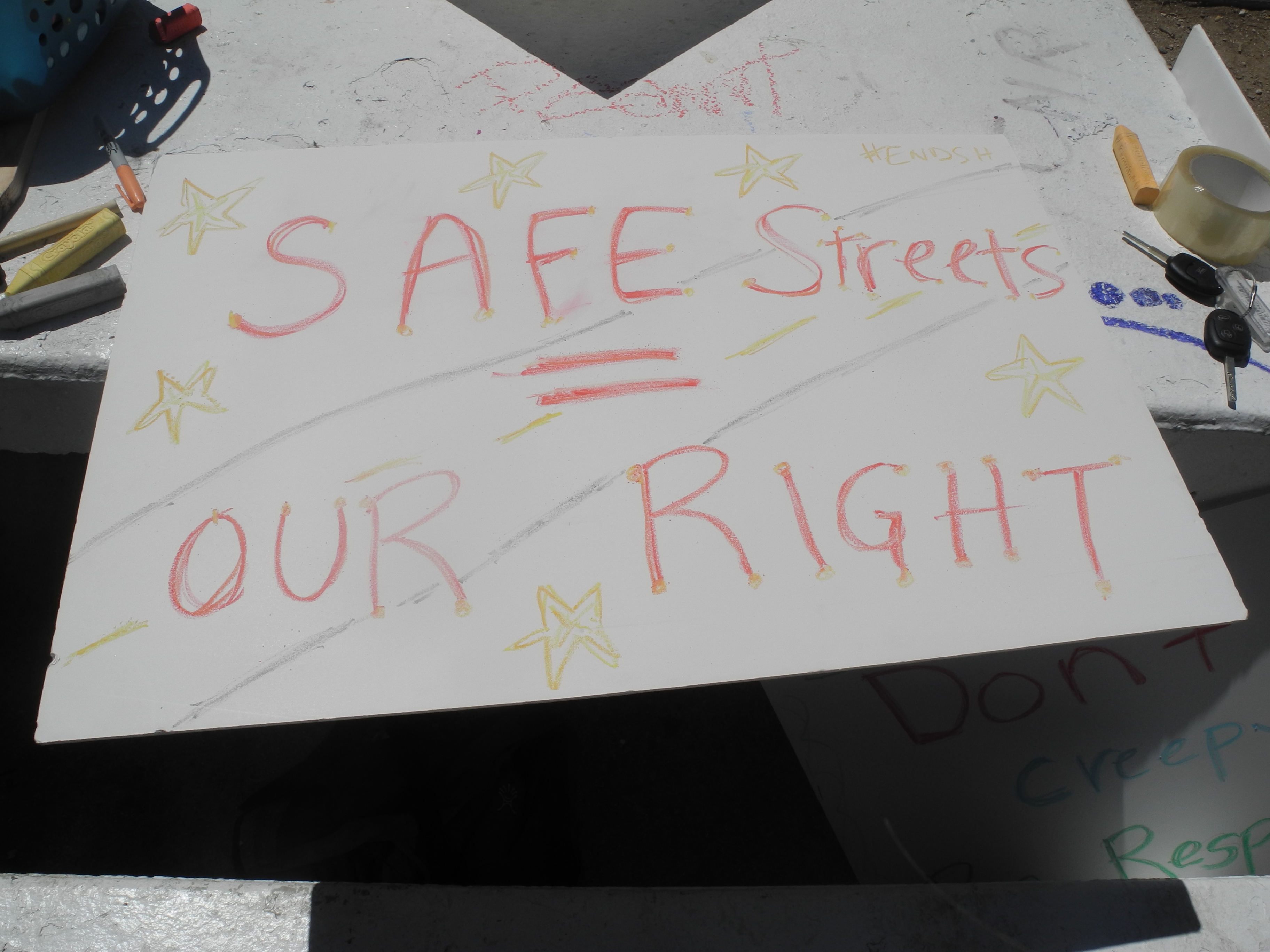
DSCN4790Every now and again, someone in a newspaper editorial, blog post, or conversation will argue that a law or policy restricting street harassment violates Americans’ First Amendment right to free speech. Though these people’s dedication to their desire to hurl sexual remarks at strangers or defend those who do so is admirable, here’s why that assertion is way off-base.

The First Amendment to the United States Constitution reads in pertinent part, “Congress shall make no law . . . abridging the freedom of speech . . . ” This is about things that Congress does; an easy way to think about it is whether the government is restricting the speech.

The First Amendment protection against government abridgement of free speech is not absolute. While the First Amendment has been found to protect rights to things like the speech of protestors outside of abortion clinics, it has been found to not protect “speech” like public school students holding a banner at a school event that reads “BONG HITS 4 JESUS” and unsolicited mailing of graphic brochures advertising pornographic books. For how often the old adage that the First Amendment doesn’t protect falsely shouting “fire” in a crowded theater is brought up in free speech arguments, no such set of facts was ever before the US Supreme Court, and in fact the case from which the concept sprung has since been overruled. But the basic premise remains: First Amendment rights are not absolute.

The U.S. Supreme Court has upheld laws restricting public place speech before. For example, in Chaplinsky v. State of New Hampshire, a man was convicted of violating a state law that read, “No person shall address any offensive, derisive or annoying word to any other person who is lawfully in any street or other public place, nor call him by any offensive or derisive name, nor make any noise or exclamation in his presence and hearing with intent to deride, offend or annoy him, or to prevent him from pursuing his lawful business or occupation” for standing outside City Hall in Rochester, New Hampshire and saying things like, “[y]ou are a God damned racketeer” and “a damned Fascist and the whole government of Rochester are Fascists or agents of Fascists.”

The Supreme Court upheld the constitutionality of the state law over Chaplinsky’s argument that the law violated his First Amendment rights because the law was limited in scope, Chaplinsky’s words lacked social value, and the law did not “unduly impair liberty of expression.” The Court wrote that Chaplinsky’s words “by their very utterance inflict injury or tend to incite an immediate breach of the peace.”

First Amendment cases use several different rules and rationales because they are so heavily fact-dependent. And we don’t have a Supreme Court case directly on this issue to compare. But one line of cases focuses on whether the restriction focuses on the content of the speech, or instead the “time, place, or manner” of the speech, which is scrutinized under a less stringent standard. This line is drawn in several Supreme Court cases.

An anti-street harassment law which regulated the content of speech, like a law that prevented shouting “compliments” at strangers in public, might fail. But a law that prohibited a certain manner of speech, like unwanted verbal contact with another person on public transportation, should pass constitutional muster. Not to mention, street harassment can sometimes be prosecuted criminally or civilly as hate speech, sexual assault, threats, defamation, intentional infliction of emotional distress, “fighting words,” intimidation, or obscenity, which receive limited or no First Amendment protection.

Street harassment is about exerting power over others who dare to enter a public space to go to work or the grocery store. The man who rode his bike dangerously close to me to force me to make eye contact and then hissed “I WANT TO TASTE YOUR PUSSY” was not trying to pay me a compliment. He was not trying to make friendly conversation. He was not informing me about a political issue he’s concerned about. He was not asking the time. He was not letting me know that I dropped a glove a half block back. He was not wishing me a good morning or remarking on the weather. His speech was not designed to convey an idea; it was intended to intimidate, dehumanize, and subjugate me.

Street harassment impacts what I wear, how I travel to work, how late I stay out, and whether or not I feel safe outside. Would educating and persuading street harassers to change their ways be a preferable course of action to legislating against that type of behavior? I think so. But that isn’t going to change attitudes overnight, and frankly, certain people, like “TASTE YOUR PUSSY” guy, probably aren’t going to change short of a criminal or civil statute giving him a reason to change that he cares about (because intimidating strangers is clearly not enough).

So while it’s an easy cop-out to blurt “BUT MAH ‘MERICAN FREEDOMS” when the government acts to prevent people from making others feel unsafe, the First Amendment argument falls flat. If this topic interests you, I’d strongly suggest reading Cynthia Grant Bowman’s wonderful Harvard Law Review article on the subject and articles and a book by Dr. Laura Beth Nielsen.

Disclaimer: this article is an opinion and is not intended to be used as legal advice.

Emily is a 3L at Michigan State University College of Law, and the president of her school’s chapter of LSRJ. Follow her on Twitter @emgillingham.

Share

Filed Under: correspondents, Resources, street harassment

“I was afraid of sharing and feeling shame”

April 23, 2015 By Contributor

I was 12 years old and when I was returning back from my school, a man came straight at me and touched my breast. I was silent because I was unaware that it was harassment and at that age I was afraid of sharing and feeling shame. Similarly, when I was traveling by bus I faced the same problem. An unknown person touched my body. At that moment I couldn’t speak up or shout because I was really afraid that maybe people would say something about me or my character. It made me feel so weak and I was depressed thinking about why it happened. I was psychologically affected. Now I know the meaning of harassment so I raise my voice wherever this kind of thing happen.

Optional: What’s one way you think we can make public places safer for everyone?

People should be aware about the harassment that they may face in the street/ somewhere else. Due to a lack of awareness people do not know if they are facing harassment or not. We also need strict rules and regulation and the people who make people suffer should be punished.

– Sunita

Location: Bus,on the way, and chinema hall

Share your street harassment story for the blog.
See the book 50 Stories about Stopping Street Harassers for more idea

Share

Filed Under: Stories, street harassment

“I feel degraded, disgusted, and unsafe”

April 22, 2015 By Contributor

I bike to work in Los Angeles. It is a short ride, about two miles, and only 15 minutes. Every single time without fail I am harassed, often multiple times in one trip by different men. Cars will slow down to follow me and men will purposely step in front of my bike. Whether it’s someone commenting on my looks, asking for a smile or hello, or even a ride on my bike, I feel degraded, disgusted, and unsafe. I feel that these men are asserting power over me and that I can’t escape their comments.

I often shout back profanities and try to degrade these men for how disgusting they are, making them feel badly about themselves in the quickest way possible. Either they laugh in the satisfaction that they got a reaction or they look very angry, and I am left feeling fearful for the rest of the trip.

– Sarah

Location: Los Angeles, CA

Share your street harassment story for the blog.
See the book 50 Stories about Stopping Street Harassers for more idea

Share

Filed Under: Stories, street harassment

« Previous Page
Next Page »

Share Your Story

Share your street harassment story for the blog. Donate Now

From the Blog

  • #MeToo 2024 Study Released Today
  • Join International Anti-Street Harassment Week 2022
  • Giving Tuesday – Fund the Hotline
  • Thank You – International Anti-Street Harassment Week 2021
  • Share Your Story – Safecity and Catcalls Collaboration

Buy the Book

Search

Archives

  • September 2024
  • March 2022
  • November 2021
  • April 2021
  • March 2021
  • January 2021
  • April 2020
  • March 2020
  • February 2020
  • December 2019
  • November 2019
  • September 2019
  • August 2019
  • July 2019
  • June 2019
  • May 2019
  • April 2019
  • March 2019
  • February 2019
  • January 2019
  • December 2018
  • November 2018
  • October 2018
  • September 2018
  • August 2018
  • July 2018
  • June 2018
  • May 2018
  • April 2018
  • March 2018
  • February 2018
  • January 2018
  • December 2017
  • November 2017
  • October 2017
  • September 2017
  • August 2017
  • July 2017
  • June 2017
  • May 2017
  • April 2017
  • March 2017
  • February 2017
  • January 2017
  • December 2016
  • November 2016
  • October 2016
  • September 2016
  • August 2016
  • July 2016
  • June 2016
  • May 2016
  • April 2016
  • March 2016
  • February 2016
  • January 2016
  • December 2015
  • November 2015
  • October 2015
  • September 2015
  • August 2015
  • July 2015
  • June 2015
  • May 2015
  • April 2015
  • March 2015
  • February 2015
  • January 2015
  • December 2014
  • November 2014
  • October 2014
  • September 2014
  • August 2014
  • July 2014
  • June 2014
  • May 2014
  • April 2014
  • March 2014
  • February 2014
  • January 2014
  • December 2013
  • November 2013
  • October 2013
  • September 2013
  • August 2013
  • July 2013
  • June 2013
  • May 2013
  • April 2013
  • March 2013
  • February 2013
  • January 2013
  • December 2012
  • November 2012
  • October 2012
  • September 2012
  • August 2012
  • July 2012
  • June 2012
  • May 2012
  • April 2012
  • March 2012
  • February 2012
  • January 2012
  • December 2011
  • November 2011
  • October 2011
  • September 2011
  • August 2011
  • July 2011
  • June 2011
  • May 2011
  • April 2011
  • March 2011
  • February 2011
  • January 2011
  • December 2010
  • November 2010
  • October 2010
  • September 2010
  • August 2010
  • July 2010
  • June 2010
  • May 2010
  • April 2010
  • March 2010
  • February 2010
  • January 2010
  • December 2009
  • November 2009
  • October 2009
  • September 2009
  • August 2009
  • July 2009
  • June 2009
  • May 2009
  • April 2009
  • March 2009
  • February 2009
  • January 2009
  • December 2008
  • November 2008
  • October 2008
  • September 2008
  • August 2008
  • July 2008
  • June 2008
  • May 2008

Comment Policy

SSH will not publish any comment that is offensive or hateful and does not add to a thoughtful discussion of street harassment. Racism, homophobia, transphobia, disabalism, classism, and sexism will not be tolerated. Disclaimer: SSH may use any stories submitted to the blog in future scholarly publications on street harassment.
  • Contact
  • Events
  • Join Us
  • Donate
  • Facebook
  • Instagram
  • Pinterest
  • Tumblr
  • Twitter
  • YouTube

Copyright © 2026 Stop Street Harassment · Website Design by Sarah Marie Lacy