• About Us
    • What Is Street Harassment?
    • Why Stopping Street Harassment Matters
    • Meet the Team
      • Board of Directors
      • Past Board Members
    • In The Media
  • Our Work
    • National Street Harassment Hotline
    • International Anti-Street Harassment Week
    • Blog Correspondents
      • Past SSH Correspondents
    • Safe Public Spaces Mentoring Program
    • Publications
    • National Studies
    • Campaigns against Companies
    • Washington, D.C. Activism
  • Our Books
  • Donate
  • Store

Stop Street Harassment

Making Public Spaces Safe and Welcoming

  • Facebook
  • Instagram
  • Pinterest
  • Tumblr
  • Twitter
  • YouTube
  • Home
  • Blog
    • Harassment Stories
    • Blog Correspondents
    • Street Respect Stories
  • Help & Advice
    • National Street Harassment Hotline
    • Dealing With Harassers
      • Assertive Responses
      • Reporting Harassers
      • Bystander Responses
      • Creative Responses
    • What to Do Before or After Harassment
    • Street Harassment and the Law
  • Resources
    • Definitions
    • Statistics
    • Articles & Books
    • Anti-Harassment Groups & Campaigns
    • Male Allies
      • Educating Boys & Men
      • How to Talk to Women
      • Bystander Tips
    • Video Clips
    • Images & Flyers
  • Take Community Action
  • Contact

“I think I gave them a tiny scare”

September 2, 2014 By Contributor

I’m 54 years old.  I don’t get yelled at any more.  And it is a relief. Every time I pass a construction site I get a little lift just from knowing that I won’t be yelled at.

But the problem is worse than ever.  And I refuse to just bask in the privilege of no longer being a target.

Last year I was walking behind a young woman as we passed a construction site.  She got cat called.  I called out to her.

“Miss, are you alright?”

“Yeah, yeah, I’m fine,” she walked quickly away, humiliated.

I stopped in front of the men who had yelled at her.

“Hey!”  I yelled, over the sound of the jackhammer.

“What?”

“What the hell was that about?”

“What?  What’s going on?”  They were looking around, confused.

“Why did you yell at that woman?”

They groaned to each other.  “Why don’t you move along, lady.”

“I’ll tell you why!  I have a daughter her age!  What the hell is your problem?”

“Why don’t you mind your own business?”

“It’s my business now!  I want to see your manager right now.  I’m calling 911 and reporting harassment if you don’t get him out here right NOW.”

They chose to ignore me.  I phoned it in. The 911 receptionist was nearly indifferent.  But I made sure they saw me call it in.  And then I called the construction company and let the receptionist know that I was very unimpressed with the company.  I wasn’t able to have a direct conversation with anyone or get taken seriously about it.  But I think I gave them a tiny scare.

Optional: What’s one way you think we can make public places safer for everyone?

People who don’t get harassed need to make a stink about it and let the world know it’s intolerable.  Victims themselves cannot always stand up because they are busy saving themselves.  The rest of us who DON’T get cat-called are morally obligated to make it stop.

– Robbie

Location: Littleton, Colorado

Share your street harassment story for the blog.
See the book 50 Stories about Stopping Street Harassers for more idea

Share

Filed Under: Stories, street harassment

“Hopefully this disrespect will die out”

September 2, 2014 By Contributor

Every day I walk down the street to my home in London I get comments from men ranging from “compliments,” to comments about my body, to something more explicit. Every time I feel attacked, undermined, disrespected, vulnerable and furious! These men know women don’t want to hear it. It’s not a compliment, it’s a power play. It’s objectification and it’s unacceptable.

I’m not very young, very pretty or very remarkable – I’m just a normal woman trying to walk home safely and quietly. What do you do in a situation like that? Do I stand up and risk my own safety or say nothing and feel like a victim? I know other women face far worse but still, to me this is not okay!

Optional: What’s one way you think we can make public places safer for everyone?

Make it an offence, by law, to sexually harass in the street as it is in the office. But, the root is education. Let’s teach our children and teenagers it’s unacceptable and hopefully this disrespect will die out.

– Mary-Anne

Location: Harringay, Londo, UK

Share your street harassment story for the blog.
See the book 50 Stories about Stopping Street Harassers for more idea
 

Share

Filed Under: Stories, street harassment

“I remember feeling shameful”

September 2, 2014 By Contributor

My father had just retired from the Air Force and we had moved off base.  This meant I had to walk from my house to the train station, then take the train to the stop right outside of Yokota AFB.

I was fifteen.  I took the same route every day.  Then one morning, a little after six, a man stepped out a bit ways ahead of me..  He stood on the side of the road.  I could see that his pants were down.  And he began to masturbate profusely

I looked away quickly, but I had to walk past him to get to where I was going.  So I did quickly, trying my best to ignore the movements he was making, scared that he would come and it would land on me.  But somehow, I made it through.

I’ve never told anyone this story.  I remember feeling shameful, like I had done something wrong to bring this on me.

– Anonymous

Location: Japan

Share your street harassment story for the blog.
See the book 50 Stories about Stopping Street Harassers for more idea

Share

Filed Under: Stories, street harassment

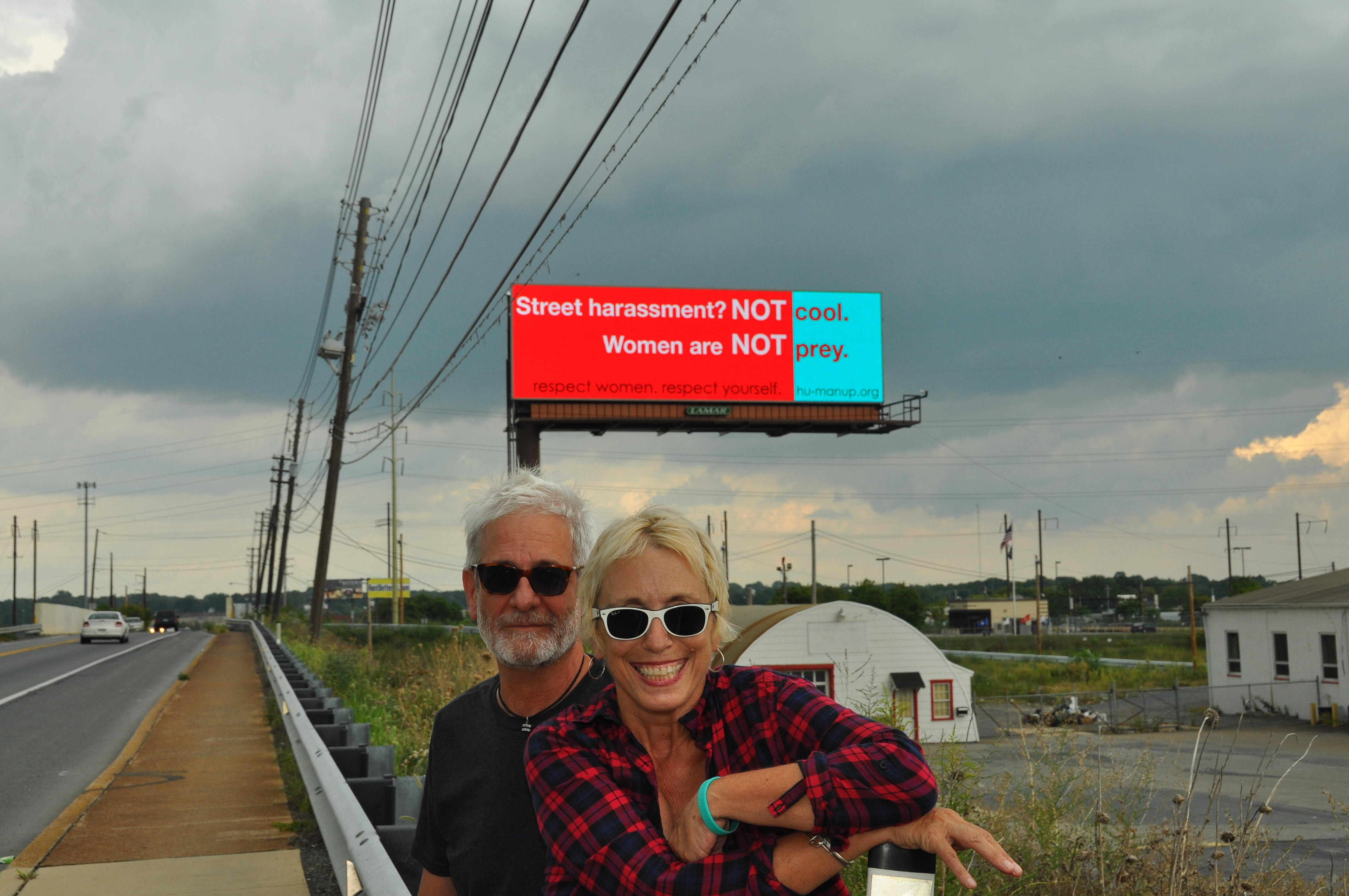
Billboards against Rape Culture in Lancaster, PA

September 1, 2014 By HKearl

Photo by Mark Hutchens

UPDATED: Here is the Ms Magazine article about the billboards. It was syndicated on Care2’s site.

Yesterday I had the privilege to meet Ray and Adele, the co-directors of hu_MAN Up, in Lancaster, PA. They’ve been involved in a number of efforts to challenge rape culture with their latest being three electronic billboard messages near the Franklin & Marshall campus. This is the one about street harassment. They’re determined to not just preach to the choir when it comes to these kinds of messages and hope that their billboard messages are reaching a lot of people who may not otherwise hear about rape culture or the need for consent and respect.

I’m writing an article about their billboards for Ms Magazine’s blog this week, so stay tuned.

They just received their 501c3 status and are fundraising to be able to do ads on buses and more billboard messages. Donate if you can!

Share

Filed Under: Activist Interviews, Resources, street harassment

USA: Decreasing harassment and increasing resiliency

September 1, 2014 By Correspondent

Kirstin Kelly, Monterey, California, USA, SSH Blog Correspondent

About a month ago, University of Tennessee researchers Dawn Syzmanski and Chandra Feltman published an article entitled “Helping Women Overcome the Anguish of Unwanted Sexual Advances.” The article professes that women who experience street harassment fall into two major categories: those who are resilient and those who are not. Immediately after publication, Syzmanski and Feltman faced backlash from people who felt the article was supporting victim-blaming mentalities by suggesting that people who are more resilient are better able to cope with the stress of unwanted sexual advances than people who are not.

Normally, I agree with people who caution against products or research that could perpetuate victim blaming because I, like most others, believe that pressuring those engaged in harassing behaviors is far more important than teaching would-be-victims to avoid responsibility. I fully agree that the onus of responsibility should be on the aggressors, not their victims. But this study is fundamentally different to me.

First, the idea of resiliency is widely accepted among psychologists as a way of understanding why certain people respond to stressors by using them as springboards while others experience overwhelming negativity as a result of the same type of occurrence.

Second, victim blaming usually refers to advice or products to help would-be-victims avoid situations that might lead to harassment or even assault. These are obviously problematic because they place the onus of responsibility on the victims to avoid situations in the first place, but ignore the reality that harassment and assault can happen to anyone at any time in any place under any circumstances.

Resiliency could be a useful tool in helping to combat the effects of street harassment because it helps survivors heal from trauma, which could include unwanted sexual advances, but it is victim blaming to suggest that people who lack resiliency will have a harder time. Similarly, since resiliency can be helpful in healing from a number of different traumas, it is not asking potential victims to alter their behavior in order to avoid negative situations.

There is nothing victims can do to keep themselves completely safe, but aggressors have the ability to stop their behavior. Social pressure definitely needs to be placed on the aggressors to stop the behavior, but in the meantime, research that helps us understand how victims can recover from their experiences is valuable. I think it’s helpful to encourage people to increase their resiliency regardless of their perceived susceptibility to aggressive behavior. Likewise, I think aggressors should be discouraged from continuing together.

Perhaps these two approaches work best when combined as a holistic approach to addressing rape culture and street harassment.

Kirstin is a Master’s Student in Nonproliferation and Terrorism Studies at the Monterey Institute of International Studies and a news editor at the Women’s International Perspective (The WIP). You can follower her on Twitter at @KirstinKelley1, where she regularly posts about human rights issues around the world.

Share

Filed Under: correspondents, Resources, street harassment

« Previous Page
Next Page »

Share Your Story

Share your street harassment story for the blog. Donate Now

From the Blog

  • #MeToo 2024 Study Released Today
  • Join International Anti-Street Harassment Week 2022
  • Giving Tuesday – Fund the Hotline
  • Thank You – International Anti-Street Harassment Week 2021
  • Share Your Story – Safecity and Catcalls Collaboration

Buy the Book

Search

Archives

  • September 2024
  • March 2022
  • November 2021
  • April 2021
  • March 2021
  • January 2021
  • April 2020
  • March 2020
  • February 2020
  • December 2019
  • November 2019
  • September 2019
  • August 2019
  • July 2019
  • June 2019
  • May 2019
  • April 2019
  • March 2019
  • February 2019
  • January 2019
  • December 2018
  • November 2018
  • October 2018
  • September 2018
  • August 2018
  • July 2018
  • June 2018
  • May 2018
  • April 2018
  • March 2018
  • February 2018
  • January 2018
  • December 2017
  • November 2017
  • October 2017
  • September 2017
  • August 2017
  • July 2017
  • June 2017
  • May 2017
  • April 2017
  • March 2017
  • February 2017
  • January 2017
  • December 2016
  • November 2016
  • October 2016
  • September 2016
  • August 2016
  • July 2016
  • June 2016
  • May 2016
  • April 2016
  • March 2016
  • February 2016
  • January 2016
  • December 2015
  • November 2015
  • October 2015
  • September 2015
  • August 2015
  • July 2015
  • June 2015
  • May 2015
  • April 2015
  • March 2015
  • February 2015
  • January 2015
  • December 2014
  • November 2014
  • October 2014
  • September 2014
  • August 2014
  • July 2014
  • June 2014
  • May 2014
  • April 2014
  • March 2014
  • February 2014
  • January 2014
  • December 2013
  • November 2013
  • October 2013
  • September 2013
  • August 2013
  • July 2013
  • June 2013
  • May 2013
  • April 2013
  • March 2013
  • February 2013
  • January 2013
  • December 2012
  • November 2012
  • October 2012
  • September 2012
  • August 2012
  • July 2012
  • June 2012
  • May 2012
  • April 2012
  • March 2012
  • February 2012
  • January 2012
  • December 2011
  • November 2011
  • October 2011
  • September 2011
  • August 2011
  • July 2011
  • June 2011
  • May 2011
  • April 2011
  • March 2011
  • February 2011
  • January 2011
  • December 2010
  • November 2010
  • October 2010
  • September 2010
  • August 2010
  • July 2010
  • June 2010
  • May 2010
  • April 2010
  • March 2010
  • February 2010
  • January 2010
  • December 2009
  • November 2009
  • October 2009
  • September 2009
  • August 2009
  • July 2009
  • June 2009
  • May 2009
  • April 2009
  • March 2009
  • February 2009
  • January 2009
  • December 2008
  • November 2008
  • October 2008
  • September 2008
  • August 2008
  • July 2008
  • June 2008
  • May 2008

Comment Policy

SSH will not publish any comment that is offensive or hateful and does not add to a thoughtful discussion of street harassment. Racism, homophobia, transphobia, disabalism, classism, and sexism will not be tolerated. Disclaimer: SSH may use any stories submitted to the blog in future scholarly publications on street harassment.
  • Contact
  • Events
  • Join Us
  • Donate
  • Facebook
  • Instagram
  • Pinterest
  • Tumblr
  • Twitter
  • YouTube

Copyright © 2026 Stop Street Harassment · Website Design by Sarah Marie Lacy