I remember one time I was walking home and I got honked at. I was going to yell something back but my next door neighbor was there. I felt so humiliated. To top things off my neighbor was a guy. Talk about awkward!
– AR
Location: Los Angeles, CA
Making Public Spaces Safe and Welcoming
By Contributor
I remember one time I was walking home and I got honked at. I was going to yell something back but my next door neighbor was there. I felt so humiliated. To top things off my neighbor was a guy. Talk about awkward!
– AR
Location: Los Angeles, CA
By Contributor
I’ve been getting stared at in the streets since I was about 13. I’m 17 now. And recently it’s been getting really hot where I live, so I’ve been wearing shorter shorts, that come a couple of inches or so above mid thigh. Apparently riding my bike and wearing these shorts with a tshirt is an invitation for older men to honk and stare at me.
I also go swing dancing every once in a while, and I’m constantly told by the men there: “Come on, smile! You have a beautiful smile!”
It makes me so angry that men think they have the right to tell me when to smile and that I should do so for them, as if I owe them something. I don’t owe you anything, I’ll smile if and when I feel like it!
– R
Location: Atlanta, GA
By HKearl
Verbal sexual harassment in public spaces is now illegal in Egypt. This is how one woman used it to stop her street harasser.
“An Egyptian court has sentenced a man to one year in prison and fined him EGP 10,000 (1,427 US dollars) for verbal sexual harassment, reported Aswat Masriya.
The man, in his 20′s, had been accused of verbally harassing a woman at the Dokki Metro station. The woman reported the incident to a local police station where a report was filed and charges were laid.
A Cairo court found the defendant guilty of attacking the modesty of the victim, added Aswat Masriya.
While five sexual harassers were found guilty on various charges last year, this is the first case under new anti-sexual harassment laws in Egypt.”
Check out our Know Your Rights toolkit to find out the laws in the USA.

Brittany Oliver, Baltimore, MD, USA, SSH Blog Correspondent

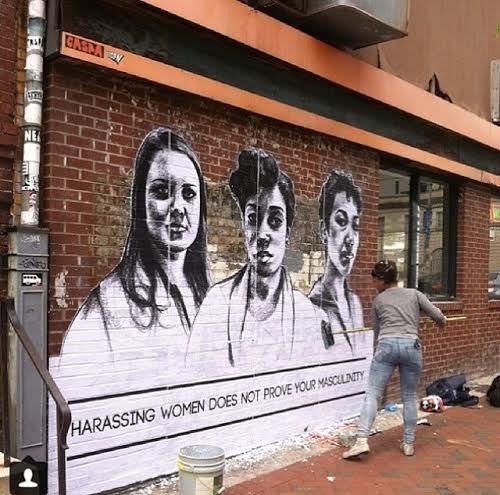
During the week of April 21st – 27th, Tatyana Fazlalizadeh traveled to Baltimore to introduce Stop Telling Women To Smile (STWTS), which is an on-going traveling public art series that attempts to address gender based street harassment.
Tatyana Fazlalizadeh is an illustrator and painter based in Brooklyn, NY who is mostly known for her oil paintings, but recently branched out into public art as a muralist. STWTS started in the fall of 2012 and was born out of the idea that street art can make a difference.
On two different days, Hollaback! Baltimore co-sponsored an open discussion and artist talk at Station North Chicken Box in Baltimore City. The process of STWTS consists of shooting photographs of local women, using them as references for drawing, and composing them into a design with captions that speak directly to offenders of street harassment. The large black and white prints that feature local women are then wheat pasted throughout cities all over the country and aims at raising awareness of the unwanted, unwelcomed, and dangerous treatment of women in the public.
The open discussion was held on Monday, April 21st and allowed women share how street harassment affected them in different areas and what was so specific about it. The more I listened to other people’s stories, the more comfortable I became to share my own. It has never been easy to discuss my experiences with street harassment, but this discussion provided me with a safe space to vent and connect with others who felt the same.
Afterwards, I met with Tatyana to tell her what I wanted to say to my harassers and to have my photo taken. After discussing a few ideas, we both decided to use “Men do not own the streets,” which would be the quote used if she did my portrait.
The artist talk held on Thursday, April 24th involved Tatyana discussing her background in visual art and how STWTS was created along with questions from the audience. This session was specifically interesting to me because I too have a background in the arts and have recently decided to incorporate feminist art into my work as an activist.
A couple days after while browsing through Instagram, I discovered a photo of Tatyana wheat pasting her very first piece at Station North and noticed that the mural included my portrait. I had no idea I would be featured in the first mural and was overwhelmed with empowerment and emotion when I saw it.
STWTS coming to Baltimore is one of the most memorable experiences I’ll ever have. This powerful campaign allows women to stand up to their harassers and it sends a strong message that street harassment is a serious issue that affects women worldwide.
The message is clear: Stop Telling Women To Smile.
Brittany Oliver is a recent graduate of Towson University and works in the non-profit communications sector and supports local anti-street harassment advocacy through Hollaback! Baltimore. She blogs at brittuniverse.wordpress.com and publicly rants on Twitter, @btiara3.
By Contributor
I am the kind of person that just ignore “compliments.” I don’t feel shame or angry when I receive them, I just forgot as I pass away because they don’t deserve any of my feelings.
But this time that man went too far.
It was morning and I was going to my office. An old man (about 60-70 idk) in his car yelled at me “Hey baby!”
As always, I pretend not to hear. He continued: “Hey, need a ride? Come here I’ll PAY you! How much is it?”
And that was the moment. That was an insult. I HAD to fight back.
I turn back, big smile on my face, and said with loud voice, “Hey you! How old are you? 80? [I know he wasn’t that old]” and I continued, “Your life is very near to the [natural] end*, so why don’t you think about your health instead of bothering young ladies?”
I saw his face turn red to purple. I walked away, smiling.
Was I rude pointing at his oldness? Yes, indeed. And I’m proud of it. You know why?
Because he “ASKED FOR IT.”
*There is a proverb in my dialect for saying this but I do not know how to translate it
Do you have any suggestions for dealing with harassers and/or ending street harassment in general?
I think education is the key, especially for young boy. Then I would educate young girl too, not to be ashamed of what they are. There is no way a girl “ask for it.” But most important of all, media should stop to objectified woman. I think this constant advertising on the virility of men who come out only by subduing women, has affected both men and women in their stereotypes.
– EZ
Location: Italy